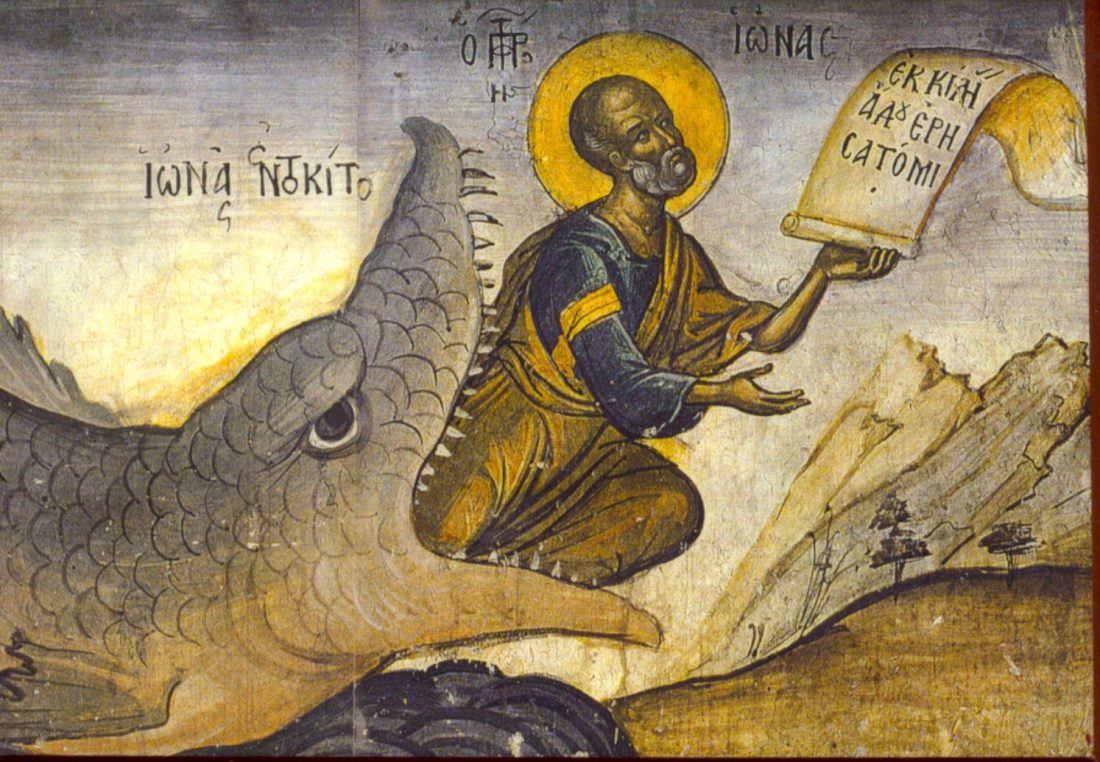
Jonah And The Whale

Jonah And The Whale

Jonah And The Whale

The story of Jonah and “the whale” has for many years been a butt of ridicule with unbelievers, and the cause of not a little perplexity with those who are “unlearned and unstable.” The story is quite generally discredited by the destructive critics as being unhistorical. They attempt to explain it as allegory or parable.

Those who desire to discredit the full inspiration and absolute veracity of the Bible have again and again assured us with a great show of scientific knowledge that such is the structure of a whale’s mouth and the configuration of his throat that it would be impossible for a fullgrown man either to pass through the sieve in its mouth or the narrow orifice of its throat, to say nothing of his coming out again alive and whole.

What shall we say to all this?

First of all, let us notice the fact that the Bible nowhere says that Jonah was swallowed by a whale. In Jonah 1:17 we are told that Jehovah “prepared a great fish to swallow up Jonah, and Jonah was in the belly of the fish three days and three nights.” There is no mention here whatever of this great fish being a whale, with its peculiarly constructed mouth and throat.

It may have been either a fish altogether prepared for the occasion, or a fish already existing providentially sent around for the purpose God had in view. It is true that in Jesus’ reference to this historical event in Matthew 12:40 in the Authorized and the Revised versions He said that Jonah was three days and three nights in “the whale’s belly”; but we read in the margin of the Revised Version that the Greek of the word rendered “whale” is “sea monster.”

One cannot help wondering why the translators should continue to put “whale” in the text if the Greek word means “sea monster,” and it certainly does. In the Septuagint translation of the book of Jonah, “a great fish” is rendered by a Greek adjective meaning “great” and by the same word that is used in Matthew 12:40 and translated “whale.”

The word whale was in the mind of the translators and not in the word spoken by Jesus, so in neither the Old Testament nor the New Testament account is it said that Jonah was swallowed by a whale, but by a great fish or sea monster. These scholarly critics have spent much labor in proving the absurdity of something God did not say.

We are not told what the great fish was, but it is a well-known fact that there exist or have existed until recent times in the Mediterranean Sea, where the recorded event seems to have taken place, sea monsters—that is, dog sharks—large enough to swallow a man or horse whole. In fact, it is recorded that a man fell overboard in the Mediterranean and was swallowed by one of these sea monsters, the monster was killed and the man rescued alive. A whole horse was taken out of the belly of another.

Furthermore, even if the Bible had said that the great fish was a whale, there would be no such difficulty with the narrative as has been supposed by unbelievers and the uninformed. While it is true that there are some kinds of whales whose mouth and throat are of such a formation that it would be impossible for a full-grown man to pass through, it is not true of all kinds of whales.

The well-known author, Frank Bullen, in his book The Cruise of the Cachalot says that “a shark fifteen feet in length has been found in the stomach of a cachalot.” He tells further that “when dying, the sperm whale always ejects the contents of its stomach.”

He tells of one whale that was caught and killed, “the ejected food from whose stomach was in masses of enormous size, some of them being estimated to be the size of our hatch-house, viz., 8 feet by 6 feet by 6 feet.” Of course such a whale would have no difficulty in swallowing a man, so the whole objection to the Bible narrative from the standpoint that a whale could not swallow a man is not founded upon superior knowledge, but upon ignorance.

Someone may say that the action of the gastric juices would kill a man within a whale or other sea monster.

But this leaves God out of the transaction, whereas in the Bible story God is very prominent in the whole transaction. The God who made both the monster and the man and the gastric juices could quite easily control the gastric juices and preserve the man alive. We are not trying to infer that the transaction was not miraculous in any event, but those who really believe in God and have had any large experience with God have no trouble with the miraculous.

It ought to be added, moreover, that the Bible does not tell us that Jonah remained alive during the period that he was in the belly of the great fish. There are things in the narrative as recorded in the book of Jonah that make it appear as if he did not remain alive (Jonah 2:2, 5–6, RV; see margin). There seems to be a strong probability that Jonah actually did die and was raised from the dead.

If he actually did die, this only adds one more to the resurrections recorded in the Bible and makes Jonah a still more remarkable type of Christ. To those who believe in God, there is no difficulty in believing in the resurrection if sufficiently well attested. “Why should it be thought a thing incredible with you that God should raise the dead?”

There are numerous instances on record, at least of resuscitation of men and women who to all appearances had been dead for some days. The historicity of this event is endorsed by Jesus Christ Himself (Matthew 12:40). To think of it as being merely allegory or parable is to discredit the words of Jesus.

So, on careful examination of what the Scripture says, and of the facts of history, all the difficulties supposed to exist in the story of Jonah and the whale are found to disappear.

[1]

[1]Torrey, R. (1998, c1996). Difficulties in the Bible : Alleged errors and contradictions. Willow Grove: Woodlawn Electronic Publishing.

Jonah And The Whale

The Book of Jonah shoots down all your arguments about sacrifice and atonement

The Book of Jonah shoots down all your arguments about sacrifice and atonement, especially with reference to Gentiles. When Jonah preached, the people repented, and God forgave them—no sacrifice, no blood offering.

Did you know that traditional Judaism, based on the Torah, teaches that the Temple sacrifices made atonement for the Gentile world? This was part of Israel’s call as a priestly nation, and it was Israel’s Temple offerings that helped make Gentile repentance acceptable to God.

When God brought our people out of Egypt, he said to them, “You yourselves have seen what I did to Egypt, and how I carried you on eagles’ wings and brought you to myself. Now if you obey me fully and keep my covenant, then out of all nations you will be my treasured possession. Although the whole earth is mine, you will be for me a kingdom of priests and a holy nation” (Exod. 19:4–6).

Israel was called to be a priestly nation, and part of that calling included making intercession and atonement for the nations of the world. (Remember, this was an integral part of the priestly calling, therefore, as a priestly nation, Israel would make intercession and atonement for the world.) According to this concept, when a Gentile nation repented and turned to God, its repentance would be accepted in conjunction with the sacrifices and prayers offered up by the people of Israel. That’s why the prophet Jonah called on the Ninevites to repent of their sins. Offering up sacrifices was Israel’s job as a priestly nation.

“Who says so?” you ask.

Actually, the Talmudic rabbis say so. In b. Sukkah 55b (see also Pesikta deRav Kahana, Buber edition, 193b–194a) we read that the seventy bulls that were offered every year during the Feast of Tabernacles (Sukkot; see Num. 29:12–34) “were for the seventy nations,” which Rashi explains to mean, “to make atonement for them, so that rain will fall throughout the world.”259 In this context—and in light of the destruction of the Temple by the Romans in 70 C.E.—the Talmud records the words of Rabbi Yohannan: “Woe to the nations who destroyed without knowing what they were destroying. For when the Temple was standing, the altar made atonement for them. But now, who will make atonement for them?” Such a strong statement bears repeating: “When the Temple was standing, the altar made atonement for them.” Blood sacrifices were indispensable. (See above, 3.10, for an in-depth discussion of this.)

Now, I recognize that God can have mercy on whom he wants to have mercy and compassion on whom he wants to have compassion (see Exod. 33:19), but he has ordained prayer, atonement rites, repentance, and faith as the means by which his people participate with him in procuring forgiveness and mercy. Thus, he singled out one particular people, the nation of Israel, and called them to conduct the Temple services, celebrating the holy days and offering sacrifices for their own sins and the sins of the world. Ultimately, these sacrifices pointed to the once-and-for-all sacrifice of Yeshua for the sins of the world.260

The bottom line is this: All of us have sinned, Jew and Gentile alike, and all of us need a way to come into right standing with God. We will see in the next objection that it was the Messiah who opened the door for all peoples to come into God’s presence by shedding his blood on our behalf, completely fulfilling what the sacrificial system could only point to in part.

259 According to ancient Jewish tradition, and based on the so-called Table of Nations in Genesis 10, there were a total of seventy (Gentile) nations in the world. See, e.g., Nahum Sarna, Genesis, The JPS Torah Commentary (Philadelphia: The Jewish Publication Society, 1989), 67–70. Note that the sacrifices were offered up for seven days, beginning with thirteen on the first day, then twelve, then eleven, etc., until the last seven were offered on the seventh day. Then, on the eighth and final day of Sukkot, one sacrifice was offered. According to George Foote Moore in his classic work Judaism: In the First Centuries of the Christian Era: The Age of the Tannaim (Peabody, Mass.: Hendrickson, 1997), 2:43, n. 2, “These burnt offerings were made, according to an often repeated explanation, in behalf of the seventy heathen nations; the one on the eighth day for the unique people of Israel. When the heathen destroyed the temple, they destroyed the atonement that was made for them.”

260 Through this sacrifice, at one and the same time, God could be just (by exacting the punishment of the Messiah’s death for those sins) and the justifier of those who believe in Yeshua (by pronouncing righteous all who put their trust in the Messiah); see Romans 3:19–31 (I have excerpted here the end of Rom. 3:26). God in his justice demanded payment for sins, but in his mercy he sent the Messiah to make that payment—with his own life!—on our behalf. So through Yeshua, God is both just and merciful.

Brown, M. L. (2000). Answering Jewish objections to Jesus, Volume 2: Theological objections (152). Grand Rapids, Mich.: Baker Books.

The Book of Jonah shoots down all your arguments about sacrifice and atonement, especially with reference to Gentiles. When Jonah preached, the people repented, and God forgave them—no sacrifice, no blood offering.

Dead Sea Scrolls Fragments in the Museum Collection [Free PDF]

Dead Sea Scrolls Fragments in the Museum Collection [Free PDF]

Dead Sea Scrolls Fragments in the Museum Collection [Free PDF]

Dead Sea Scrolls Fragments in the Museum Collection [Free PDF]

Edited by Emanuel Tov (Hebrew University, Jerusalem), Kipp Davis (Trinity Western University), Robert Duke (Azusa Pacific University)

This volume contains thirteen previously unpublished Dead Sea Scrolls fragments, twelve Hebrew Bible fragments and one non-biblical fragment, presented with the full scholarly apparatus and advanced reconstruction techniques. The books from the Hebrew Bible are Genesis, Exodus, Leviticus, Numbers, Jeremiah, Ezekiel, Jonah, Micah, Psalms, Daniel, and Nehemiah. The latter is an especially important addition to known material. The non-biblical fragment probably represents a new copy of 4QInstruction.

The work on these fragments was conducted under the auspices of the Museum of the Bible Scholars Initiative, whose mission is to publish research conducted collaboratively by scholar-mentors and students. The ultimate goal is to provide students with the opportunity to develop as scholars under the guidance of their scholar-mentors.

click here to download

Dead Sea Scrolls Fragments in the Museum Collection [Free PDF]

Exit mobile version