Why are all the Gospel accounts of the inscription on the cross different? MATTHEW 27:37 (cf. Mark 15:26; Luke 23:38; John 19:19)

MATTHEW 27:37 (cf. Mark 15:26; Luke 23:38; John 19:19)—Why are all the Gospel accounts of the inscription on the cross different?

PROBLEM: The wording of the accusation above Christ’s head on the cross is rendered differently in each Gospel account.

Matthew: “This is Jesus the king of the Jews” (27:37).

Mark: “The king of the Jews” (15:26).

Luke: “This is the king of the Jews” (23:38).

John: “Jesus of Nazareth, the king of the Jews” (19:19).

SOLUTION: While there is a difference in what is omitted, the important phrase, “the king of the Jews,” is identical in all four Gospels. The differences can be accounted for in different ways.

First, John 19:20 says, “Then many of the Jews read this title, for the place where Jesus was crucified was near the city; and it was written in Hebrew, Greek, and Latin.” So then, there are at least three different languages in which the sign above Christ’s head was written. Some of the differences may come from it being rendered in different languages.

Further, it is possible that each Gospel only gives part of the complete statement as follows:

Matthew: “This is Jesus [of Nazareth] the king of the Jews.”

Mark: “[This is Jesus of Nazareth] the king of the Jews.”

Luke: “This is [Jesus of Nazareth] the king of the Jews.”

John: “[This is] Jesus of Nazareth the king of the Jews.”

Thus, the whole statement may have read “This is Jesus of Nazareth, the king of the Jews.” In this case, each Gospel is giving the essential part (“the king of the Jews”), but no Gospel is giving the whole inscription. But neither is any Gospel contradicting what the other Gospels say. The accounts are divergent and mutually complementary, not contradictory.

Geisler, N. L., & Howe, T. A. (1992). When critics ask : A popular handbook on Bible difficulties (361). Wheaton, Ill.: Victor Books.


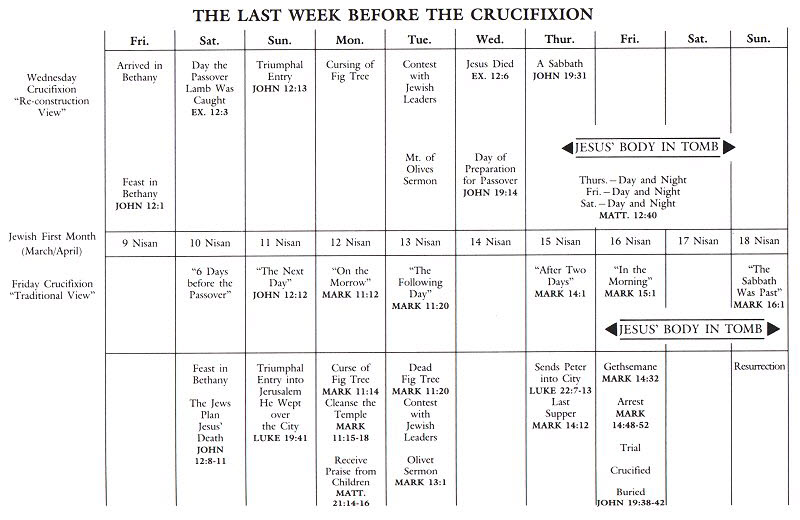
If Jesus was crucified on Friday, how could He have been in the grave three days and nights? MATTHEW 12:40 (cf. John 19:14)

MATTHEW 12:40 (cf. John 19:14)—If Jesus was crucified on Friday, how could He have been in the grave three days and nights?

PROBLEM: Christ rose on Sunday (Matt. 28:1), but He stated that He would be “three days and three nights in the heart of the earth.” If Christ was crucified on Friday, how could He have been three days and three nights in the earth and rise on Sunday only two days later?”

SOLUTION 1: Some scholars believe Jesus was in the grave for three full days and nights (72 hours), being crucified on Wednesday. They offer the following in support of this contention.

First, they insist that this is the literal meaning of the phrase “three days and nights.” Second, they point out that, on the view that Jesus was crucified on Friday, there is no explanation for what He did on Wednesday. All other days are accounted for. Third, they argue that the passover was not a fixed day (Friday), but floated.

SOLUTION 2: Most biblical scholars believe that Jesus was crucified on Friday. They take the phrase “three days and nights” to be a Hebrew figure of speech referring to any part of three days and nights. They offer the following in support of their position.

First, the phrase “day and night” does not necessarily mean a complete 24 hour period. The psalmist’s reference to meditating “day and night” on God’s Word does not mean one has to read the Bible all day and all night (Ps. 1:2).

Second, it is clear from the use of the phrase “three days and three nights” in the Book of Esther that it does not mean 72 hours. For, although they fasted three days and nights (4:16) between the time they started and the time she appeared before the king, the passage states that Esther appeared before the king “on the third day” (5:1). If they began on Friday, then the third day would be Sunday. Hence, “three days and nights” must mean any part of three days and nights.

Third, Jesus used the phrase “on the third day” to describe the time of His resurrection after His crucifixion (Matt 16:21; 17:23; 20:19; cf. 26:61). But, “on the third day” cannot mean “after three days” which 72 hours demands. On the other hand, the phrase “on the third day” or “three days and nights” can be understood to mean within three days and nights.

Fourth, this view fits best with the chronological order of events as given by Mark (cf. 14:1), as well as the fact that Jesus died on Passover day (Friday) to fulfill the conditions of being our Passover Lamb (1 Cor. 5:7; cf. Lev. 23:5–15).

The two views can be compared as follows:


how could He have been in the grave three days and nights

[1]


[1]Geisler, N. L., & Howe, T. A. (1992). When critics ask : A popular handbook on Bible difficulties (343). Wheaton, Ill.: Victor Books.

Exit mobile version