Why are all the Gospel accounts of the inscription on the cross different? MATTHEW 27:37 (cf. Mark 15:26; Luke 23:38; John 19:19)

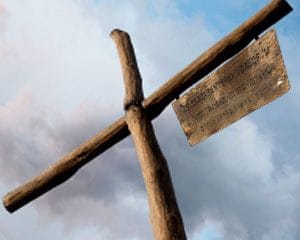
MATTHEW 27:37 (cf. Mark 15:26; Luke 23:38; John 19:19)—Why are all the Gospel accounts of the inscription on the cross different?

PROBLEM: The wording of the accusation above Christ’s head on the cross is rendered differently in each Gospel account.

Matthew: “This is Jesus the king of the Jews” (27:37).

Mark: “The king of the Jews” (15:26).

Luke: “This is the king of the Jews” (23:38).

John: “Jesus of Nazareth, the king of the Jews” (19:19).

SOLUTION: While there is a difference in what is omitted, the important phrase, “the king of the Jews,” is identical in all four Gospels. The differences can be accounted for in different ways.

First, John 19:20 says, “Then many of the Jews read this title, for the place where Jesus was crucified was near the city; and it was written in Hebrew, Greek, and Latin.” So then, there are at least three different languages in which the sign above Christ’s head was written. Some of the differences may come from it being rendered in different languages.

Further, it is possible that each Gospel only gives part of the complete statement as follows:

Matthew: “This is Jesus [of Nazareth] the king of the Jews.”

Mark: “[This is Jesus of Nazareth] the king of the Jews.”

Luke: “This is [Jesus of Nazareth] the king of the Jews.”

John: “[This is] Jesus of Nazareth the king of the Jews.”

Thus, the whole statement may have read “This is Jesus of Nazareth, the king of the Jews.” In this case, each Gospel is giving the essential part (“the king of the Jews”), but no Gospel is giving the whole inscription. But neither is any Gospel contradicting what the other Gospels say. The accounts are divergent and mutually complementary, not contradictory.

Geisler, N. L., & Howe, T. A. (1992). When critics ask : A popular handbook on Bible difficulties (361). Wheaton, Ill.: Victor Books.

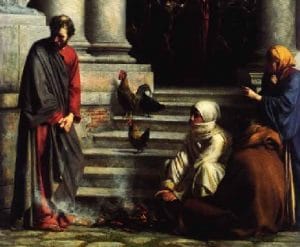
When Peter denied Christ, did the rooster crow once or twice? MATTHEW 26:34 (cf. Mark 14:30)

MATTHEW 26:34 (cf. Mark 14:30)—When Peter denied Christ, did the rooster crow once or twice?

PROBLEM: Matthew and John (13:38) say before the rooster crows once, Peter will have denied the Lord three times. But Mark affirms that before the rooster crows twice Peter will deny Christ three times. Which account is right?

SOLUTION: There is no contradiction between the two accounts because, given the correctness of the text, Matthew and John do not expressly state how many times the rooster will crow. They simply say Peter will deny Christ three times “before the rooster crows,” but they do not say how many times it will crow. Mark may simply be more specific, affirming exactly how many times the rooster would crow.

It is also possible that different accounts are due to an early copyist error in Mark, that resulted in the insertion of “two” in early manuscripts (at Mark 14:30 and 72). This would explain why some important manuscripts of Mark mention only one crowing, just like Matthew and John, and why “two” appears at different places in some manuscripts.

[1]


[1]Geisler, N. L., & Howe, T. A. (1992). When critics ask : A popular handbook on Bible difficulties (359). Wheaton, Ill.: Victor Books.

Will we be like angels (spirits) in heaven, beings without physical bodies? MATTHEW 22:30

MATTHEW 22:30—Will we be like angels (spirits) in heaven, beings without physical bodies?

PROBLEM: Jesus said that in the resurrection we will be “like the angels of God” (Matt. 22:30). But angels have no physical bodies—they are spirits (Heb. 1:14). Thus, it is argued that we will have no physical bodies in the resurrection. This, however, is contradictory to those verses that claim there will be a resurrection of the physical body from the grave (John 5:28–29; Luke 24:39).

SOLUTION: Jesus did not say that we would be like angels in that they are spirits, but like them in that they do not marry. Two observations are relevant here.

First of all, the context is not talking about the nature of the resurrection body, but whether or not there will be marriage in heaven. The question Jesus answered with this statement was, “In the resurrection, whose wife of the seven [husbands she had] will she be, for they all had her?” (22:28) Jesus’ reply was that, like angels, there will be no marriage in heaven. So the woman will not be married to any of these seven husbands in heaven. But Jesus said nothing here about having immaterial bodies in heaven. Such a conclusion is totally unwarranted by the context.

Second, when Jesus said “in the resurrection … [they] are like angels of God,” He obviously meant like angels in that they will “neither marry nor are given in marriage” (v. 30). He did not say they would be like angels in that they would have no physical bodies. Rather, they would be like angels in that they would be without sexual propagation.

[1]


[1]Geisler, N. L., & Howe, T. A. (1992). When critics ask : A popular handbook on Bible difficulties (355). Wheaton, Ill.: Victor Books.

When was the fig tree cursed by Jesus, before or after the temple was cleansed? MATTHEW 21:12–19 (cf. Mark 11:12–14, 20–24)

MATTHEW 21:12–19 (cf. Mark 11:12–14, 20–24)—When was the fig tree cursed by Jesus, before or after the temple was cleansed?

PROBLEM: Matthew places the cursing of the fig tree after the cleansing of the temple. But Mark places the cursing before the temple was cleansed. But, it cannot be both. Did one Gospel writer make a mistake?

SOLUTION: Jesus actually cursed the fig tree on His way to the temple as Mark said, but this does not mean that Matthew’s account is mistaken. Christ made two trips to the temple, and He cursed the fig tree on His second trip.

Mark 11:11 says that Christ entered the temple the day of His triumphal entry. When Christ enters the temple, Mark does not mention Christ making any proclamations against any wrongdoing. Verse 12 says “Now the next day,” referring to the trip to the fig tree on the way to the temple on the second day. On this day, Christ threw out those buying and selling in the temple. Matthew, however, addresses the two trips of Christ to the temple as though they were one event. This gives the impression that the first day Christ entered the temple He drove out the buyers and sellers as well. Mark’s account, however, gives more detail to the events, revealing that there were actually two trips to the temple. In view of this, we have no reason to believe that there is a discrepancy in the accounts.

[1]


[1]Geisler, N. L., & Howe, T. A. (1992). When critics ask : A popular handbook on Bible difficulties (354). Wheaton, Ill.: Victor Books.

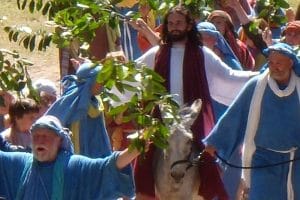
Were there two donkeys involved in the triumphal entry or just one? MATTHEW 21:2 (cf. Mark 11:2; Luke 19:30)

MATTHEW 21:2 (cf. Mark 11:2; Luke 19:30)—Were there two donkeys involved in the triumphal entry or just one?

PROBLEM: Matthew’s account records Jesus’ request of two disciples to go into a village and get two donkeys. But in Mark and Luke, He requests that the two disciples get just the colt.

SOLUTION: Both animals were involved in Jesus’ triumphal entry into Jerusalem. There is no mistake in the accounts because Mark and Luke mention just the colt (p_olos), and Matthew refers to the colt (p_olos, 21:5) and its mother. The passage in Matthew is pointing out the literal fulfillment of the prophecy of Zechariah 9:9 which states, “Behold your king is coming to you … humble, and mounted on a donkey, even on a colt, the foal of a donkey.” The Greek version of the OT uses the same word for colt (p_olos) as the NT passages. Matthew literally states that once the disciples placed their garments on the donkeys, Jesus sat on them, that is, on their garments. Matthew does not say that Jesus rode on both the mother and the colt. It merely states that Jesus sat on the garments that the disciples had placed on the donkeys. Perhaps they placed some garments on the mother and others on the colt, and Jesus sat on those garments which were placed on the colt. The fact is the text of Matthew simply does not say on which donkey Jesus sat. Mark and Luke focus on the colt on which Jesus rode, while Matthew mentions the presence of the colt’s mother. Her presence may have been necessary because the colt was so young. Mark 11:12 states that no one had ridden on the colt, and that the colt would be taking a passenger through a noisy crowd (Mark 11:9). Perhaps the mother was brought along in order to be a calming influence upon her young.

[1]


[1]Geisler, N. L., & Howe, T. A. (1992). When critics ask : A popular handbook on Bible difficulties (353). Wheaton, Ill.: Victor Books.

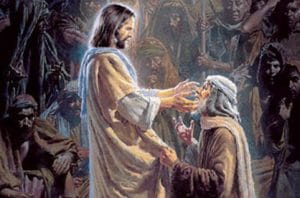
Did Jesus heal the blind man coming into or going out of Jericho? MATTHEW 20:29–34 (cf. Mark 10:46–52; Luke 18:35–43)

MATTHEW 20:29–34 (cf. Mark 10:46–52; Luke 18:35–43)—Did Jesus heal the blind man coming into or going out of Jericho?

PROBLEM: According to Luke, a blind man was healed as Jesus entered the city of Jericho (18:35), but Matthew and Mark declare that the healing took place as Jesus left the city of Jericho. Again, the accounts do not seem to be harmonious.

SOLUTION: Some believe that the healing in Luke may have actually taken place as Jesus left Jericho, claiming that it was only the initial contact that took place as “He was coming near Jericho” (Luke 18:35) and the blind man may have followed Him through the city, since he was continually begging Jesus to heal him (vv. 38–39). But this seems unlikely, since even after the healing (v. 43) the very next verse (19:1) says, “then Jesus entered and passed through Jericho.”

Others respond by noting there were two Jerichos, the old and the new, so that as He went out of one He came into the other.

Still others suggest that these are two different events. Matthew and Mark clearly affirm the healing occurred as Jesus left the city (Matt. 20:29; Mark 10:46). But Luke speaks of healing one blind man as He entered the city. This is supported by the fact that Luke refers only to a “multitude” of people being present as Jesus entered the city (18:36), but both Matthew (20:29) and Mark (10:46) make a point to say there was a “great multitude” of people there by the time Jesus left the city. If the word spread of the miraculous healing on the way into the city, this would account for the swelling of the crowd. It might also explain why two blind men were waiting on the other side of the city to plead for Jesus to heal them. Perhaps the first blind man who was healed went quickly to tell his blind friends what happened to him. Or maybe the other blind men were already stationed at the other end of the city in their customary begging position. At any rate, there is no irresolvable difficulty in the passage. The two accounts can be understood in a completely compatible way.

Geisler, N. L., & Howe, T. A. (1992). When critics ask : A popular handbook on Bible difficulties (353). Wheaton, Ill.: Victor Books.

Did Jesus heal two blind men or just one? MATTHEW 20:29–34 (cf. Mark 10:46–52; Luke 18:35–43)

MATTHEW 20:29–34 (cf. Mark 10:46–52; Luke 18:35–43)—Did Jesus heal two blind men or just one?

PROBLEM: Matthew says that Christ healed two men, but Mark refers to only one man being healed (10:46). This appears to be a clear contradiction.

SOLUTION: Although Mark records one individual getting healed, this does not mean that there were not two, as Matthew says there were. First of all, Mark does not declare that there was only one blind man healed. Matthew says there were two, and where there are two there is always one, every time! Matthew earlier mentions two demoniacs where Mark and Luke mention one (Matt. 8:28–34), so Matthew again mentions the two blind men where Mark mentions just one. Further, the fact that Mark mentions the name of one blind man, Bartimaeus, and his father (Timaeus, 10:46), indicates that Mark is centering on the one that was personally known to him. If two men were to receive a medal of honor from the president of the United States and one was your friend, it is understandable that when you relate the story you might only speak of the one whom you knew receiving the medal.

Geisler, N. L., & Howe, T. A. (1992). When critics ask : A popular handbook on Bible difficulties (352). Wheaton, Ill.: Victor Books.

Who came to talk with Jesus, the mother of James and John or James and John? MATTHEW 20:20 (cf. Mark 10:35)

MATTHEW 20:20 (cf. Mark 10:35)—Who came to talk with Jesus, the mother of James and John or James and John?

PROBLEM: In Matthew, the mother of James and John made a request of Jesus. However, Mark states that it was James and John who came to Jesus to make their request.

SOLUTION: It is clear that both the mother and her sons came to Jesus to make the request, since the text declares “the mother … came to Him with her sons” (v. 20). It is possible that the mother spoke first with the two sons closely following to reiterate the request. This is supported by Matthew’s account because when Jesus responds “are you able to drink the cup that I am about to drink?” the Bible says “they said to Him, `we are able’ ” (v.22). So, there is no unsolvable conflict here. The two accounts are harmonious.

[1]


[1]Geisler, N. L., & Howe, T. A. (1992). When critics ask : A popular handbook on Bible difficulties (352). Wheaton, Ill.: Victor Books.

If Jesus was God, why did He seem to rebuke the rich young ruler for calling Him good? MATTHEW 19:16–30 (cf. Mark 10:17–31; Luke 18:18–30)

MATTHEW 19:16–30 (cf. Mark 10:17–31; Luke 18:18–30)—If Jesus was God, why did He seem to rebuke the rich young ruler for calling Him good?

PROBLEM: The rich young ruler called Jesus “Good Teacher,” and Jesus rebuked him, saying, “Why do you call Me good? No one is good but One, that is, God.” Yet on other occasions Jesus not only claimed to be God (Mark 2:8–10; John 8:58; 10:30), but He accepted the claim of others that He was God (John 20:28–29). Why did Jesus appear to deny that He was God to the young ruler?

SOLUTION: Jesus did not deny He was God to the young ruler. He simply asked him to examine the implications of what he was saying. In effect, Jesus was saying to him, “Do you realize what you are saying when you call Me Good? Are you saying I am God?”

The young man did not realize the implications of what he was saying. Thus Jesus was forcing him to a very uncomfortable dilemma. Either Jesus was good and God, or else He was bad and man. A good God or a bad man, but not merely a good man. Those are the real alternatives with regard to Christ. For no good man would claim to be God when he was not. The liberal Christ, who was only a good moral teacher but not God, is a figment of human imagination.

[1]


[1]Geisler, N. L., & Howe, T. A. (1992). When critics ask : A popular handbook on Bible difficulties (350). Wheaton, Ill.: Victor Books.

Why does Peter’s confession here differ from that recorded in Mark and Luke? MATTHEW 16:16

MATTHEW 16:16—Why does Peter’s confession here differ from that recorded in Mark and Luke?

PROBLEM: Peter’s confession of Christ in Caesarea Philippi is stated differently in the three Gospels:

Matthew: “You are the Christ, the Son of the living God.”

Mark: “You are the Christ” (8:29).

Luke: “The Christ of God” (9:20).

If the Bible is the inspired Word of God, why are there three different reports of what Peter said? What did he really say?

SOLUTION: There are several reasons why the Gospel accounts of Peter’s statements differ. First, Peter probably spoke Aramaic, while the Gospels are written in Greek. So, some changes come naturally as a result of translating the words differently. Second, the Gospel writers sometimes paraphrased the essence of what people said, much like the way journalists do today. Third, other writers selected and abbreviated what was said to fit the theme of their book or the emphasis they wished to make.

What is important to notice is that the Gospel writers never created these sayings, rather, they reported them. Further, their reports were in accordance with journalistic standards of the day (and even today for that matter). Also, whenever there are multiple reports, they all give the essence of what was said. For example, all three reports note that Peter confessed that Jesus is “the Christ of God.” Sometimes, all the reports can be put together as a whole, giving what may have been the word-for-word original statement of Peter. For example, Peter may have said exactly what Matthew reported, and the others may have reported the important parts of Peter’s confession, as illustrated in the following:

Matthew: “You are the Christ, the Son of the living God.”

Mark: “You are the Christ [the Son of the living God].”

Luke: “[You are] the Christ [the Son] of [the living] God.”

[1]


[1]Geisler, N. L., & Howe, T. A. (1992). When critics ask : A popular handbook on Bible difficulties (347). Wheaton, Ill.: Victor Books.

Exit mobile version