God Hardening Pharaoh’s Heart

God Hardening Pharaoh’s Heart

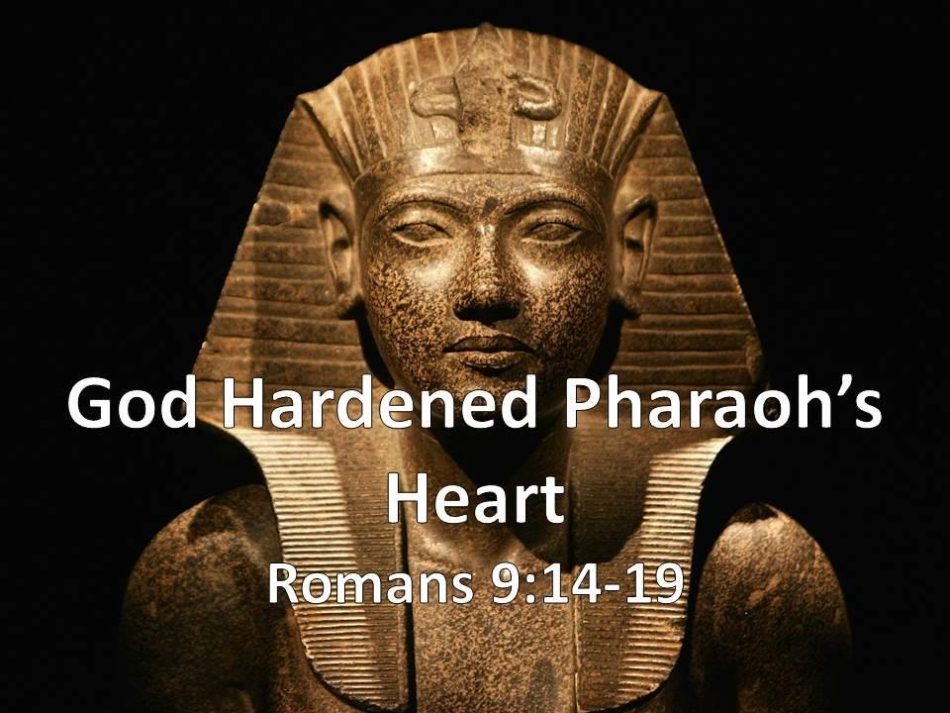
God Hardening Pharaoh’s Heart

The various statements that are made in the Scriptures in regard to God hardening Pharaoh’s heart have also perplexed a great many young Christians and have frequently been made use of by unbelievers in their attacks upon the Bible.

It is said that if God hardened Pharaoh’s heart and, in consequence of this hardening, Pharaoh rebelled against God, then God Himself was responsible for Pharaoh’s sin, and it was unjust to hold Pharaoh accountable for his rebellion and to punish him for it.

In Exodus 4:21 (RV) we read: “And the LORD said unto Moses, When thou goest to return into Egypt, see that thou do all those wonders before Pharaoh, which I have put in thine hand: but I will harden his heart, that he shall not let the people go” (see also Exodus 7:3; 14:4).

Now from reading these passages it does seem at the first glance as if there were some ground for criticism of God’s action in this matter, or of the Bible account of it. But when we study carefully exactly what the Bible says, and exactly what God is reported as saying, and the circumstances under which He said it, the difficulty disappears.

For God to take a man who really desires to know and do His will, harden his heart and thus incline him not to do His will, would indeed be an action on God’s part that it would be difficult or impossible to justify.

But when we read God’s utterances on this matter in their setting, we find this is not at all what God did with Pharaoh. Pharaoh was not a man who wished to obey God. The whole account begins not with God’s hardening Pharaoh’s heart but with Pharaoh’s hardening his own heart.

In Exodus 4:21 we have a prophecy of what God would do with Pharaoh, a prophecy that God made fully knowing beforehand what Pharaoh would do before He hardened his heart.

In Exodus 9:12 and later passages we have the fulfillment of this prophecy, but before God does here harden Pharaoh’s heart we have a description of what Pharaoh himself did.

In Exodus 5:1–2 we are told that Moses and Aaron appeared in the presence of Pharaoh with Jehovah’s message: “Thus saith the LORD God of Israel, Let my people go, that they may hold a feast unto me in the wilderness,” and that Pharaoh replied, “Who is the LORD, that I should obey his voice to let Israel go? I know not the LORD, neither will I let Israel go.” Here Pharaoh definitely and defiantly refused to recognize or obey God. This was before God hardened his heart.

Then follows a description of how Pharaoh gave himself over to more cruel oppression of the Israelites than ever (Exodus 5:3–9). In Exodus 7:10 and following verses we see Moses and Aaron coming in to the presence of Pharaoh and doing signs before him as proof that they were messengers sent from God; but Pharaoh would not listen.

We read in the Authorized Version, “And he hardened Pharaoh’s heart, that he hearkened not unto them” (v. 13). But the Revised Version correctly renders it thus: “Pharaoh’s heart was hardened.” It does not say as yet that the Lord hardened his heart.

The facts in the case are these: Pharaoh was a cruel and oppressive tyrant, subjecting the people of Israel to most awful bondage, suffering and death. God looked down upon His people, heard their cries, and in His mercy determined to deliver them (Exodus 2:25; 3:7–8).

He sent Moses as His representative to Pharaoh to demand the deliverance of His people, and Pharaoh in proud rebellion defied Him and gave himself up to even more cruel oppression of the people. It was then and only then that God hardened his heart.

This was simply in pursuance of God’s universal method of dealing with men. God’s universal method is, if man chooses error, to give him up to error (2 Thessalonians 2:9–12, RV); if with a stout heart they choose sin, at last He gives them over to sin (Romans 1:24–26, 28, RV). This is stern dealing, but it is just dealing.

If there is any difficulty that still remains in the incident, it all disappears when we consider the manner in which God hardened Pharaoh’s heart. It was, of course, not a physical act. God was not dealing with Pharaoh’s heart as a part of his body. He was dealing with the heart in the sense in which we constantly use the word as the supposed seat of intelligence, affection and will. The will cannot be coerced by force.

The will can no more be moved by force than a train of cars can be drawn by an argument or an inference. The way in which God hardened Pharaoh’s heart was by sending to him a series of demonstrations of His own existence and power, and a series of judgments. If Pharaoh had taken the right attitude toward these revelations of God’s existence and power in these judgments that God sent upon him, they would have led to his repentance and salvation.

But by willingly and willfully taking the wrong attitude toward them, he was hardened by them. Nothing that God sends us is more merciful than His judgments upon our sins. If we take these judgments right they will soften our hearts and lead us to repentance and entire surrender to God, and thus bring us salvation. But if we rebel against them, they will harden our hearts and bring us eternal ruin.

The fault is not with God, and the fault is not with His judgments; the fault is with ourselves and the attitude we take toward His judgments and toward the truth of God itself. The gospel is the savor of life unto life—unto men who receive it—but it is the savor of death unto death—to those who reject it (2 Corinthians 2:15–16). The trouble is not with the gospel, which is “the power of God unto salvation to every one that believeth” (Romans 1:16).

The trouble is with the man who rejects the gospel, and who is thus hardened, condemned and destroyed by it. To him it thus becomes the savor of death unto death. The same sermon brings life to one man and death to another. It brings life, pardon and peace to the one who believes it and acts upon it. It brings condemnation and death to the one that rejects its truth. It softens the heart of one; it hardens the heart of the other.

Jesus Christ Himself came into the world, not to condemn the world, but to save it (John 3:17); but to the one who does not believe He brings condemnation and eternal ruin (John 3:18, 36; Hebrews 10:28–29).

[1]


[1]Torrey, R. (1998, c1996). Difficulties in the Bible : Alleged errors and contradictions. Willow Grove: Woodlawn Electronic Publishing.


God Hardening Pharaoh’s Heart

Why does the Bible commend the Magi for following the star, when it condemns astrology? MATTHEW 2:2

MATTHEW 2:2—Why does the Bible commend the Magi for following the star, when it condemns astrology?

PROBLEM: The Bible condemns the use of astrology (see Lev. 19:26; Deut. 18:10; Isa. 8:19), yet God blessed the wise men (Magi) for using a star to indicate the birth of Christ.

SOLUTION: First, we need to ask what astrology is. Astrology is a belief that the study of the arrangement and movement of the stars can enable one to foretell events—whether they will be good or bad.

Second, the star used in the biblical account was to announce the birth of Christ, not to foretell this event. God gave the star to the Magi to proclaim to them that the child had already been born. We know the child was already born, because in Matthew 2:16, Herod gives a command to kill all the boys in Bethlehem and vicinity that are two years old or younger in accordance with “the time which he had ascertained from the Magi” (nasb).

Third, there are other cases in the Bible in which the stars and planets are used by God to reveal His desires. Psalm 19:1–6 affirms that the heavens declare God’s glory, and Romans 1:18–20 teaches that creation reveals God’s existence. Christ refers to what will happen to the sun, moon, and stars in connection with His second coming (Matt 24:29–30), as did the prophet Joel (2:31–32). The star guiding the Magi was not used to predict, but to proclaim the birth of Christ.

[1]


[1]Geisler, N. L., & Howe, T. A. (1992). When critics ask : A popular handbook on Bible difficulties (326). Wheaton, Ill.: Victor Books.

Is God True? God’s Existence Make Sense of Our Universe


Detectives assess evidence at death scenes to answer the most critical questions: Is this a natural death or a homicide? If it’s a homicide, which suspect best explains the evidence at the scene? While there may be a number of potential suspects accounting for some (or most) of the evidence, one suspect will usually emerge as the “best” inference, explaining the evidence more completely (and more reasonably) than other alternatives. One suspect makes better sense of what we are seeing evidentially. As good detectives, we then infer this suspect is, in fact, the true killer. In a similar way, each of us holds a view of the world (something we refer to as a “worldview”) attempting to explain the common observations. We observe the world around us and begin to think about potential explanations for what we are seeing. We then offer the most reasonable explanation to explain the evidence. We are inferring to the best explanation. Is God True? God’s existence makes sense of our universe and provides a satisfactory answer to life’s most important questions. God is the most reasonable explanation.

Every one of us develops a particular worldview in order to explain our observations and answer life’s most important questions. Along the way we make a decision between two potential realities: a world in which only natural forces are at work (an atheistic worldview known as Philosophical Naturalism) or a world in which supernatural forces are at work in addition to natural forces (as represented by Theistic Worldviews). I hold a theistic worldview because I believe it best explains the world around me, and it does so in a way unequaled by the philosophical naturalism inherent to atheism. In the ten most intriguing and important questions asked by humans, Christian theism continues to offer the best explanation, especially when compared to philosophical naturalism:

How Did the Universe Come Into Being?
Why Does There Appear to Be Design (Fine Tuning) in the Universe?
How Did Life Originate?
Why Does There Appear to Be Evidence of Intelligence in Biology?
How Did Human Consciousness Come Into Being?
Where Does Free Will Come From?
Why Are Humans So Contradictory in Nature?
Why Do Transcendent Moral Truths Exist?
Why Do We Believe Human Life to be Precious?
Why Does Pain, Evil and Injustice Exist in Our World?

The ten “big questions” of life can also be seen as ten pieces of evidence “in the room”. As a detective, I look at the evidence, offer possible hypotheses capable of explaining what I am seeing, then evaluate the hypotheses to see which is the best explanation. The process (called, “Abductive Reasoning”) requires me to evaluate a given explanation to make sure it is feasible (it possesses “explanatory viability”), simple (it has the most “explanatory power”), exhaustive (it has the most “explanatory scope”), logical (it has the most “explanatory consistency”) and is superior (it possesses “explanatory superiority”). When looking at these ten pieces of evidence, I quickly recognize the problem Philosophical Naturalism has explaining them. Many of these questions are (or will be) addressed here at ColdCaseChristianity.com. As I examined the explanations offered by naturalism, I found them lacking. At the same time, Christian Theism offers feasible, simple, exhaustive, logical and superior explanations (if we don’t simply reject the existence of God before we even begin the examination). To be fair, we’ve must start each investigation by offering the broadest possible solutions, then allow the evidence to tell us which of these “possibilities” is actually the most “reasonable inference”.

Finally, it’s important for us to recognize no solution will explain the evidence completely (without leaving some limited number of unanswered questions). I’ve never worked a homicide case, nor presented a case in front of a jury, lacking some unanswered question. But this deficiency has never prevented us from moving toward a decision, and it has never prevented a jury from coming to a verdict. Certainty can reasonably emerge from what I call “evidential sufficiency”. At some point, the evidence is sufficient to cause us to believe our hypothesis is the true explanation for the evidence under consideration. We cannot expect every question will be answered, but the hypothesis explaining the evidence the most powerfully, the most exhaustively and the most consistently must sufficiently satisfy our need for certainty. Is God True? God’s existence makes sense of our universe and provides a satisfactory answer to life’s most important questions. The Christian Worldview is the best explanation, and I hope ColdCaseChristianity.com will make the case in a compelling way.

J. Warner Wallace is a Cold-Case Detective, a Christian Case Maker, and the author of Cold-Case Christianity

Comment on this blog, Subscribe to J. Warner’s Daily Email, or download the Cold-Case Christianity App from the iTunes Store or Android Marketplace.


Exit mobile version