MATTHEW 2:6—How can we explain Matthew’s apparent misquotation of Micah 5:2?
PROBLEM: Matthew 2:6 quotes Micah 5:2. However, the words Matthew uses are different than those used by Micah.
SOLUTION: Although Matthew seems to have changed some of the words from the passage in Micah, there is no real deviation in the meaning of the text. Matthew, in some instances, seems to have paraphrased.
First, Matthew inserts the phrase “land of Judah” for the word “Ephrathah.” This does not really change the meaning of the verse. There is no difference between the land of Judah and Ephrathah, except one is more specific than the other. In fact, Ephrathah refers to Bethlehem in the Micah passage, and Bethlehem is located in the land of Judah. However, this does not change the basic meaning of this verse. He is speaking of the same area of land. Interestingly, when Herod asked the chief priests and the scribes where the child was to be born, they said, “in Bethlehem of Judea” (Matt. 2:5, nasb).
Second, Matthew describes the land of Judah as “not the least” but Micah states that it is “little.” Here, Matthew may be saying that since the Messiah is to come from this region, it is by no means least among the other areas of land in Judah. The phrase in Micah only says that Bethlehem is too little or small, as compared to the other areas of land in Judah. The verse does not say it is the least among them, only very little. Matthew is saying the same thing in different words, namely, that Bethlehem is little in size, but by no means the least in significance, since the Messiah was born there.
Finally, Matthew uses the phrase “who will shepherd My people Israel” and Micah does not. Micah 5:2 recognizes that there will be a ruler in Israel, and Matthew recognizes this as well. However, the phrase that is not mentioned in Micah is actually taken from 2 Samuel 5:2. The combining of verses does not take away what is being said, but it strengthens the point that the author is making. There are other instances where an author combines one Scripture with another. For example, Matthew 27:9–10 combines some of Zechariah 11:12–13 with Jeremiah 19:2, 11 and 32:6–9. Also, Mark 1:2–3 combines some of Isaiah 40:3 with Malachi 3:1. Only the first passage is mentioned, since it is the main passage being cited.
In brief, Matthew is not misrepresenting any information in his quotation of Micah 5:2 and 2 Samuel 5:2. Matthew’s quote is still accurate even though he paraphrases part of it and combines another portion of Scripture with it.
MATTHEW 2:2—Why does the Bible commend the Magi for following the star, when it condemns astrology?
PROBLEM: The Bible condemns the use of astrology (see Lev. 19:26; Deut. 18:10; Isa. 8:19), yet God blessed the wise men (Magi) for using a star to indicate the birth of Christ.
SOLUTION: First, we need to ask what astrology is. Astrology is a belief that the study of the arrangement and movement of the stars can enable one to foretell events—whether they will be good or bad.
Second, the star used in the biblical account was to announce the birth of Christ, not to foretell this event. God gave the star to the Magi to proclaim to them that the child had already been born. We know the child was already born, because in Matthew 2:16, Herod gives a command to kill all the boys in Bethlehem and vicinity that are two years old or younger in accordance with “the time which he had ascertained from the Magi” (nasb).
Third, there are other cases in the Bible in which the stars and planets are used by God to reveal His desires. Psalm 19:1–6 affirms that the heavens declare God’s glory, and Romans 1:18–20 teaches that creation reveals God’s existence. Christ refers to what will happen to the sun, moon, and stars in connection with His second coming (Matt 24:29–30), as did the prophet Joel (2:31–32). The star guiding the Magi was not used to predict, but to proclaim the birth of Christ.
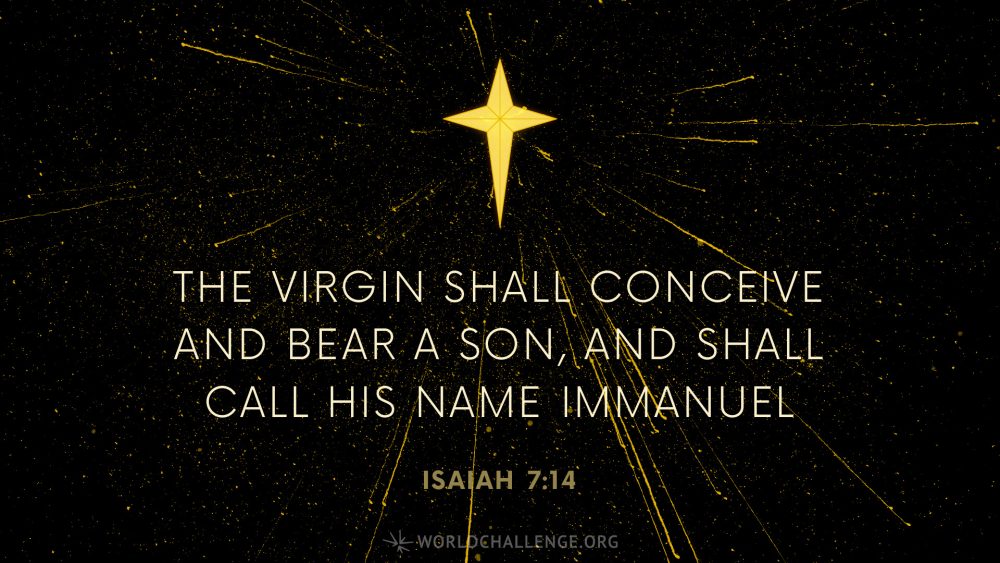
Isaiah 7:14 does not prophesy a virgin birth! And it has nothing whatsoever to do with Jesus, since it dealt with a crisis seven hundred years before he was born.
Isaiah 7:14 does not prophesy a virgin birth! And it has nothing whatsoever to do with Jesus, since it dealt with a crisis seven hundred years before he was born.
Although biblical scholars of varied religious backgrounds continue to debate the precise significance of Isaiah 7:14 (Jewish scholars disagree among themselves, as do Christian scholars), the overall meaning is clear: The prophet speaks of a supernatural event of great importance to the house of David, apparently the birth of a royal child. When read in the larger context of Isaiah 7–11, it is not difficult to see how Isaiah 7:14 was taken to be Messianic. Matthew, therefore, had good reason to cite this passage with reference to the birth of Jesus the Messiah. But you have raised some fair questions, so let’s look at them in a little more detail.
Isaiah 7:14 is often attacked by the anti-missionaries as a “central” prophecy of the New Testament, as if it were quoted dozens of times by the New Testament authors and as if it were grossly misinterpreted there. In fact, it is quoted only once in the entire New Testament, and when understood properly—in terms of Isaiah’s original prophecy and Matthew’s quotation—you will see that the Messianic interpretation makes good scriptural sense.
Let’s begin by looking back to the original context, dating to more than seven hundred years before the birth of Jesus. The people of Judah had a crisis on their hands. They were being attacked by their brothers in the north, the Israelites, who were joined by the Arameans. These enemy armies were heading toward Jerusalem, and their goal was to take the city, remove the reigning king (remember that in Judah, the king was always a descendant of David), and place their own man on the throne.
How real was the threat? So real that it is the “house of David” that is addressed twice in Isaiah 7 (vv. 2 and 13), something that takes on real significance when we realize that outside of this chapter of Isaiah, the phrase occurs only three other times in the remaining 165 chapters of the Major Prophets (two other times in Isaiah, namely, 16:5; 22:22; once in Jeremiah, namely, 21:12; not at all in Ezekiel). This attack was nothing less than a frontal assault on God’s established dynasty, the dynasty from which the Messiah would come. Unfortunately, the current king in David’s line, Ahaz, was a faithless man who was more prepared to hire a foreign army to help him fight than to rely on God. And so it was that the Lord sent the prophet Isaiah to speak to this weak Davidic king, urging him to put his trust in Yahweh alone and assuring him that Judah’s enemies would be defeated:
Yet this is what the Sovereign Lord says:
“It will not take place,
it will not happen,
for the head of Aram is Damascus,
and the head of Damascus is only Rezin.
Within sixty-five years
Ephraim will be too shattered to be a people.
The head of Ephraim is Samaria,
and the head of Samaria is only Remaliah’s son.
If you do not stand firm in your faith,
you will not stand at all.”
Isaiah 7:7–9
But Ahaz refused to stand firm in his faith, even when the Lord offered to give him a sign of supernatural proportions: “Ask the Lord your God for a sign, whether in the deepest depths or in the highest heights” (Isa. 7:11). Faithless Ahaz wanted nothing to do with this. So the Lord rebuked him with these words: “Hear now, you house of David! [Notice that Ahaz is not simply addressed as the king, but rather as the representative of the house of David; the Hebrew here and in the next verse is in the plural, so Ahaz is not being addressed alone.] Is it not enough to try the patience of men? Will you try the patience of my God also? Therefore the Lord himself will give you a sign: The virgin (ʿalmah)will be with child [or “is with child”] and will give birth to a son, and will call him Immanuel” (Isa. 7:13–14).31
That is the famous prophecy! The following verses, which clearly contain elements of judgment as well as deliverance, are not quoted as often but are certainly relevant:
He [namely, Immanuel] will eat curds and honey when he knows enough to reject the wrong and choose the right. But before the boy knows enough to reject the wrong and choose the right, the land of the two kings you dread will be laid waste. The Lord will bring on you and on your people and on the house of your father a time unlike any since Ephraim broke away from Judah—he will bring the king of Assyria. [Bear in mind that Ahaz was looking to this very same Assyria, rather than to the Lord, to deliver him from the present military threat; how ironic!]
Isaiah 7:15–17
Who is this Immanuel? Some say a child to be born to Isaiah; some say a child to be born to Ahaz; some say a child to be born to one particular Judean woman at that time, although she is not specifically named in the context; some say a child to be born to an unidentified Judean woman at that time. The context does not make this matter clear (in spite of Isaiah 8:8; cf. also 8:10; both verses have the words ʿimmanu ʾel in the Hebrew text).32 It would be fair to say, however, that the birth of the child has something to do with the future of the house of David, since (1) the main threat of Israel and Aram, Judah’s enemies in this chapter, was that they would oust the Davidic king and put their own man on the throne; (2) the Lord specifically says he will give a sign to the unbelieving house of David, and that sign has to do with the birth of a son; and (3) the following chapters, especially 9 and 11, contain some of the most significant Messianic prophecies in the Bible, focusing on the birth and supernatural reign of a new Davidic king. We will return to the larger context of this passage after addressing several more questions.33
What is the supernatural sign given by God?34 Some say Isaiah is simply predicting that the child born will be a boy (not the most supernatural sign, since the chances of being right are fifty-fifty); some say the sign is to be found in the name Immanuel, which means “God is with us” (and will deliver us); some say the sign is that the mother would prophesy for the first time (giving her son the name Immanuel by divine inspiration, which, of course, is hardly a sign if she already knew about this prophecy!); some say the nature of the sign is found in verses 14 to 17—in other words, a child will be born soon, bearing a significant name, and before he reaches a certain age, God will defeat Judah’s enemies; some say the nature of the sign is exactly the opposite, namely, that before the promised child reaches a certain age, Judah will be devastated; some say the sign consists in the supernatural nature of the birth, since the woman who will conceive Immanuel will be a virgin.35 This much is obvious from the context: The sign must clearly bear the marks of divine activity and intervention, since Ahaz grieved the Lord by refusing to ask for a sign, “whether in the deepest depths or in the highest heights,” as a result of which the Lord said that he himself would give Ahaz a sign. What a sign it needed to be!36
This leads to a question that has received almost endless discussion for close to twenty centuries: Does the word ʿalmah mean “virgin”? My answer—as a committed believer in Yeshua the Messiah—may surprise you: While the word ʿalmah can refer to a virgin, it does not specifically mean “virgin.” Its basic meaning is primarily related to adolescence, not sexual chastity.37 The evidence is actually fairly clear: (1) There is a masculine equivalent to ʿalmah, namely, ʿelem, occurring twice in the Hebrew Scriptures (1 Sam. 17:56; 20:22). It simply means “youth, young man,” with no reference to virginity at all. Just substitute “male virgin” in either of these two passages, and the absurdity of such a translation will be seen at once. (Cf., e.g., 1 Sam. 17:56, where Saul wants to learn more about David after he killed Goliath. Did Saul say, “Find out whose son this male virgin is”? Hardly! He simply said, “Find out whose son this young man is”—because ʿelem meant “young man,” not “male virgin.”)38 (2) The words ʿelem (masc.) and ʿalmah (fem.) should be derived from a Semitic root meaning “to come into puberty, to come into heat (for an animal),” not from a Semitic root meaning, “to hide, be hidden” (with a supposed reference to virginity).39 (3) In the other Semitic languages, ʿalmah does not specifically mean “virgin.”40 (4) Within the Tanakh, ʿalmah does not, in and of itself, clearly and unambiguously mean “virgin.” Outside of Isaiah 7:14, ʿalmah occurs six times in the Old Testament, and in four of these cases, the NIV—a conservative Christian translation—does not render the word as “virgin.” Why? Because that is not the primary meaning of the word.41 (5) The related noun ʿalumim, occurring in Isaiah 54:4 and Psalm 89:45[46], is correctly translated as “youth” (not “virginity”) in the KJV, the NKJV, the NASB, and the NIV, all of which translate ʿalmah in Isaiah 7:14 as “virgin.”42 Again, youthfulness, not sexual chastity, is the basic meaning of the word. (6) In Aramaic, ʿalmah (i.e., ʿulemtaʾ) sometimes refers to women who have been sexually active.43
To put it simply, there are women who are fifty years old and have never been with a man, making them fifty-year-old virgins, and this is perfectly acceptable English usage, since virginity has to do with sexual chastity, not age. But it would be incorrect to speak of a fifty-year-old ʿalmah in biblical Hebrew usage, since the root ʿ-l-m has more to do with age and sexual development (i.e., adolescence) than with sexual chastity.44
“Exactly!” you say. “If Isaiah wanted to speak of a virgin birth, he would have used the Hebrew word betulah, a word that clearly and unequivocally means ‘virgin.’ ”45
Not at all! Actually, there is no single word in biblical Hebrew that always and only means “virgin” (called in Latin virgo intacta).46 As for the Hebrew word betulah, while it often refers to a virgin in the Hebrew Scriptures, more often than not it has no reference to virginity but simply means “young woman, maiden.”47 In fact, out of the fifty times the word betulah occurs in the Tanakh, the NJPSV translates it as “maiden”—rather than “virgin”—thirty-one times!48 This means that more than three out of every five times that betulah occurs in the Hebrew Bible, it is translated as “maiden” rather than “virgin” by the most widely used Jewish translation of our day.49 Not only so, but the Stone edition of the Tanakh, reflecting traditional Orthodox scholarship, frequently translates betulah as “maiden” as well.50 Even in verses where the translation of “virgin” is appropriate for betulah, a qualifying phrase is sometimes added, as in Genesis 24:16: “The maiden (naʿarah) was very beautiful, a virgin (betulah) whom no man had known.” Obviously, if betulah clearly and unequivocally meant “virgin” here, there would be no need to explain that this betulah never had intercourse with a man.51 Just think of normal English usage; we would never say, “The young woman was a virgin, and she never had sexual intercourse in her life.” How redundant!52 What other kind of virgin is there?
Just consider the absurdity of translating betulah with the word “virgin” instead of “maiden” in some of the following verses. (Note that all of the verses cited here use “maiden” or the like—rather than “virgin”—in both the NJPSV and the Stone edition, which are leading Jewish, not Christian, translations.)
“Be ashamed, O Sidon, for the sea has spoken, the fortress of the sea, saying: ‘I have neither labored nor given birth, I have neither reared young men nor brought up young women’ ” (Isa. 23:4 NRSV). Could you imagine translating this with “brought up virgins”? What parent says, “I’ve raised young men and virgins”?)
“ ‘Slaughter old men, young men and maidens, women and children, but do not touch anyone who has the mark. Begin at my sanctuary.’ So they began with the elders who were in front of the temple” (Ezek. 9:6; cf. 2 Chron. 36:17. It is very common for betulah to be parallel with bahur, “young man”—not young male virgin—as it is in this verse. There is no thought here about virgins being a special category of those who would be slain. Rather, the command is comprehensive: Slay the old men, the young men and young women, the mothers and children. Virginity is not an issue here.)
“I made a covenant with my eyes not to look lustfully at a girl” (Job 31:1; this was Job’s personal pledge of piety. Obviously, he was not promising never to look lustfully at a virgin. How could he know which attractive young lady was a virgin and which was not? Rather, he had promised not to lust after a young woman.).53
In Joel 1:8 betulah refers to a widow: “Lament—like a maiden girt with sackcloth for the husband of her youth” (NJPSV). A widow is hardly a virgin!54
Even more clear is Isaiah 47:1, rendered in the NIV as, “Go down, sit in the dust, Virgin Daughter of Babylon; sit on the ground without a throne, Daughter of the Babylonians. No more will you be called tender or delicate.” Yet a few verses later we read that this “Virgin” will lose her husband and her children on the very same day! “Now then, listen, you wanton creature, lounging in your security and saying to yourself, ‘I am, and there is none besides me. I will never be a widow or suffer the loss of children.’ Both of these will overtake you in a moment, on a single day: loss of children and widowhood. They will come upon you in full measure, in spite of your many sorceries and all your potent spells” (Isa. 47:8–9).
Of course, Israel, Zion, or the surrounding nations could be referred to as a betulah, always translated as “Maiden” in such contexts by the NJPSV (see n. 55).55 The point, however, is clear: Betulah did not immediately convey the image or meaning of “virgin.” Otherwise, the usage would be totally inappropriate in these verses in which the betulah is married and with children. Once again, virginity was not the issue.56 In fact, an ancient Aramaic text even makes reference to a betulah who is pregnant but cannot bear!57
All this is of great importance when we remember that anti-missionaries commonly tell us that if Isaiah had intended to prophesy a virgin birth clearly, he would have used betulah rather than ʿalmah.58 Not so! Rather, neither word in and of itself would clearly and unequivocally convey the meaning of virgin.59
“Well then,” you say, “you’ve shot yourself in the foot with your own argument! Even if you’re right about betulah not always meaning ‘virgin,’ you’ve said that ʿalmah doesn’t necessarily mean ‘virgin’ either. What then has happened to your major Messianic prophecy? What has become of the prophecy of the virgin birth of Jesus?”
That’s a very good question, and it leads me to explain the real meaning of Isaiah’s prophecy, especially as Matthew looked back at it more than seven hundred years later. It’s a lot deeper and more profound than you may have realized! In reality, it is the very fact that the original prophecy is so obscure and difficult that provides the key to understand the depth of Matthew’s insight. Let me take a few minutes and explain all of this to you.
For almost thirty years now, I have been reading commentaries on the Book of Isaiah, often with the goal of seeking to understand the meaning of this famous prophecy found in chapter 7. At this very moment, as I write these words in my office, I am surrounded by commentaries and special studies dealing with Isaiah 7:14, including the classic Jewish commentaries in Hebrew (Rashi, Ibn Ezra, Radak, Metsudat David, Metsudat Zion, among others, along with the later commentary of Samuel David Luzzatto, known as Shadal, and also Targum Jonathan in Aramaic) and Christian commentaries from every perspective, both conservative and liberal (J. A. Alexander, F. Delitzsch, B. Duhm, G. A. Smith, G. B. Gray, G. Fohrer, O. Kaiser, H. W. Wildberger, J. W. Watts, J. N. Oswalt, E. J. Young, B. S. Childs, J. Blenkinsopp, and others); studies on Messianic prophecy (including E. W. Hengstenberg, C. A. Briggs, E. Riehm, F. Delitzsch, F. F. Bruce, J. Smith, A. W. Kac, R. Santala, G. Van Groningen, W. Riggans, A. Fruchtenbaum, and others); and whole books or articles written just on this subject (E. A. Hinson, A. H. Bartlett, J. B. Payne, J. H. Walton, G. Miller, R. Niessen, and many others)—not to mention the treatment of this passage in biblical dictionaries and encyclopedias. I have really thought about this prophecy and considered carefully what others have written.60
What is my conclusion? Simply this: From our current vantage point, it is impossible to determine exactly what the prophecy meant to the original hearers when it was delivered, other than that it was a promise of a supernatural sign, a birth of great importance to the house of David, a token of divine intervention and deliverance, and a rebuke to unbelief and apostasy.61 Many commentators also point out that the wording of the birth announcement in Isaiah 7:14 follows the pattern of several other major birth announcements in the Hebrew Bible, underscoring the importance of the announcement here:
To Hagar, Abram’s concubine: “The angel of the Lord also said to her: ‘You are now with child and you will have a son. You shall name him Ishmael, for the Lord has heard of your misery’ ” (Gen. 16:11).
Regarding the birth of Samson: “The angel of the Lord appeared to her and said, ‘You are sterile and childless, but you are going to conceive and have a son.’ … ‘you will conceive and give birth to a son.’… He said to me, ‘You will conceive and give birth to a son’ ” (Judg. 13:3, 5, 7).
All three of these birth announcements—concerning Ishmael, Samson, and Immanuel—are of great significance in the Hebrew Bible, and all three are introduced with similar words and phrases. Also relevant is an ancient pagan text from the city of Ugarit (north of Israel, in modern-day Syria), written roughly five hundred years before Isaiah and announcing the birth of a god to a goddess in words very similar to those used in Isaiah 7:14: “Behold, the maiden [Ugaritic ġalmatu, the equivalent of Hebrew ʿalmah] will bear a son.”62
All this points to the fact that a birth of great importance was being announced by the prophet, especially for David’s house. It was God’s answer to the attack on the Davidic dynasty, and it was meant as a demonstration of his power and reality. As Matthew looked back at this prophecy in context, this is what he saw: The birth of Immanuel is highly significant in Isaiah 7–8; there are two major Messianic prophecies found in Isaiah 9 and 11;63 Yeshua’s birth truly was a supernatural sign (part of the sign being that the ʿalmah was in fact a virgin, yet she gave birth to a son); and Yeshua was Immanuel—a name found nowhere else in the Bible or the Ancient Near East (see n. 32)—in the literal sense of the name (God is with us!), as seen clearly in Isaiah 9:5–6[6–7] (see below, 4.4).64 Therefore Matthew could say that this prophecy reached its “fulfillment” with the birth of Jesus the Messiah since (1) the meaning of the text in its original historical context is somewhat veiled from our eyes, and not enough is said in the context to interpret the verses in a definite and dogmatic way; and (2) as a prophecy regarding the line of David and the coming Davidic king, and as part of Israel’s ongoing sacred Scriptures, we can see that its full and complete meaning was reached with the birth of the Messiah.65
But this is not only true of Isaiah 7:14. This is also true of other Messianic prophecies that were originally spoken regarding the birth or reign of Davidic kings who lived at those times—in other words, contemporaries of the prophets who were delivering the messages. It was only decades or even centuries later, when the writings were recognized as Holy Scripture, that these prophecies were understood to be still unfulfilled Messianic prophecies (see principles 2 and 4 in the appendix for further explanation).
Put another way, Isaiah 7:14, when read in the context of Isaiah 7–11—one of the key Messianic sections in the prophetic books—ultimately pointed to Jesus/Yeshua, our Messiah and King. In Isaiah 7 he is about to be born; in Isaiah 9 he is already born and declared to be the divine king (see below, 4.5, and see also vol. 2, 3.3); in Isaiah 11 he is ruling and reigning (in the supernatural power of the Spirit, at that). As Matthew looked back at these prophecies hundreds of years later, it would have been apparent to him that (1) these chapters were clearly linked together, and (2) the promises of a worldwide, glorious reign of the promised Davidic king were not yet realized. Something must have happened in Isaiah’s day relative to the birth of an Immanuel figure, but its greater promise—elaborated more fully in chapters 9 and 11—did not reach fulfillment in any sense of the word.66
And how do we know that Matthew had these other chapters of Isaiah in mind? He cited them or made reference to them elsewhere in the first four chapters of his book! So, in Matthew 1:23 he quotes Isaiah 7:14; in 4:15–16 he quotes Isaiah 9:1–2[8:23–9:1]; and in 2:23 he makes reference to Isaiah 11:1 (see vol. 4, 5.3). This means Matthew was not looking at Isaiah 7:14 in isolation, but rather in the larger context of the Messianic prophecies of Isaiah 7–11 (some would also include chapter 12 in this Messianic section).
We ask again, Who was this Immanuel? He was a king promised to the line of David—with an important, symbolic name—whose birth would serve as a divine sign. And if Immanuel is also the king spoken of in Isaiah 9 and 11, he was to be the Messiah, seen prophetically as emerging on the immediate horizon of history (see again principle 4 in the appendix). In that light, it is interesting to note that the promise of yet another child of promise, Maher-Shalal-Hash-Baz in chapter 8, seems to take the place of the Immanuel prophecy in chapter 7 in terms of the immediate historical context spoken of there. In other words, Isaiah declares that before Immanuel reaches a certain age, Judah’s enemies would be destroyed, and then God would bring judgment on Judah as well. But the birth in Isaiah 8 seems to repeat this very same promise, with one important exception: The text indicates the child was actually born, whereas there is no record of Immanuel being born in Isaiah’s day.
The Catholic Old Testament scholar, Joseph Blenkinsopp, even suggested that
the very close structural parallel between 7:10–17 and 8:1–4 would suggest the hypothesis … of alternative accounts of one sign-act, the first addressed to the dynasty, the second to the Judean public. The parallelism may be set out as follows:
Immanuel
Maher-shalal-hash-baz (8:1, 3)
The Young Woman
The Prophetess (8:3)
“the young woman is pregnant and about to give birth to a son”
“she became pregnant and bore a son”
“she will give him the name Immanuel”
“call him Maher-shalal-hash-baz”
“before the child knows how to reject what is bad and choose what is… good”
“before the child is able to say, ‘my father’ or ‘my mother’ ”
“the king of Assyria” (7:17)
“the king of Assyria” (8:4)
To round it off, the declaration of the meaning of the sign-act is followed in both cases by a threat of punishment for Judah to be administered by the Assyrians as agents of Yahveh (7:18–25; 8:5–10). I conclude, then, that within the prophetic world view, Immanuel and Maher-shalal-hash-baz represent different aspects of the divine intervention in human affairs at that critical juncture. They are, so to speak, the recto and verso of the same coin.67
How interesting! Two birth prophecies with similar subject matter and similar time frames following one after the other, but with different names for the boys to be born (Immanuel and Maher-Shalal-Hash-Baz) and with the birth of the latter actually described (as would be expected), while the birth of the former is not. It seems, then, that for Isaiah’s contemporaries, the birth of Maher-Shalal-Hash-Baz virtually took the place of the birth of Immanuel, leaving this important prophetic announcement without any record of fulfillment for more than seven hundred years.
I am fully aware of the standard, quite logical, Jewish argument against any fulfillment of the Immanuel prophecy hundreds of years after Isaiah’s day. As summarized in the Encyclopedia Judaica:
The medieval Jewish commentator David Kimḥi (on Isa. 7:14) comments that the sign was to strengthen Ahaz’s conviction in the truth of the prophet’s message. This would imply that the sign be contemporary with Ahaz and not a symbol for a future occurrence. The birth of Immanuel therefore could not take place, as Christianity has it, in the distant future after the period of Isaiah.68
However, this argument fails to take into account that (1) it was a promise to the house of David as a whole (addressed, significantly, in the plural in verses 13–14), and the promises to the Davidic kings often had meaning beyond their own generations (see appendix); (2) the Maher-Shalal-Hash-Baz prophecy becomes the more prominent in terms of Isaiah’s own day, serving as the time setter; (3) the prophecy is shrouded in some degree of obscurity, allowing Matthew to look at it afresh and inquire as to its deeper meaning.69
It is also fair to point out that Matthew’s interpretive method, throughout his writings, is quite typical of the best of ancient Jewish interpretation, reflecting literal interpretations, allegorical interpretations, plays on words, and midrashic allusions.70 Thus, in the first two chapters alone, he cites Micah 5:1–2 (in Matt. 2:5–6), interpreted as a direct prophecy of the birth of the Messiah in Bethlehem; Hosea 11:1 (in Matt. 2:15), interpreted as a prophetic parallel (in other words, as it happened to Israel in its infancy, so also did it happen to Yeshua in his infancy; see vol. 4, 5.2); Jeremiah 31:15 (in Matt. 2:18), where Rachel is heard allegorically and poetically weeping for her children once again; and then, in all probability, Isaiah 11:1 and several other prophetic passages (in Matt. 2:23) as a play on words related to a title of the Messiah in the Tanakh (see vol. 4, 5.3).
For Matthew—rightly so—the Hebrew Bible was the Messiah’s Bible, and therefore, given that (1) Yeshua was literally Immanuel, God with us, (2) the Immanuel prophecy was clearly directed to the house of David, (3) Miriam, Yeshua’s mother was an ʿalmah who had never known a man, and (4) the surrounding context in Isaiah contained highly significant Messianic prophecies, it is no wonder that Matthew pointed to Isaiah 7:14 as being “fulfilled” in the birth of Jesus the Messiah.71 Who else fulfilled it? Or put another way, since Matthew knew beyond a doubt that Jesus was the Messiah and since he knew that Yeshua was born of a virgin, was he wrong to quote Isaiah 7:14 in reference to Yeshua’s miraculous birth? Was it not another important link in the chain of promises and prophecies given to David and his line?
It is also interesting (and extremely well known) that the Septuagint translated the Hebrew ʿalmah with the Greek parthenos (normally rendered “virgin”) more than two hundred years before the time of Jesus. This has been cited for the last two millennia as a further proof that ʿalmah really meant “virgin.” Otherwise, why would the Jewish translators of the Septuagint render the Hebrew in that way before Jesus was born? Anti-missionaries have recently countered by pointing out that parthenos does not always mean “virgin” either, as evidenced by the Septuagint’s rendering of Genesis 34:3, where Dinah is still called a parthenos even after being raped.72
Actually, I agree in part with this anti-missionary argument. While it is not absolutely decisive (for a number of reasons), we cannot, as I have stated, argue that Hebrew ʿalmah would have clearly and unequivocally conveyed the meaning of “virgin” to Isaiah’s hearers and (later) readers.73 Yet I believe there is something of importance in the Septuagint’s rendering, leading me to the fascinating comment on this passage made by none other than Rashi himself.
Am I saying that Rashi claimed that ʿalmah meant “virgin”? Actually, he has been misquoted to this effect, as Rabbi Tovia Singer points out quite passionately:
One of the most well known missionary books to flagrantly misquote Rashi in this manner is David Stern’s Jewish New Testament Commentary. On pages six and seven of his book, Stern writes,
The most famous medieval Jewish Bible commentator, Rabbi Shlomo Yitzchaki (“Rashi,” 1040–1105), who determinedly opposed christological interpretation of the Tanakh, nevertheless wrote on Isaiah 7:14, “Behold, the ʿalmah shall conceive and bear a son and shall call his name Immanuʾel.” This means that our Creator will be with us. This is the sign: The one who will conceive is a girl (naʿarah) who never in her life has had intercourse with any man. Upon this one shall the Holy Spirit have power.” (Mikraʾot Gʾdolot, ad loc.)
The fact is Stern’s quote of Rashi simply does not exist. What Stern has done is deliberately change the words of Rashi in order to provide his readers with a completely distorted, christological version of Rashi’s commentary. In essence, these missionaries are walking in the path of Matthew who tampered with the text of Isaiah 7:14 in order to present his readers with a christological rendition of the prophet’s words.
Here is what Rashi actually says on this verse.
Immanuel… Meaning, that our Rock will be with us, and this is the sign: She is a young girl and has never prophesied (nitneviet), yet in this instance, Divine inspiration shall rest upon her …
Missionaries have mistranslated the Hebrew word nitneviet in Rashi’s commentary to mean “sex” or “intercourse.” This is a preposterous translation. This Hebrew word means “prophesied,” not “intercourse.” The Hebrew word nitneviet is a common word in the Hebrew language. It is related to the Hebrew word navie which means “a prophet,” a word with which most students of the Bible are familiar.
It is unfortunate, yet predictable, that missionaries do to the words of Rashi what Matthew did to the words of Isaiah. 74
Now, Rabbi Singer is completely right to point out the serious error in Dr. Stern’s extremely valuable commentary, although Stern did not deliberately alter a single word of Rashi’s commentary. (He would no more deliberately mistranslate a text than he would bow down to Buddha.) Rather, the source that he used in this one particular case was not accurate, and Dr. Stern, being a serious scholar and a man of the highest integrity, promptly corrected this error when it was brought to his attention. Thus, beginning with the 1996 printing, his commentary reads:
Victor Buksbazen, a Hebrew Christian, in his commentary The Prophet Isaiah, quoted Rashi as writing that in Isa 7:14 “ʿalmah” means “virgin.” In the first four editions of the Jewish New Testament Commentary I cited this Rashi. It has been pointed out to me that Rashi did not write what I represented him as having written, so I have removed the citation from the main body of the JNTC and herewith apologize for not checking the original source.75
To his credit, Stern not only corrected this erroneous citation, but he actually added an appendix in which he translated Rashi’s commentary to Isaiah 7:14 in full, even stating candidly, “I am embarrassed by a mistake uncorrected in the first four editions of this Commentary, in which I misquoted Rashi. … I regret misrepresenting Rashi.”76
There is, however, something Rabbi Singer failed to tell his readers. It is he who has not been totally forthcoming. He actually left out Rashi’s closing comments on verse 14, in which that illustrious Jewish commentator said something of great interest to Christians. As rendered by Rashi’s “official” English translator, Rabbi A. J. Rosenberg: “And some interpret that this is the sign, that she was a young girl [ʿalmah] and incapable of giving birth.” So the birth itself was unusual and perhaps even supernatural!77
Does Rashi say that ʿalmah means “virgin” here? Absolutely not. Does he say that Isaiah prophesied a virgin birth? Not at all. Does he apply the text to Jesus? Of course not. Yet despite his strong dislike for Christian interpretation of Messianic prophecy, he acknowledges that some Jewish commentators interpret the text to indicate that God’s sign to Ahaz had to do with the highly unusual nature of the birth: She would be only an ʿalmah—a young girl!—and for such a woman to give birth would not be normal.78 How interesting! Not only so, he also notes that the plural ʿalamot in Song of Solomon 1:3 means “virgins” (betulot).
With this in mind, we return to the Septuagint’s rendering of Isaiah 7:14, where no less an authoritative source than the Theological Dictionary of the New Testament states that
on purely lexical grounds it is impossible to say whether the translator is expressing true virginity when he uses parthenos at Is. 7:14. The total picture of LXX usage demands no more than the sense of a “woman untouched by man up to the moment of the conception (of Immanuel).” … [However o]n the basis of LXX usage it is also possible that the translator of Is. 7:14 envisaged a non-sexual origin of the virgin’s son.79
In other words, while the evidence is not entirely clear, it is possible that the Septuagint rendering indicated an expectation that the birth spoken of in Isaiah 7:14 would be virginal (and, hence, supernatural), just as the Hebrew could point to the unusual nature of the birth. In the fullness of time—to use a New Testament expression (see Gal. 4:4)—it became apparent that the ʿalmah of whom the prophet spoke, this unnamed maiden, was in fact a parthenos—a virgin—bearing the very Son of God. If a different word had been used (e.g., a specifically designated woman/wife, rather than just “the ʿalmah”), then a later virginal conception would have been impossible. The miraculous nature of the sign ultimately becomes clear in light of its fulfillment, whatever the original expectations and overall understanding might have been.80
To reiterate: Rashi’s closing comment is of importance, since some Jewish interpreters felt that it was striking to read of an ʿalmah being pregnant and soon to bear a child. Centuries after Isaiah’s day, this uniqueness came to the fore, quite possibly reflected in the Septuagint’s parthenos, and then certainly reflected in Matthew’s Greek text. So, the deepest meaning of the prophecy became apparent as the fullness of time dawned. This is the kind of thing where you look back at the Word and say, “This is amazing. It was hidden in the Scriptures all along.”
There are some who still claim that Yeshua did not fulfill the prophecy because he was never called Immanuel (in particular, by his mother, as spelled out in Isaiah 7:14). But this objection can be easily refuted: (1) According to 2 Samuel 12:24–25, Solomon was to be called Jedidiah, but he was never referred to by this name once in the Tanakh.81 (2) The Talmud and a number of Rabbinic commentaries claim that the birth of Hezekiah fulfilled Isaiah 9:6, referring all the names of the child to him (see below, 4.4). But when was he ever called by any of these names, let alone called by all of them? Yet that did not stop these traditional Jewish sources from claiming that this passage referred to him. How then can the argument be made that Isaiah 7:14 cannot refer to Jesus because he was not called Immanuel in the New Testament? (3) The fact is that Yeshua the Lord is praised and adored as Immanuel by millions of his followers around the world. Many of the great hymns of the church center in on that one key name, including the medieval classic beginning with the words, “O come, O come, Emmanuel, and ransom captive Israel.”82
To conclude, then, there is no substance to the argument that Matthew misinterpreted Isaiah 7:14 when he claimed that the prophecy was fulfilled in Yeshua’s virgin birth. To the contrary, his interpretation reflects genuine insight into a difficult passage of Scripture, an insight that bears the mark of the inspiration of the Holy Spirit.83
31 Matthew 1:23 agrees with the Septuagint here, reading, “will be with child” (Greek, en gastri exei); other translations understand the text to say, “The ʿalmah is pregnant and about to give birth to a son.” Both views are supportable by the grammar and context, the primary question being how one renders the participial harah (“is pregnant” versus “will conceive”). Delitzsch recognizes the grammatical issues but argues for a future understanding of the prophecy (the virgin conceives and bears a son) because, he claims, the Hebrew word hinneh, “behold,” “is always used by Isaiah [seventy-eight times in total] to introduce a future occurrence.” See F. Delitzsch, Isaiah, in C. F. Keil and F. Delitzsch, Commentary on the Old Testament, trans. James Martin and others, CD ROM ed. (Albany, Ore.: AGES Software, 1997), 183. Note that the Orthodox Jewish Stone edition renders the verbs as future: “Therefore, my Lord Himself will give you a sign: Behold, the maiden will become pregnant and bear a son, and she will name him Immanuel.” The grammatical explanation for this rendering is that a predicate adjective and/or participle derives its tense from the surrounding verbal context, and in this verse, that context seems to be future (the Lord will give you a sign). See further Hans Wildberger, Isaiah 1–12, trans. Thomas H. Trapp (Minneapolis: Fortress, 1991), 286, n. 14d, where Wildberger notes, “Whether the participle is to be translated in a present or a future sense can be determined only on the basis of a full treatment of the entire section” (referring to the Septuagint and other Greek recensions). G. B. Gray, The Book of Isaiah, 1–27, International Critical Commentary (Edinburgh: T. & T. Clark, 1912), 127, presents both translations (“is with child and shall bear” and “shall be with child and bring forth”) as possible.
32 There is dispute whether either or both of these occurrences are proper names (“Immanuel”) or rather the words “God is with us”; for discussion, see the standard commentaries and cf. Jacob Licht, “Immanuel,” Encyclopedia Miqra’it (in Hebrew), (Jerusalem: Bialik Institute, 1950–82), 6:292, where it is pointed out that the name Immanuel is unique, found only here in the Scriptures, and otherwise unattested in ancient Near Eastern sources.
33 It is interesting to note that the Haftorah (or Haphtarah) selection from these chapters (meaning the weekly reading in the synagogues from the prophetic Scriptures) links chapters 7 and 9 together with the Torah portion called Yitro (i.e., Jethro, consisting of Exodus 18:1–20:26). The specific passages from Isaiah are 6:1–7:6; 9:5–6[6–7]. A cursory reading of these verses would indicate that God’s answer to the threat to remove the Davidic king in Isaiah 7 is the birth oracle in Isaiah 9. How interesting! I would only add that God’s first answer to the threat is found in Isaiah 7 itself, the Immanuel prophecy, which then ties in with the birth oracle in chapter 9. We will take this up in more detail in our ongoing discussion.
34 According to Delitzsch (Isaiah, 179–80, on Isa. 7:10–12), “A sign …was something, some occurrence, or some action, which served as a pledge of the divine certainty of something else. This was secured sometimes by visible miracles performed at once (Ex 4:8–9), or by appointed symbols of future events (Isa 8:18; 20:3); sometimes by predicted occurrences, which, whether miraculous or natural, could not possibly be foreseen by human capacities, and therefore, if they actually took place, were a proof either retrospectively of the divine causality of other events (Ex 3:12), or prospectively of their divine certainty (Isa 37:30; Jer 44:29–30). The thing to be confirmed on the present occasion was what the prophet had just predicted in so definite a manner, viz., the maintenance of Judah with its monarchy, and the failure of the wicked enterprise of the two allied kingdoms. If this was to be attested to Ahaz in such a way as to demolish his unbelief, it could only be effected by a miraculous sign.”
35 This, of course, represents the traditional Christian view. For statements to this effect from early Christian leaders, see David W. Bercot, ed., A Dictionary of Early Christian Belief: A Reference Guide to More Than 700 Topics Discussed by the Early Church (Peabody, Mass.: Hendrickson, 1998).
36 One of the most respected Jewish scholars of the last generation, H. L. Ginsberg, longtime professor of Bible at the Jewish Theological Seminary, actually questioned the Hebrew text in its current form, since in his judgment there was no real sign recorded. “Immanuel,” in the Encyclopedia Judaica, CD ROM ed. (Israel: Judaica Multimedia, 1997), states Ginsberg’s views as follows: “It will become obvious, on reflection, that where the sign stands in the received text, between verses 10–14a and 17, it is inapposite, for two reasons: first, verse 11 leads us to expect here a sign ‘down in Sheol or up in the sky’; and second, the tone of verses 13–14a and verse 17 leads us to expect an omen that bodes ill for Judah, not for Aram and Israel. The [Talmudic sage] R. Johanan (Sanh. 96a) rightly inferred from Isaiah 38:8 that prior to abruptly receding ten steps in the reign of Hezekiah the shadow has abruptly advanced ten steps in the reign of Ahaz (for us that involves regarding be-maʿalot, ‘on the steps of’ before Ahaz as a contamination, due to the four other occurrences of maʿalot in the same verse, of an original bi-Yme, ‘in the days of’). Taking a hint from R. Johanan, Ginsberg inferred that this is the ‘sign’ that was originally related between 7:14a and 7:17. In summary, Ginsberg claims “the Immanuel sign is unhistorical.” This again indicates the thorny problems of interpretation that surround Isaiah 7:14.
37 For a scholarly evangelical perspective on the evidence, cf. John H. Walton, “Isaiah 7:14: What’s in a Name?” Journal of the Evangelical Theological Society 30 (1987): 289–306; idem, “ ʿalûmîm,” New International Dictionary of Old Testament Theology and Exegesis, ed. Willem VanGemeren (Grand Rapids: Zondervan, 1997), 3:415–419 (henceforth cited as NIDOTTE). For full citations from lexical and theological articles, arguing for the meaning of “virgin,” cf. Glen Miller, “Response to ‘The Fabulous Prophecies of the Messiah,’ part 2, The Isaiah 7:14 Passage,” <http://www.christian-thinktank.com/fabprof2.html>.
38 The masculine noun is also common in various Semitic languages; cf. B. Dohmen, “ʿalmâ,” in Theological Dictionary of the Old Testament, ed. G. Johannes Botterweck and Helmer Ringgren, trans. David E. Green and others (Grand Rapids: Eerdmans, 1974), 11:155–56 (henceforth cited as TDOT). Referring primarily to evangelical writing on this subject, Walton rightly asks, “Why is it never mentioned that there are two masculine occurrences of this noun (ʿelem)? In 1 Sam 17:56 David is described as an ʿelem, and the same term is applied to Jonathan’s servant in 20:22. In neither of these cases is the sexual chastity of the individual a viable issue” (“Isaiah 7:14,” 292). Walton, however, may have overlooked the fairly thorough 1980 article by Richard Niessen, “The Virginity of the ʿAlmah in Isaiah 7:14,” Biblotheca Sacra 137 (1980): 133–50 (see 135, where he notes that “the masculine derivative ʿelem ‘young man,’ is used in 1 Samuel 17:42, 56, and possibly 16:12. … First Samuel 20:22 uses ʿelem to describe the servant whom Jonathan sent out to chase arrows”).
39 The derivation from the root ʿ-l-m, “to hide, be hidden,” has been suggested for centuries and remains popular to this day. However, there is no compelling reason to connect the concept of “being hidden” with that of being a virgin, especially since some of the ʿalmah’s referred to in the Tanakh went about freely in public and were anything but hidden (see, e.g., Gen. 24:43 and esp. Ps. 68:25[26]; I am aware, of course, that there were other alleged aspects of the ʿalmah’s “hiddenness,” but none are worthy of serious consideration). More importantly, there is a strong reason to connect Hebrew ʿelem/ʿalmah with the Arabic root ġ-l-m, since both the verbal and nominal forms occur there (relating to coming into puberty and/or adolescence; or for animals, being in heat), and the nominal forms correspond to this root in Ugaritic (a Northern Canaanite language very close to Hebrew), in which the noun ġlmt (probably pronounced ġalmatu) occurs in the context of a goddess giving birth to a son (see below, n. 62, for further discussion), as well as in the context of the marriage of a king (the masculine form of this noun, ġlm, occurs frequently and simply means “young man”). Readers who have studied the Semitic languages know that in ancient Hebrew, the letter ʿayin (which is the first letter of the words ʿelem/ʿalmah) represented two distinct phonemes, namely, ʿayin and ġayin, just as several letters in our English alphabet represent two distinct phonemes (e.g., the letter c can be pronounced as s or k even in the same word, like “circus,” while the letter g can be pronounced g or j as in the word “garage”). So, e.g., the Philistine city of Gaza is spelled ʿazzah in Hebrew and would be pronounced azzah, not gazzah, by any Hebrew reader today. However, we know that it was originally pronounced ġazzah, as evidenced by its transliteration in the Septuagint as gazza (the Greek gamma being the closest sound available to represent Semitic ġ). So, based on the fairly clear evidence of the Semitic languages, we should recognize that the Hebrew ʿayin in ʿalmah was originally a ġayin, and is to be derived from the root ġ-l-m rather than ʿ-l-m, ruling out even the possibility of a connection between ʿalmah and the root ʿ-l-m, “to hide, be hidden” (although, as stated, there is no good semantic reason to connect ʿalmah to ʿ-l-m). According to G. B. Gray, a careful Semitic scholar writing before the discovery of Ugaritic (The Book of Isaiah, 126–27), ʿalmah means “a girl, or young woman, above the age of childhood and sexual immaturity … , a person of the age at which sexual emotion awakens and becomes potent; it asserts neither virginity nor the lack of it; it is naturally in actual usage often applied to women who were as a matter of fact certainly (Gn 24:43, Ex 2:8), or probably (Ca 1:3, Ps 68:26), virgins. On the other hand, it is also used in Pr 30:19 where the marvels of procreation and embryology (cp. Ps 139:13–16, Ec 11:5) seem to be alluded to, and the corresponding term (or terms) is used in Aramaic of persons certainly not virgin, as, e.g., in [Targum] Jg 19:5 of a concubine who had proved unfaithful; in Palmyrene [an Aramaic dialect] it is used of harlots, and in a bi-lingual inscription ʿlwmt’ [Aramaic for the ʿalmah] apparently corresponds to [Greek] [hē]tairo[n].” Despite this detailed analysis, however, Gray oversimplifies his next statement by claiming, “The Hebrew word for virgin is btwlh …” (ibid., 127). For further treatment of betulah, see nn. 47–59, below. The section on the etymology of ʿalmah by Dohmen, TDOT, 11:158–59, is supplemented and rightly corrected by H. Ringgren, ibid., 11:159.
40 Of relevance is the fact that ancient Semitic legal documents never use the equivalent of ʿalmah for “virgin.”
41 Note the use of ʿalmah in these verses: “See, I am standing beside this spring; if a maiden (ʿalmah) comes out to draw water …” (Gen. 24:43); “ ‘Yes, go,’ she answered. And the girl (ʿalmah) went and got the baby’s mother” (Exod. 2:8); “In front are the singers, after them the musicians; with them are the maidens (ʿalamot) playing tambourines” (Ps. 68:25[26]); “There are three things that are too amazing for me, four that I do not understand: the way of an eagle in the sky, the way of a snake on a rock, the way of a ship on the high seas, and the way of a man with a maiden (ʿalmah)” (Prov. 30:18–19); “Pleasing is the fragrance of your perfumes; your name is like perfume poured out. No wonder the maidens (ʿalamot) love you!” (Song of Songs 1:3); “Sixty queens there may be, and eighty concubines, and virgins (ʿalamot) beyond number” (Song of Songs 6:8). Could ʿalmah mean virgin in each of these verses? Quite possibly (in some cases, quite certainly, although there is much dispute about Proverbs 30:19), and the fine Messianic scholar Walter Riggans expresses the predominant evangelical view in his Yeshua ben David (349–62), also noting, “In Hebrew legal documents and contracts …the term ʿalmah is never used of married women.” He argues, “If we cannot find any places in the Hebrew Bible where this term is used of non-virgins, then we have a very strong case for arguing that indeed a virgin birth is being prophesied by Isaiah” (356–57). However, John Walton points out, “In English a fiancée is often also a virgin (though the percent of semantic overlapping of these two words is in sad decline). That does not mean that the word ‘fiancée’ means ‘virgin.’ Someone could show me a thousand passages where ‘fiancée’ was used to refer to a virgin, but that would not change the meaning. It is the same with ʿalmah: The word primarily describes an adolescent, or a young woman of marriageable age, who is presumably a virgin, but who is not by semantic definition a virgin” (“Isaiah 7:14,” 292).
42 According to Walton, “Isaiah 7:14,” 292, ʿalmah in Isaiah 54:4 “is used to describe a rejected barren wife.” Niessen, however, comes to the opposite conclusion, stating that the “most significant and illuminating usage” of ʿalmah “is in Isaiah 54:4–5 where the word essentially means to be ‘unmarried’ and ‘without children’. The term ʿalûmîm is placed in a position of contrasting parallelism with ʿalmanût, ‘widowhood,’ so that it can only mean ‘maidenhood,’ and is further opposed to ‘marriage’ and ‘many children’ in the preceding context of 53:1–3” (“The Virginity of the ʿAlmah,” 135). Both arguments, however, may be overstated, since ʿalmah in Isaiah 54:4 simply means “youth, youthfulness,” referring back to the widow’s younger years, but without specifying whether or not she was married and therefore not proving or disproving virginity.
43 See the discussion of Gray, above, n. 39; cf. further the comments of Harry Orlinsky, below, n. 47.
44 It is often argued that in the culture of that time, a woman who was an ʿalmah—in particular one who was the subject of a prophecy concerning a significant child she was to bear—was presumed to be a virgin, since, it is argued, there is no record of a married ʿalmah in the Bible. There are, however, several problems with this argument, including: (1) If the goal of the prophecy was to clearly and unambiguously declare that there would be a virgin birth, a qualifying statement would need to be made (see the comments of J. A. Alexander, n. 46, below); (2) The cognate evidence (i.e., the word ʿalmah in other Semitic languages) does not support this premise (see below, n. 39); (3) Many scholars believe that Proverbs 30:19 speaks of an ʿalmah having sexual intercourse (although this interpretation is disputed; cf. Niessen, “The Virginity of the ʿAlmah,” and Miller, “The Isaiah 7:14 Passage,” for good arguments to the contrary; see also above, n. 41).
45 This is the standard anti-missionary position, raised almost without exception when Isaiah 7:14 and the virgin birth of Yeshua are being discussed.
46 More than 150 years ago, Joseph Addison Alexander, one of the leading Christian scholars of his day, expressed the possibility that in Hebrew “the idea of a virgin could not be expressed except by a periphrasis” (J. A. Alexander, Isaiah [repr., Grand Rapids: Zondervan, 1974], 1:168). According to the Israeli biblical scholar Matityahu Tsevat (“betûlâ,” TDOT, 2:340), in the ancient Near Eastern and Mediterranean world, “in early linguistic stages the concept of virginity, with all the meaning that belongs to it in early linguistic associations, can frequently be expressed only negatively,” hence, “it is best to conjecture that there was an original common Semitic word batul(t), and that it meant a young girl at the age of puberty and the age just after puberty. Then very gradually this word assumed the meaning ‘virgo intacta’ in Hebrew and Aramaic, a development that ended in Middle Hebrew, to which the German ‘Jungfrau’ offers an instructive parallel. It is not surprising that this process of narrowing the meaning and of making it more precise is discernible in legal language.”
47 In the words of the respected Jewish biblical scholar Harry M. Orlinsky, “Although the term btwlh basically means ‘maiden,’ it is often used in contexts whose intent is to specify virginity,” see “Virgin,” in Keith R. Crim, ed., Interpreter’s Dictionary of the Bible, supp. vol. (Nashville: Abingdon, 1976), 939. Orlinsky concurs with the observation of the Assyriological scholar J. J. Finkelstein, namely, that the Akkadian term batultu (equivalent to Hebrew betulah) denotes “an age distinction …and only implicitly, therefore, untouched. She is then more explicitly described as not yet having been deflowered, nor taken in marriage.” In other words, in the ancient Near Eastern culture, it would be expected that a maiden would be a virgin simply because of her age. But this observation would also apply to Hebrew usage of ʿalmah. According to Orlinsky, ʿalmah “means simply ‘young woman, girl, maiden’ ” (ibid., 940).
48 In the NJPSV, betulah is translated as “maiden” in Deut. 32:25; Isa. 23:4; 62:5; Jer. 31:13; 51:22; Ezek. 9:6; Amos 8:13; Zech. 9:17; Ps. 78:63; 148:12; Lam. 1:18; 2 Chron. 36:17 (all the previous verses contain bahur, “young man, youth”); 2 Kings 19:21 (= Isa. 37:22); Isa. 23:12; 47:1; Jer. 14:17 (fn.); 18:13; 31:4; 31:21; 46:11; Amos 5:2; Lam. 1:15; 2:13 (the preceding twelve verses contain betulat bat, “Fair Maiden”; or simply betulat, “Maiden”); Jer. 2:32; Joel 1:8; Ps. 45:15; Job 31:1; Lam. 1:4; 2:10; 5:11.
49 Note that virtually all of the translations of betulah as “virgin” in the NJPSV occur in (1) specific legal contexts (e.g., Exod. 22:15–16), (2) verses with explanatory comments (e.g., Gen. 24:16), or (3) contexts in which the meaning is certain because of the nature of the narrative in question (e.g., Esther 2:2–3, 17, 19). According to Tsevat (“betûlâ,” TDOT, 2:341), “Out of the 51 times that bethulah occurs in the OT, 3 times it clearly means ‘virgin’ (Lev. 21:13f.; Dt. 22:19; Ezk. 44:22), and once it certainly does not [referring to Joel 1:8]. … In 12 passages, almost all of which are poetic, it is connected (both in the sing. and in the pl.) with bachur(im), and the two expressions together mean the same thing as ‘young people’; here virginity plays no discernible role.”
51 Messianic Jewish scholar Daniel Gruber notes that even in Talmudic language and law, there are discussions about the precise meaning of betulah. See his God, the Rabbis, and the Virgin Birth (Hanover, N.H.: Elijah Publishing, n.d.), 8–16, for extensive references. In keeping with this, classical scholar Adam Kamesar pointed out that “the possibility that a woman might conceive with her virginity intact, though by means of normal fertilization, is an occurrence which is conceded in the Talmud” (quotation is taken from <http://www.jfjonline.org/apol/qa/almah.htm>). See Kamesar’s important article, especially in terms of ancient Christian polemics, “The Virgin of Isaiah 7:14: The Philological Argument from the Second to the Fifth Century,” Journal of Theological Studies, n.s., 41, part 1 (1990): 51.
52 The rendering of the English Standard Version (Wheaton: Crossway, 2001) is therefore an improvement on most other English versions: “The young woman was very attractive in appearance, a maiden [the footnote reads, “or a woman of marriageable age”] whom no man had known. She went down to the spring and filled her jar and came up” (Gen. 24:16).
53 Some commentators have suggested that Job pledged never to gaze at one particular virgin, meaning “the virgin Anat” (a Canaanite goddess), thus he was committing himself to never engage in idolatry; see, e.g., Norman C. Habel, The Book of Job, Old Testament Library (Philadelphia: Westminster, 1985), 431–32, for discussion and refutation of this view.
54 Some have argued that the betulah spoken of here was only espoused to be married, and thus there would have been no sexual consummation of the marriage (cf., e.g., Radak; see further John H. Walton, bətûlâ,” NIDOTTE, 1:782–83). But this argument, which is purely speculative, is only necessary if one first assumes that a betulah cannot be married. Tsevat, TDOT, 2:341, correctly notes that “this interpretation [namely, that betulah does not mean “virgin” at Joel 1:8] can be avoided only by the singular assumption that baʾal means not only ‘husband,’ but also ‘fiancé.’ ”
56 As is commonly noted, in the Ugaritic language (closely related to biblical Hebrew), the goddess known as Betulat Anat, “the Maiden Anat,” is infamous for her promiscuity. Her description as “Betulah” hardly signifies a virgin.
57 The text comes from Nippur and was originally published by James A. Montgomery (Aramaic Incantation Texts from Nippur [Philadelphia: University Museum, 1913]). This text is discussed by Shalom Paul, the highly respected Israeli scholar of Semitics and the Bible, in his article on “Virgin” in the Encyclopedia Judaica. He makes a number of important observations, including the fact that “the biblical betulah … usually rendered ‘virgin,’ is in fact an ambiguous term which in nonlegal contexts may denote an age of life rather than a physical state. Cognate Akkadian batultu (masculine, batulu) and Ugaritic btlt refer to ‘an adolescent, nubile, girl.’ That the woman who is so called need not necessarily be a virgo intacta is shown by the graphic account in a Ugaritic myth of the sexual relations of Baal with the goddess Anath, who bears the honorific epithet btlt (see Pritchard, Texts, 142). Moreover, in an Aramaic incantation text from Nippur there is a reference to a betultaʾ who is ‘pregnant but cannot bear’ (Montgomery, Aramaic Incantation Texts, in bibl. 13:9, 178). The male counterpart to betulah in the Bible is often bahur. … ‘young man,’ e.g., Jeremiah 31:12[13] and Amos 8:13 (cf. Joel 1:8, where a betulah moans for her bridegroom); and the word betulah interchanges with the somewhat synonymous age term ʿalmah … which also describes a young woman. Thus, in Genesis 24:16, 43, Rebekah is first called a betulah and then an ʿalmah. (Exactly the same interchange of the two words appears in a Ugaritic text.)” Paul also discusses the usage of ʿalmah, noting that “despite a two-millennium misunderstanding of Isaiah 7:14, ‘Behold a young woman [LXX: parthenos, “virgin”] shall conceive and bear a son,’ indicates nothing concerning the chastity of the woman in question. The only way that the term ‘virgin’ can be unambiguously expressed is in the negative: thus, Sumerian and Akkadian, ‘undeflowered,’ and Akkadian, ‘not experienced,’ ‘unopened,’ and ‘who has not known a male.’ The description of Rebekah (Gen. 24:16), who is first called a betulah, ‘young woman,’ and then ‘whom no man had known’ (cf. Judg. 21:12), is similar. In legal contexts, however, betulah denotes a virgin in the strict sense (as does batultu in certain Akkadian legal contexts).” See further Walton, NIDOTTE, 1:781–84 (who defines betulah as a “girl under the guardianship of her father”; note also the oft-cited article of Gordon J. Wenham, “Bətulah, ‘A Girl of Marriageable Age,’ ” Vetus Testamentum 22 (1972): 326–48. Wenham points out, among other things, that in Esther 2:17–19, the young women who are chosen to spend the night with the king are referred to as betulah both before and after they have sexual relations with the king.
58 On the flip side—actually, the exact opposite of the anti-missionary view—I find insupportable the common evangelical argument that if Isaiah intended to prophesy a virgin birth in clear and unambiguous terms, he would have used ʿalmah rather than betulah. A simple reading of the relevant verses in the Tanakh (see above, n. 41)—as translated in leading Christian versions—demonstrates that ʿalmah did not clearly and unequivocally mean “virgin.”
59 Walton, NIDOTTE, 1:783, makes the following distinctions between the two words: “The lexical relationship between bətûlâ and ʿalmâ is that the former is a social status indicating that a young girl is under the guardianship of her father, with all the age and sexual references that accompany that status. The latter is to be understood with regard to fertility and childbearing potential. Obviously there are many occasions where both terms apply to the same girl. A girl ceases to be a bətûlâ when she becomes a wife; she ceases to be an ʿalmâ when she becomes a mother.” As nuanced as his argument is, in my opinion some of the biblical evidence would seem to challenge his conclusions. According to Delitzsch (Isaiah, 184), “The two terms could both be applied to persons who were betrothed, and even to such as were married (Joel 2:16; Prov. 30:19: see Hitzig on these passages). It is also admitted that the idea of spotless virginity was not necessarily connected with ʿalmâh (as in Gen 24:43, cf., 16), since there are passages—such, for example, as Song of Sol. 6:8—where it can hardly be distinguished from the Arabic surrîje; and a person who had a very young-looking wife might be said to have an ʿalmah for his wife. But it is inconceivable that in a well-considered style, and one of religious earnestness, a woman who had been long married, like the prophet’s own wife, could be called hâʿalmâh without any reserve. … On the other hand, the expression itself warrants the assumption that by hâʿalmâh the prophet meant one of the ʿalâmoth of the king’s harem (Luzzatto); and if we consider that the birth of the child was to take place, as the prophet foresaw, in the immediate future, his thoughts might very well have been fixed upon Abijah (Abi) bath-Zechariah (2 Kings 18:2; 2 Chron. 29:1), who became the mother of King Hezekiah, to whom apparently the virtues of the mother descended, in marked contrast with the vices of his father. This is certainly possible.” The next comments of Delitzsch (Isaiah, 184–85), turning to the Messianic significance of Isaiah 7:14, should also be cited: “At the same time, it is also certain that the child who was to be born was the Messiah, and not a new Israel (Hofmann, Schriftbeweis, ii. 1, 87, 88); that is to say, that he was no other than that ‘wonderful’ heir of the throne of David, whose birth is hailed with joy in ch. 9, where even commentators like Knobel are obliged to admit that the Messiah is meant. It was the Messiah whom the prophet saw here as about to be born, then again in ch. 9 as actually born, and again in ch. 11 as reigning—an indivisible triad of consolatory images in three distinct states, interwoven with the three stages into which the future history of the nation unfolded itself in the prophet’s view. If, therefore, his eye was directed toward the Abijah mentioned, he must have regarded her as the future mother of the Messiah, and her son as the future Messiah. Now it is no doubt true, that in the course of the sacred history Messianic expectations were often associated with individuals who did not answer to them, so that the Messianic prospect was moved further into the future; and it is not only possible, but even probable, and according to many indications an actual fact, that the believing portion of the nation did concentrate their Messianic wishes and hopes for a long time upon Hezekiah; but even if Isaiah’s prophecy may have evoked such human conjectures and expectations, through the measure of time which it laid down, it would not be a prophecy at all, if it rested upon no better foundation than this, which would be the case if Isaiah had a particular maiden of his own day in his mind at the time.”
60 For good bibliographies on Isaiah 7:14, cf. the Isaiah commentaries of Wildberger, Watts, Blenkinsopp, Childs, and Oswalt, along with the works cited in the article of Niessen. Cf. also Tan Kim Huat, “Christmas in Isaiah 7:14—Sensus Literalis, Sensus Plenior aut Felix Culpa?” Trinity Theological Journal 9 (2000): 5–33, arguing for the sensus plenior approach, which is similar to, although not identical with, the approach that I advocate here.
61 Cf. Riggans, Yeshua ben David, 337. Wildberger, Isaiah 1–12, 310, notes that while the prophecy may be obscure to our ears, it was probably not obscure to the original hearers (although Martin Buber called Isaiah 7:14 the “most controversial passage in the Bible,” cited in ibid., 307). This, of course, is presumably correct, since as Wildberger states (310), “it is not normal for prophetic oracles that they would not have an understandable meaning.” The issue, however, is whether there is a purpose to the Immanuel prophecy as part of Scripture. If so, what is that purpose? Also, if it is an oracle concerning a child born to the house of David, then by its very nature, it takes on greater meaning in the larger picture of the Messianic hope.
62 When this Ugaritic text was first discovered, there was a misreading of this line due to its poor preservation, and it was thought that for the first time, the Semitic equivalents of betulah and ʿalmah occurred in parallelism. This was then taken as evidence that ʿalmah meant “virgin,” and Christian and Messianic Jewish writers have often pointed to an article of the influential Semitic scholar, Cyrus H. Gordon, “Almah in Isaiah 7:14,” Journal of Bible and Religion 21 (1953): 106, to buttress this view (see, e.g., <http://www.christiancourier.com/questions/virginProphecyQuestion.htm> [15 January 2002]). A more careful analysis of the Ugaritic tablets, however, indicated that this reading was clearly in error, and scholars since then have transcribed the lines as hl ġlmt tld bn, the translation of which I have cited in the text. For examples of scholars who pointed to Gordon’s article in defense of the virgin birth interpretation of Isaiah 7:14, cf. Edward E. Hindson, Isaiah’s Immanuel: A Sign of His Times or the Sign of the Ages (Grand Rapids: Baker, 1979); David H. Stern, Jewish New Testament Commentary 7 (henceforth cited as JNTC) in editions up to 1996; Stern subsequently corrected his discussion as soon as the matter was brought to his attention; Riggans, Yeshua ben David, 356–57, although, as expected, his conclusions are sober. For discussion of the Ugaritic text, see Wolframm von Hermann, Yariḫ und Nikkal und der Preis der Kuṯarāt-Göttinen, ein Kultisch-Magischer Text aus Ras Schamra, Beihefte zur Zeitschrift fur die alttestamentliche Wissenschaft, 106 (Berlin: A. Topelman, 1968).
63 Gruber points out that “the ancient Rabbis found at least 16 Messianic prophecies in chapters 7 to 12 of the book of Isaiah. Some of these are transparently Messianic, others are embedded in the context. All of these rabbinically acknowledged Messianic references are part of the scriptural context of Is. 7:14” (God, the Rabbis, and the Virgin Birth, 23–24). He adds, quite tellingly, that the ancient rabbis “considered this a very Messianic portion. In fact, the only portion of Scripture in which the ancient Rabbis found more Messianic prophecies is Isaiah chapters 49–54” (ibid., 24). For all who know the content of those chapters in Isaiah, this is a highly significant observation.
64 I should emphasize here that it is possible that Isaiah’s sign was understood by the original hearers as a prophetic announcement of a virgin birth, however: (1) The word ʿalmah in and of itself does not prove that point, even if it was argued that an ʿalmah, by presumption, was a virgin (being unmarried) and that it is certain God would not give a sign through an illegitimate birth (i.e., an unmarried ʿalmah being pregnant). While that reasoning is logical, we simply do not have sufficient textual or linguistic evidence to argue that an ʿalmah had to be an unmarried, never pregnant, young woman. (2) If, in fact, Isaiah indisputably prophesied a virgin birth, would that not mean that a virgin birth was expected at that time? (Kaiser, The Messiah in the Old Testament, counters this argument by suggesting that the first fulfillment—in Isaiah’s day—was a partial one, meaning a child who was not truly Immanuel born to a nonvirgin, whereas the true fulfillment—the birth of Jesus—was the complete one. But this is hardly compelling.) If so, were there two virgin births? The only way around this is to understand the Hebrew grammatical structure (predicate adjective + participle) in light of an apparently still-future sign, hence, “The ʿalmah will conceive and give birth to a son,” as reflected in the (Jewish) Septuagint and many translations, both Christian and Jewish. While this is possible (see above, n. 31, with the observation of Delitzsch, that hinneh, “behold,” in Isaiah always introduces a future event), a strong argument can be made that the words announce an imminent birth.
65 According to John D. W. Watts, Isaiah 1–33, Word Biblical Commentary (Dallas: Word, 1985), 102, who interprets the sign with reference to the days of Ahaz (i.e., not with future reference to Jesus), “The entire setting shows a positive attitude toward the House of David. hʿlmh must be someone in sight to whom Isaiah points. The most likely women to have been present with the King would have been the Queen and her escort. If this is true, the son that is to be born would be the heir apparent to the throne, i.e., the Anointed One. In this sense, at least, the passage is ‘messianic.’ It related to the fulfillment of God’s promises to David and his dynasty.… It is significant that all the passages that explicitly deal with messianic themes related to the Davidic dynasty occur in the Ahaz section of the Vision (7:1–16; 9:5–6[6–7]; and 11:1–5, 10)” (my emphasis). Note also that Dohmen, whose attempt to define ʿalmah in the Hebrew Bible as an “alien woman” is quite forced, is still able to observe that with a reinterpretation of this prophetic oracle beginning in the days of Hezekiah, “the sign described in v. 14 becomes a symbol, and Immanuel becomes a savior figure expected in this sense. In the postexilic period Isaiah 7:14 was interpreted messianically in this sense” (TDOT, 11:162; the entire article, with a massive bibliography, runs from 11:154–63).
66 Note again Delitzsch on the progression from Isaiah 7–11: “The Messianic prophecy, which turns its darker side towards unbelief in ch. 7, and whose promising aspect burst like a great light through the darkness in Isa 8:5–9:6, is standing now upon its third and highest stage. In ch. 7 it is like a star in the night; in Isa 8:5–9:6, like the morning dawn; and now [approaching Isa 11] the sky is perfectly cloudless, and it appears like the noonday sun” (Isaiah, 235).
67 Joseph Blenkinsopp, Isaiah 1–39: A New Translation with Introduction and Commentary, Anchor Bible (New York: Doubleday, 2000), 238–39. According to Orlinsky (speaking of Isaiah 7:14), the text indicates that “before the baby that the pregnant woman will soon bear has grown significantly [7:16] the invaders will themselves be invaded. This is related to what the prophet says in the next chapter (8:1–4),” see “Virgin,” in Crim, ed., Interpreter’s Dictionary of the Bible, supp. vol., 940.
68 “Immanuel,” Encyclopedia Judaica; the force of this is recognized by Alexander, Isaiah, 166–73.
69 According to Delitzsch (Isaiah, 187), “the sign in question was, on the one hand, a mystery glaring in the most threatening manner upon the house of David; and, on the other hand, a mystery smiling with which consolation upon the prophet and all believers, and couched in these enigmatical terms, in order that those who hardened themselves might not understand it, and that believers might increasingly long to comprehend its meaning.”
70 Cf. the standard work of Robert H. Gundry, The Use of the Old Testament in St. Matthew’s Gospel, with Special Reference to the Messianic Hope, Supplements to Novum Testamentum, vol. 18 (Leiden: E. J. Brill, 1967); more broadly, cf. Richard N. Longenecker, Biblical Exegesis in the Apostolic Period, 2d ed. (Grand Rapids: Eerdmans, 1999); see also the comments throughout Stern’s JNTC on Matthew; and cf. further Craig S. Keener, A Commentary on the Gospel of Matthew (Grand Rapids: Eerdmans, 1999), which contains extensive references to the primary sources.
71 It is also possible that Matthew considered the fact that the prophecies contained in Isaiah 7:14–25 were also fulfilled (namely, that before Immanuel reached a certain age, the lands of those who were attacking Ahaz and Judah would be abandoned), and since he read the prophecy as future (the virgin will conceive …), and since the Maher-Shalah-Hash-Baz sign took the place of the Immanuel sign as a time setter, he might well have felt fully justified in citing Isaiah’s prophecy with reference to Yeshua. It is also fair to ask why Isaiah declared that “within sixty-five years Ephraim will be too shattered to be a people” (7:8) if the sign later given by God was to be immediate, reaching total fulfillment just a few years later (“before the boy knows enough to reject the wrong and choose the right, the land of the two kings you dread will be laid waste” [Isa. 7:16]). Cf. J. Barton Payne, “Right Questions about Isaiah 7:14,” in Morris Inch and Ronald Youngblood, eds., The Living and Active Word of God: Studies in Honor of Samuel H. Schultz (Winona Lake, Ind.: Eisenbrauns, 1983), 74–85.
72 According to Greek scholar Gerhard Delling, “In a special instance parthenos can even be a girl who has been raped, Gn. 34:3 for naʿarah [Hebrew],” Delling, “parthenos,” in Theological Dictionary of the New Testament, ed. Gerhard Kittel for Gerhard Friedrich, trans. Geoffrey W. Bromiley (Grand Rapids: Eerdmans, 1976), 5:833 (henceforth cited as TDNT). Note also that the Septuagint renders ʿalmah with parthenos at Genesis 24:43.
73 It could be argued that the meaning of parthenos was developing and becoming more narrow, so that when the Torah was translated into Greek, the word still carried meanings beyond that of virgin, but by the time Isaiah was translated—several decades later—the meaning had become more narrow. This, however, is somewhat tenuous (although anti-missionaries would certainly argue that by Matthew’s day, parthenos meant “virgin”—otherwise, where is the controversy about Matthew’s alleged misinterpretation of ʿalmah if parthenos did not clearly mean “virgin” even in his day? Another possibility is that Genesis 34:3 is making reference to the situation before the rape recorded in 34:2, but this is certainly not the most natural reading of the text. Also, it fails to explain why the Septuagint would translate the Hebrew naʿarah, “girl, young woman”—with no reference to virginity—as parthenos. Most interesting is the statement of Bruce Chilton, a New Testament and Aramaic scholar, who claimed that neither the Hebrew ʿalmah (in Isa. 7:14) nor the Greek parthenos (in the Septuagint to Isa. 7:14 and in Matt. 1:23) meant “virgin”! See his Rabbi Jesus: An Intimate Biography (New York: Doubleday, 2000), 23. If that is the case, then most of this objection, along with some of my answer, has no relevance at all!
76 Ibid., 929–30. He further notes (930), “A friend says that Rashi did write the paragraph as quoted, but it is not in Mikraʾot Gʾdolot. However, until someone directs me to a genuine Rashi source for it, the matter remains as I have left it in this Appendix note.” This speaks volumes for the integrity of Dr. Stern as both a scholar and a Messianic Jew, and one can only ask why Rabbi Singer still claims Stern deliberately misrepresented Rashi. Since Stern made his corrections in 1996, what else but a deliberate attempt to misrepresent Stern would motivate Singer to fail to update the discussion on his web site?
77 Unless otherwise noted, all quotes from Rashi’s Bible commentary are from Rabbi A. J. Rosenberg, Judaica Press Complete Tanach with Rashi, CD ROM ed. (New York: Davka Corporation and Judaica Press, 1999). Stern, JNTC, 930, is actually more conservative in his translation of Rashi, translating the key word rʾuyah as “appropriate”: “she was an ʿalmah for whom it was inappropriate that she give birth,” noting that “some interpret this to mean either that it was improper for her to give birth (presumably because she was unmarried, in which case what would be proper is that she would be a virgin), or that she was too young to be physically capable of giving birth (in which case, unless she had been abused, she would be a virgin).”
78 When Rashi simply says, “Some say” (literally, “some interpret,” potrin), he is citing a possible interpretation, otherwise he would not quote it at all (or he would quote it to refute it). In this case, he offers no refutation, but rather closes with this comment. For more on Rashi’s methodology, see the series by Avigdor Bonchek, What’s Bothering Rashi? 5 vols. to date (Jerusalem and New York: Feldheim, 1997–).
79 Delling, “parthenos,”TDNT, 5:833. The discussion concludes with, “Historically, even in his narrow circle [i.e., the narrow circle of the Septuagint translator of Isaiah], this might arise if historical value can be accorded to the stricter statements of [Plutarch] … about Egypt.”
80 Riggans, Yeshua ben David, 355, is correct in rejecting Fruchtenbaum’s argument here, namely, that the reference to the ʿalmah in Isaiah’s prophecy specifically had in mind Genesis 3:15.
82 The words were originally composed in Latin by an unknown author in the ninth century (“Veni Emmanuel”); the first English translation was by John M. Neale in 1851. The words of the first stanza are: “O come, O come, Emmanuel / And ransom captive Israel / That mourns in lonely exile here / Until the Son of God appear,” followed by the refrain, “Rejoice! Rejoice! / Emmanuel shall come to thee, O Israel.”
83 According to Dohmen, a critical—as opposed to evangelical—Old Testament scholar, “The NT taking up of Isa. 7:14 … is not a piece of theologizing inspired by the LXX translation of the verse; on the contrary, it stands solidly in the tradition of the uses made of this verse within the OT itself, which lead up to a messianic interpretation” (TDOT, 11:163).
[1]Brown, M. L. (2003). Answering Jewish objections to Jesus, Volume 3: Messianic prophecy objections (17). Grand Rapids, Mich.: Baker Books.
Isaiah 7:14 does not prophesy a virgin birth! And it has nothing whatsoever to do with Jesus, since it dealt with a crisis seven hundred years before he was born.
If Jesus is the Jewish Messiah, why don’t more Jews believe in him?
Actually, there are tens of thousands of Jews who have believed and do believe in him. The problem is that most Jews have not bothered to check into the facts about Jesus, and the only Jesus most of them know is either the baby Jesus of Christmas, an emaciated figure hanging on a cross in churches, or the Jesus of the Crusades and Inquisitions. The question is, Why don’t you believe Jesus is the Messiah? Do you really know who he is?
I encourage you to consider the following points.
1. Most Jews have never seriously studied the issue. Many of those who have decided to find out who Jesus is have been quite surprised by what they have learned. The greatest scholars and scientists in the world once believed the earth was flat—until firsthand investigation and discovery altered their outlook. It’s the exact same thing with Jews who honestly investigate the Messianic claims of Jesus. Everything changes—to put it mildly.
2. If most religious Jews learn anything about Jesus in their traditional studies, it is quite biased and negative. 22 Thus, they do not entertain even the possibility of the messiahship of Jesus.
3. Many so-called Christians have committed atrocities against Jews in the name of Jesus, helping to drive Jews away from their true Messiah. (See below, 2.7, for more on this, along with my book Our Hands Are Stained with Blood.)
4. These same Christians have often put forth a distorted picture of Jesus that bears little resemblance to the real Messiah who walked the earth two thousand years ago. Can Jews be blamed for thinking that Christians worshiped idols when the churches were filled with worshipers bowing before large, beautiful statues depicting Jesus as a babe in his mother’s lap?
5. There is often great pressure on those Jews—especially religious Jews—who put their faith in Jesus the Messiah. Some succumb to the fear, the pressure, the intimidation, the separation, and the loneliness, and they deny with their lips what they know to be true in their hearts.
6. Traditional Jewish teaching gives a slanted portrayal of who the Messiah is and what he will do. Since the description is faulty, people are looking in the wrong direction for the wrong person. No wonder relatively few have found him.
7. Once a learned Jew does believe in Yeshua, he is discredited, and so his name is virtually removed from the rolls of history. It’s almost as if such people ceased to exist. (Do you remember reading the novel Animal Farm in school? Revisionist history goes on to this day—even in traditional Jewish circles.) The story of Max Wertheimer provides one case in point. In the last century, Wertheimer came to the States as an Orthodox Jew, but over the course of time, he became a Reform Jew and was ordained a rabbi upon graduating from Hebrew Union College in Cincinnati in 1889. (He also received a Ph.D. from the University of Cincinnati the same year.) He then served as the greatly loved rabbi of B’Nai Yeshurun synagogue in Dayton, Ohio, for the next ten years. When he became a fervent believer in Jesus, however, pastoring a church as well, his name was literally removed from the rolls of the school—a school of alleged tolerance at that. Why was his name dropped? According to Alfred A. Isaacs, cited in the November 25, 1955, edition of the National Jewish Post, Wertheimer was disowned by Hebrew Union College solely because of his Christian faith. 23 And to think, this happened in a “liberal” Reform Jewish institution!
8. Although this may be hard for you to accept, because our leadership rejected Jesus the Messiah when he came, God judged us as a people (just as he judged us as a people for rejecting his law and his prophets in previous generations), and as a result, our hearts have become especially hardened toward the concept of Jesus as Messiah. 24 Paul explained this in his important letter to the believers in Rome: “What Israel sought so earnestly it did not obtain, but the elect did. The others were hardened, as it is written: ‘God gave them a spirit of stupor, eyes so that they could not see and ears so that they could not hear, to this very day’ ” (Rom. 11:7–8; the quote here is taken from Deut. 29:4 in our Torah and Isa. 29:10 in our Prophets).
If you stop to think about it, isn’t it strange that as a people we have almost totally lost sight of the fact that Jesus-Yeshua is one of us, actually, the most influential Jew ever to walk the earth? 25 Yet most of us think of him as if he were some fair-skinned, blue-eyed European. The good news is that Israel’s hardening was only partial: There have always been Jews who followed Jesus the Messiah, and in the end, our people will turn back to him on a national scale. Paul explains this a few verses later:
I do not want you [Gentiles] to be ignorant of this mystery, brothers, so that you may not be conceited: Israel has experienced a hardening in part until the full number of the Gentiles has come in. And so all Israel will be saved, as it is written: “The deliverer will come from Zion; he will turn godlessness away from Jacob. And this is my covenant with them when I take away their sins.”
Romans 11:25–27; the quote is taken from Isaiah 59:20–21; 27:9; and Jeremiah 31:33–34, all in our Prophets
Hopefully, you will be one of those Jews who is determined to find out the truth about the Messiah right now, determining to follow him at any cost. In the end, you must decide for yourself, and the bottom line question is one that only you can answer: Why don’t you believe Jesus is our promised Messiah?
What if more Jews—including your rabbi—did believe in him? Would you? Of course, that wouldn’t change the facts. Either Jesus is or is not the Messiah of Israel. Public opinion can’t affect the truth. But many times, when people find out that it’s okay to hold to a certain opinion, they come out of the closet.
Maybe it would help you to know that many of us in Jewish work have spoken with Orthodox and even ultra-Orthodox Jews who have told us in private that they believe Jesus is the Messiah, but they are afraid to go public for fear of what could happen to them. Maybe if a number of these religious Jews—some of whom are rabbis—showed up one day on your doorstep and told you their views, it would get you to think seriously about the matter.
As we grow and mature—from infants to children to teens to adults—we find out that not everything we have been told is true. Sometimes we just have to learn for ourselves. And even as adults, we often have skewed perspectives on many things. Just look at what Democrats believe about Republicans (and vice versa) or what Palestinians believe about Israelis (and vice versa) or what Black Muslims believe about Jews (and vice versa). Our perspectives, opinions, and convictions are not always right—no matter how strenuously we argue for our position. Common sense tells us that all of us can’t be right about everything all the time.
Even on an interpersonal level, how often have you met someone only to find out that all the bad things you heard about that person were greatly exaggerated or false? It happens all the time. As for the matter at hand, I assure you in the strongest possible terms: As a Jew, most everything you have heard about Jesus has been untrue. You owe it to yourself to find out just who this Jesus really is—and I say this to you whether you are an ultra-Orthodox rabbi reading this book in secret or you are a thoroughly secular, wealthy Jewish businessman who was given this book by a friend.
This much is certain: We have carefully investigated the claims of Jesus and can testify firsthand that Yeshua is who he said he was. What do you say?
[1]
22 The infamous Rabbinic collection of anti-Jesus fables, called Toledot Yeshu, is still studied in some ultra-Orthodox circles, although virtually all other Jewish scholars have long since repudiated the Toledot. These scurrilous writings, based in part on some Talmudic references, accusing Mary of fathering Jesus through a Roman soldier (or by rape), and portraying Jesus as an idolater, magician, and Israel’s arch-deceiver, were the primary source of information about Jesus for many traditional Jews, especially in the Middle Ages. Of course, as noted by the Oxford Dictionary of Jewish Religion, ed. Geoffrey Wigoder (New York: Oxford, 1997), 695, “the work is an expression of vulgar polemics written in reaction to the no less vulgar attacks on Judaism in popular Christian teaching and writing.” But as I have stated before, just as many Gentiles around the world have had a biased and inaccurate view of the Jewish people, so also have many Jews had a biased and inaccurate view of Jesus, the Jewish Messiah. For a representative sampling from the Toledot, see the excellent study of Walter Riggans, Yeshua ben David: Why Do the Jewish People Reject Jesus as Their Messiah? (Crowborough, England: Marc, 1995), 127–32. Interested readers of this present volume would do well to read Riggans as well.
23 For more on this, see Nahum Brodt, “The Truth about the Rabbi,” in Would I? Would You?, ed. Henry and Marie Einspruch (Baltimore: Lederer, 1970), 8–10. For a fuller account of Wertheimer’s faith, see Jacob Gartenhaus, Famous Hebrew Christians (Grand Rapids: Baker, 1979), 191–97.
24 This is not the first time in our history that God has hardened our hearts because we sinned against him. This is what God said to the prophet Isaiah more than twenty-five hundred years ago: “Go and tell this people: ‘Be ever hearing, but never understanding; be ever seeing, but never perceiving.’ Make the heart of this people calloused; make their ears dull and close their eyes. Otherwise they might see with their eyes, hear with their ears, understand with their hearts, and turn and be healed” (Isa. 6:9–10). The prophet was actually called to a ministry of hardening his people’s hearts! It was as if God were saying, “Fine. If you want to be hard-hearted, refusing to believe me or obey me, I will give you over to your hardness and make you even harder.” This is exactly what has happened to us regarding the Messiah: When so many of our people refused to follow him, God gave us over to our unbelief and obduracy to the point that through the centuries, we have become especially resistant to Jesus.
25 This well-known, anonymous tribute to Jesus, known as “One Solitary Life,” puts things in perspective: “He was born in an obscure village. He worked in a carpenter shop until He was thirty. He then became an itinerant preacher. He never held an office. He never had a family or owned a house. He didn’t go to college. He had no credentials but himself. He was only thirty-three when the public turned against him. His friends ran away. He was turned over to his enemies and went through the mockery of a trail. He was nailed to a cross between two thieves. While he was dying, his executioners gambled for his clothing, the only property he had on earth. He was laid in a borrowed grave. Nineteen centuries have come and gone, and today he is the central figure of the human race. All the armies that ever marched, all the navies that ever sailed, all the parliaments that ever sat, and all the kings that ever reigned have not affected the life of man on this earth as much as that one solitary life.”
[1]Brown, M. L. (2000). Answering Jewish objections to Jesus, Volume 1: General and historical objections. (21). Grand Rapids, Mich.: Baker Books.
Speaking through the prophet Isaiah, God said, “My thoughts are not your thoughts, / Nor are your ways My ways … / For as the heavens are higher than the earth, / So are My ways higher than your ways, / And My thoughts than your thoughts” (Isa. 55:8–9). God is infinite, man is finite, so there are mysteries about God that man cannot fully understand. One of these mysteries is the Trinity, the tri-personality of God. According to Christian orthodoxy, God is one God in essence, power, and authority, and also eternally exists as three distinct co-equal persons. These three persons are the Father, the Son (Jesus), and the Holy Spirit. This does not mean that Christians believe in three gods (polytheism). Rather, the doctrine of the Trinity is that there is only one God who exists in three distinct persons, and all three share the exact same divine nature or essence.
Understanding this fully is beyond human comprehension and has no human parallels, although various analogies have been offered. One of these analogies is the three physical states of water. Water is not only a liquid but also a solid (ice) and a gas (vapor), yet its chemical composition (substance) never changes in all three forms (two parts hydrogen and one part oxygen—H2O). Although such analogies help us visualize the concept of the Trinity, they all fall short in some way. In the case of the water analogy, although the molecule H2O can be liquid, solid, or gas, it is never all three at one time. The Trinity, on the other hand, is all three persons as one God.
The word Trinity is not used in Scripture, but it has been adopted by theologians to summarize the biblical concept of God. Difficult as it is to understand, the Bible explicitly teaches the doctrine of the Trinity, and it deserves to be explained as clearly as possible, especially to non-Christians who find the concept a stumbling-block to belief. So let’s dig into this topic by addressing four key questions.
IS THE DOCTRINE OF THE TRINITY IRRATIONAL?
The doctrine of the Trinity is certainly a mystery but that doesn’t mean it’s irrational. The concept cannot be known by human reason apart from divine revelation, and, as we’ll soon see, the Bible definitely supports the idea of the Trinity. But for now, I want to demonstrate that the doctrine of the Trinity, although beyond human comprehension, is nevertheless rational. Our acceptance of it is congruous with how we respond to other data about the known world.
There are many things about the universe we don’t understand today and yet accept at face value simply because of the preponderance of evidence supporting their existence. The scientific method demands that empirical evidence be accepted whether or not science understands why it exists or how it operates. The scientific method does not require that all data be explained before it is accepted.
Contemporary physics, for instance, has discovered an apparent paradox in the nature of light. Depending on what kind of test one applies (both of them “equally sound”), light appears as either undulatory (wave-like) or corpuscular (particle-like). This is a problem. Light particles have mass, while light waves do not. How can light have mass and not have it, apparently at the same time? Scientists can’t yet explain this phenomenon, but neither do they reject one form of light in favor of the other, nor do they reject that light exists at all. Instead, they accept what they’ve found based on the evidence and press on.
Like physicists, we are no more able to explain the mechanics of the Trinity than they can explain the apparent paradox in the nature of light. In both cases, the evidence is clear that each exists and harbors mystery. So we must simply accept the facts and move on. Just because we cannot explain the Trinity, how it can exist, or how it operates does not mean that the doctrine must be rejected, so long as sufficient evidence exists for its reality. So let’s now explore this evidence.
HOW DOES THE BIBLE PRESENT THE DOCTRINE OF THE TRINITY?
THE OLD TESTAMENT
Although the doctrine of the Trinity is fully revealed in the New Testament, its roots can be found in the Old Testament.
In several places, God refers to Himself in plural terms. For example, “Then God said, ‘Let Us make man in Our image’” (Gen. 1:26; see 3:22; 11:7; Isa. 6:8).
The Messiah was prophesied in the Old Testament as being divine. Isaiah 9:6 states that the Messiah will be called “Mighty God,” a term applied in the Old Testament specifically to Yahweh (see Mic. 5:2).
Isaiah 48:16 refers to all three members of the Godhead: “Come near to Me, listen to this: From the first I have not spoken in secret, from the time it took place, I was there. And now the Lord God [Father] has sent Me [Jesus], and His Spirit [the Holy Spirit]” (nasv).
The Old Testament also makes numerous references to the Holy Spirit in contexts conveying His deity (Gen. 1:2; Neh. 9:20; Ps. 139:7; Isa. 63:10–14).
THE NEW TESTAMENT
The New Testament provides the most extensive and clear material on the Trinity. Here are just a few of the texts that mention all three members of the Godhead and imply their co-equal status.
• Matthew 28:19, the baptismal formula: “Go therefore and make disciples of all the nations, baptizing them in the name [not ‘names’] of the Father and of the Son and of the Holy Spirit.”
• Matthew 3:16, at the baptism of Christ in the Jordan: “And after being baptized, Jesus went up immediately from the water; and behold, the heavens were opened, and He saw the Spirit [Holy Spirit] of God [Father] descending as a dove, and coming upon Him [Jesus]” (nasv).
• Luke 1:35, the prophetic announcement to Mary of Jesus’ birth: “And the angel answered and said to her, ‘The Holy Spirit will come upon you, and the power of the Highest [Father] will overshadow you; therefore, also, that Holy One who is to be born will be called the Son of God [Jesus].’”
• The trinitarian formula is also found in 1 Peter 1:2, 2 Corinthians 13:14, and 1 Corinthians 12:4–6.
DIGGING DEEPER
To explain the doctrine of the Trinity, I will take an inductive (scientific) approach. By this I mean I will accumulate general facts in Scripture that lead to a specific conclusion—that the nature of God is triune. The argument will go like this:
1. The Bible teaches that God is one (monotheism) and that He possesses certain attributes that only God can have.
2. Yet when we study the attributes of the Father, the Son, and the Holy Spirit, we discover that all three possess the identical attributes of deity.
3. Thus we can conclude that there is one God eternally existing as three distinct persons.
God Is One (Monotheism)
The Hebrew Shema of the Old Testament is “Hear, O Israel: The Lord our God, the Lord is one!” (Deut. 6:4; see Isa. 43:10; 44:6; 46:9). Some people have argued that this passage actually refutes the concept of the triune nature of God because it states that God is one. But the Hebrew word for “one” in this text is echod, which carries the meaning of unity in plurality. It is the same word used to describe Adam and Eve becoming “one flesh” (Gen. 2:24). Scripture is not affirming that Adam and Eve literally become one person upon marriage. Rather, they are distinct persons who unite in a permanent relationship.
The New Testament confirms the teaching of the Old: “You believe that God is one. You do well; the demons also believe, and shudder” (James 2:19, nasv; see 1 Tim. 2:5; 1 Cor. 8:4; Eph. 4:4–6).
God Has a Certain Nature
Both the Old and New Testaments list the attributes of God. We won’t consider all of them here, but what follows are some of the clearest expressions of what constitutes deity.
• God is omnipresent (present everywhere at once): Psalm 139:7–10; Jeremiah 23:23–24.
• God is omniscient (possesses infinite knowledge): Psalms 139:1–4; 147:4–5; Hebrews 4:13; 1 John 3:20.
• God is omnipotent (all-powerful): Psalm 139:13–18; Jeremiah 32:17; Matthew 19:26.
The Father Is God
To the Jews, who do not accept the Trinity, God is Yahweh. In the Old Testament, Yahweh is to the Hebrews what Father is in the New Testament and to Christians. The attributes of God (Yahweh) listed above are the same for Yahweh and Father because both names apply to the one God. Although the concept of God as Father is not as explicit in the Old Testament as it is in the New, nevertheless, it has its roots in the Old (see Pss. 89:26; 68:5; 103:13; Prov. 3:12).
In the New Testament, the concept of the Father as a distinct person in the Godhead becomes clear (Mark 14:36; 1 Cor. 8:6; Gal. 1:1; Phil. 2:11; 1 Pet. 1:2; 2 Pet. 1:17). God is viewed as Father over creation (Acts 17:24–29), the nation of Israel (Rom. 9:4; see Exod. 4:22), the Lord Jesus Christ (Matt. 3:17), and all who believe in Jesus as Lord and Savior (Gal. 3:26).
The Son Is God
Like the Father, Jesus possesses the attributes of God. He is omnipresent (Matt. 18:20; 28:20). He is also omniscient: He knows people’s thoughts (Matt. 12:25), their secrets (John 4:29), the future (Matt. 24:24–25), indeed all things (John 16:30; 21:17). His omnipotence is also taught. He has all power over creation (John 1:3; Col. 1:16), death (John 5:25–29; 6:39), nature (Mark 4:41; Matt. 21:19), demons (Mark 5:11–15), and diseases (Luke 4:38–41).
In addition to these characteristics, Jesus exhibits other attributes that the Bible acknowledges as belonging only to God. For example, He preexisted with the Father from all eternity (John 1:1–2), accepted worship (Matt. 14:33), forgave sins (Matt. 9:2), and was sinless (John 8:46).
The Holy Spirit Is God
The Holy Spirit is also omnipresent (Ps. 139:7–10), omniscient (1 Cor. 2:10), and omnipotent (Luke 1:35; Job 33:4).
Like Jesus, the Holy Spirit exhibits other divine attributes that the Bible ascribes to God. For instance, He was involved in creation (Gen. 1:2; Ps. 104:30), inspired the authorship of the Bible (2 Pet. 1:21), raised people from the dead (Rom. 8:11), and is called God (Acts 5:3–4).
The upshot of all this is that God is triune. In a formal argument, we can put it this way:
Major Premise:
Only God is omnipresent, omniscient, and omnipotent.
Minor Premise:
The Father, the Son, and the Holy Spirit are omnipresent, omniscient, and omnipotent.
Conclusion:
Therefore, God is triune as Father, Son, and Holy Spirit.
THE TRINITY
HOW DOES JESUS TEACH THE DOCTRINE OF THE TRINITY?
In the Bible, Jesus claims to be God and then demonstrates this claim by displaying the attributes of God and by raising Himself from the dead. So what Jesus has to say about God must be true. And Jesus clearly teaches that God is triune.
Jesus Is Equal with the Father and Holy Spirit
In Matthew 28:19, Jesus tells His followers to “make disciples of all the nations, baptizing them in the name of the Father and of the Son and of the Holy Spirit.” He uses the singular word name but associates it with three persons. The implication is that the one God is eternally three co-equal persons—Father, Son, and Holy Spirit.
Jesus Is One with the Father
In John 14:7 and 9, Jesus identifies Himself with the Father by saying to His disciples, “If you had known Me, you would have known My Father also; and from now on you know Him and have seen Him … He who has seen Me has seen the Father” (see John 5:18). Jesus is not claiming to be the Father; rather, He is saying that He is one with the Father in essence.
Jesus Is One with the Holy Spirit
Continuing in John 14, Jesus tells His disciples that, after He is gone, He will send them “another Helper” who will be with them forever and will indwell them (vv. 16–17). The “Helper” is the Holy Spirit. The trinitarian implication lies with the word another. The apostle John, as he wrote this passage, could have chosen one of two Greek words for another. Heteros denotes “another of a different kind,” while allos denotes “another of the same kind as myself.” The word chosen by John was allos, clearly linking Jesus in substance with the Holy Spirit, just as He is linked in substance with the Father in verses 7 and 9. In other words, the coming Holy Spirit will be a different person than Jesus, but He will be the same with Him in divine essence just as Jesus and the Father are different persons but one in their essential nature. Thus, in this passage, Jesus teaches the doctrine of the Trinity.
So far we have seen that the authors of Scripture and Jesus Christ teach the triune nature of God. Therefore, the only way the doctrine of the Trinity can be rejected is if one refuses to accept the biblical evidence. Some groups, such as the Jehovah’s Witnesses, do this by reinterpreting and altering Scripture. Others, such as the Unitarians (who claim that Jesus is just a man), arbitrarily and without any evidence deny anything supernatural or miraculous in the Bible. Both the Jehovah’s Witnesses and the Unitarians are guilty of the very same thing of which they accuse Christians—irrationality. They refuse to accept the evidence for the Trinity regardless of how legitimate it is. This is unscientific and irrational. If one approaches Scripture without bias, he will clearly discover what the church has maintained for centuries: God is triune—one God in essence but eternally existing in three persons as Father, Son, and Holy Spirit.
A COMMON OBJECTION
Perhaps you’ve wondered or heard someone say, “If Jesus is one in essence with the Father, an equal member of the triune Godhead, why does He say, ‘the Father is greater than I’” (John 14:28)? This question actually moves away from the doctrine of the Trinity and launches us into the doctrine of the incarnation, the process whereby Jesus, as the eternal Son of God, came to earth as man. Nevertheless, because this question is frequently raised as an objection, it needs to be answered.
Numerous passages in Scripture teach that Jesus, although fully God, is also fully man (John 1:14; Rom. 8:3; Col. 2:9; 1 Tim. 3:16). However, Philippians 2:5–8 states that, in the process of taking on humanity, Jesus did not give up any of His divine attributes. Rather, He gave up His divine glory (see John 17:5) and voluntarily chose to withhold or restrain the full use of His divine attributes. There are numerous instances in Scripture where Jesus, although in human form, exhibits the attributes of deity. If Jesus had surrendered any of His divine attributes when He came to earth, He would not have been fully God and thus could not have revealed the Father as He claimed to do (John 14:7, 9).
The key to understanding passages such as John 14:28 is that Jesus, like the Father and the Holy Spirit, has a particular position in the triune Godhead. Jesus is called the Son of God, not as an expression of physical birth, but as an expression of His position in relationship to the Father and Holy Spirit. This in no way distracts from His equality with the Father and the Holy Spirit or with His membership in the Godhead. As man, Jesus submits to the Father and acts in accordance to the Father’s will (see John 5:19, 30; 6:38; 8:28). So when we read passages such as Mark 14:36 where Jesus submits to the Father’s will, His submission has nothing to do with His divine essence, power, or authority, only with His position as the Incarnate Son.
Perhaps an illustration will help to explain this. Three people decide to pool their money equally and start a corporation. Each are equal owners of the corporation, but one owner becomes president, another vice-president, and the third secretary/treasurer. Each are completely equal so far as ownership, yet each has his own particular function to perform within the corporation. The president is the corporate head, and the vice-president and secretary/treasurer are submissive to his authority and carry out his bidding.
So when Jesus the God-man submits to the Father’s will or states that the Father is greater than He or that certain facts are known only by the Father (e.g., Matt. 24:36), it does not mean that He is less than the other members of the Godhead but that in His incarnate state He did and knew only that which was according to the Father’s will. The Father did not will that Jesus have certain knowledge while in human form. Because Jesus voluntarily restrained the full use of His divine attributes, He was submissive to the Father’s will.
Why did Jesus choose to hold back from fully using His divine powers? For our sake. God willed that Jesus feel the full weight of man’s sin and its consequences. Because Jesus was fully man, He could fulfill the requirements of an acceptable sacrifice for our sins. Only a man could die for the sins of mankind. Only a sinless man could be an acceptable sacrifice to God. And it is only because Jesus is an equal member of the triune Godhead, and thus fully God, that He was able to raise Himself from the dead after dying on the cross and thereby guarantee our eternal life.
When all the evidence is accounted for and the verdict read, the Bible clearly teaches that the Father, the Son, and the Holy Spirit are three distinct, co-equal, co-eternal members of the Godhead, yet one in essence, power, and authority. All three are one God. Were this not the case, if the Trinity were not a reality, there would be no Christianity.
[1]
[1]Story, D. (1997). Defending your faith. Originally published: Nashville : T. Nelson, c1992. (99). Grand Rapids, MI: Kregel Publications.