Did Jesus err by affirming that the signs of the end time would be fulfilled in His era? MATTHEW 24:34

MATTHEW 24:34—Did Jesus err by affirming that the signs of the end time would be fulfilled in His era?

PROBLEM: Jesus spoke of signs and wonders regarding His second coming. But Jesus said “this generation” would not end before all these events took place. Did this mean that these events would occur in the lifetime of His hearers?

SOLUTION: These events (e.g., the Great Tribulation, the sign of Christ’s return, and the end of the age) did not occur in the lifetime of Christ’s hearers. Therefore, it is reasonable to understand their fulfillment as something yet to come. This calls for a closer examination of the meaning of “generation” for meanings other than that of Jesus’ contemporaries.

First, “generation” in Greek (genea) can mean “race.” In this particular instance, Jesus’ statement could mean that the Jewish race would not pass away until all things are fulfilled. Since there were many promises to Israel, including the eternal inheritance of the land of Palestine (Gen. 12; 14–15; 17) and the Davidic kingdom (2 Sam. 7), then Jesus could be referring to God’s preservation of the nation of Israel in order to fulfill His promises to them. Indeed, Paul speaks of a future of the nation of Israel when they will be reinstated in God’s covenantal promises (Rom. 11:11–26). And Jesus’ response to His disciples’ last question implied there would yet be a future kingdom for Israel, when they asked: “Lord, will You at this time restore the kingdom to Israel?” Rather than rebuking them for their misunderstanding, He replied that “It is not for you to know times or seasons which the Father has put in His own authority” (Acts 1:6–7). Indeed, Paul in Romans 11 speaks of the nation of Israel being restored to God’s promised blessings (cf. vv. 25–26).

Second, “generation” could also refer to a generation in its commonly understood sense of the people alive at the time indicated. In this case, “generation” would refer to the group of people who are alive when these things come to pass in the future. In other words, the generation alive when these things (the abomination of desolation [v.15], the great tribulation such as has never been seen before [v. 21], the sign of the Son of Man in heaven [v. 30], etc.) begin to come to pass will still be alive when these judgments are completed. Since it is commonly believed that the tribulation is a period of some seven years (Dan. 9:27; cf. Rev. 11:2) at the end of the age, then Jesus would be saying that “this generation” alive at the beginning of the tribulation will still be alive at the end of it. In any event, there is no reason to assume that Jesus made the obviously false assertion that the world would come to an end within the lifetime of His contemporaries.

[1]


[1]Geisler, N. L., & Howe, T. A. (1992). When critics ask : A popular handbook on Bible difficulties (358). Wheaton, Ill.: Victor Books.

Why did Jesus call people fools and yet condemn others for doing the same thing? MATTHEW 23:17

MATTHEW 23:17—Why did Jesus call people fools and yet condemn others for doing the same thing?

PROBLEM: Jesus said, “whoever says [to his brother], `You fool!’ shall be in danger of hell fire” (Matt. 5:22). Yet He Himself said to the scribes and Pharisees, “Fools and blind!” (Matt. 23:17) The Apostle Paul, following suit, said, “O foolish Galatians” (Gal. 3:1; cf. 1 Cor. 15:36).

SOLUTION: There are good reasons why there is a strong difference between the two uses of the term “fool.” First, this is another example of the principle that the same word can be used with different meanings in different contexts (see Introduction). For instance, the word “dog” can be used of a canine animal or a detested person.

Second, in Matthew 5, it is used in the context of someone who is “angry” with his brother, indicating a hatred. Neither Jesus nor Paul harbored hatred toward those to whom they applied the term. Thus, their use of the term “fool” does not violate Jesus’ prohibition against calling others a fool.

Third, technically speaking, Jesus only commanded that a “brother” (Matt. 5:22) not be called a “fool,” not an unbeliever. In fact the scriptural description of a fool is one who “has said in his heart, `There is no God’ ” (Ps. 14:1). In view of this, one can see the seriousness of calling a brother a fool; it is tantamount to calling him an unbeliever. Hence, when He who “knew what was in man” (cf. John 2:25) called unbelievers “fools,” it was a most appropriate description of what they really were.

[1]


[1]Geisler, N. L., & Howe, T. A. (1992). When critics ask : A popular handbook on Bible difficulties (357). Wheaton, Ill.: Victor Books.

Are rewards the same for all, or do they differ in degree? MATTHEW 20:1ff

MATTHEW 20:1ff—Are rewards the same for all, or do they differ in degree?

PROBLEM: Jesus told a parable of His kingdom in which each servant got the same pay even though each had worked a different number of hours. Yet in other places, the Bible speaks of different degrees of reward for working in God’s kingdom (cf. 1 Cor. 3:11–15; 2 Cor. 5:10; Rev. 22:12).

SOLUTION: There are different degrees of reward in heaven, depending on our faithfulness to Christ on earth. Jesus said, “I am coming quickly, and My reward is with Me, to give to every one according to his work” (Rev. 22:12). Paul said each believer’s work will be tried by fire and “if anyone’s work which he has built on it endures, he will receive a reward” (1 Cor. 3:14). In 2 Corinthians 5, he says we must all appear before the judgment seat of Christ “that each one may receive the things done in the body, according to what he has done, whether good or bad” (v. 10, emphasis added).

The point of the parable in Matthew 20 is not that all rewards will be the same, but that all rewards are by grace. It is to show that God rewards on the basis of opportunity, not simply on accomplishment. Not all the servants had the opportunity to work for the master the same amount of time, but all, nevertheless, were given the same pay. God looks at our disposition as well as our actions and judges accordingly.

Geisler, N. L., & Howe, T. A. (1992). When critics ask : A popular handbook on Bible difficulties (351). Wheaton, Ill.: Victor Books.

Did Jesus make a mistake about His disciples seeing the kingdom come in their lifetimes? MATTHEW 16:28

MATTHEW 16:28—Did Jesus make a mistake about His disciples seeing the kingdom come in their lifetimes?

PROBLEM: Jesus told His disciples that some of them would not see death until they saw Him coming in His kingdom. Yet during the life of the apostles, Jesus never returned to set up His kingdom.

SOLUTION: This is a question of when this was going to take place, not whether it would. There are three possible solutions.

First, some have suggested that this may be a reference to the Day of Pentecost where Christ’s Helper, the Holy Spirit, came to descend upon the apostles. In John’s Gospel (14:26), Jesus promised to send the Holy Spirit, and, in the beginning of Acts (1:4–8), He tells them not to leave Jerusalem until they have received the Holy Spirit. But this hardly seems to fit the description of seeing Christ coming in His kingdom (Matt. 16:28).

Second, others believe this might be a reference to the destruction of Jerusalem and the temple in a.d. 70. This would mean that He would return to bring judgment upon the city that rejected Him and crucified Him. While this is a possible explanation, it does not seem to account for the fact that Jesus appears to be coming for believers (those “standing there” with Him), not simply coming in judgment on unbelievers. Nor does the judgment on Jerusalem in a.d. 70 adequately express seeing the “Son of Man coming in His kingdom” (v. 28), a phrase reminiscent of His second coming (cf. 26:64). Nor does it explain why Jesus never appeared in a.d. 70.

A third and more plausible explanation is that this is a reference to the appearance of Christ in His glory on the Mount of Transfiguration which begins in the very next verse (17:1). Here Christ does literally appear in a glorified form, and some of His apostles are there to witness the occasion, namely Peter, James, and John. This transfiguration experience, of course, was only a foretaste of His Second Coming when all believers will see Him come in power and great glory (cf. Acts 1:11; Rev. 1:7).

[1]


[1]Geisler, N. L., & Howe, T. A. (1992). When critics ask : A popular handbook on Bible difficulties (349). Wheaton, Ill.: Victor Books.

Why does the Bible commend the Magi for following the star, when it condemns astrology? MATTHEW 2:2

MATTHEW 2:2—Why does the Bible commend the Magi for following the star, when it condemns astrology?

PROBLEM: The Bible condemns the use of astrology (see Lev. 19:26; Deut. 18:10; Isa. 8:19), yet God blessed the wise men (Magi) for using a star to indicate the birth of Christ.

SOLUTION: First, we need to ask what astrology is. Astrology is a belief that the study of the arrangement and movement of the stars can enable one to foretell events—whether they will be good or bad.

Second, the star used in the biblical account was to announce the birth of Christ, not to foretell this event. God gave the star to the Magi to proclaim to them that the child had already been born. We know the child was already born, because in Matthew 2:16, Herod gives a command to kill all the boys in Bethlehem and vicinity that are two years old or younger in accordance with “the time which he had ascertained from the Magi” (nasb).

Third, there are other cases in the Bible in which the stars and planets are used by God to reveal His desires. Psalm 19:1–6 affirms that the heavens declare God’s glory, and Romans 1:18–20 teaches that creation reveals God’s existence. Christ refers to what will happen to the sun, moon, and stars in connection with His second coming (Matt 24:29–30), as did the prophet Joel (2:31–32). The star guiding the Magi was not used to predict, but to proclaim the birth of Christ.

[1]


[1]Geisler, N. L., & Howe, T. A. (1992). When critics ask : A popular handbook on Bible difficulties (326). Wheaton, Ill.: Victor Books.

Jesus cannot be the Messiah because the Messiah had to rebuild the Temple, yet the Temple was standing in Jesus’ day.

Jesus cannot be the Messiah because the Messiah had to rebuild the Temple, yet the Temple was standing in Jesus’ day.

There is a fatal flaw to your objection, since we know for a fact that many religious Jews in Jesus’ day were expecting the coming of the Messiah in their lifetimes. This means they were not expecting the Messiah to rebuild the Temple; the Temple was already standing! As for the prophecies in the Hebrew Scriptures associating the rebuilding of the Temple with the work of the Messiah, we should point out that these prophecies were delivered during the time of the Babylonian exile and pointed to the rebuilding of the Second Temple—and that Temple was destroyed more than nineteen hundred years ago. This means that we must reinterpret these passages if we are to apply them to a future rebuilding of the Temple. In that case, it can be argued that these prophecies await the return of the Messiah, when he will establish his kingdom on the earth and build the Third Temple.

It is a widely held principle of traditional Judaism that the Messiah will rebuild the Temple. In fact, according to Maimonides, this is how the Messiah will be recognized:

If a king will arise from the House of David who is learned in Torah and observant of the miztvot [commandments], as prescribed by the written law and the oral law, as David, his ancestor was, and will compel all of Israel to walk in [the way of the Torah] and reinforce the breaches [in its observance]; and fight the wars of God, we may, with assurance, consider him the Messiah.332

If he succeeds in the above, builds the Temple in its place, and gathers the dispersed of Israel, he is definitely the Messiah.333

This scenario, however, is not universally held to by traditional Jews, as explained in the commentary to the above translation, where it is noted that

The Rambam’s [i.e., Maimonides’] source is the Jerusalem Talmud, Megillah 1:11 and Numbers Rabbah 13:2. By contrast, Rashi and Tosafot (Sukkah 41a) and Midrash Tanchuma, Pekudei, maintain that the third Temple is “the sanctuary of God, established by Your hands.” It is already completely built and is waiting in the heavens to be revealed.334

So, both the traditional Jewish sources (the Talmudic and midrashic writings) and the leading Rabbinic authorities (Rashi and Rambam) differ over this question. Nonetheless, it is understandable why the belief that the Messiah will be the one to rebuild the Temple in Jerusalem would be psychologically powerful since: (1) The destruction of the Temple in 70 C.E. was a devastating national tragedy, deeply affecting the psyche of the Jewish people. Since the Temple was destroyed over nineteen hundred years ago, it would seem that only a figure as great as the Messiah could rebuild it. (2) Traditional Jews pray three times daily for the rebuilding of the Temple, just as they pray for the Messianic era of redemption to come. This great event, then, plays a large role in the hopes of many of our people, and the longer the Temple remains in ruins, the more its restoration will seem to be a cosmic, end-time event associated with the work of the Messiah. Many Christians also believe that there will be a restored Temple in the Messianic era, although it is by no means a central doctrine and there is widespread disagreement on this subject among followers of Jesus (see vol. 2, 3.17).

The questions we must address here are: What does the Tanakh teach about the Messiah’s role in the rebuilding of the Temple? And if the Messiah is to build a literal Temple in Jerusalem, when will this take place?

Given the importance placed on this subject by Maimonides—writing more than one thousand years after the time of Jesus—you might find it surprising to learn that there are very few Messianic prophecies in the Hebrew Scriptures that say anything about the rebuilding of the Temple, and those few that speak of it seem to be pointing to the rebuilding of the Second Temple in the sixth century B.C.E. The prophet Isaiah did not say a word about a restored or rebuilt Temple, nor did he link any such concept to the Messianic hope. He did speak of Messianic subjects such as the regathering of the Jewish exiles from the nations (Isa. 11:10–11), the abolition of war from the earth (Isa. 2:1–4; 11:1–9), the atoning death of the Messiah (Isa. 53:4–6), and salvation coming to the Gentile nations, all of whom would come to the house of the Lord in Jerusalem (Isa. 2:1–4; see also 19:16–25; 42:1–7; 49:5–7). But there is nothing at all about part of the Messiah’s mission being the rebuilding of the Temple, let alone it’s being a major part of his mission.335

Jeremiah, who lived to see the Temple’s destruction in 586 B.C.E., has a number of key prophecies about the restoration of Jerusalem, including promises that the sounds of joy will once again be heard there—sounds of the bride and bridegroom, sounds of dancing and celebration—and that sacrifices will again be offered to the Lord (e.g., Jer. 33:10–11; see also vol. 2, 3.17). But there is no mention of the Temple’s restoration, nor is there any explicit connection between the Temple and the Messiah anywhere in the book. Similar statements could be made concerning every one of the remaining prophetic books except Zechariah and Ezekiel. This is true for two reasons: (1) Some of the prophets lived during the days of the First Temple (such as Hosea, Amos, Isaiah, and Micah), while others lived during the days of the Second Temple (Malachi), therefore the rebuilding of the Temple was hardly an issue for any of these prophets. Rather, their issue was God’s visitation at his Temple (see, e.g., Mal. 3:1–5). Thus, in Yeshua’s day many Jewish people were expecting the Messiah to come to the Temple (which had been standing for more than five hundred years) rather than rebuild it. (2) The rebuilding of the Temple was not the primary work of the Messiah. Rather, his role was first to make atonement for his people as a priestly King, offering forgiveness and redemption to Israel and the nations, and then, through his redeemed people, to extend his kingdom throughout the world until he would return to earth and establish a reign of universal peace. At that time, if at all, the issue of a rebuilt Temple in Jerusalem would be a factor. Thus, if part of the Messiah’s mission was to rebuild the Temple, it would be the tail end of his mission rather than the beginning (or even central) part of it.

As for the lengthy Temple prophecies of Ezekiel, studied in vol. 2, 3.17, it is important to observe that the prophet does not give any hint whatsoever that the Messiah will build this Temple, simply mentioning that “the prince” will worship there (see Ezekiel 44–46). In fact, Ezekiel doesn’t say that anyone will build it. Rather, he is shown in a vision the fully built, glorious Temple of the Lord.

Where then are the alleged prophecies that the Messiah will build the Temple? They are found in only one book of the Hebrew Scriptures, and the passages in question are by no means a clear declaration that the Messiah will one day build a literal Third Temple in Jerusalem. In fact, Rashi believes there is nothing Messianic about the verses in question and that the prophecies refer exclusively to events that took place more than twenty-five hundred years ago. Let’s look carefully at the relevant texts in the Book of Zechariah.

In the first half of Zechariah, there are two anointed leaders spoken of by the prophet—Joshua, the high priest, and Zerubbabel, the governor of Judah and a descendant of David (see Zech. 3:8; 4:1–14; 6:9–15). Both of these men serve as prototypes of “the Branch,” a well-known Messianic title (Zech. 3:8; 6:12; Jer. 23:5; 33:15; cf. also Isa. 11:1),336 and both of them were key players in the rebuilding of the Temple (the Second Temple) after the Babylonian exile (see the Books of Haggai and Ezra). But of Zerubbabel it is said, “The hands of Zerubbabel have laid the foundation of this temple; his hands will also complete it. Then you will know that the Lord Almighty has sent me to you” (Zech. 4:9). This seems to be fairly straightforward in meaning, reiterating the major role that Zerubbabel would play in the Temple’s restoration.

The longer oracle, found in Zechariah 6:9–15, is more open to Messianic interpretation:

The word of the Lord came to me: “Take silver and gold from the exiles Heldai, Tobijah and Jedaiah, who have arrived from Babylon. Go the same day to the house of Josiah son of Zephaniah. Take the silver and gold and make a crown, and set it on the head of the high priest, Joshua son of Jehozadak. Tell him this is what the Lord Almighty says: ‘Here is the man whose name is the Branch, and he will branch out from his place and build the temple of the Lord. It is he who will build the temple of the Lord, and he will be clothed with majesty and will sit and rule on his throne. And he will be a priest on his throne. And there will be harmony between the two.’ The crown will be given to Heldai, Tobijah, Jedaiah and Hen son of Zephaniah as a memorial in the temple of the Lord. Those who are far away will come and help to build the temple of the Lord, and you will know that the Lord Almighty has sent me to you. This will happen if you diligently obey the Lord your God.”

This time, it is not Zerubbabel who is singled out but rather Joshua, seated as a royal priest, a prototype of “the man whose name is the Branch.” What a fitting picture this is of Yeshua, our King and our great High Priest! (See above, 4.1 and 4.29, and more fully, vol. 1, 2.1.) But what exactly does this prophecy mean? How and when will this man called the Branch build the Temple of the Lord, and who are those who will come from “far away” and help build the Temple? I believe there are three possible answers to these questions, none of which exclude Jesus in the least.

The first possibility is on a purely historical level: Both Joshua and Zerubbabel were involved with the building of the Second Temple, and so their historical actions serve as types and shadows of things to come. It is true that Rashi sees no prophetic significance to these passages, stating, “Some interpret this [namely, the reference to “the Branch” in 6:12] as referring to the King Messiah but the entire context deals with the [time of the] Second Temple.” And if that is the case, then that would mean that there is not a single prophecy in the Tanakh predicting that the Messiah would build a future Temple—thereby undermining this entire objection. Nonetheless, the Messianic imagery in the Hebrew Bible associated with the Branch is too clear to be denied, and it is also clear that Joshua and Zerubbabel serve as Messianic prototypes, the former as the (royal) high priest, the latter as the ruling son of David.337 In light of this, I do not believe that Zechariah is speaking only of events that would take place in his lifetime but that he is delivering Messianic prophecies here as well. This would indicate that the literal building of the Second Temple by Joshua and Zerubbabel, the two Messianic prototypes, foreshadows the building of another Temple by the Messiah. But what kind of Temple will he build?

The second possibility is that this passage in Zechariah 6 is foretelling the building of a spiritual Temple, a house of the Lord made up of people, not wood and stones. This is a rich spiritual image that is found frequently in the New Testament writings, and it is an interpretation that makes very good sense when you consider the context. You see, the building of the Second Temple was already well under way when Zechariah delivered his prophecy, and it was the building of that Temple that was in view.338 To think otherwise would be totally illogical, since there would be no way in the world that anyone hearing the prophecy would be thinking about building another Temple somewhere in the distant future. They were expending all their energies on building that Temple, the prophets were encouraging them to build that Temple (see Haggai 1–2; Ezra 5:1–2), and all their hopes and aspirations were caught up with that Temple.339 How strange it would be for a prophet to bring a word of encouragement that “the Branch” (meaning the Messiah) would build a future Temple when the present Temple was not even fully rebuilt, let alone rebuilt, destroyed, and left in ruins for millennia. Hardly! This would be similar to someone standing in Japan during the early stages of the rebuilding of Hiroshima after World War II and prophesying that the city would be restored—but actually meaning that after it was rebuilt in the mid-twentieth century, it would be destroyed again hundreds of years later, then lie in ruins for more than a thousand years, then one day be restored.

Looking back at Zechariah’s prophecy, then, it could be argued that the building of the physical Temple in Jerusalem by Joshua and Zerubbabel, both of whom were Messianic prototypes, foreshadows the building of a spiritual Temple by the Messiah himself. As we noted in vol. 2, 3.17, the new covenant Scriptures do not emphasize a holy building inhabited by God but rather a holy people inhabited by God. Here are two of the key references:

Don’t you know that you yourselves are God’s temple and that God’s Spirit lives in you? If anyone destroys God’s temple, God will destroy him; for God’s temple is sacred, and you are that temple.

1 Corinthians 3:16–17

As you come to him, the living Stone—rejected by men but chosen by God and precious to him—you also, like living stones, are being built into a spiritual house to be a holy priesthood, offering spiritual sacrifices acceptable to God through Jesus [the Messiah].

1 Peter 2:4–5

What is especially interesting about this “spiritual Temple” concept is that its origins are found in the Tanakh, where the Lord declared that he would dwell in the midst of his people, just as he had promised to dwell in the midst of the Tabernacle/Temple (see vol. 2, 3.1–3.2). And so, when Paul (whose Hebrew name was Saul) exhorted Gentile followers of the Messiah to live as holy temples of the Lord, he backed up his exhortation by weaving together several passages from the Hebrew Bible:

What agreement is there between the temple of God and idols? For we are the temple of the living God. As God has said: “I will live with them and walk among them, and I will be their God, and they will be my people” [see Lev. 26:12; Jer. 32:38; Ezek. 37:27]. “Therefore come out from them and be separate, says the Lord. Touch no unclean thing, and I will receive you [see Isa. 52:11; Ezek. 20:34, 41]. I will be a Father to you, and you will be my sons and daughters, says the Lord Almighty” [see 2 Sam. 7:14; 7:8]. Since we have these promises, dear friends, let us purify ourselves from everything that contaminates body and spirit, perfecting holiness out of reverence for God.

2 Corinthians 6:16–7:1

We should also point out that these quotes deepen the spiritual meaning of the verses cited within them. That is to say, the Lord promised his obedient people that his dwelling place would be in their midst (see, e.g., Lev. 26:12, referred to in the passage cited above), meaning that there would be a literal building, in a real geographical location in the land of Israel, in which God would manifest his glory. This also means that, due to its geographical location in one place in the land, few people would have regular access to this building, and therefore they would rarely, if ever, experience the reality of God’s presence in their midst. With the coming of the Messiah into the world, all of God’s people are indwelt by his Spirit—both individually and corporately—and now communion and fellowship with the Lord can be experienced directly and universally by one and all. This is in keeping with Ezekiel’s prophecy to his Jewish people scattered among the nations:

For I will take you out of the nations; I will gather you from all the countries and bring you back into your own land. I will sprinkle clean water on you, and you will be clean; I will cleanse you from all your impurities and from all your idols. I will give you a new heart and put a new spirit in you; I will remove from you your heart of stone and give you a heart of flesh. And I will put my Spirit in you and move you to follow my decrees and be careful to keep my laws. You will live in the land I gave your forefathers; you will be my people, and I will be your God.

Ezekiel 36:24–28

Is the picture becoming more clear? This spiritual Temple is being built every day, as more and more people—both Gentiles and Jews—turn to the God of Israel through Yeshua the Messiah. And this Temple will be complete when Ezekiel’s prophecy comes to pass and the Jewish people en masse are cleansed, renewed, and indwelt by the Spirit.

This spiritual concept also sheds light on the final verse of Zechariah 6, where it is stated, “Those who are far away will come and help to build the temple of the Lord” (v. 15a). In its immediate context, this could refer to men like Heldai, Tobijah and Jedaiah (all mentioned in Zechariah 6) who were exiles who had returned from Babylon. Such an interpretation is common.340 However, if Joshua and Zerubbabel serve as earthly prototypes of coming spiritual realities, could it be that the Jewish exiles returning to Jerusalem are prototypes of the Gentile nations—all of whom are, in a sense, spiritual exiles—turning to the Lord? And could it be that just as the exiles came from far away and helped build the physical Temple in Jerusalem, these converted Gentiles will come from far away (both geographically and spiritually) and help build the worldwide spiritual Temple?341

We know that the prophets declared that the Gentile nations would come streaming to Jerusalem in the Messianic age to learn the ways of the Lord (see esp. Isa. 2:1–5; Mic. 4:1–3; cf. also Isa. 19:18–25), and we also know that Malachi prophesied that the Lord’s name would be revered among the nations. As it is written in Malachi 1:11, “ ‘My name will be great among the nations, from the rising to the setting of the sun. In every place incense and pure offerings will be brought to my name, because my name will be great among the nations,’ says the Lord Almighty.” But what is meant by the promise that “in every place incense and pure offerings will be brought to my name”? Will this be literally fulfilled, with offerings and incense being brought to the Lord from every location on the globe, or will the worshipers from every nation offer praise and prayer and adoration and service to the Lord, part of their spiritual ministry to God, part of their building a Temple fit for his dwelling?

Paul seems to give credence to the latter view, reminding Gentile followers of the Messiah that at one time they were “separate from [Messiah], excluded from citizenship in Israel and foreigners to the covenants of the promise, without hope and without God in the world. But now in [Messiah] Jesus you who once were far away have been brought near through the blood of [Messiah]” (Eph. 2:12–13). He then explains that Jesus “came and preached peace to you who were far away and peace to those who were near. For through him we both have access to the Father by one Spirit” (Eph. 2:17–18). And this leads to his final statement:

Consequently, you are no longer foreigners and aliens, but fellow citizens with God’s people and members of God’s household, built on the foundation of the apostles and prophets, with Christ Jesus himself as the chief cornerstone. In him the whole building is joined together and rises to become a holy temple in the Lord. And in him you too are being built together to become a dwelling in which God lives by his Spirit.

Ephesians 2:19–22

So then, those who were “far away” did come and help build the Temple of the Lord, with the Branch himself being the cornerstone and chief architect, thus fulfilling the prophecy of Zechariah (cf. also Isa. 57:15–19). Certainly, this interpretation deserves consideration and is a fitting complement to the earthly Temple imagery found in that prophetic book. It also makes sense when you realize that when the Messiah came into the world almost two thousand years ago, the Second Temple was still standing, having been elaborately beautified by Herod. The building of that Temple was obviously not in question. In fact, one of Yeshua’s most unpopular pronouncements was that that glorious, imposing Temple would be totally destroyed! Yet, in the providence of God, before the earthly Temple in Jerusalem was demolished, a worldwide spiritual Temple consisting of redeemed Jews and Gentiles was being built.

Having said all this, there is still the third possibility that our Messiah will rebuild a physical Temple in Jerusalem when he returns to earth to destroy the wicked and establish his Father’s kingdom. As I stated previously, this view is held to by some Christians, who see this as the culmination of God’s promises to the house of Israel. If that is the case, then we can be sure that when Yeshua sets his feet on the Mount of Olives (see Zech. 14:1–5) and brings cleansing to the land (see Zech. 12:10–13:1), he will soon order the building of the final Temple (or else, in keeping with some traditional Jewish thought, that Temple will descend to earth).

Certainly, this is a subject for speculation. But one thing is sure: If there is to be a final glorious Temple to be built by the Messiah himself, we know who that Messiah will be!

What then do we make of the description of the Messiah outlined by Maimonides? There is no doubt but that he missed the mark, painting a picture of the Messiah that (1) would be in agreement with Rabbinic Judaism and (2) would rule out Yeshua as a candidate. And so after stating that all the prophetic books make mention of “this matter” (meaning the matter of the Messiah),342 he immediately downplays the miracles of the Messiah—despite the fact that the prophets explicitly associated miraculous acts with the Messianic age (see, e.g., Isa. 35:5–7)—by stating, “One should not presume that the Messianic King must work miracles and wonders, bring about new creations within the world, resurrect the dead, or perform other similar deeds. This is definitely not true.”343 As explained in the commentary of Rabbi Eliyahu Touger, “The identity of the Messiah will not be determined by miracles and wonders, but rather, as explained in the following Halachah [legal statement], by his ability to lead the Jewish people to a more complete observance of Torah and Miztvot”344—meaning both the written and the oral law, as cited at the beginning of this objection. Maimonides even goes so far as to say that David himself observed both the written and the oral law, whereas the truth is that no one ever heard of such a thing as an authoritative “oral law” until more than one thousand years after the time of David.345

Yet there is more. Not only did Maimonides fashion the Messiah after the image of a great rabbi or Torah sage;346 he also made it clear that anyone claiming to be the Messiah who died could not be the Messiah. Thus, speaking of the false messiah Bar Kochba (who died in the war against Rome in 135 C.E.), he writes that Rabbi Akiva “and all the Sages of his generation considered him to be the Messianic King until he was killed because of sins. Once he was killed, they realized that he was not [the Messiah]. The Sages did not ask him for signs or wonders.”347 This, then, would clearly exclude Jesus, who did work signs and wonders and who did die. The only problem with this exclusion is that Jesus performed signs and wonders in keeping with the prophetic promises and in fulfillment of his liberating Messianic role.348 And he not only died, he rose from the dead—also in keeping with the prophetic Scriptures (see above, 4.13–4.14 and 4.23–4.24). Unfortunately, Maimonides failed to see the priestly role of the Messiah, of making atonement for the sins of Israel and the world, and the prophetic role of the Messiah, of bringing a message from heaven in the power of the Spirit.349 It is also unfortunate to realize that for more than eight hundred years, most observant Jews have been more familiar with the Maimonidean description of the Messiah than with the biblical description, actually believing that his description is the biblical one. It behooves us to set the record straight.

[1]


332 It is also correct to render this, “we may presume that he is the Messiah.”

333 As rendered in Touger, Laws of Kings and Their Wars, 232, rendering Laws of Kings 11:4.

334 Ibid., 233.

335 Bear in mind that when Isaiah 2:1–4 was written, the Temple in Jerusalem was standing; thus, this prophecy cannot be pointed to as evidence that the Messiah would build a future Temple to the Lord. (In fact, the Messiah is not even mentioned in this passage.) What is prophesied is the extraordinary exaltation of the house of the Lord.

336 Note, however, that Rashi applies this title to Zerubbabel in Zechariah, finding no Messianic significance to it.

337 In Haggai 2:20–23, God speaks of Zerubbabel in almost Messianic terms for at least two reasons: First, it reaffirms the universal, royal promise to the Davidic line, despite the lack of a Davidic king at that time; second, it clearly reverses the curse that was spoken over Jehoiachin (also called Jeconiah or Coniah), son of Josiah, in Jeremiah 22:18–30. The curse in question is found in 22:30. For the restoring of favor to Jehoiachin’s line—Zerubbabel was his grandson—cf. esp. Hag. 2:23 with Jer. 22:24; see also Jer. 52:31–34. It was recognized by both the Talmud and Rabbinic commentaries (cf. Radak) that the curse on Jehoiachin’s line was, in fact, reversed; for further discussion of this in the context of Messianic polemics, cf. 5.12. For Zerubbabel as a Messianic figure in later Jewish literature (esp. in the medieval Sefer Zerubbabel), cf. Patai, Messiah Texts, 37–38, 110–11, 125–28, 251–52, 254.

338 Cf. Ralph L. Smith, Micah-Malachi, Word Biblical Commentary (Waco: Word, 1984), 218–19.

339 See vol. 2, 3.13, for information about the importance attached to the building of the Second Temple.

340 See the standard contemporary commentaries for details.

341 As noted by Old Testament commentator Joyce G. Baldwin (cited in Smith, Micah-Malachi, 219), “The building of Zerubbabel’s Temple can hardly have been meant because it was already well on the way to completion, and those ‘far off’ are not necessarily confined to Jews of the dispersion (cf. 2:11; 8:22). The ‘Book of Visions’ [of which Zechariah 6 is a part] looked farther afield than the rebuilding in Jerusalem, and embraced all nations. Like many other prophetic passages it was concerned with the focal point of all history, the coming of the Davidic king, who would transform the concepts of Temple and of leadership.”

342 Cf. also b. Sanhedrin 99a, “All the prophets, all of them, did not prophesy except of the days of the Messiah,” quoted in the epigraph of this book along with Acts 3:24, “Indeed, all the prophets from Samuel on, as many as have spoken, have foretold these days.”

343 Touger, Laws of Kings and Their Wars, 230, rendering Laws of Kings 11:3.

344 Ibid.

345 It is not surprising that traditional Jews believe that the Patriarchs, Moses, the prophets, and the kings and leaders of Judah observed the precepts of the oral Torah, since it is common for religious people to project their own beliefs back on their spiritual forefathers. Thus, Christians often see references to the cross in Old Testament passages where such a concept would have been completely unknown. All of these anachronistic retrojections, however, should be rejected. As to the Messiah’s calling to lead all peoples, both Jew and Gentile, into the knowledge of God and observance of his laws (Hebrew, torah), see Isa. 42:1–4; Jer. 31:31–34.

346 For the Rabbinic recreation of the Messiah as a great Torah sage, cf. Jacob Neusner, Messiah in Context: Israel’s History and Destiny in Formative Judaism (Philadelphia: Fortress, 1984).

347 Touger, Laws of Kings and Their Wars, 230, rendering Laws of Kings 11:3. For debate and discussion concerning the Rambam’s view here, cf. ibid., 231–32.

348 Cf. Brown, Israel’s Divine Healer, 215–222.

349 Interestingly, Touger, Laws of Kings and Their Wars, 233, notes that elsewhere in his Law Code (Hilchot Teshuvah 9:2), Maimonides “relates that the Messiah will possess prophetic powers that approach those of Moses. However, in the present context, the Rambam does not mention these abilities because he desires to emphasize the Messiah’s achievements as a Torah leader and not his greatness as an individual.” Again, this is quite telling. Cf. further the standard commentaries on Maimonides’ Mishneh Torah for discussion of this section of his Law Code.

[1]Brown, M. L. (2003). Answering Jewish objections to Jesus, Volume 3: Messianic prophecy objections (170). Grand Rapids, Mich.: Baker Books.


Isaiah 53 cannot refer to Jesus because it says the servant of the Lord would not lift up his voice or cry out, yet Jesus cried out several times on the cross, once in near blasphemy (Psalm 22:1).

Isaiah 53 cannot refer to Jesus because it says the servant of the Lord would not lift up his voice or cry out, yet Jesus cried out several times on the cross, once in near blasphemy (Psalm 22:1).

One of the most striking aspects of the suffering and death of Jesus was that he went as a lamb to the slaughter, not resisting those who arrested him, not defending himself before his accusers, and even forgiving those who crucified him. In this, he has become the worldwide symbol of a man who truly “turned the other cheek.” As for his quoting Psalm 22:1 on the cross—a beloved passage of Scripture—how is this “near blasphemy”?

Isaiah 53:7 says of the servant of the Lord: “He was oppressed and afflicted, yet he did not open his mouth; he was led like a lamb to the slaughter, and as a sheep before her shearers is silent, so he did not open his mouth.” This quite accurately describes the actions and attitudes of Yeshua the Messiah when he “was oppressed and afflicted.” In fact, his followers pointed to this very text to indicate that he, quite clearly, was the one of whom the prophet Isaiah spoke (see Acts 8:26–39). That’s why Peter, an eyewitness of the Messiah’s suffering and death, could write of him, “When they hurled their insults at him, he did not retaliate; when he suffered, he made no threats. Instead, he entrusted himself to him who judges justly” (1 Peter 2:23).

Let’s look for a moment at the specific details of Jesus’ arrest, trials, beatings, mockings, flogging, and crucifixion:

•     When Jesus was arrested in the Garden of Gethsemane, he did not allow his disciples to fight on his behalf, saying to Peter, “Put your sword back in its place, for all who draw the sword will die by the sword” (see Matt. 26:52). Thus, he went as a lamb to the slaughter.

•     When all kinds of false charges were brought against him at his bogus trial before the high priest, the Scriptures record, “The high priest stood up and said to Jesus, ‘Are you not going to answer? What is this testimony that these men are bringing against you?’ But Jesus remained silent” (Matt. 26:62–63a). Here is a man being falsely accused, with the death penalty hanging over his head, and he refuses to defend himself! It is only when the high priest orders him to state whether he is the Messiah, the Son of God, that he says, “Yes, it is as you say.… But I say to all of you: In the future you will see the Son of Man sitting at the right hand of the Mighty One and coming on the clouds of heaven” (Matt. 26:64, pointing his accusers to the prophetic picture of the Son of man in Daniel 7:13–14). When some of those at the trial then began to spit on him and punch him, he did not say a word (Matt. 26:67). His trial before Pontius Pilate, the Roman governor, was conducted along similar lines:

Early in the morning, all the chief priests and the elders of the people came to the decision to put Jesus to death. They bound him, led him away and handed him over to Pilate, the governor.

Matthew 27:1–2

Meanwhile Jesus stood before the governor, and the governor asked him, “Are you the king of the Jews?”

“Yes, it is as you say,” Jesus replied.

When he was accused by the chief priests and the elders, he gave no answer. Then Pilate asked him, “Don’t you hear the testimony they are bringing against you?” But Jesus made no reply, not even to a single charge—to the great amazement of the governor.

Matthew 27:11–14

Once again, we see Yeshua going as a lamb to the slaughter—without resistance of any kind—and his refusal to defend himself amazes the governor.156

•     After Pilate sentenced him to be crucified, Jesus was flogged and then abused by the Roman soldiers. The Gospels record the picture quite graphically. But note carefully: At no point does Jesus resist; at no point does he respond to his captors; at no point does he raise his voice and revile those attacking him. He suffers silently like a lamb.

Then the governor’s soldiers took Jesus into the Praetorium and gathered the whole company of soldiers around him. They stripped him and put a scarlet robe on him, and then twisted together a crown of thorns and set it on his head. They put a staff in his right hand and knelt in front of him and mocked him. “Hail, king of the Jews!” they said. They spit on him, and took the staff and struck him on the head again and again. After they had mocked him, they took off the robe and put his own clothes on him. Then they led him away to crucify him.

Matthew 27:28–31

•     Comparing the verses just cited with some of the other related accounts penned by Yeshua’s followers, we see that in each stage of his suffering, it is stated that he was led away, just as a lamb being led to slaughter: First, he was seized and led away to his trial at the home of the high priest (Luke 22:54); second, he was bound and led away to his trial before Pilate (Matt. 27:2; Mark 15:1); third, he was led away to be crucified after being flogged and abused (Matt. 27:31; Luke 23:26). This is exactly what Isaiah prophesied: “He was oppressed and afflicted, yet he did not open his mouth; he was led like a lamb to the slaughter, and as a sheep before her shearers is silent, so he did not open his mouth” (Isa. 53:7).

And what does our blessed Messiah say when he is being crucified? He prays that his Father would forgive those nailing him to the cross! (See Luke 23:34.) And when the soldiers and religious leaders mock him as he hangs there naked and humiliated, challenging him to demonstrate that he is the Messiah, the Son of God, he says nothing in defense. He doesn’t utter a word! Nor does he reply to the two criminals crucified on either side of him, both of whom initially mock him as well (see Matt. 27:38, 44). It is only when one of these men comes to his senses and recognizes that there is something different about Jesus, that he is in fact God’s chosen one, that Jesus says, “I tell you the truth, today you will be with me in paradise” (Luke 23:43). So, he only speaks to show mercy, not to retaliate. This goes beyond the noncombative qualities of a lamb!

His only other utterances on the cross are (1) his recitation of Psalm 22:1, pointing those listening to the words of the righteous sufferer who would be delivered from death by God (Matt. 27:46; see also below, 4.24); (2) his committing his mother’s care into the hands of his disciple John (John 19:26–27); (3) the words, “I am thirsty” (John 19:28);157 and (4) his last words, namely, “It is finished” and “Father, into your hands I commit my spirit” (John 19:30; Luke 23:46; see also Matt. 27:50). None of these utterances, in spirit or in letter, violate the words of Isaiah 53. Rather, like a lamb, he did not resist his oppressors nor did he seek to defend himself. Like a sheep silent before his shearers, he did not raise his voice when mocked, ridiculed, beaten, flogged, and crucified. And when he did speak, it was to commune with his Father, to pronounce mercy and forgiveness for the guilty, and to commit his mother to the care of one of his trusted followers. Truly, this was the Lamb of God! (See John 1:29.)

[1]


156 The account of Jesus’ trial before Pilate is most fully related in John 18:28–40, and at no time in that account does Jesus seek to defend himself, protest, or resist the sentence of death. Rather, he accepts it as his destiny.

157 As explained in John 19:28a, Jesus uttered these words “… knowing that all was now completed, and so that the Scripture would be fulfilled,” with apparent reference to verses such as Psalm 22:15[16], “My strength is dried up like a potsherd, and my tongue sticks to the roof of my mouth; you lay me in the dust of death.”

[1]Brown, M. L. (2003). Answering Jewish objections to Jesus, Volume 3: Messianic prophecy objections (80). Grand Rapids, Mich.: Baker Books.

Isaiah 53 cannot refer to Jesus because it says the servant of the Lord did no violence..

Isaiah 53 cannot refer to Jesus because it says the servant of the Lord did no violence, yet Jesus drove out the Temple money changers with a whip.

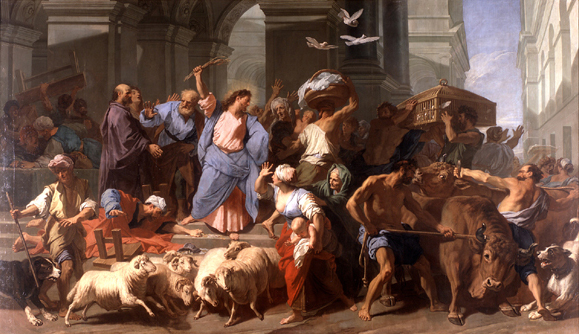
Jesus, who was known for his meekness and gentleness—all the way to the cross—did not engage in “violence” in the Temple courts. There is no record of anyone being hurt or injured, and in contrast to some of the ancient Israelite prophets like Moses, Joshua, or Samuel, Jesus did not put anyone to death in the name of the Lord. Obviously, he used a whip—not a sword—because his design was to clear the area, not to hurt anyone. This is hardly “violence” according to the standards of the Hebrew Scriptures. In fact, it’s unlikely he used a whip to drive people out; rather, the whip was used to drive out the animals.

It is interesting to note that Mahatma Gandhi and Dr. Martin Luther King Jr.—the two twentieth-century leaders best known for putting the principle of nonviolent resistance into practice—both learned this principle from Jesus. He was the ultimate example of a totally nonviolent man involved in radical action and change. The witness of the New Testament is very clear on this, even pointing out that Jesus fulfilled the words of Isaiah 42:1–4:

Here is my servant whom I have chosen,

the one I love, in whom I delight;

I will put my Spirit on him,

and he will proclaim justice to the nations.

He will not quarrel or cry out;

no one will hear his voice in the streets.

A bruised reed he will not break,

and a smoldering wick he will not snuff out,

till he leads justice to victory.

In his name the nations will put their hope.

Matthew 12:18–21

This is hardly the picture of a violent individual!

The specific question being raised here, however, does not have to do with the whole of Yeshua’s life but rather with his driving out the money changers from the Temple. Was not this an act of violence?

Let’s first consider what the Tanakh means by “violence” (Hebrew, hamas), since Isaiah 53:9b specifically states that the servant did no hamas. What exactly does this mean? The Hebrew noun hamas, “violence,” occurs sixty times in the Hebrew Bible, along with eight occurrences of the verb h-m-s, “to act violently, do violence.” What kind of actions are called “violent”? Actions such as murder, bloodshed, and robbery are, quite clearly, acts of violence, and the subject of Isaiah 53, as stated explicitly in verse 9, could not have committed any such acts. In keeping with this and true to his character, Jesus did not murder or shed blood, neither did he strike, hurt, rob, or assault anyone at any time, nor did he allow his followers to do so. In fact, when the Temple guards came to take him away by force in the middle of the night, his overzealous disciple Peter struck one of those guards, cutting off his ear. But Jesus rebuked him for his violence, telling him to put his sword away—before healing the man’s ear (John 18:10–11; see also Matt. 26:52, where the Messiah taught that “all who draw the sword will die by the sword”).

As for Yeshua’s controversial actions in the Temple, the text is clear: He made a whip of cords, drove out the sheep and cattle with that whip, overturned the money tables, scattered the coins, and ordered the money changers to get out, exclaiming, “Get these out of here! How dare you turn my Father’s house into a market!… It is written… ‘My house will be called a house of prayer,’ but you are making it a ‘den of robbers’ ” (John 2:16; Matt. 21:13). This is hardly “violence”!

It is understandable that some have failed to read the varied accounts in the four Gospels carefully and therefore have failed to put together the fact that John 2 mentions Jesus making a whip of cords (with which he drove out the sheep and cattle) while Matthew 21, Mark 11, and Luke 19 mention that he drove out the people selling. But the whip was for the animals; sharp words of rebuke were for the people. It is interesting that all four Gospels speak of this event (some believe it was actually two separate events), which indicates the great importance attached to the Messiah’s prophetic actions in the Temple.155 He was cleaning out his Father’s house, and it was a praiseworthy deed motivated by zeal for God and the work of God (see John 2:17). We should also point out that none of the Gospels record a single word of criticism from the Jewish leadership for Jesus’ actions here, even when false witnesses were being brought to slander and attack him (Matt. 26:59–61). Not a word about this incident was spoken by any of his accusers—obviously because there was nothing worth mentioning. (None of the Rabbinic literature mentions this incident either, despite the fact that there are some ugly attacks on Yeshua in that literature. See vol. 1, pp. 136–39, for more on these anti-Jesus hostilities.)

Returning again to the specific nature of hamas, “violence,” in the Tanakh, we must remember that Moses, Joshua, David, Samuel, and other great leaders put people to death at God’s command, yet they were not called “violent” because of their deeds. That is because hamas speaks of illegal violent acts, as opposed to simply carrying out God’s righteous judgments against sinners. Thus, when Moses called on the Levites to put their fellow Israelites to death for their idolatry, they were not committing violence (Exod. 32:25–28); when Joshua killed the five Canaanite kings, he was not committing violence (Josh. 10:16–27), nor was Samuel when he chopped up the Amalekite king, Agag (1 Sam. 15:32–33). How then could anyone say Jesus acted violently when he drove out animals with a whip and overturned the tables of money changers? This is certainly not violence!

What I find most ironic is that anti-missionaries say Isaiah 53 cannot possibly apply to Yeshua because of his alleged violence in cleansing the Temple, yet they freely apply Isaiah 53 to the nation of Israel (or the righteous remnant within Israel; see above, 4.6). Yet our people have been at their most heroic historically when they have used armed, forceful resistance against their adversaries—be it the warring Maccabees in the second century C.E., the courageous fighters of the Warsaw Ghetto uprising during the Holocaust, or the Israeli Defense Forces (IDF) who recaptured the Golan in 1973. We commend our people for heroic acts of war! How then can we apply Isaiah 53 to Israel—as a nonviolent people—while disqualifying Yeshua, the greatest example of nonviolence the world has ever known? Obviously, we cannot.

[1]


155 For discussion of the various Gospel accounts of this incident (whether there was one cleansing of the Temple or two), cf. the standard evangelical commentaries on the Synoptics and John.

[1]Brown, M. L. (2003). Answering Jewish objections to Jesus, Volume 3: Messianic prophecy objections (77). Grand Rapids, Mich.: Baker Books.
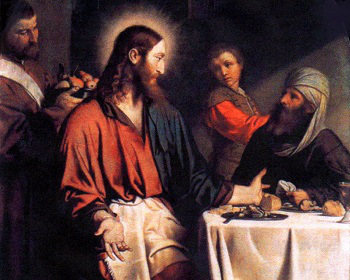
Isaiah 53 cannot refer to Jesus because it says no one was interested in the servant of the Lord

Isaiah 53 cannot refer to Jesus because it says no one was interested in the servant of the Lord or attracted to him, yet the New Testament records that large crowds followed Jesus.

Actually, the New Testament record agrees with the picture of the servant of the Lord described in Isaiah 53, despite the fact that great crowds did follow Jesus at numerous times during his ministry. This is because he spent most of his life almost unknown, and then once he became popular, he became the center of controversy and was vehemently rejected by many religious teachers and influential leaders, ultimately dying a criminal’s death on the cross. This is certainly in harmony with Isaiah 53.

At first glance, this objection might seem odd. After all, wasn’t Jesus rejected by his own people, and didn’t he die a horrific, humiliating death on the cross? Doesn’t he clearly fulfill the image of the suffering servant of the Lord described in Isaiah 53? And don’t the anti-missionaries sometimes claim that the authors of the New Testament made up details about the life of Jesus in order to give the impression that he was fulfilling Messianic prophecies? How then can they claim that the picture of Yeshua painted by the writers of the Gospels actually contradicts the words of the prophets?

Obviously, there is something self-contradictory in these two objections: arguing on the one hand that Yeshua, as described in the New Testament, did not fulfill the Messianic prophecies, while arguing on the other hand that the very same New Testament gives a false picture of Yeshua in order to make it appear that he fulfilled those very same prophecies. I address this contradiction directly in vol. 4, 5.14. For now, however, we will simply deal with the objection raised here, an objection based on the fact that the Gospels record that great crowds often followed Jesus, whereas Isaiah prophesied that he would be despised, rejected, and unpopular.

The key relevant verses in Isaiah 52:13–53:12 of the servant of the Lord are these:

Just as there were many who were appalled at him—

his appearance was so disfigured beyond that of any man

and his form marred beyond human likeness …

He grew up before him like a tender shoot,

and like a root out of dry ground.

He had no beauty or majesty to attract us to him,

nothing in his appearance that we should desire him.

He was despised and rejected by men,

a man of sorrows, and familiar with suffering.

Like one from whom men hide their faces

he was despised, and we esteemed him not.

Surely he took up our infirmities

and carried our sorrows,

yet we considered him stricken by God,

smitten by him, and afflicted.

Isaiah 52:14; 53:2–4

Isn’t this picture contradicted by New Testament passages stating that “large crowds” followed Jesus? Verses such as these are fairly common: “Large crowds from Galilee, the Decapolis, Jerusalem, Judea and the region across the Jordan followed him… . When he came down from the mountainside, large crowds followed him… . Such large crowds gathered around him that he got into a boat and sat in it, while all the people stood on the shore” (Matt. 4:25; 8:1; 13:2; see also Matt. 19:2; Luke 14:25, among other passages). How does this agree with the verses from Isaiah, just cited, that say “he had no beauty or majesty to attract us to him” and “he was despised and rejected by men”?

Let’s examine these verses in greater detail, without twisting anything, rewriting anything, or taking anything out of context. What does the text actually say? It begins with the servant’s humble, inauspicious origins: “He grew up before him like a tender shoot, and like a root out of dry ground. He had no beauty or majesty to attract us to him, nothing in his appearance that we should desire him” (Isa. 53:2–3). This agrees well with the humble, inauspicious origins of Jesus. He was raised by (apparently) poor parents in Nazareth,143 his foster father, Joseph, was a carpenter, and there is only one mention of Jesus doing anything of prominence in his first thirty years of life (Luke 2:41–51; 3:23a). Truly, he grew up like a tender shoot, like a root out of dry ground, and when he began his public ministry, those who knew him were taken aback: “ ‘Isn’t this the carpenter’s son? Isn’t his mother’s name Miriam, and aren’t his brothers Jacob, Joseph, Simon and Judah? Aren’t all his sisters with us? Where then did this man get all these things?’ And they took offense at him” (Matt. 13:55–57 NIV, with Hebraized names).

The fact that Jesus hailed from Nazareth in Galilee also raised some eyebrows. When Nathaniel, who became one of the Messiah’s followers, was introduced to “Jesus of Nazareth,” he exclaimed, “Nazareth! Can anything good come from there?” (John 1:45–46). And when the religious leaders heard talk about Jesus being the Messiah, some of them protested asking, “How can the [Messiah] come from Galilee?” and again, “Look into it, and you will find that a prophet [or the Prophet] does not come out of Galilee” (John 7:41, 52).

The prophet Isaiah stated, “he had no beauty or majesty to attract us to him, nothing in his appearance that we should desire him” (53:2b), and this too accords well with the Gospel witness, since there is not a single reference to Yeshua’s having a stately appearance or imposing physical presence. This is in clear contrast with the descriptions of some of Israel’s leaders of old, men like Saul, who was head and shoulders above his people in height (1 Sam. 10:23), or David, who was “ruddy, with a fine appearance and handsome features” (1 Sam. 16:12b). Nothing like this is said of Yeshua!

Isaiah also stated that the servant of the Lord was “despised and rejected by men,” something that very accurately describes the ministry of Jesus. No sooner did he preach his inaugural message in the synagogue in Capernaum than some of the people tried to kill him (Luke 4:16–30). Such murderous plots against Jesus followed him wherever he went—because of both his teachings and his miracles—right up to the time of his betrayal and crucifixion (see, e.g., Mark 3:1–6; Luke 22:47–71). Religious leaders accused him of being a demon-possessed Samaritan and of healing the sick by satanic power (John 8:48; Matt. 12:22–24). This certainly qualifies as being “despised and rejected,” especially when you realize that the rejection followed him more closely than the crowds did!

And there was something else about these crowds: They were fickle! For example, John 6:2 records that “a great crowd of people followed him because they saw the miraculous signs he had performed on the sick.” But by the end of the chapter, after hearing him teach some hard things, it is written that “many of his disciples turned back and no longer followed him” (John 6:66). In fact, it was common for Jesus to present a hard teaching to the big crowds that followed him in order to expose their hypocrisy and the shallowness of their commitment (see Luke 14:25–34). That’s why it is no surprise that one day great crowds could shout, “Crown him! Crown him!” when he entered Jerusalem and then shout “Crucify him! Crucify him!” only a few days later. As Christian leader Dan Harman pointed out, “So long as Jesus was misunderstood He was followed by the crowd. When they came to really understand Him, they crucified Him.”144

It is the graphic portrait of a crucified Messiah that Isaiah so powerfully describes: “His appearance was so disfigured beyond that of any man and his form marred beyond human likeness” (Isa. 52:14b)—the result of the savage beating he endured before his crucifixion (Matt. 26:67; 27:26–30); “we considered him stricken by God, smitten by him, and afflicted” (Isa. 53:4b)—as he hung on the cross dying a criminal’s death; he was pierced and crushed and punished and wounded (Isa. 53:5). “He was oppressed and afflicted, … led like a lamb to the slaughter, … cut off from the land of the living; … he poured out his life unto death, and was numbered with the transgressors” (see Isa. 53:7–8, 12). How could the picture be any clearer? Only transgressors were flogged and nailed to a cross. Jesus was numbered among them!(See 4.12, below.)

It should be perfectly clear, then, to any unbiased reader of the text that Isaiah 53 accurately describes the life, ministry, and sufferings of Jesus the Messiah. Go back and read the chapter again for yourself, or ask a Jewish friend who is unfamiliar with this chapter to read it and then ask him or her, “Who does this describe?” You might be surprised with the response.145

[1]


143 Cf. Luke 2:22–24 with Leviticus 12:8.

144 The original source of this quote is unknown to me.

145 It is fair to ask a follower of the late Lubavitcher Rebbe, Menchaem Schneerson, hailed by many of his followers as the Messiah, how the picture of Isaiah 53 correlates with his life, since his disciples pointed to this very passage of Scripture when he suffered a debilitating stroke in 1992 at the age of ninety. He had several hundred thousand devotees around the world and was considered by his people to be the most influential Jewish leader of the twentieth century. Can’t the same objection raised here against Jesus—incorrectly so, as we have seen—also be raised against the Rebbe? Yet anti-missionaries in his camp use this objection against Yeshua!

[1]Brown, M. L. (2003). Answering Jewish objections to Jesus, Volume 3: Messianic prophecy objections (67). Grand Rapids, Mich.: Baker Books.

If Jesus is the Jewish Messiah, why don’t more Jews believe in him? | Brown, M. L

If Jesus is the Jewish Messiah, why don’t more Jews believe in him?

Actually, there are tens of thousands of Jews who have believed and do believe in him. The problem is that most Jews have not bothered to check into the facts about Jesus, and the only Jesus most of them know is either the baby Jesus of Christmas, an emaciated figure hanging on a cross in churches, or the Jesus of the Crusades and Inquisitions. The question is, Why don’t you believe Jesus is the Messiah? Do you really know who he is?

I encourage you to consider the following points.

1. Most Jews have never seriously studied the issue. Many of those who have decided to find out who Jesus is have been quite surprised by what they have learned. The greatest scholars and scientists in the world once believed the earth was flat—until firsthand investigation and discovery altered their outlook. It’s the exact same thing with Jews who honestly investigate the Messianic claims of Jesus. Everything changes—to put it mildly.

2. If most religious Jews learn anything about Jesus in their traditional studies, it is quite biased and negative. 22 Thus, they do not entertain even the possibility of the messiahship of Jesus.

3. Many so-called Christians have committed atrocities against Jews in the name of Jesus, helping to drive Jews away from their true Messiah. (See below, 2.7, for more on this, along with my book Our Hands Are Stained with Blood.)

4. These same Christians have often put forth a distorted picture of Jesus that bears little resemblance to the real Messiah who walked the earth two thousand years ago. Can Jews be blamed for thinking that Christians worshiped idols when the churches were filled with worshipers bowing before large, beautiful statues depicting Jesus as a babe in his mother’s lap?

5. There is often great pressure on those Jews—especially religious Jews—who put their faith in Jesus the Messiah. Some succumb to the fear, the pressure, the intimidation, the separation, and the loneliness, and they deny with their lips what they know to be true in their hearts.

6. Traditional Jewish teaching gives a slanted portrayal of who the Messiah is and what he will do. Since the description is faulty, people are looking in the wrong direction for the wrong person. No wonder relatively few have found him.

7. Once a learned Jew does believe in Yeshua, he is discredited, and so his name is virtually removed from the rolls of history. It’s almost as if such people ceased to exist. (Do you remember reading the novel Animal Farm in school? Revisionist history goes on to this day—even in traditional Jewish circles.) The story of Max Wertheimer provides one case in point. In the last century, Wertheimer came to the States as an Orthodox Jew, but over the course of time, he became a Reform Jew and was ordained a rabbi upon graduating from Hebrew Union College in Cincinnati in 1889. (He also received a Ph.D. from the University of Cincinnati the same year.) He then served as the greatly loved rabbi of B’Nai Yeshurun synagogue in Dayton, Ohio, for the next ten years. When he became a fervent believer in Jesus, however, pastoring a church as well, his name was literally removed from the rolls of the school—a school of alleged tolerance at that. Why was his name dropped? According to Alfred A. Isaacs, cited in the November 25, 1955, edition of the National Jewish Post, Wertheimer was disowned by Hebrew Union College solely because of his Christian faith. 23 And to think, this happened in a “liberal” Reform Jewish institution!

8. Although this may be hard for you to accept, because our leadership rejected Jesus the Messiah when he came, God judged us as a people (just as he judged us as a people for rejecting his law and his prophets in previous generations), and as a result, our hearts have become especially hardened toward the concept of Jesus as Messiah. 24 Paul explained this in his important letter to the believers in Rome: “What Israel sought so earnestly it did not obtain, but the elect did. The others were hardened, as it is written: ‘God gave them a spirit of stupor, eyes so that they could not see and ears so that they could not hear, to this very day’ ” (Rom. 11:7–8; the quote here is taken from Deut. 29:4 in our Torah and Isa. 29:10 in our Prophets).

If you stop to think about it, isn’t it strange that as a people we have almost totally lost sight of the fact that Jesus-Yeshua is one of us, actually, the most influential Jew ever to walk the earth? 25 Yet most of us think of him as if he were some fair-skinned, blue-eyed European. The good news is that Israel’s hardening was only partial: There have always been Jews who followed Jesus the Messiah, and in the end, our people will turn back to him on a national scale. Paul explains this a few verses later:

I do not want you [Gentiles] to be ignorant of this mystery, brothers, so that you may not be conceited: Israel has experienced a hardening in part until the full number of the Gentiles has come in. And so all Israel will be saved, as it is written: “The deliverer will come from Zion; he will turn godlessness away from Jacob. And this is my covenant with them when I take away their sins.”

Romans 11:25–27; the quote is taken from Isaiah 59:20–21; 27:9; and Jeremiah 31:33–34, all in our Prophets

Hopefully, you will be one of those Jews who is determined to find out the truth about the Messiah right now, determining to follow him at any cost. In the end, you must decide for yourself, and the bottom line question is one that only you can answer: Why don’t you believe Jesus is our promised Messiah?

What if more Jews—including your rabbi—did believe in him? Would you? Of course, that wouldn’t change the facts. Either Jesus is or is not the Messiah of Israel. Public opinion can’t affect the truth. But many times, when people find out that it’s okay to hold to a certain opinion, they come out of the closet.

Maybe it would help you to know that many of us in Jewish work have spoken with Orthodox and even ultra-Orthodox Jews who have told us in private that they believe Jesus is the Messiah, but they are afraid to go public for fear of what could happen to them. Maybe if a number of these religious Jews—some of whom are rabbis—showed up one day on your doorstep and told you their views, it would get you to think seriously about the matter.

As we grow and mature—from infants to children to teens to adults—we find out that not everything we have been told is true. Sometimes we just have to learn for ourselves. And even as adults, we often have skewed perspectives on many things. Just look at what Democrats believe about Republicans (and vice versa) or what Palestinians believe about Israelis (and vice versa) or what Black Muslims believe about Jews (and vice versa). Our perspectives, opinions, and convictions are not always right—no matter how strenuously we argue for our position. Common sense tells us that all of us can’t be right about everything all the time.

Even on an interpersonal level, how often have you met someone only to find out that all the bad things you heard about that person were greatly exaggerated or false? It happens all the time. As for the matter at hand, I assure you in the strongest possible terms: As a Jew, most everything you have heard about Jesus has been untrue. You owe it to yourself to find out just who this Jesus really is—and I say this to you whether you are an ultra-Orthodox rabbi reading this book in secret or you are a thoroughly secular, wealthy Jewish businessman who was given this book by a friend.

This much is certain: We have carefully investigated the claims of Jesus and can testify firsthand that Yeshua is who he said he was. What do you say?

[1]


22 The infamous Rabbinic collection of anti-Jesus fables, called Toledot Yeshu, is still studied in some ultra-Orthodox circles, although virtually all other Jewish scholars have long since repudiated the Toledot. These scurrilous writings, based in part on some Talmudic references, accusing Mary of fathering Jesus through a Roman soldier (or by rape), and portraying Jesus as an idolater, magician, and Israel’s arch-deceiver, were the primary source of information about Jesus for many traditional Jews, especially in the Middle Ages. Of course, as noted by the Oxford Dictionary of Jewish Religion, ed. Geoffrey Wigoder (New York: Oxford, 1997), 695, “the work is an expression of vulgar polemics written in reaction to the no less vulgar attacks on Judaism in popular Christian teaching and writing.” But as I have stated before, just as many Gentiles around the world have had a biased and inaccurate view of the Jewish people, so also have many Jews had a biased and inaccurate view of Jesus, the Jewish Messiah. For a representative sampling from the Toledot, see the excellent study of Walter Riggans, Yeshua ben David: Why Do the Jewish People Reject Jesus as Their Messiah? (Crowborough, England: Marc, 1995), 127–32. Interested readers of this present volume would do well to read Riggans as well.

23 For more on this, see Nahum Brodt, “The Truth about the Rabbi,” in Would I? Would You?, ed. Henry and Marie Einspruch (Baltimore: Lederer, 1970), 8–10. For a fuller account of Wertheimer’s faith, see Jacob Gartenhaus, Famous Hebrew Christians (Grand Rapids: Baker, 1979), 191–97.

24 This is not the first time in our history that God has hardened our hearts because we sinned against him. This is what God said to the prophet Isaiah more than twenty-five hundred years ago: “Go and tell this people: ‘Be ever hearing, but never understanding; be ever seeing, but never perceiving.’ Make the heart of this people calloused; make their ears dull and close their eyes. Otherwise they might see with their eyes, hear with their ears, understand with their hearts, and turn and be healed” (Isa. 6:9–10). The prophet was actually called to a ministry of hardening his people’s hearts! It was as if God were saying, “Fine. If you want to be hard-hearted, refusing to believe me or obey me, I will give you over to your hardness and make you even harder.” This is exactly what has happened to us regarding the Messiah: When so many of our people refused to follow him, God gave us over to our unbelief and obduracy to the point that through the centuries, we have become especially resistant to Jesus.

25 This well-known, anonymous tribute to Jesus, known as “One Solitary Life,” puts things in perspective: “He was born in an obscure village. He worked in a carpenter shop until He was thirty. He then became an itinerant preacher. He never held an office. He never had a family or owned a house. He didn’t go to college. He had no credentials but himself. He was only thirty-three when the public turned against him. His friends ran away. He was turned over to his enemies and went through the mockery of a trail. He was nailed to a cross between two thieves. While he was dying, his executioners gambled for his clothing, the only property he had on earth. He was laid in a borrowed grave. Nineteen centuries have come and gone, and today he is the central figure of the human race. All the armies that ever marched, all the navies that ever sailed, all the parliaments that ever sat, and all the kings that ever reigned have not affected the life of man on this earth as much as that one solitary life.”

[1]Brown, M. L. (2000). Answering Jewish objections to Jesus, Volume 1: General and historical objections. (21). Grand Rapids, Mich.: Baker Books.

Exit mobile version