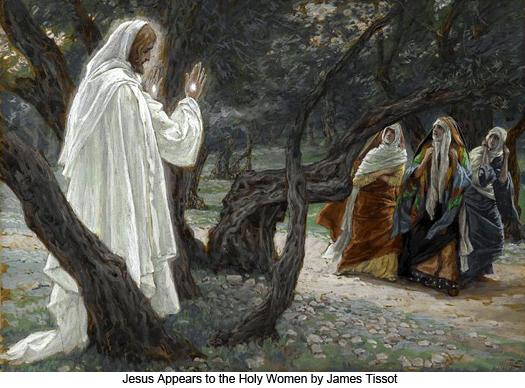
To whom did Christ appear first, the women or His disciples? MATTHEW 28:9

MATTHEW 28:9—To whom did Christ appear first, the women or His disciples?

PROBLEM: Both Matthew and Mark list women as the first ones to see the resurrected Christ. Mark says, “He appeared first to Mary Magdalene” (16:9). But Paul lists Peter (Cephas) as the first one to see Christ after His resurrection (1 Cor. 15:5).

SOLUTION: Jesus appeared first to Mary Magdalene, then to the other women, and then to Peter. The order of the twelve appearances of Christ goes as follows:

THE ORDER OF THE TWELVE APPEARANCES OF CHRIST

PERSON(S)

SAW

HEARD

TOUCHED

OTHER EVIDENCE

1.

Mary
(John 20:10–18)

X

X

X

Empty tomb

2.

Mary & Women
(Matt. 28:1–10)

X

X

X

Empty tomb

3.

Peter
(1 Cor. 15:5)

X

X*

Empty tomb, Clothes

4.

Two Disciples
(Luke 24:13–35)

X

X

Ate with Him

5.

Ten Apostles
(Luke 24:36–49; John 20:19–23)

X

X

X**

Saw wounds, Ate food

6.

Eleven Apostles
(John 20:24–31)

X

X

X**

Saw wounds

7.

Seven Apostles
(John 21)

X

X

Ate food

8.

All Apostles
(Matt. 28:16–20; Mark 16:14–18)

X

X

9.

500 Brethren
(1 Cor. 15:6)

X

X*

10.

James
(1 Cor. 15:7)

X

X*

11.

All Apostles
(Acts 1:4–8)

X

X

Ate with Him

12.

Paul
(Acts 9:1–9; 1 Cor. 15:8)

X

X

Paul was not giving a complete list, but only the important one for his purpose. Since only men’s testimony was considered legal or official in the 1st century, it is understandable that the apostle would not list the women in his defense of the resurrection here.

[1]


* Implied

** Offered Himself to be touched

** Offered Himself to be touched

* Implied

* Implied

[1]Geisler, N. L., & Howe, T. A. (1992). When critics ask : A popular handbook on Bible difficulties (365). Wheaton, Ill.: Victor Books.


Is Jesus advocating pacifism and denouncing capital punishment in this passage? MATTHEW 26:52

MATTHEW 26:52—Is Jesus advocating pacifism and denouncing capital punishment in this passage?

PROBLEM: When the soldiers came to arrest Jesus, Peter took out his sword and cut off the ear of the high priest’s servant. Jesus told Peter to put back the sword because those who take up the sword will die by the sword. Some use this verse to support pacifism and to oppose capital punishment, which the Bible affirms elsewhere (Gen. 9:6).

SOLUTION: Total pacifism is not taught in this Scripture. Indeed, Abraham was blessed by the Most High God (Gen 14:19) after engaging in a war against the unjust aggression of the kings who had captured his nephew Lot. In Luke 3:14, soldiers come to inquire of John the Baptist about what they should do. John never told them to leave the army. Likewise, Cornelius, in Acts 10, was a centurion. He was called a devout man (v. 2), and the Scriptures say that the Lord heard the prayers of Cornelius (v. 4). When Cornelius becomes a Christian, Peter does not tell him to leave the army. Also, in Luke 22:36–38, Christ says that the one who has no sword should sell his robe and buy one. The apostles responded saying that they had two swords. Jesus responded saying that “it was enough.” In other words, they did not need to get rid of their swords. The Apostle Paul accepted the protection of the Roman army to save his life from unjust aggressors (Acts 23). Indeed, he reminded the Roman Christians that God had given the sword to the king who did not bear it in vain (Rom. 13:1–4). When Jesus returns to earth, He will come with the armies of heaven and will war against the kings of the earth (Rev. 19:11–19). So, from the beginning to the end, the Bible is filled with examples of the justification of war against evil aggressors.

What, then, did Jesus mean when He commanded Peter to put away his sword? Peter was making two mistakes in using his sword. First, while the Bible permits the sword by the government for civil purposes (Rom. 13:1–4), it does not endorse its use for spiritual ends. It is to be used by the state, not by the church. Second, Peter’s use was aggressive, not purely defensive. His life was not being unjustly threatened. That is, it was not clearly an act of self-defense (Ex. 22:2). Jesus appears to have endorsed the use of the sword in civil self-defense (Luke 22:36), as did the Apostle Paul (Acts 23).

Likewise, capital punishment is not forbidden in Scripture, but rather was established by God. Genesis 9:6 affirms that whoever sheds man’s blood, the blood of the killer will also be shed. Numbers 35:31 makes a similar statement. In the NT, Jesus recognized that Rome had capital authority and submitted to it (John 19:11). The Apostle Paul informed the Romans that governing authorities are ministers of God and that they still possessed the God-given sword of capital authority (13:1, 4). So Jesus in no way did away with the just use of the sword by civil authorities. He simply noted that those who live lives of aggression often die by the same means.

[1]


[1]Geisler, N. L., & Howe, T. A. (1992). When critics ask : A popular handbook on Bible difficulties (360). Wheaton, Ill.: Victor Books.

Was Jesus always present with His disciples? MATTHEW 26:11

MATTHEW 26:11—Was Jesus always present with His disciples?

PROBLEM: According to Jesus’ statement here, He would not always be with the disciples, for He said: “but Me you do not have always” with you. On the other hand, in Matthew 28:20 Jesus said, “Lo, I am with you always, even to the end of the age.”

SOLUTION: In the first passage, Jesus was speaking of His physical presence (which would not be with them between His ascension and second coming), and, in the later text, He is referring to His spiritual presence with them as they preached the Gospel in all the world. There is no contradiction here whatsoever.

Geisler, N. L., & Howe, T. A. (1992). When critics ask : A popular handbook on Bible difficulties (359). Wheaton, Ill.: Victor Books.

Did Jesus err by affirming that the signs of the end time would be fulfilled in His era? MATTHEW 24:34

MATTHEW 24:34—Did Jesus err by affirming that the signs of the end time would be fulfilled in His era?

PROBLEM: Jesus spoke of signs and wonders regarding His second coming. But Jesus said “this generation” would not end before all these events took place. Did this mean that these events would occur in the lifetime of His hearers?

SOLUTION: These events (e.g., the Great Tribulation, the sign of Christ’s return, and the end of the age) did not occur in the lifetime of Christ’s hearers. Therefore, it is reasonable to understand their fulfillment as something yet to come. This calls for a closer examination of the meaning of “generation” for meanings other than that of Jesus’ contemporaries.

First, “generation” in Greek (genea) can mean “race.” In this particular instance, Jesus’ statement could mean that the Jewish race would not pass away until all things are fulfilled. Since there were many promises to Israel, including the eternal inheritance of the land of Palestine (Gen. 12; 14–15; 17) and the Davidic kingdom (2 Sam. 7), then Jesus could be referring to God’s preservation of the nation of Israel in order to fulfill His promises to them. Indeed, Paul speaks of a future of the nation of Israel when they will be reinstated in God’s covenantal promises (Rom. 11:11–26). And Jesus’ response to His disciples’ last question implied there would yet be a future kingdom for Israel, when they asked: “Lord, will You at this time restore the kingdom to Israel?” Rather than rebuking them for their misunderstanding, He replied that “It is not for you to know times or seasons which the Father has put in His own authority” (Acts 1:6–7). Indeed, Paul in Romans 11 speaks of the nation of Israel being restored to God’s promised blessings (cf. vv. 25–26).

Second, “generation” could also refer to a generation in its commonly understood sense of the people alive at the time indicated. In this case, “generation” would refer to the group of people who are alive when these things come to pass in the future. In other words, the generation alive when these things (the abomination of desolation [v.15], the great tribulation such as has never been seen before [v. 21], the sign of the Son of Man in heaven [v. 30], etc.) begin to come to pass will still be alive when these judgments are completed. Since it is commonly believed that the tribulation is a period of some seven years (Dan. 9:27; cf. Rev. 11:2) at the end of the age, then Jesus would be saying that “this generation” alive at the beginning of the tribulation will still be alive at the end of it. In any event, there is no reason to assume that Jesus made the obviously false assertion that the world would come to an end within the lifetime of His contemporaries.

[1]


[1]Geisler, N. L., & Howe, T. A. (1992). When critics ask : A popular handbook on Bible difficulties (358). Wheaton, Ill.: Victor Books.

Did Christ come to earth immediately following the Tribulation or sometime later? MATTHEW 24:29

MATTHEW 24:29—Did Christ come to earth immediately following the Tribulation or sometime later?

PROBLEM: In Matthew, Jesus represents His coming as “immediately after” (24:29) the Great Tribulation. But Luke seems to separate it by the “times of the Gentiles” (Luke 21:24, 27).

SOLUTION: The interval referred to by Luke is the time between the destruction of Jerusalem (a.d. 70), which began God’s judgment on Jerusalem (cf. Matt. 24:2), and the return of Christ to earth “with power and great glory” (Matt. 24:30). So, when Matthew affirms that Christ’s coming is “immediately after the tribulation of those days” (24:29), he is referring to the end of the “times of the Gentiles” mentioned by Luke (21:24). Hence, there is no irresolvable conflict between the two accounts.

Geisler, N. L., & Howe, T. A. (1992). When critics ask : A popular handbook on Bible difficulties (358). Wheaton, Ill.: Victor Books.

Did Jesus make a mistake in referring to Zechariah the son of Jehoiada rather than to Zechariah the son of Berechiah? MATTHEW 23:34–35

MATTHEW 23:34–35—Did Jesus make a mistake in referring to Zechariah the son of Jehoiada rather than to Zechariah the son of Berechiah?

[button color=”red” size=”big” link=”https://www.facebook.com/difa3iat” target=”blank” ]إضغط هنا[/button]

PROBLEM: Jesus said to the scribes and Pharisees that the guilt of all the righteous blood from Abel to Zechariah will fall on them. Concerning Zechariah, Jesus said he was killed between the sanctuary and the altar. Some conclude that the Zechariah referred to by Christ is the son of Jehoiada (2 Chron. 24:20–22).

SOLUTION: The Zechariah referred to has to be the son of Berechiah. This Zechariah is one of the minor prophets, and his father is listed as Berechiah (Zech. 1:1). He would be the most likely candidate because the other Zechariah (son of Jehoiada) died about 800 b.c. If one thinks Christ referred to this Zechariah, then the time span from Abel to this Zechariah would not cover the OT period, which extended to 400 b.c. Abel to Zechariah the son of Berechiah would make a much better sweep of the OT period than would the period from Abel to Zechariah the son of Jehoiada. Since many Zechariahs are mentioned in the OT, it would not be too difficult to imagine two Zechariahs dying from similar circumstances.

[1]


[1]Geisler, N. L., & Howe, T. A. (1992). When critics ask : A popular handbook on Bible difficulties (357). Wheaton, Ill.: Victor Books.

Why did Jesus call people fools and yet condemn others for doing the same thing? MATTHEW 23:17

MATTHEW 23:17—Why did Jesus call people fools and yet condemn others for doing the same thing?

PROBLEM: Jesus said, “whoever says [to his brother], `You fool!’ shall be in danger of hell fire” (Matt. 5:22). Yet He Himself said to the scribes and Pharisees, “Fools and blind!” (Matt. 23:17) The Apostle Paul, following suit, said, “O foolish Galatians” (Gal. 3:1; cf. 1 Cor. 15:36).

SOLUTION: There are good reasons why there is a strong difference between the two uses of the term “fool.” First, this is another example of the principle that the same word can be used with different meanings in different contexts (see Introduction). For instance, the word “dog” can be used of a canine animal or a detested person.

Second, in Matthew 5, it is used in the context of someone who is “angry” with his brother, indicating a hatred. Neither Jesus nor Paul harbored hatred toward those to whom they applied the term. Thus, their use of the term “fool” does not violate Jesus’ prohibition against calling others a fool.

Third, technically speaking, Jesus only commanded that a “brother” (Matt. 5:22) not be called a “fool,” not an unbeliever. In fact the scriptural description of a fool is one who “has said in his heart, `There is no God’ ” (Ps. 14:1). In view of this, one can see the seriousness of calling a brother a fool; it is tantamount to calling him an unbeliever. Hence, when He who “knew what was in man” (cf. John 2:25) called unbelievers “fools,” it was a most appropriate description of what they really were.

[1]


[1]Geisler, N. L., & Howe, T. A. (1992). When critics ask : A popular handbook on Bible difficulties (357). Wheaton, Ill.: Victor Books.

Does Jesus want us to love ourself first or others? MATTHEW 22:39

MATTHEW 22:39—Does Jesus want us to love ourself first or others?


PROBLEM: Jesus says in Matthew that we are to love our neighbor as ourselves. But, if we love ourselves first, before we love our neighbor, then this would be putting self before neighbor. Is Jesus teaching that we should be selfish?

SOLUTION: Loving others as we love ourselves can be understood in different ways, but in no way is Jesus implying that we should be selfish. The Bible condemns “lovers of themselves” (2 Tim. 3:2). It exhorts us not to consider only our own interests, but also the interest of others (Phil. 2:4). There are three ways to understand the phrase, “love others as yourself.”

First, some believe that Jesus is saying that we ought to love others as we ought to love ourselves, namely, unselfishly. This, however, seems far too subtle and dialectical for Jesus’ normally straight-forward moral assertions. It would have been more forthright to simply say do not be selfish than the tangled command of loving oneself unselfishly.

Second, Jesus could have meant that we should love others as we ought to love ourselves, namely, properly. There is a legitimate self-respect or self-love. Ephesians tells us to care for our own bodies, “for no one ever hated his own flesh, but nourishes and cherishes it” (5:28–29). There is nothing wrong with a legitimate self-care and self-respect. The Bible condemns someone for “thinking of himself more highly than he ought,” but urges him to think “soberly” (Rom. 12:3). In this sense, Jesus may be saying love others as you ought to love yourselves.

Third, Jesus could have meant that we should love others as much as we do love ourselves. That is, He might have been saying that we should measure how we ought to love others by how we actually do love ourselves without implying that the way we love ourselves is correct. Rather, God may be simply pointing to love for self as the standard by which we should judge how much to love others. In this way, there would be an automatic check on our selfish love, since we would have to love others this much too.

Geisler, N. L., & Howe, T. A. (1992). When critics ask : A popular handbook on Bible difficulties (355). Wheaton, Ill.: Victor Books.

When was the fig tree cursed by Jesus, before or after the temple was cleansed? MATTHEW 21:12–19 (cf. Mark 11:12–14, 20–24)

MATTHEW 21:12–19 (cf. Mark 11:12–14, 20–24)—When was the fig tree cursed by Jesus, before or after the temple was cleansed?

PROBLEM: Matthew places the cursing of the fig tree after the cleansing of the temple. But Mark places the cursing before the temple was cleansed. But, it cannot be both. Did one Gospel writer make a mistake?

SOLUTION: Jesus actually cursed the fig tree on His way to the temple as Mark said, but this does not mean that Matthew’s account is mistaken. Christ made two trips to the temple, and He cursed the fig tree on His second trip.

Mark 11:11 says that Christ entered the temple the day of His triumphal entry. When Christ enters the temple, Mark does not mention Christ making any proclamations against any wrongdoing. Verse 12 says “Now the next day,” referring to the trip to the fig tree on the way to the temple on the second day. On this day, Christ threw out those buying and selling in the temple. Matthew, however, addresses the two trips of Christ to the temple as though they were one event. This gives the impression that the first day Christ entered the temple He drove out the buyers and sellers as well. Mark’s account, however, gives more detail to the events, revealing that there were actually two trips to the temple. In view of this, we have no reason to believe that there is a discrepancy in the accounts.

[1]


[1]Geisler, N. L., & Howe, T. A. (1992). When critics ask : A popular handbook on Bible difficulties (354). Wheaton, Ill.: Victor Books.

Did Jesus heal the blind man coming into or going out of Jericho? MATTHEW 20:29–34 (cf. Mark 10:46–52; Luke 18:35–43)

MATTHEW 20:29–34 (cf. Mark 10:46–52; Luke 18:35–43)—Did Jesus heal the blind man coming into or going out of Jericho?

PROBLEM: According to Luke, a blind man was healed as Jesus entered the city of Jericho (18:35), but Matthew and Mark declare that the healing took place as Jesus left the city of Jericho. Again, the accounts do not seem to be harmonious.

SOLUTION: Some believe that the healing in Luke may have actually taken place as Jesus left Jericho, claiming that it was only the initial contact that took place as “He was coming near Jericho” (Luke 18:35) and the blind man may have followed Him through the city, since he was continually begging Jesus to heal him (vv. 38–39). But this seems unlikely, since even after the healing (v. 43) the very next verse (19:1) says, “then Jesus entered and passed through Jericho.”

Others respond by noting there were two Jerichos, the old and the new, so that as He went out of one He came into the other.

Still others suggest that these are two different events. Matthew and Mark clearly affirm the healing occurred as Jesus left the city (Matt. 20:29; Mark 10:46). But Luke speaks of healing one blind man as He entered the city. This is supported by the fact that Luke refers only to a “multitude” of people being present as Jesus entered the city (18:36), but both Matthew (20:29) and Mark (10:46) make a point to say there was a “great multitude” of people there by the time Jesus left the city. If the word spread of the miraculous healing on the way into the city, this would account for the swelling of the crowd. It might also explain why two blind men were waiting on the other side of the city to plead for Jesus to heal them. Perhaps the first blind man who was healed went quickly to tell his blind friends what happened to him. Or maybe the other blind men were already stationed at the other end of the city in their customary begging position. At any rate, there is no irresolvable difficulty in the passage. The two accounts can be understood in a completely compatible way.

Geisler, N. L., & Howe, T. A. (1992). When critics ask : A popular handbook on Bible difficulties (353). Wheaton, Ill.: Victor Books.
Exit mobile version