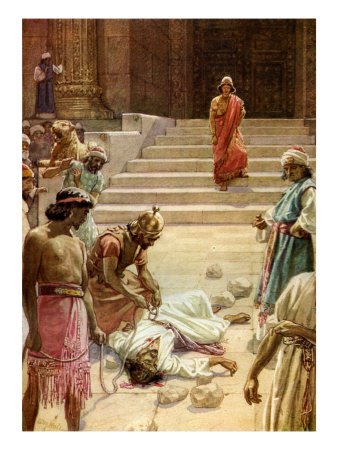
Did Jesus make a mistake in referring to Zechariah the son of Jehoiada rather than to Zechariah the son of Berechiah? MATTHEW 23:34–35

MATTHEW 23:34–35—Did Jesus make a mistake in referring to Zechariah the son of Jehoiada rather than to Zechariah the son of Berechiah?

[button color=”red” size=”big” link=”https://www.facebook.com/difa3iat” target=”blank” ]إضغط هنا[/button]

PROBLEM: Jesus said to the scribes and Pharisees that the guilt of all the righteous blood from Abel to Zechariah will fall on them. Concerning Zechariah, Jesus said he was killed between the sanctuary and the altar. Some conclude that the Zechariah referred to by Christ is the son of Jehoiada (2 Chron. 24:20–22).

SOLUTION: The Zechariah referred to has to be the son of Berechiah. This Zechariah is one of the minor prophets, and his father is listed as Berechiah (Zech. 1:1). He would be the most likely candidate because the other Zechariah (son of Jehoiada) died about 800 b.c. If one thinks Christ referred to this Zechariah, then the time span from Abel to this Zechariah would not cover the OT period, which extended to 400 b.c. Abel to Zechariah the son of Berechiah would make a much better sweep of the OT period than would the period from Abel to Zechariah the son of Jehoiada. Since many Zechariahs are mentioned in the OT, it would not be too difficult to imagine two Zechariahs dying from similar circumstances.

[1]


[1]Geisler, N. L., & Howe, T. A. (1992). When critics ask : A popular handbook on Bible difficulties (357). Wheaton, Ill.: Victor Books.

Did Jesus make a mistake about His disciples seeing the kingdom come in their lifetimes? MATTHEW 16:28

MATTHEW 16:28—Did Jesus make a mistake about His disciples seeing the kingdom come in their lifetimes?

PROBLEM: Jesus told His disciples that some of them would not see death until they saw Him coming in His kingdom. Yet during the life of the apostles, Jesus never returned to set up His kingdom.

SOLUTION: This is a question of when this was going to take place, not whether it would. There are three possible solutions.

First, some have suggested that this may be a reference to the Day of Pentecost where Christ’s Helper, the Holy Spirit, came to descend upon the apostles. In John’s Gospel (14:26), Jesus promised to send the Holy Spirit, and, in the beginning of Acts (1:4–8), He tells them not to leave Jerusalem until they have received the Holy Spirit. But this hardly seems to fit the description of seeing Christ coming in His kingdom (Matt. 16:28).

Second, others believe this might be a reference to the destruction of Jerusalem and the temple in a.d. 70. This would mean that He would return to bring judgment upon the city that rejected Him and crucified Him. While this is a possible explanation, it does not seem to account for the fact that Jesus appears to be coming for believers (those “standing there” with Him), not simply coming in judgment on unbelievers. Nor does the judgment on Jerusalem in a.d. 70 adequately express seeing the “Son of Man coming in His kingdom” (v. 28), a phrase reminiscent of His second coming (cf. 26:64). Nor does it explain why Jesus never appeared in a.d. 70.

A third and more plausible explanation is that this is a reference to the appearance of Christ in His glory on the Mount of Transfiguration which begins in the very next verse (17:1). Here Christ does literally appear in a glorified form, and some of His apostles are there to witness the occasion, namely Peter, James, and John. This transfiguration experience, of course, was only a foretaste of His Second Coming when all believers will see Him come in power and great glory (cf. Acts 1:11; Rev. 1:7).

[1]


[1]Geisler, N. L., & Howe, T. A. (1992). When critics ask : A popular handbook on Bible difficulties (349). Wheaton, Ill.: Victor Books.

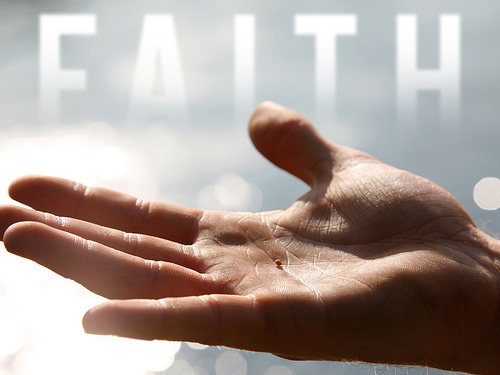
Did Jesus make a mistake when referring to the mustard seed as the smallest of all seeds? MATTHEW 13:31–32

MATTHEW 13:31–32—Did Jesus make a mistake when referring to the mustard seed as the smallest of all seeds?

PROBLEM 1: Jesus said that the mustard seed was “the least of all the seeds.” However, today we know that the mustard seed is not the smallest seed of all. Some think Jesus was speaking of the black mustard seed. But, even this is not the smallest of all seeds.

SOLUTION 1: Jesus was not referring to all the seeds in the world, but only those that a Palestinian farmer sowed in his field. This is made clear by the qualifying phrase “which a man took and sowed in his field” (v. 31). And it is a fact that the mustard seed was the smallest of all seeds which the 1st century Jewish farmer sowed in his field. So there is no contradiction here between science and Scripture. What Jesus said was literally true in the context in which He said it.

PROBLEM 2: Some claim that the mustard seed cannot grow big enough to house birds, let alone grow to tree size.

SOLUTION 2: But this is not so, because there is evidence that some mustard seeds grow into trees about ten feet tall. This would certainly provide enough branch space for a bird to build a nest (Matt. 13:32).

[1]


[1]Geisler, N. L., & Howe, T. A. (1992). When critics ask : A popular handbook on Bible difficulties (345). Wheaton, Ill.: Victor Books.

Exit mobile version