All Names and Titles of Jesus Christ

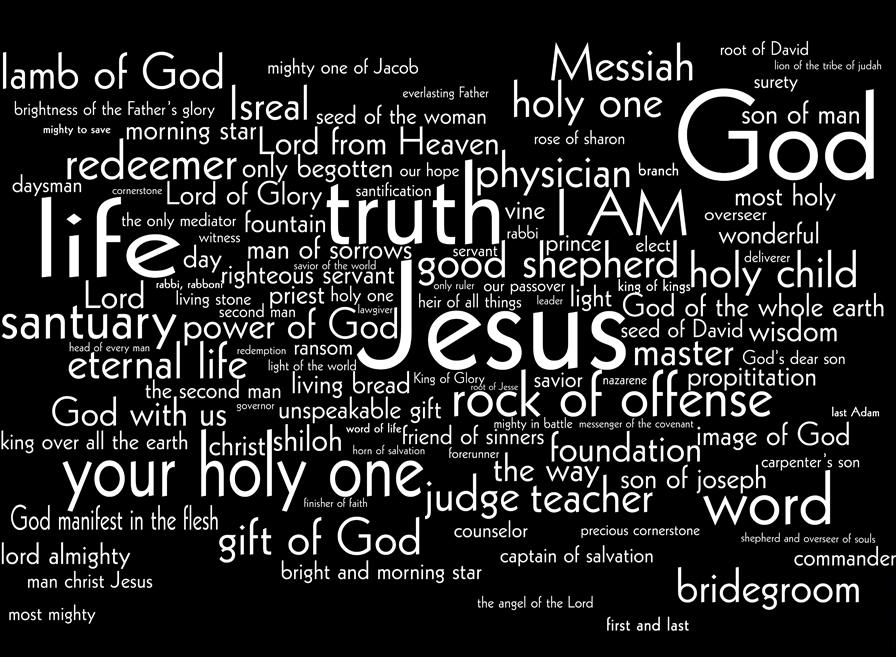
In our culture names serve primarily to distinguish one person from another. In Bible times names had other significant functions. In the New Testament, names that were applied to Jesus often had special meanings that went back into Old Testament and intertestamental times.
“Name” in the Ancient Near East.
Outside Israel knowledge of the name of a god or goddess was important in the performance of magical rites, by which a person could get control of the deity. Benevolent deities would reveal their names and protect or aid their human contacts; unwilling or malevolent deities would be reluctant to reveal their names and thereby come under the control of the magician.
Though it is anachronistic to speak of “secular” Greek, non-Christian Greek literature used “name” in a number of different ways. For example, if a stranger expected hospitality, he first had to indicate to his host what his name was. Philosophers such as Plato attacked the widespread idea that the root meaning of the names of gods or humans revealed their character.
Though Stoicism argued that there was really only one god, it also held that the deity was known by many different names. At the other extreme, the seventeen tractates of the Greco-Egyptian god Hermes Trismegistos argue that he is so lofty that no name is appropriate for him and that, as in rabbinic Judaism, human beings should not attempt to utter his name at all.
The Old Testament uses the word, shēm, “name,” no less than 854 times, with “in the name of” occurring over 130 times. The idea of Name often revealed a basic characteristic of an individual. Similarly, names could be changed to reflect changes in circumstances (e.g., Jacob becomes Israel—Gen. 32:28).
Of special importance is shēm Yahweh, “the name of the Lord” (or similar expressions such as “in the name of [our] God”). Though some scholars suggest that the “name” is somehow a being separate from the Lord who is present in the angel of the Lord (Exod. 23:20–21) or in the temple (1 Kings 8:14–30), such a conclusion was contradicted by the monotheistic history of Israel.
The name of God was significant to the ancient Hebrews because it comprehended in itself all that God is. In fact, “the name” was a synonym for God; hence believers are not to take the name of the Lord in vain (Exod. 20:7). The name of God is holy and awesome (Pss. 99:3; 111:9) and signifies his personal presence (2 Chron. 7:16; Ps. 75:1). God’s people are to reverence (Ps. 86:11), love (Ps. 5:11), praise (Ps. 97:12), trust (Isa. 50:10), call upon (Isa. 12:4), and hope in the divine name (Ps. 52:9). In God’s divine name is the ultimate salvation of his people.
In the pseudepigraphical and rabbinic writings of later Judaism, two significant developments centering on the “name” of God occur, though in general the tendency is to repeat the practices of the Old Testament. The apocalyptic literature of the period tends to focus on the meaning of the names of saints and angels, not God. Seven divine names are mentioned in 4 Esdras 7:132–39.
The rabbinic writings mention the healing of a rabbi “in the name of” another person. The most important development was the substitution of “Adonai” (Lord) for “Yahweh” in synagogue usage and the use of hashēm, “the name,” for both “Yahweh,” “Elohim” (God), and even “Adonai” in the rabbinic schools, at least when quoting the Tanach, so the rabbis forgot how YHWH was orginally pronounced.
The “Name” of Jesus.
The expression the “Name” of Jesus is frequent and highly significant in New Testament usage in that it parallels the use of the name of God in the Old Testament. The early Christians had no difficulty substituting the name of Jesus for the name of God. Indeed, for them the divine name, YHWH, was given to Jesus, that every knee should bow to him and every tongue confess that he is Lord (Phil. 2:9–11; cf. Isa. 45:20–23).
New Testament believers are to live their lives in Jesus’ name just as the Old Testament believers were to live in the name of God the Lord.<par>People who hear the gospel and respond positively, call upon Jesus’ name for salvation (Acts 2:21), put their faith in Jesus’ name (John 1:12; 1 John 5:13), are then justified (1 Cor. 6:11) and forgiven in Jesus’ name (Acts 10:43; 1 John 2:12), and are then baptized into Jesus’ name (Acts 2:38; 10:48; 19:5).
Having then, life in his name (John 20:31), believers are to glorify the name of Jesus (2 Thess. 1:12) and give thanks for and do everything in the name of Jesus (Eph. 5:20; Col. 3:17). Just as in the Old Testament where the name of God represents the person of God and all that he is, so in the New Testament “the Name” represents all who Jesus is as Lord and Savior.
The Titles of Jesus
In addition to the comprehensive idea that is found in the idea of Jesus’ name there are also a number of significant titles that are ascribed to Jesus in the New Testament. Each one has something special to say about who Jesus is and together they constitute a definition of his person and work, and become as it were his “name.”
Author-Prince.
Jesus is called “Author” in Acts 3:15 and Hebrews 2:10; 12:2 and “Prince” in Acts 5:31 (niv). In each case the Greek word is the same: archēgos. Uses of the term in the Greek Old Testament (LXX) and nonbiblical Greek suggest it carries a threefold connotation:
(1) path-breaker (pioneer) who opens the way for others, hence, “guide” or “hero”;
(2) the source or founder, hence “author,” “initiator,” “beginning”; and
(3) the leader-ruler, hence, “captain,” “prince,” “king.”
The ideas may well overlap or be combined. In its fullest sense the Greek word denotes someone who explores new territory, opens a trail, and leads others to it. The archēgos builds a city or fortress for those who follow and leads them in defense against attackers. When the peace has been won he remains as their ruler and the city or community bears his name. He is thereafter honored as the founding hero.
In Acts 3:15 Peter accuses the Jews of killing the “author (archēgos) of life,” suggesting that Jesus is not only the orgin of biological life, but also of “new life” and the provider-proctor of those identified with him. Later Peter speaks of Jesus as the “Prince (archēgos) and Savior” who gives repentance to Israel (5:31). The word “Savior” was associated with the Judges of old.
Jesus is the one who meets the emergency situation caused by the sin of God’s people and he comes to bring not only deliverence but also the continuing service of Author (archēgos). The writer to the Hebrews speaks of the suffering “Author (archēgos) … of salvation” (2:10) and the “author (archēgos) and perfecter of our faith” (12:2). In each case Jesus not only initiates and provides the new life for his people but remains with them through it; they bear his name, he is their king.
The Chosen One.
Jesus is referred to as God’s chosen in Luke’s account of the transfiguration (9:35) and by Matthew (12:18) as he applies Isaiah 42:1 to Jesus. In 1 Peter he is designated as the one “chosen before the creation of the world … revealed in these last times” (1:20) and as the “living stone—rejected by men but chosen by God” (2:4).
In the Old Testament Israel’s leaders—Abraham (Gen. 18:19), Moses and Aaron (Pss. 105:26; 106:23), priests and Levites (Deut. 2:5), Saul (1 Sam. 10:24), David (1 Kings 8:16; 2 Chron. 6:6; Ps. 89:3), and the Servant of the Lord (Isa. 42:1; 43:10)—are said to be chosen by God. Israel as a whole is frequently designated as God’s chosen (Deut. 7:6; Isa. 41:8; 44:1; Amos 3:2). All of these were earthly persons or groups through whom God carried on his work of revelation and redemption.
Jesus is “The Chosen One” par excellence and been appointed by God to accomplish his task on earth. He embodies all that Old Testament chosen ones were to have been. He is the special object of God’s love and the perfect divine messenger-redeemer.
Jesus refers to his apostles as those whom he has chosen (John 6:70; 13:18; 15:19), and church is also called God’s “chosen” (Eph. 1:11; Col. 3:12; James 2:5; 1 Peter 1:2; 2:9), by virtue of being Christ’s body. As the church abides “in Christ” she shares that special designation of being “chosen.” The church is the object of Christ’s love and redemption, called to have fellowship with him and to continue his work on work.
Julius Scott, Jr
Christ, Messiah, Anointed One māsûɩ̂aḥ.
The title “Christ” or “Anointed One” (Heb. māsûɩ̂aḥ; Gk. Christos), which occurs about 350 times in the New Testament, is derived from verbs that have the general meaning of “to rub (something)” or, more specifically, “to anoint someone.” The Old Testament records the anointing with oil of priests (Exod. 29:1–9), kings (1 Sam. 10:1; 2 Sam. 2:4; 1 Kings 1:34), and sometimes prophets (1 Kings 19:16b) as a sign of their special function in the Jewish community.
The prophet Isaiah recognizes his own anointing (to preach good news to the poor, 61:1) and that of Cyrus, king of Persia (to “subdue nations,” 45:1), apparently as coming directly from the Lord without the usual ceremony of initiation. As a noun, the Lord’s “Anointed” usually refers to a king (1 Sam. 12:3, 5), while designation of a priest (Lev. 4:5) or the partriarchs (Ps. 105:15) is less common.
The word “anointed,” however, is not used directly in the Hebrew Bible as a title for a future messianic person, who would save Israel. The word “Messiah,” therefore, does not appear in major English translations of the Hebrew Bible such as the Revised Standard Version or the New International Version. “Messiah” appears only twice in the New Testament (John 1:41; 4:25) as an explanation of the Greek word “Christ.”
By the time Jesus was born, however, a number of passages in the Hebrew Bible were understood to refer to a specific anointed person who would bring about the redemption of Israel, and that person was called “the Christ” (Acts 2:27, 31). The Samaritans were looking for him (John 4:24). The Jews looked for him and expected him to perform great miracles (John 7:31). He was to be the son of David (Matt. 22:42) and, like David, come from Bethlehem (John 7:41–42). Even criminals condemned to death on a cross knew about a Christ and asked Jesus if he was that person (Luke 23:39).
The word “Christ” is used to identify Jesus of Nazareth as that person whom God anointed to be the redeemer of humanity. It thus often appears as a title in the phrase “Jesus the Christ” (Acts 5:42; 9:22; 17:3) or “the Christ was Jesus” (Acts 18:28).
Peter referred to him as “both Lord and Christ” (Acts 2:36). Very frequently the word is coupled with the name of Jesus and appears to be virtually a second name “Jesus Christ” (Acts 2:38; 3:6; 9:34; 10:36; Rom. 1:6–8; 1 Cor. 1:6–10), through not a surname, because “Christ Jesus” is also commonly used (1 Cor. 1:1–30; Gal. 2:4). In close proximity in the same chapter, Jesus can be called “Jesus Christ” (Gal. 3:22), “Christ” (3:24), and “Christ Jesus” (3:26).
In Paul’s writings “Christ” is used both with and without the definite article (1 Cor. 6:15; Gal. 2:17), in combination with the title Lord (kyrios, Rom. 10:9), as well as combined with such ideas as gospel (Rom. 1:16) or faith (Gal. 2:16).
Elsewhere in the New Testament, the author of the Epistle to the Hebrews picks up on the Old Testament anoiting of priests and applies the same in relation to Jesus (1:9; 5:8–10; 7:1–28). The name occurs also in the Petrine Epistles (1 Peter 1:13; 3:15; 2 Peter 1:1–2, 16; 3:18), as well as those of James (1:1; 2:1) and Jude (1, 17, 21, 25). The Apocalypse of John describes Jesus as the Anointed One when looking forward to the end when the kingdom and salvation of the Lord and his Messiah will enjoy an eternal and full dominion (11:15; 12:10; 20:4, 6).
The significance of the name “Christ” lies in the fact that it was a title granted to Jesus by virtue of his fulfillment of Old Testament prophecy and by his resurrection from the dead. The name “Jesus” was a common Hebrew name (the Greek form of Joshua, cf. Luke 3:29; Heb. 4:8, where Jesus in the Greek text is translated Joshua) and is borne by other people in the New Testament including Barabbas (Matt. 27:17) and Justus (Col. 4:11).
But no one else bears the name Christ. It is significant that early disciples of Jesus were not called “Jesusites” but “Christians,” followers of Christ (Acts 11:26; 26:28; 1 Peter 4:16).
James A. Kelhoffer and John McRay
Firstborn.
Jesus is referred to by the singular form of the word “firstborn” (prōtotokos) in six passages in the New Testament. He is called the physical firstborn of Mary in Luke 2:7, because he subsequently had brothers and sisters (Matt. 13:55). In a spiritual sense, he is called firstborn to differentiate him from the angels (Heb. 1:6).
He is the firstborn of all creation (Col. 1:15), and to those who believe in him he is the “firstborn among many brothers” (Rom. 8:29). He is unique among human beings, among other reasons, because of his resurrection from the dead. He was the first one resurrected to die no more, and thus he has the preeminence (Col. 1:18; Rev. 1:5).
John McRay
God.
The New Testament rarely calls Jesus “God” as such (Gk. theos). “Lord,” stressing his co-regency with the Father as Son, or “Christ,” hallowing the kingly function he fulfilled, is preferred. Still, references to Jesus as God are not absent. John 1:1 clearly equates “the word” with God; in 1:14 it becomes clear that “the word” is Jesus. Arguments by Jehovah’s Witnesses and others proposing different renderings of John 1:1 are untenable.
In John 1:18 some translations call Jesus “God the One and Only” (niv). The King James and other translations, however, follow a manuscript tradition that calls him “Son” here, not God.
Other passages, too, explicitly name Jesus as God. Romans 9:5 speaks of “Christ, who is God over all, forever praised!” Grammatical rules permit rending 2 Thessalonians 1:12 as “the grace of our God and Lord, Jesus Christ.” The same holds true of Titus 2:13 (“our great God and Savior, Jesus Christ”) and 2 Peter 1:1 (“our God and Savior Jesus Christ”).
Hebrews 1:8 calls the Son God; 1 John 5:20 says of Jesus,“He is the true God and eternal life.” Such texts confirm the impression given indirectly in other places that Jesus merits the name “God” by virtue of his mastery over wind and sea (Mark 4:41), personification of God’s kingdom (Luke 11:20), ability to forgive sins (Mark 2:7), and intimacy with the invisible Father by which, enemies charged, he presumed to be “equal with God” (John 5:18).
They could not accept that this was not effrontery but his due and possession (Phil. 2:6) from all eternity (John 17:24). It can be concluded that belief in Jesus’ essential divinity (along with his obvious full humanity) extends to all levels of early Christian confession.
At the same time New Testament writers are not indiscriminate in speaking of Jesus as “God.” They realized that despite the Father’s virtual presence through his Son, “no one has ever seen God” in terms of mortals on earth beholding the unmediated fullness of God in heaven (John 1:18). They intuited, if they did not spell out and reflect on, the subtle offsetting truths of later Trinitarian affirmations.
Their restraint in predicating full deity of Jesus is due, among other thing, to his humanity (which the good news of the incarnation [Luke 2:10] was bound to emphasize) and to their theological sophistication: Jews imbued with the sacred truth of God’s oneness—Deuteronomy 6:4, “the Lord is one,” rang out daily in worship—were not so callow as to label fellow humans “God.”
Their own Scriptures, in fact, forbade this (Deut. 4:15–16), violation of which was blasphemy. Those same Scriptures sternly denounced any man “hung on a tree” (Deut. 21:23). Yet the crucified Jesus must be hailed as redeemer, not censured as a crimal (Gal. 3:13–14). By the same logic he must be granted his apparent divine parity. Thus was the man Jesus hailed rightly as God.
Holy One of God
In the Old Testament, “the Holy One of God” is a divine epithet common in the prophets and poetic literature used to communicate the separateness of the Lord. The New Testament applies this name to Jesus on two occasions in the Gospels (Mark 1:24 = Luke 4:34; John 6:69), once in Acts (3:14) and possibly on two other occasions (1 John 2:20; Rev. 3:7).
In the Gospel of Mark, Jesus begins his public ministry teaching in a Capernaum synagogue (1:21–22). Someone possed with an evil spirit then cries out, “What do you want with us, Jesus of Nazareth? Have you come to destroy us? I know who you are—the Holy One of God!” (1:23–24). The event is probably best understood in light of the secrecy motif of Mark’s Gospel, whereby human beings rarely comprehend the true identity of Jesus.
Instead, it is usually God (1:11; 9:7) or, as in this passage, demons (5:7) who know who Christ is before the crucifixion. In addition, knowing someone’s “name” can communicate that an individual possesses power over that person. In spite of the demon’s knowledge of his potential exorcist as “the Holy One of God,” Jesus casts him out with a short command and amazes the crowd by his teaching and authority (Mark 1:25).
John contrasts the turning away of “many” disciples with the faith of the Twelve (John 6:66–69). Peter responds to Jesus, “Lord, to whom shall we go? You have the words of eternal life. We believe and know that you are the Holy One of God.” First John 2:20 can refer to either God or Jesus when writing, “But you have an anointing from the Holy One. ”The above reference to the Gospel of John makes it possible that Jesus is the giver of this anointing, but the author may intentionally leave this designation unclear.
In the Book of Acts Peter addresses the curious crowd on the role they played in the crucifixion of Jesus. Nothing could be worse than denying “the Holy and Righteous One” and asking for the release of a murderer instead (3:14). Finally, in the letter to the angel presiding over the church at Philadelphia, Jesus is him who is holy and true, who holds the key of David” (Rev. 3:7).
This verse, like Acts 3:14, illustrates how the full epithet (“the Holy One of God”) could be abbreviated and combined with other descriptions of Jesus to enhance the main thrust of the passage. In Acts Peter aims to convict his audience, while the apocalyptic writer offers multiple images of Jesus to encourage the congregation in a time of intense persecution.
James A. Kelhoffer
Lord
Scripture ascribes glory to Jesus Christ in numerous ways, but in naming him “Lord” (Gk. kyrios) it makes an ultimate statement. In the Septuagint the word appears over nine-thousand times; in over six-thousand of those passages kyrios replaces YHWH (Yahweh, Jehovah), the so-called sacred tetragrammaton. This was the name revealed by God to his covenant people through Moses affirmation (Exod. 3:14), a name held in such high esteem that by New Testament times it was rarely spoken out loud.
The truth of God’s holy oneness, a nonnegotiable Old Testament affirmation (Exod. 20:3, Deut. 6:4; Isa. 43:10–11), would seem to rule out, at least among Jews, any application of kyrios to mere flesh and blood. Yet this is precisely what Paul does in testifying that God the Father bestowed on the Son “the name that is above every man” in order that all creation might acknowledge Jesus Christ as “Lord [kyrios], to the glory of God the Father” (Phil. 2:9–11). “Lord” thus serves as the name par excellence for Jesus Christ.
But Paul was by no means the first to apply this sacred title to Jesus. The Old Testament had predicted that a deliverer would come in the name of Lord. He would somehow be the Lord himself. Jesus invites reflection on this logically difficult truth in asking what David meant by affirming, “The Lord [Heb. YHWH] says to my Lord (LXX kyrios) …”(Ps. 110:1).
In modern and postmodern thought Jesus’ essential oneness with God the Father, his full divinity as second person of the Trinity, has been widely rejected as Hellenistic embellishment of earliest Christian belief. Yet ascription of full deity to Jesus seems necessitated by Old Testament prophecies as interpreted by Jesus himself.
Jesus’ disciples, taught by him from the Old Testament and witnesses to his numerous and varied mighty acts, came to understand and proclaim the truth of Thomas’ outburst of recognition: “My Lord [kyrios] and my God!” (John 20:28).
Writing in the middle of the a.d. 50s Paul could already draw on an older tradition hailing Jesus as Lord: “Come, O Lord!” (1 Cor. 16:22) is not Greek (the language of Paul’s Corinthian readers) but the Aramaic maranatha (one of the languages of Jesus’ Palestinian surroundings). The confession is therefore rooted in the earliest days of church life where the prevailing linguistic milieu was Semitic.
This rules out an older but still popular theory that the name “Lord” was projected back onto Jesus only long after his death by Gentile Christians whose pagan religious background caused them to have no scruples about applying the title kyrios to a mere human being.
While kyrios was common as a polite, even honorific title for “sir” or “master,” calling Jesus “Lord” to imply divine associations or idenity was by no means a convention readily adopted from the Roman world. In Jesus’ more Eastern but militantly monotheistic Jewish milieu, where the title’s application to humans to connote divinity was not only absent but anathema, the title is an eloquent tribute to the astoning impression he made. It also points to the prerogatives he holds.
Since Jesus is Lord, he shares with the Father qualities like deity (Rom. 9:5), preexistence (John 8:58), holiness (Heb. 4:15), and compassion (1 John 4:9), to name just a few. He is co-creator (Col. 1:16) and co-regent, presiding in power at the Father’s right hand (Acts 2:33; Eph. 1:20; Heb. 1:3), where he intercedes for God’s people (Rom. 8:34) and from whence, as the Creed states, he will return to judge the living and dead (2 Thess. 1:7–8).
Just as it is impossible to overstate the power, grandeur, and goodness of the kyrios the Father, so there is hardly limit to the glory ascribed in Scripture to the kyrios the Son. Therefore Isaiah’s counsel, and Peter’s, is to be heeded: “Sanctify the Lord [LXX kyriosʰ Heb. ‘adonai sabbaōth] himself” (Isa. 8:13 LXX), which Peter tellingly restates as “sanctify Christ as Lord” (1 Peter 3:15 nasb).
Robert W. Yarbrough
One and Only, Only Begotten
Jesus is called monogenēs (kjv “only begotten”) in five New Testament passages (John 1:14, 18; 3:16, 18; 1 John 4:9). Modern translations tend to render the word “only” (rsv) or “one and only” (niv). In any case, emphasis falls on Jesus’ singular status: He is uniquely related to the Father, so close to him as to be one with him (John 5:18; 10:30), yet as distinct from him as was neccessary to allow for full identification with humanity through the incarnation (John 1:14).
Monogenēs is used in Luke 7:12, 8:42, and 9:38 to refer to the only child of the widow’s son at Nain, to Jairus’ daughter, and to an epileptic son, respectively. This shows that in conventional usage the word connoted being the solitary child. The one other New Testament occurrence of the word is Hebrews 11:17, speaking of Abraham’s near-sacrifice of “his one and only son” Isaac.
It has been suggested that for John as for the writer of Hebrews this incident (Gen. 22:1–18) serves as primary background for early Christian understanding of Jesus’ sonship and sacrificial death.
Recent translations correctly reflect that Jesus’ status as “only begotten” underscores his uniqueness rather than his place or mode of origin—it does not directly refer to his virgin birth. Both as unrivaled expression of the Father’s glory and as distinct from any created human, he holds preeminemce (Col. 1:18). He is monogenēs, utterly unique, in his person and saving role.
The church father Jerome (ca. a.d. 400) supplied the Vulgate’s unigenitus (“only begotten”) to help counter the Arian view that Jesus was a created being; unigenitus permitted Jesus to be “begotten” of the Father in the sense implied in certain Bible passages (e.g., Ps. 2:7; Acts 13:33), while “only” left room for affirmation of his divine nature. Through the Vulgate’s influence on early English versions of the Bible, the traditional translation “only begotten” still rings true for many today.
Robert W. Yarbrough
Son of David.
We can trace two lines of interpretation regarding the Son of David (Gk. hyios Dauid) in the Old Testament, one that draws attention to a direct successor during the united monarchy (2 Sam. 7:12–16), and the other that applies the earlier promises to the coming of a future individual (Isa. 9:6–7). Both are crucial to understanding the title for Jesus in the New Testament.
Mention of the Son of David begins in the Old Testament with the oracle the prophet Nathan delivers to David (2 Sam. 7:12–16). God promises David offspring to succeed him. God “will be his father,” and David’s house and kingdom will be established forever. Numerous psalms highlight the same excitement over the continuation of the Davidic line (89:3–4; 110; 132).
Even after the collapse of the united monarchy, the line of David remained significant for describing a future leader for the covenant people. Isaiah, for example, looks to the future for a child to be born who will reign on David’s throne (9:6–7; cf. 55:3–4; Jer. 23:5; Ezek. 34:23).
In the century before Christ, moreover, both the Psalms of Solomon and the Qumran literature look to the same “Son” or “shoot” of David either as an ideal Hasmonean king or a ruler for the expectant Dead Sea community (Ps. Sol. 17–18; 4Qpatr 1–4). These last references would be of concern to New Testament authors since at least two (most probably opposing) Jewish groups had expectations for the Davidic line that were at odds with the historical Jesus.
The former author, who portrays a triumphant and politically successful king, would never be satisfied with Jesus, who neither purged Jerusalem nor placed the Gentiles “under his yoke” (Ps. Sol. 17:30–32), but instead came “to seek and save that which was lost” and “to give his life as a ransom for many” (Mark 10:45).
The New Testament addresses this issue by affirming that Jesus is both a direct descendent of David and yet more than another human successor. The two most significant passages using this title are Mark 12:35–37a and Romans 1:1–4. In the Synoptic text Jesus questions the assumption that the son of David is merly a descendant of David since David himself in Psalm 110:1 refers to him as “Lord.” In Romans 1:1–4 an ancient Christian creed to which Paul refers clarifies this same problem from the above Synoptic passage.
Jesus was both “born through the seed of David according to the flesh (kata sarka)” and “foreseen as the Son of God in power by the Spirit of sanctification (kata pneuma hagiōsunēs) through the resurrection of the dead.” In 2 Timothy 2:8 we also find the resurrection and Christ’s having “descended from David” in a creedal context.
The Evangelist Matthew takes special interest in this title for Jesus, emphasizing that both Jesus (1:4) and Joseph (1:20) are direct descendants of the great Israelite king. Elsewhere Jesus is referred to as the “Son of David” in connection with healing (Matt. 12:23; 15:22; Mark 10:47–48), and the triumphal entry into Jerusalem (Matt. 21:9, 15).
James A. Kelhoffer
Son of God.
Mark begins his Gospel with the statement: “The beginning of the gospel of Jesus Christ, the Son of God” (Mark 1:1). The phrase “Son of God” (huios theou) is a title used of Jesus to indicate that he is divine in nature, just as the title “Son of Man,” among other things, indicates that he is human. Although the title is not used in a trinitarian context in the New Testament, the word Son is so used in Matthew 28:18–20, where Jesus commanded baptism to be performed in the name of the Father, Son, and Holy Spirit.
The title “Son of God” is used twenty-six times in the Gospels referring to Jesus. He is called Son of God by Satan (Matt. 4:3, 6; Luke 4:3, 9), by demons (Matt. 8:29; Mark 3:11; Luke 4:41), by John the Baptist (John 1:34), by his followers (Matt. 14:23; John 1:49; 11:27; 20:31), by angels (Luke 1:35), and by a Roman centurion (Matt. 27:54; Mark 15:39).
Those who passed by while he was on the cross derided him, asking for proof that he was the Son of God by coming down from the cross (Matt. 27:40). They were joined in their taunts by the most eminent of Jewish religious leaders: chief priests, scribes, and elders (Matt. 27:43; cf. 26:63). Jews considered the title to be an assumption of equality with Jehovah the God of Israel (John 10:36; 19:7); most were unprepared to allow a human being to occupy that position.
Jesus on occasion referred to himself with this title (John 3:18; 5:25; 10:36; 11:4) and on other occasions acknowledged its validity (Luke 22:70).
After his conversion and call to apostleship, Paul immediately began to declare in the synagogues that Jesus was indeed the Son of God (Acts 9:22). In his letters Paul used the phrase in reference to Jesus, saying he was “designated Son of God in power according to the Spirit of holiness by his resurrection from the dead” (Rom. 1:4; cf. 2 Cor. 1:19; Gal. 2:20). The only other letter in the Pauline corpus to use this title is Ephesians (4:13).
It is used in Hebrews (4:14; 6:6; 10:29), in the letters of John (1 John 3:8; 4:15; 5:5, 10–13, 20), and once in the Book of Revelation (2:18).
John McRay
Son of Man.
The term “Son of Man” occurs sixty-nine times in the Synoptic Gospels, thirteen times in John, and once in Acts. All but three occurences come from the lips of Jesus. In John 12:34, the crowd, equating the Son of Man with eternal Messiah, was puzzled at Jesus’ prediction that he would be “lifted up” and inquired about the idenity of the Son of Man.
The dying martyr Stephen said he saw “the Son of Man standing at the right hand of God” (Acts 7:56). Jesus frequently refers to the Son of Man in the third person, causing some to assume he was not speaking of himself. Nevertheless the term seems to be not only a self-designation, but Jesus’ favorite one.
In the Synoptics references to the Son of Man may be loosely grouped into three categories: those which speak of him as: (1) present with authority and power (Mark 2:10, 27); (2) suffering rejection and death by crucifixion at the hands of humans as a ransom for many (Mark 8:31; 9:12, 31; 10:45; 14:41); and (3) returning at some future time in glory to judge, and bring the consummation of all things (Mark 8:38; 13:26; 14:62).
Son of Man references in John fall roughly into the same categories but with some special emphases. John 3:13 and 6:27, 62 allude to the eternal existence of the Son of Man; 1:51 and 8:28 imply an invisible continuing relation with God not found in the Synoptics; 12:23 and 13:31 speak of his glorification during his earthly life; and 3:13–16 and 6:53 make plain that the Son of Man’s work brings eternal life.
Elsewhere in the New Testament the phrase “Son of Man” occurs in Hebrews 2:6, a quotation from Psalm 8:4 which is clearly applied to Jesus. In Revelation 1:13 the Son of Man is in the midst of the lampstands (the churches); in 14:14 he sits on a cloud, wearing a golden crown and holding a sharp sickle.
Ninety-three of the 106 occurences of the term in the Old Testament are in the Book of Ezekiel where it is God’s standard way of addressing the prophet. Elsewhere it is also a reference to either humanity as a whole or to a particular human person except in Psalms 8:4; 80:17; and Daniel 7:13. As already noted, the writer to the Hebrews interprets Psalm 8:4 messianically and probably 80:17 should be as well.
Daniel 7:13–14 introduces a different perspective. Here one like a Son of Man is an apocalyptic figure from heaven who receives an all-inclusive kingdom, unlimited by space or time.
Intertestamental references to Son of Man are in the same vein as that of Daniel’s vision. In that section of 1 Enoch called the Similitudes or Parables (37–71) the Son of Man is a heavenly person, eternal, righteous, and holy, who rules and judges. Second Esdras (4 Ezra) 13 relates a vision of “something like the figure of a man come up out of the heart of the sea … this man flew with the clouds of heaven” (v. 3).
He defeats the hostile (cosmic) powers and delivers captives through a series of actions that precede the confirmation of his reign.
Controversies abound about the origin, use, meaning, and implications of “Son of Man” in biblical literature and particularly its use by Jesus. The term could be a synonym for “I” or “a human person.” Some scholars have thought it to be a corporate term including Israel (n.b., Dan. 7:18) or the church (e.g., T. W. Manson), an office Jesus expected to receive (e.g., A. Schweutzer), or a figure imported into Judaism from a foreign source.
Jesus was in constant danger of being forced into limited or illegitimate messianic role (John 6:15). In response to Peter’s confession (Mark 8:29–31) he accepted the title “Messiah,” equated it with Son of Man, and linked his work with that of the Suffering Servant. In the Judaism of Jesus’ day “Messiah” was frequently understood as a political-military leader whose primary concern was for the welfare of Israel.
Jesus’ usage seems to be an extension of the portrayal of the Son of Man in Daniel and the intertestamental literature. With the term Jesus dissociated his nature and mission from purely earthly, nationalistic notions. He is a transcendent, preexistent person whose mission is primarily a spiritual one that orginates in heaven and whose concern is with all peoples, nations, and languages.
Julius Scott, Jr
Bibliography.
O. Cullmann, The Christology of the New Testament; W. Elwell, TAB, pp. 117–34; L. Goppelt, Theology of the New Testament; D. Guthrie, New Theology; F. Hahn, The Titles of Jesus in Christology; M. J. Harris, Jesus as God: The New Testament Use of THEOS in Reference to Jesus;
S. Kim, The Son of Man as the Son of God; B. Lindars, Jesus Son of Man; I. H. Marshall, The Origins of New Testament Christology; C. F. D. Moule, The Origin of Christology; A. E. J. Rawlinson, The New Testament Doctrine of the Christ;
L. Sabourin, The Names and Titles of Jesus; V. Taylor, The Person of Christ in New Testament Teaching; B. B. Warfield, The Lord of Glory; B. Witherington, The Christology of Jesus.
Leslie R. Keylock Keylock, Leslie R Ph.D., Trinity International University. Professor of Bible and Theology, Moody Bible Institute, Chicago, Illinois.
1. Julius Scott, Jr Scott, J. Julius, Jr Ph.D., University of Manchester. Professor of Biblical and Historical Studies, Wheaton College Graduate School, Wheaton, Illinois.
James A. Kelhoffer, James A M.A., Wheaton College Graduate Student, Univerisity of Chicago.
John McRay McRay, John Ph.D., University of Chicago. Professor of New Testament and Archaeology, Wheaton College, Wheaton, Illinois.
Robert W. Yarbrough Yarbrough, Robert W Ph.D., University of Aberdeen. Associate Professor of New Testament Studies, Covenant Theological Seminary, St. Louis, Missouri.
TAB Topical Analysis of the Bible, ed. W. A. Elwell
Elwell, W. A., & Elwell, W. A. (1997, c1996). Evangelical dictionary of biblical theology (electronic ed.). Baker reference library; Logos Library System. Grand Rapids: Baker Book House.