Jews don’t believe in a suffering Messiah

Jews don’t believe in a suffering Messiah

That is not true. From the Talmud until our own day, important Jewish traditions have acknowledged the Messiah’s sufferings. In addition, many Jews believe in two messiahs, a triumphant reigning king called Messiah ben David, and a suffering warrior called Messiah ben Joseph. More importantly, the Hebrew Scriptures speak clearly of the Messiah’s sufferings. In fact, it is because our Bible describes the Messiah as a priest as well as a king that he had to suffer on our behalf, fulfilling his priestly role. To miss this is to miss an essential part of the Messiah’s work.

There are many rich, beautiful, and theologically moving traditions in Jewish literature about the sufferings of the Messiah. In fact, the learned Jewish scholar Raphael Patai devoted an entire chapter to the subject in his unparalleled collection titled The Messiah Texts.378 More than fifty years earlier, Gustaf Dalman, a Christian scholar of Judaica whose reference works are used by Jewish scholars to this day, devoted an entire volume to the subject of the suffering Messiah in Jewish tradition.379

Further, the texts that describe the Messiah’s suffering are not obscure, little-known texts representing the views and opinions of peripheral Jewish groups. Rather, they are found in the most important branches of Rabbinic literature, including the Talmud, the midrashic writings, and the medieval and modern commentaries on the Bible.

Some of these traditions speak of the sufferings of the Messiah son of David (or Messiah ben David), the Messiah whose coming religious Jews pray for daily. Other traditions speak of the sufferings of the Messiah son of Joseph (Messiah ben Joseph), the immediate forerunner of Messiah ben David according to some traditions (see above, 3.22, and below, 3.24, for more on this).

Patai makes this startling statement regarding the Messiah’s sufferings:

The sufferings Israel must face in the days of the Messiah are temporary and transitory. They will last, according to the Talmudic view … seven years; a later Aggada … reduces this period to a mere forty-five days. The Messiah himself, on the other hand, must spend his entire life, from the moment of his creation until the time of his advent many centuries or even millennia later, in a state of constant and acute suffering.380

Summarizing the key Rabbinic teachings on the sufferings and afflictions of the Messiah, Patai writes:

Despised and afflicted with unhealing wounds, he sits in the gates of Great Rome and winds and unwinds the bandages of his festering sores; as a Midrash expresses it, “pains have adopted him.” According to one of the most moving, and at the same time psychologically most meaningful, of all Messiah legends, God, when He created the Messiah, gave him the choice of whether or not to accept the sufferings for the sins of Israel.

And the Messiah answered: “I accept it with joy, so that not a single soul of Israel should perish.”… In the later, Zoharic [i.e., mystical] formulation of this legend, the Messiah himself summons all the diseases, pains, and sufferings of Israel to come upon him, in order thus to ease the anguish of Israel, which otherwise would be unbearable.381

Jewish tradition is filled with moving references to a suffering Messiah. Let’s look first at the traditions relative to Messiah ben Joseph (also called Messiah ben Ephraim in some texts). According to the Talmud (b. Sukkah 52a), this Messiah would perform many mighty acts of valor for his Jewish people before dying in the great war that would precede the reign of Messiah ben David.

In fact, Zechariah 12:10 (“They will look on me, the one they have pierced”), quoted with reference to the death of Yeshua in the New Testament, is applied to Messiah ben Joseph in this Talmudic text (for further discussion of Zech. 12:10, see vol. 3, 4.31). The Talmud also goes on to say that God would hear the prayer of Messiah ben David and would raise Messiah ben Joseph from the dead.382

Later Jewish traditions expanded on the sufferings of Messiah ben Joseph. This midrash, describing one of the houses in heavenly paradise, is typical:

… there sit Messiah ben David and Elijah and Messiah ben Ephraim. And there is a canopy of incense trees as in the Sanctuary which Moses made in the desert. And all its vessels and pillars are of silver, its covering is gold, its seat is purple. And in it is Messiah ben David who loves Jerusalem. Elijah of blessed memory takes hold of his head, places it in his lap and holds it, and says to him, “Endure the sufferings and the sentence your Master who makes you suffer because of the sin of Israel.” And thus it is written: He was wounded because of our transgressions, he was crushed because of our iniquities (Isa. 53:5)—until the time when the end comes.

And every Monday and Thursday, and every Sabbath and holiday, the Fathers of the World [i.e. Abraham, Isaac, and Jacob] and Moses and Aaron, David and Solomon, and the prophets, and the pious come and visit him, and weep with him. And he weeps with them. And they give him thanks and say to him: “Endure the sentence of your Master, for the end is near to come, and the chains which are on your neck will be broken, and you will go into freedom.”383

Were you aware that such texts existed in Jewish literature? Judaism does believe in a suffering Messiah. In fact, Christian readers will immediately be struck by two parallels between this midrashic description of the sufferings of Messiah ben Ephraim and the very real sufferings of Jesus the Messiah: (1) Both are said to suffer for the sins of their people, Messiah ben Ephraim enduring pain and affliction while waiting to be revealed to Israel, Messiah Yeshua enduring mockery, savage flogging, and crucifixion at the very moment that most of Israel was rejecting him. (2)

The sufferings of both are explained with reference to Isaiah 53, the biblical text most frequently cited by followers of Jesus in order to prove that the Hebrew Scriptures did, in fact, point directly to him. Yet here the midrash applies this text to Messiah ben Ephraim, exactly as the Zohar did with reference to the Messiah’s sufferings: “In the hour in which they [i.e. the souls of the righteous sufferers] tell the Messiah about the sufferings of Israel in exile, and [about] the sinful among them who seek not the knowledge of their Master, the Messiah lifts up his voice and weeps over those sinful among them. This is what is written, He was wounded because of our transgressions, he was crushed because of our iniquities (Isa. 53:5).”384

There is also an extraordinary comment about the atoning power of the death of Messiah ben Joseph made by Moshe Alshekh, the influential sixteenth-century rabbi, in his commentary to Zechariah 12:10:

I will yet do a third thing, and that is, that “they shall look unto me,” for they shall lift up their eyes unto me in perfect repentance, when they see him whom they pierced, that is, Messiah, the Son of Joseph; for our Rabbis, of blessed memory, have said that he will take upon himself all the guilt of Israel, and shall then be slain in the war to make atonement in such manner that it shall be accounted as if Israel had pierced him, for on account of their sin he has died; and, therefore, in order that it may be reckoned to them as a perfect atonement, they will repent and look to the blessed One, saying that there is none beside him to forgive those that mourn on account of him who died for their sin: this is the meaning of “They shall look upon me.”385

As for Messiah ben David, despite the fact that Maimonides made no mention of any kind of Messianic sufferings for him (referred to above, 3:22), there are many important traditional texts that do speak of the sufferings of Messiah ben David. Here are some key texts.

In the well-known Talmudic passage summarized by Patai (see above), Rabbi Yehoshua ben Levi found Elijah the prophet sitting in a cave and asked him when the Messiah would come. When Elijah replied, “Go, ask him himself,” Rabbi Yehoshua asked, “And where does he sit?” Elijah then explained that he sat at the entrance of the city, further clarifying that the Messiah had these distinctive marks: “… he sits among the poor who suffer of diseases, and while all of them unwind and rewind [the bandages of all their wounds] at once, he unwinds and rewinds them one by one, for he says, ‘should I be summoned, there must be no delay’ (b. Sanhedrin 98a).”386

How this conveys the heart of the Messiah, eager and ready to be revealed to his people, yet suffering with them in pain and sickness. The account concludes with this poignant narrative.

Rabbi Yehoshua went and found the Messiah, asking him, “When will the Master [meaning the Messiah] come?” The Messiah answered, “Today,” a reply that Rabbi Yehoshua found dishonest, later saying to Elijah, “The Messiah lied to me, for he said, ‘Today I shall come,’ and he did not come.” Elijah said, “This is what he told you: ‘Today, if you but hearken to his voice’ (Ps. 95:7).”387

The Schottenstein Talmud, an extensive and highly valuable Orthodox commentary being published by Artscroll-Mesorah, offers this striking commentary on the passage:

They [namely, those sitting with Messiah] were afflicted with tzaraas—a disease whose symptoms include discolored patches on the skin (see Leviticus ch. 13). The Messiah himself is likewise afflicted, as stated in Isaiah (53:4):… Indeed, it was our diseases that he bore and our pains that he endured, whereas we considered him plagued (i.e. suffering tzaraas [see 98b, note 39], smitten by God, and afflicted. This verse teaches that the diseases that the people ought to have suffered because of their sins are borne instead by the Messiah [with reference to the leading Rabbinic commentaries].388

In 1998, while lecturing to a small group of Ph.D. students at a leading Christian seminary, I had occasion to study this very Talmudic text. As I read and translated with these students, I was suddenly overcome with emotion, barely managing to hold back the tears. Somehow this legendary text became real to me, and I was struck by the Messiah’s longing to be revealed, his carefulness to be ready at any moment, and the frustration on the part of my Jewish people that “today” had not yet come.

How natural it was for me to think back to the pain Yeshua bore when our people did not recognize him, when they could have had their “today” almost two thousand years ago (see Luke 19:41–44, and my discussion in vol. 1, 2.1). How quickly my mind went to the long and difficult centuries our people have endured, proclaiming daily their faith in the Messiah’s imminent coming, still waiting, still hoping. (In the classic words articulated by Maimonides in the Thirteen Principles of Faith and recited daily by traditional Jews, “I believe in the coming of the Messiah, and even if he tarry, yet I will wait for him every day, expecting him to come.”

See further vol. 3, 4.2.) And how my thoughts went to our Messiah, waiting even now with eager anticipation, ready to return to earth with the blast of the ram’s horn. These traditional Jewish texts strike a deep chord in me—and perhaps in you as well. But there’s more to learn about the suffering Messiah in traditional Judaism. Let’s keep reading.

We have pointed out that portions from Isaiah 52:13–53:12, the famous passage describing the sufferings of the servant of the Lord, were applied to the sufferings of the Messiah in some Rabbinic sources. In this regard, Patai noted that “the Messiah becomes heir to the Suffering Servant of God, who figures prominently in the prophecies of Deutero-Isaiah” (i.e., Isaiah 40–55).389

Yet this passage was frequently quoted in the New Testament with regard to Jesus. You would have thought that this fact alone would have discouraged the rabbis from using it to refer to the Messiah. After all, if Isaiah 53 is a Messianic text, then Jesus, better than any other candidate, fits the bill. (For in-depth discussion of Isaiah 53, see vol. 3, 4.5–4.17.) Yet some Talmudic rabbis believed this text referred to the Messiah, as did some medieval mystics.

It would be fair to ask, however, whether any of the major Jewish commentators on the Bible actually read Isaiah 52:13–53:12 with regard to the Messiah, since it is one thing for a Talmudic midrash to cite an isolated verse from this section and apply it to the Messiah. After all, Talmudic citations are not meant to be precise interpretations of the biblical text but are often based on free associations and wordplays.

It is another thing, however, for a traditional Jewish commentator to apply the text to the Messiah, especially given the missionary activity of the church through the ages, along with the history of “Christian” anti-Semitism (see vol. 1, 2.4–2.9). And yet there were key commentators that did apply Isaiah 52:13–53:12 to the Messiah (meaning Messiah son of David), with specific reference to his sufferings.390

I am especially familiar with these interpretations due to an unusual event that took place when holding a live radio debate with ant-missionary Rabbi Tovia Singer in May of 1991. As we were discussing Isaiah 53, Rabbi Singer stated that not one traditional Jewish Bible commentary interpreted the passage with reference to Messiah son of David.

I differed with him emphatically, stating that several traditional commentaries did, in fact, say that Isaiah 53 referred to the Messiah. To this Rabbi Singer gave me a challenge: If he could prove me wrong, would I become a traditional Jew? “Yes,” I responded (since I was sure I was right in my position), asking him in return, “Would you become a Messianic Jew if I could prove you wrong?” To this he in turn responded, “Yes.”

Right then and there, we shook hands on it. And he was wrong indeed! In fact, we got on the air again a few weeks later (together with the host and moderator, Messianic Jewish leader Sid Roth), and Rabbi Singer explained that what he meant to say was that no traditional Jewish commentary applied Isaiah 53 to the death of the Messiah son of David—a subject that had never come up once in our previous discussion.

Of course, Sid and I released Rabbi Singer from his promise (I never expected him to become a believer in Jesus just because he made a mistake in the middle of a live debate), but an unforgettable lesson was learned: Even traditional Jewish commentators referred Isaiah 53 to the Messiah, meaning Messiah son of David.391

What then were some of the commentaries to which I referred?392 Most prominently, I pointed to Moses ben Nachman (called Nachmanides or the Ramban), one of the greatest of all medieval Jewish scholars and famed for his Barcelona debate with the Catholic Jew Pablo Christiani (see vol. 1, 2.12). He claimed that Isaiah spoke of “the Messiah, the son of David … [who] will never be conquered or perish by the hands of his enemies.”393 In spite of this victorious description of the Messiah, however, Nachmanides also spoke of his suffering:

Yet he carried our sicknesses [Isa. 53:4], being himself sick and distressed for the transgressions which should have caused sickness and distress in us, and bearing the pains which we ought to have experienced. But we, when we saw him weakened and prostrate, thought that he was stricken, smitten of God.… The chastisement of our peace was upon him—for God will correct him and by his stripes we were healed—because the stripes by which he is vexed and distressed will heal us: God will pardon us for his righteousness, and we shall be healed both from our own transgressions and from the iniquities of our fathers.…

He was oppressed and he was afflicted [v. 7]: for when he first comes, “meek and riding upon an ass” [Zech. 9:9], the oppressors and officers of every city will come to him, and afflict him with revilings and insults, reproaching both him and the God in whose name he appears.394

Quite strangely, when interpreting the verses that speak clearly of the Messianic servant’s death, Nachmanides goes out of his way to avoid the obvious fact that the servant did, indeed, die. Instead, he attempts to explain that the Messiah was willing to die, that he expected to die, that it would be reported that he was cut off from the land of the living, and that evil Israelites, together with wicked Gentiles, would devise all kinds of deaths for him.395

Thus Nachmanides still claims that “there is, however, no mention made in the Parashah [i.e., portion of Scripture] that the Messiah would be delivered into the hands of those who hated him, or that he would be slain, or hung upon a tree; but that he should see seed and have long life, and that his kingdom should be high and exalted among the nations, and that mighty kings should be to him for spoil.”396

It would have been much truer to the text to speak plainly of the Messiah’s death, explaining the references to his seeing offspring and having long life in terms of his resurrection.397 Still, it is fascinating to see how a rabbi of Nachmanides’s stature found it appropriate to read Isaiah 53 as a prophecy of Messiah son of David, describing his sufferings as well as his exaltation.

Other significant commentators interpreting this key passage with reference to the sufferings of Messiah son of David include Rabbi Moshe Kohen Ibn Crispin (or Ibn Krispin), who first described the highly exalted nature of the Messiah (following a famous midrash to Isaiah 52:13; see above, 3.22) and then spoke of his sufferings in great detail, explaining that he would share Israel’s “subjugation and distress” and be “exceedingly afflicted”:

… his grief will be such that the colour of his countenance will be changed from that of a man, and pangs and sicknesses will seize upon him … and all the chastisements which come upon him in consequence of his grief will be for our sakes, and not from any deficiency or sin on his part which might bring punishment in their train, because he is perfect, in the completeness of perfection, as Isaiah says (11:2 f.).398

Commenting on some of the central verses, Ibn Crispin writes:

A man of pains and known to sickness, i.e., possessed of pains and destined to sicknesses; so all that see him will say of him. They will also, it continues, on account of his loathsome appearance, be like men hiding their faces from him: they will not be able to look at him, because of his disfigurement. And even we, who before were longing to see him, when we see what he is like, shall despise him till we no longer esteem him, i.e., we shall cease to think of him as a Redeemer able to redeem us and fight our battles because of all the effects which we see produced by his weakness.

… it will be as though he had borne all the sickness and chastisements which fall upon us.… Or, perhaps … from his pity and prayers for us he will atone for our transgressions: and our pains he hath borne, viz., as a burden upon himself … i.e., all the weight of our pains he will carry, being himself pained exceedingly by them. And we esteemed him stricken, smitten of God, and afflicted. We shall not believe that there could be any man ready to endure such pain and grief as would disfigure his countenance, even for his children, much less for his people: it will seem a certain truth to us that such terrible sufferings must have come upon him as a penalty for his own many shortcomings and errors.399

Much more could be quoted, along with selections from the commentary of Rabbi Mosheh El-Sheikh (or Alshekh), who claimed that “our Rabbis with one voice accept and affirm the opinion that the prophet is speaking of the King Messiah,” also referring to a midrash that stated that “of all the sufferings which entered into the world, one third was for David and the fathers, one for the generation in exile, and one for the King Messiah.”400

In our own day, Isaiah 53 was applied directly to Menachem Schneerson, hailed as Messiah ben David by his devoted followers worldwide, with specific reference to his suffering. Thus, when Rabbi Schneerson (known simply as the Rebbe, in keeping with Hasidic tradition) suffered a stroke in 1992 and could not speak, his followers pointed to Isaiah 53:7, “He was oppressed and afflicted, yet he did not open his mouth; he was led like a lamb to the slaughter, and as a sheep before her shearers is silent, so he did not open his mouth.”

When his paralyzed condition showed little or no improvement, they pointed to other verses in Isaiah 53 that speak of the sickness of the servant of the Lord. The Rebbe became sick, they claimed, so that we might be healed! When he died in 1994 at the age of ninety-two, some of his most loyal disciples proclaimed in writing that his death was an atonement for us, in keeping with the traditional teaching that the death of the righteous atones (see above, 3.15)—and then they began to pray fervently and wait expectantly for his resurrection and/or return.401

If I didn’t see and hear and read these things for myself, it would be difficult to believe them, seeing that they form such an exact parallel to the suffering and death of Yeshua (as atonement for our sins), along with his resurrection (thank God, Yeshua really did rise from the dead!), and his awaited return. Yet the traditional Jewish teaching of a suffering Messiah was so ingrained in the Jewish psyche that the suffering and death of the Rebbe was seen by his followers in wholly Messianic terms—in spite of the fact that they had to use a favorite text of “Christian missionaries” (namely, Isaiah 53) in very “Christian” ways. As Patai observes:

There can be little doubt that psychologically the Suffering Messiah is but a projection and personification of Suffering Israel.… Similarly, the Leper Messiah and the Beggar Messiah [spoken of in the Talmud] … are but variants on the theme of Suffering Israel personified in the Suffering Messiah figure. And it is undoubtedly true in the psychological sense that, as the Zohar states, the acceptance of Israel’s sufferings by the Messiah (read: their projection onto the Messiah) eases that suffering which otherwise could not be endured.402

The final text we will read actually gives the fullest and most detailed description of the Messiah’s sufferings found anywhere in the major Rabbinic sources. I refer to chapters, 34, 36, and 37 of the important eighth-to-ninth century midrash known as Pesikta Rabbati. In fact, the descriptions of the Messiah’s sufferings found there are possibly stronger than anything found in the New Testament.403 Some scholars, basing their position on the fact that the Messiah is called Ephraim in these chapters, believe that the reference is to Messiah ben Joseph.

Others, however, point out that he is referred to as “My righteous Messiah,” which would normally be taken to mean Messiah ben David. Thus, Rabbi Schochet notes that “the term Ephraim, though, may relate here to collective Israel, thus referring to Mashiach ben David.”404 In any event, what we have before us is indisputable: a Rabbinic text prized by traditional Jews and outlining in graphic detail the vicarious sufferings of the Messiah. Here are selections from Pesikta Rabbati chapter 36, as translated by Patai:

They said: In the septenary [i.e., seven year period] in which the Son of David comes they will bring iron beams and put them upon his neck until his body bends and he cries and weeps, and his voice rises up into the Heights, and he says before Him: “Master of the World! How much can my strength suffer? How much my spirit? How much my soul? And how much my limbs? Am I not but flesh and blood?…”

In that hour the Holy One, blessed be He, says to him: “Ephraim, My True Messiah, you have already accepted [this suffering] from the six days of Creation. Now your suffering shall be like My suffering. For ever since the day on which wicked Nebuchadnezzar came up and destroyed My Temple and burnt My sanctuary, and I exiled My children among the nations of the world, by your life and the life of your head, I have not sat on My Throne. And if you do not believe, see the dew that is upon my head.…”

In that hour he says before Him: “Master of the World! Now my mind is at rest, for it is sufficient for the servant to be like his Master!”405

The Fathers of the World [Abraham, Isaac, and Jacob] will in the future rise up in the month of Nissan and will speak to him: “Ephraim, our True Messiah! Even though we are your fathers, you are greater than we, for you suffered because of the sins of our children, and cruel punishments have come upon you the likes of which have not come upon the early and the later generations, and you were put to ridicule and held in contempt by the nations of the world because of Israel, and you sat in darkness and blackness and your eyes saw no light, and your skin cleft to your bones, and your body dried out was like wood, and your eyes grew dim from fasting, and your strength became like a potsherd.

All this because of the sins of our children. Do you want that our children should enjoy the happiness that the Holy One, blessed be He, allotted to Israel, or perhaps, because of the great sufferings that have come upon you on their account, and because they imprisoned you in the jailhouse, your mind is not reconciled with them?”

And the Messiah answers them: “Fathers of the World! Everything I did, I did only for you and for your children, and for your honor and for the honor of your children, so that they should enjoy this happiness the Holy One, blessed be He, has allotted to Israel.”

Then the Fathers fo the World say to him: “Ephraim, our True Messiah, let your mind be at ease, for you put at ease our minds and the mind of your Creator!”406

Amazingly, one key passage cited in the Pesikta with reference to the Messiah’s afflictions is Psalm 22, the psalm of the righteous sufferer, a psalm well known among Christians because it is applied to Jesus in the New Testament—although anti-missionaries are quick to point out that it is not a Messianic psalm (see vol. 3, 4.24). Yet here it is applied to the Messiah in Pesikta Rabbati.407 Notice also how the Messiah here willingly suffers because of (or for the sake of) the sins of his people, having to endure rejection, scorn, and mockery—and after that, he is highly exalted. I assure you: If you gave these passages to Christian preachers, they would have plenty of sermon material!

What makes this all the more interesting is that we could have easily expected some Jewish leaders to try to expunge all references to the Messiah’s sufferings from the traditional literature, since Christians claimed that according to the Hebrew Scriptures the Messiah had to suffer and die. But the fact that there are so many texts that speak of these sufferings in the Talmud, the midrashic collections, the mystical literature, and the Bible commentators reminds us that Judaism does indeed believe in a suffering Messiah. It is too scriptural to deny!

However, Messianic Jews would be quick to point out that there is a distinct redemptive reason for these sufferings. They are part of God’s gracious help on our behalf and part of the priestly ministry of the Messiah. He reached out to us, becoming like us in our weakness and laying down his life as an atoning sacrifice on our behalf. As we stated in our discussion of the Holocaust (vol. 1, 2.10), Jesus the Messiah is the best known Jew of all time, yet he was beaten, flogged, humiliated, and nailed to a cross. He is a Messiah with whom we can identify—and who can identify with us—a suffering Messiah who brings life, deliverance, and lasting victory to all who put their trust in him.

The midrash we just cited contains powerful words spoken by the Messiah to Abraham, Isaac, and Jacob: “Fathers of the World! Everything I did, I did only for you and for your children, and for your honor and for the honor of your children, so that they should enjoy this happiness the Holy One, blessed be He, has allotted to Israel.”

But there is something more powerful than this: Messiah Jesus really did suffer and die for the sins of Israel and the world, rising in power and ascending to heaven, where he sits enthroned until the time of his return. All that he did, he did for us! I pray that through his pains, you will find the happiness and peace with God that he has purchased and provided. In the words of Simon bar Jonah, one of Messiah’s first followers and a man who witnessed Yeshua’s life and death and then saw him after his resurrection,

[Messiah] suffered for you, leaving you an example, that you should follow in his steps. “He committed no sin, and no deceit was found in his mouth.” When they hurled their insults at him, he did not retaliate; when he suffered, he made no threats. Instead, he entrusted himself to him who judges justly. He himself bore our sins in his body on the tree, so that we might die to sins and live for righteousness; by his wounds you have been healed. For you were like sheep going astray, but now you have returned to the Shepherd and Overseer of your souls.

1 Peter 2:21–25

378 See above, n. 84, for publication information. The section dealing with the suffering Messiah runs from 104–21.

379 Gustaf H. Dalman, Der leidende und der sterbende Messias der Synagoge im ersten nachchristlichen Jarhtausend (Berlin: Reuther, 1888). Cf. also Gustaf H. Dalman, Jesaja 53: das Prophetenwort vom Sühnleiden des Gottesknechtes mit besonderer Berücksichtung der jüdischen Literatur, 2d ed. (Leipzig: J. C. Hinrichs’, 1914). For a thorough bibliography on the subject through the early 1980s, see Emil Schürer, The History of the Jewish People in the Age of Jesus Christ (175 B.C.—A.D. 135), rev. Eng. vers, by Geza Vermes, Fergus Millar, and Matthew Black (Edinburgh: T &T Clark, 1973–1987), 2:547–49.

380 Patai, Messiah Texts, 104.

381 Ibid.

382 This provides an interesting parallel to the Christian belief in Messiah Jesus, who suffered, died, and rose from the dead. I should note, however, that in the Talmudic text I just cited, there is no concept of Messiah ben Joseph dying for the sins of Israel, so the parallel is hardly exact. (For the Rabbinic teaching that the death of the righteous atones, see above, 3.15)

383 Midrash Konen, from Bet HaMidrash, 2:29–30, as translated by Patai, Messiah Texts, 114, his emphasis.

384 Zohar 2:212a, as translated by Patai, ibid., 116, his emphasis. For Isaiah 53 cited by the Zohar in the context of the atoning power of the death of the righteous, see above, 3.15, where another portion of this text from the Zohar is quoted as well.

385 As cited in David Baron, The Visions and Prophecies of Zechariah (Grand Rapids: Kregel, 1972), 442. Baron, in translating from the Hebrew, capitalized the pronouns relating to God (e.g., “me” in the phrase “They shall look unto me”) as well as to Messiah ben Joseph (e.g., “himself in the phrase “he will take upon himself all the guilt of Israel”), giving the erroneous impression that Alshekh may have viewed the Messiah son of Joseph as divine. To avoid confusion, I removed all capitalization, since, in any event, there are no capital letters in Hebrew.

386 Ibid., 110.

387 Ibid., his emphasis.

388 Tractate Sanhedrin, Talmud Bavli, The Schottenstein Edition (Brooklyn, N.Y.: Mesorah, 1995), vol. 3, 98a5, emphasis in original. The actual text in the Schottenstein Talmud includes the Hebrew of Isaiah 53:4, represented here by my ellipses. Nothing has been deleted from the text. Need I emphasize that once more Isaiah 53 is being cited with reference to the Messiah’s sufferings, and this time in a compendium of Orthodox commentaries?

389 Patai, Messiah Texts, 104–5.

390 Note that Targum Jonathan, the Targum to the prophetic books, applied this section directly to the Messiah (“my servant the Messiah”) but changed the text in a number of key points, thereby effectively removing all references to the Messiah’s suffering. How odd it is that the Targum recognized that the servant of the Lord spoken of in Isaiah 52:13–53:12 was actually the Messiah—a fundamental position of the New Testament—and yet found it necessary to radically alter the meaning of the text to make it into a statement of the Messiah’s military prowess and his victory over the nations. It would have been more logical to attempt to argue that the text did not refer to the Messiah at all! For a discussion of all this, see Samson H. Levey, The Messiah: An Aramaic Interpretation: The Messianic Exegesis of the Targum (Cincinnati: Hebrew Union College-Jewish Institute of Religion, 1974), 63–67.

391 For audio copies of the debate (including a recap with Sid Roth), contact ICN Ministries, 8594 Hwy. 98 W., Pensacola, FL 32506; 850–458–6424; fax: 850–458–1828; www.icnministries.org.

392 For the more common traditional interpretation associating Isaiah 52:13–53:12 with the people of Israel, see vol. 3, 4.5–4.6, 4.10. I find it somewhat ironic that the classic Jewish commentators who read the passage in terms of Israel’s sufferings believe that Isaiah prophesied of the deaths of many Jews through the ages. Yet when the passage is interpreted with reference to the Messiah, it is normally claimed that Isaiah 53 does not speak of the death of the servant of the Lord! Such a contradiction in interpretations actually came to the surface in 1992 at Yale University when the campus rabbi from Lubavitch raised objections to my presentation in a public forum hosted by Christian students there. (We were comparing the Messianic credentials of Yeshua with those of the Lubavitcher Rebbe.) The inconsistency in his interpretations became apparent to almost everyone in the audience.

393 Driver and Neubauer, Fifty-Third Chapter of Isaiah, 2:78.

394 Ibid., 2:81, their emphasis.

395 See further vol. 3, 4.10–12, 4.14, on the prophesied death of the servant of the Lord according to Isaiah 53.

396 Driver and Neubauer, Fifty-Third Chapter of Isaiah, 2:84.

397 For a detailed treatment of the relevant verses, see vol. 3, 4.10–12, 4.14.

398 Driver and Neubauer, Fifty-Third Chapter of Isaiah, 2:103.

399 Ibid., 2:107–8, emphasis in original. Amazingly, Ibn Crispin ends his comments by saying, “This prophecy was delivered by Isaiah at the divine command for the purpose of making known to us something about the nature of the future Messiah, who is to come and deliver Israel, and his life from the day when he arrives at discretion until his advent as a redeemer, in order that if any one should arise claiming to be himself the Messiah, we may reflect, and look to see whether we can observe in him any resemblance to the traits described here: if there is any such resemblance, then we may believe that he is the Messiah our righteousness; but if not, we cannot do so.” Even more amazingly, the scribe who copied out Ibn Crispin’s interpretation was troubled by it, although he hoped that “an answer may be found in it against the heretics who interpret it of Jesus.” And so he added that “it does not seem to me to be right or permissible to apply the prophecy to the King Messiah (for reasons which any intelligent man will easily find out); it must, in fact, be referred either to Israel as a whole, or to Jeremiah.” See ibid., 2:114.

400 Ibid., 2:259. According to Alshekh, the Jewish people will say of the Messiah, “We beheld a man, just and perfect, bruised and degraded by suffering, despised in our eyes, and plundered verily before God and man, while all cried, ‘God hath forsaken him;’ he must surely, therefore, we thought, be ‘despised’ likewise in the eyes of the Almighty, and this is why he hath made him ‘an offscouring and refuse’ (Lam. 3:45).” See ibid., 2:264.

401 See the quote from Mordechai Staiman, below, 3:24, with reference to the Rebbe’s hoped-for return. Cohn-Sherbok, The Jewish Messiah, xv–xvi, summarizes some of the key events as follows: “When the Rebbe suffered a stroke, his followers were not deterred; indeed, the Rebbe’s incapacity fueled the flames of messianic enthusiasm. His illness was invested with redemptive significance: the suffering servant in Isaiah 53 was perceived as being a reference to the Rebbe’s debilitated state.… Even the Rebbe’s death did not daunt those who were convinced of his Messiahship. He would return! In the view of one Israeli newspaper, those who had lost faith in the Rebbe were like the worshippers of the golden calf who had given up hope of Moses’ return from Mount Sinai. Within a few months of the funeral, two volumes appeared, explaining the grounds for continuing faith in his Messiahship. Eventually, as time passed, a number of messianists became convinced that the Rebbe had not in fact died: in their view he remains alive but concealed. Hence what happened on 3 Tammuz 5754 (the Jewish date of his death) was an illusion. The Rebbe’s corpse, they argued, was a test for carnal eyes; but in truth there was no passing away or leave-taking at all.”

402 Patai, Messiah Texts, 105.

403 Interestingly, some have speculated that these chapters of Pesikta Rabbati, which is a compilation of a series of Sabbath sermons preached in the synagogue, bear evidence of Christian influence. On the contrary, these chapters remind us of just how Jewish true “Christianity” really is.

404 Schochet, Mashiach, 92–93, n. 2, where he also points out some overlap in terminology in the descriptive titles of the two Messiahs.

405 Cf. Yeshua’s words to his disciples about suffering: “All men will hate you because of me, but he who stands firm to the end will be saved. When you are persecuted in one place, flee to another. I tell you the truth, you will not finish going through the cities of Israel before the Son of Man comes. A student is not above his teacher, nor a servant above his master. It is enough for the student to be like his teacher, and the servant like his master. If the head of the house has been called Beelzebub, how much more the members of his household!” (Matt. 10:22–25). Note also John 15:18–21: “If the world hates you, keep in mind that it hated me first. If you belonged to the world, it would love you as its own. As it is, you do not belong to the world, but I have chosen you out of the world. That is why the world hates you. Remember the words I spoke to you: ‘No servant is greater than his master.’ If they persecuted me, they will persecute you also. If they obeyed my teaching, they will obey yours also. They will treat you this way because of my name, for they do not know the One who sent me.”

406 Patai, Messiah Texts, 113–14.

407 Several verses from Psalm 22 are quoted in Pesikta Rabbati 37:2.

Brown, M. L. (2000). Answering Jewish objections to Jesus, Volume 2: Theological objections (220). Grand Rapids, Mich.: Baker Books.

Jews don’t believe in a suffering Messiah

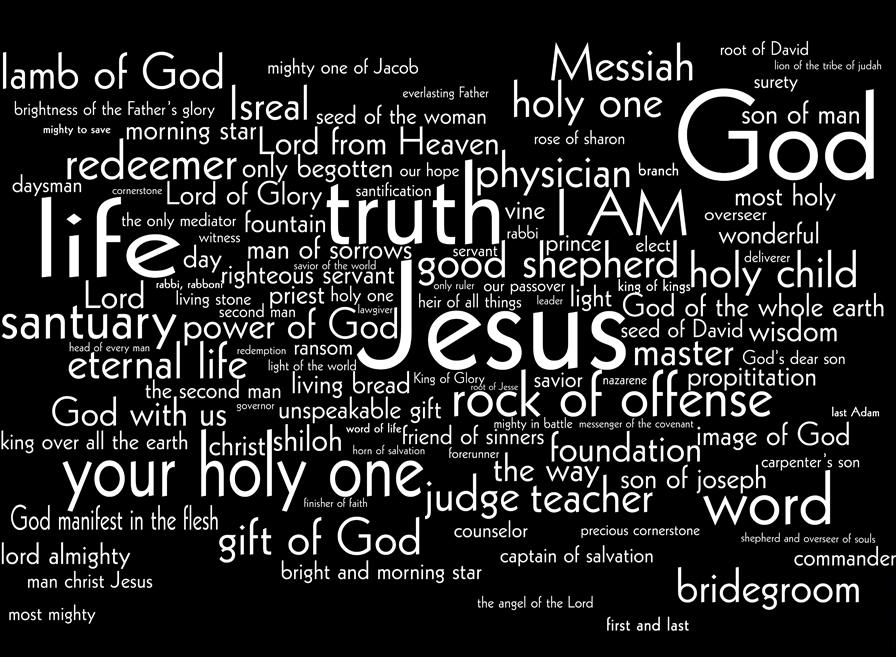
All Names and Titles of Jesus Christ

All Names and Titles of Jesus Christ

All Names and Titles of Jesus Christ

In our culture names serve primarily to distinguish one person from another. In Bible times names had other significant functions. In the New Testament, names that were applied to Jesus often had special meanings that went back into Old Testament and intertestamental times.


“Name” in the Ancient Near East.

Outside Israel knowledge of the name of a god or goddess was important in the performance of magical rites, by which a person could get control of the deity. Benevolent deities would reveal their names and protect or aid their human contacts; unwilling or malevolent deities would be reluctant to reveal their names and thereby come under the control of the magician.

Though it is anachronistic to speak of “secular” Greek, non-Christian Greek literature used “name” in a number of different ways. For example, if a stranger expected hospitality, he first had to indicate to his host what his name was. Philosophers such as Plato attacked the widespread idea that the root meaning of the names of gods or humans revealed their character.

Though Stoicism argued that there was really only one god, it also held that the deity was known by many different names. At the other extreme, the seventeen tractates of the Greco-Egyptian god Hermes Trismegistos argue that he is so lofty that no name is appropriate for him and that, as in rabbinic Judaism, human beings should not attempt to utter his name at all.

The Old Testament uses the word, shēm, “name,” no less than 854 times, with “in the name of” occurring over 130 times. The idea of Name often revealed a basic characteristic of an individual. Similarly, names could be changed to reflect changes in circumstances (e.g., Jacob becomes Israel—Gen. 32:28).

Of special importance is shēm Yahweh, “the name of the Lord” (or similar expressions such as “in the name of [our] God”). Though some scholars suggest that the “name” is somehow a being separate from the Lord who is present in the angel of the Lord (Exod. 23:20–21) or in the temple (1 Kings 8:14–30), such a conclusion was contradicted by the monotheistic history of Israel.

The name of God was significant to the ancient Hebrews because it comprehended in itself all that God is. In fact, “the name” was a synonym for God; hence believers are not to take the name of the Lord in vain (Exod. 20:7). The name of God is holy and awesome (Pss. 99:3; 111:9) and signifies his personal presence (2 Chron. 7:16; Ps. 75:1). God’s people are to reverence (Ps. 86:11), love (Ps. 5:11), praise (Ps. 97:12), trust (Isa. 50:10), call upon (Isa. 12:4), and hope in the divine name (Ps. 52:9). In God’s divine name is the ultimate salvation of his people.

In the pseudepigraphical and rabbinic writings of later Judaism, two significant developments centering on the “name” of God occur, though in general the tendency is to repeat the practices of the Old Testament. The apocalyptic literature of the period tends to focus on the meaning of the names of saints and angels, not God. Seven divine names are mentioned in 4 Esdras 7:132–39.

The rabbinic writings mention the healing of a rabbi “in the name of” another person. The most important development was the substitution of “Adonai” (Lord) for “Yahweh” in synagogue usage and the use of hashēm, “the name,” for both “Yahweh,” “Elohim” (God), and even “Adonai” in the rabbinic schools, at least when quoting the Tanach, so the rabbis forgot how YHWH was orginally pronounced.


The “Name” of Jesus.

The expression the “Name” of Jesus is frequent and highly significant in New Testament usage in that it parallels the use of the name of God in the Old Testament. The early Christians had no difficulty substituting the name of Jesus for the name of God. Indeed, for them the divine name, YHWH, was given to Jesus, that every knee should bow to him and every tongue confess that he is Lord (Phil. 2:9–11; cf. Isa. 45:20–23).

New Testament believers are to live their lives in Jesus’ name just as the Old Testament believers were to live in the name of God the Lord.<par>People who hear the gospel and respond positively, call upon Jesus’ name for salvation (Acts 2:21), put their faith in Jesus’ name (John 1:12; 1 John 5:13), are then justified (1 Cor. 6:11) and forgiven in Jesus’ name (Acts 10:43; 1 John 2:12), and are then baptized into Jesus’ name (Acts 2:38; 10:48; 19:5).

Having then, life in his name (John 20:31), believers are to glorify the name of Jesus (2 Thess. 1:12) and give thanks for and do everything in the name of Jesus (Eph. 5:20; Col. 3:17). Just as in the Old Testament where the name of God represents the person of God and all that he is, so in the New Testament “the Name” represents all who Jesus is as Lord and Savior. 

Leslie R. Keylock


The Titles of Jesus

In addition to the comprehensive idea that is found in the idea of Jesus’ name there are also a number of significant titles that are ascribed to Jesus in the New Testament. Each one has something special to say about who Jesus is and together they constitute a definition of his person and work, and become as it were his “name.”


Author-Prince.

Jesus is called “Author” in Acts 3:15 and Hebrews 2:10; 12:2 and “Prince” in Acts 5:31 (niv). In each case the Greek word is the same: archēgos. Uses of the term in the Greek Old Testament (LXX) and nonbiblical Greek suggest it carries a threefold connotation:

(1) path-breaker (pioneer) who opens the way for others, hence, “guide” or “hero”;

(2) the source or founder, hence “author,” “initiator,” “beginning”; and

(3) the leader-ruler, hence, “captain,” “prince,” “king.”

The ideas may well overlap or be combined. In its fullest sense the Greek word denotes someone who explores new territory, opens a trail, and leads others to it. The archēgos builds a city or fortress for those who follow and leads them in defense against attackers. When the peace has been won he remains as their ruler and the city or community bears his name. He is thereafter honored as the founding hero.

In Acts 3:15 Peter accuses the Jews of killing the “author (archēgos) of life,” suggesting that Jesus is not only the orgin of biological life, but also of “new life” and the provider-proctor of those identified with him. Later Peter speaks of Jesus as the “Prince (archēgos) and Savior” who gives repentance to Israel (5:31). The word “Savior” was associated with the Judges of old.

Jesus is the one who meets the emergency situation caused by the sin of God’s people and he comes to bring not only deliverence but also the continuing service of Author (archēgos). The writer to the Hebrews speaks of the suffering “Author (archēgos) … of salvation” (2:10) and the “author (archēgos) and perfecter of our faith” (12:2). In each case Jesus not only initiates and provides the new life for his people but remains with them through it; they bear his name, he is their king.

Julius Scott, Jr


The Chosen One.

Jesus is referred to as God’s chosen in Luke’s account of the transfiguration (9:35) and by Matthew (12:18) as he applies Isaiah 42:1 to Jesus. In 1 Peter he is designated as the one “chosen before the creation of the world … revealed in these last times” (1:20) and as the “living stone—rejected by men but chosen by God” (2:4).

In the Old Testament Israel’s leaders—Abraham (Gen. 18:19), Moses and Aaron (Pss. 105:26; 106:23), priests and Levites (Deut. 2:5), Saul (1 Sam. 10:24), David (1 Kings 8:16; 2 Chron. 6:6; Ps. 89:3), and the Servant of the Lord (Isa. 42:1; 43:10)—are said to be chosen by God. Israel as a whole is frequently designated as God’s chosen (Deut. 7:6; Isa. 41:8; 44:1; Amos 3:2). All of these were earthly persons or groups through whom God carried on his work of revelation and redemption.

Jesus is “The Chosen One” par excellence and been appointed by God to accomplish his task on earth. He embodies all that Old Testament chosen ones were to have been. He is the special object of God’s love and the perfect divine messenger-redeemer.

Jesus refers to his apostles as those whom he has chosen (John 6:70; 13:18; 15:19), and church is also called God’s “chosen” (Eph. 1:11; Col. 3:12; James 2:5; 1 Peter 1:2; 2:9), by virtue of being Christ’s body. As the church abides “in Christ” she shares that special designation of being “chosen.” The church is the object of Christ’s love and redemption, called to have fellowship with him and to continue his work on work.

Julius Scott, Jr


Christ, Messiah, Anointed One māsûɩ̂aḥ.

The title “Christ” or “Anointed One” (Heb. māsûɩ̂aḥ; Gk. Christos), which occurs about 350 times in the New Testament, is derived from verbs that have the general meaning of “to rub (something)” or, more specifically, “to anoint someone.” The Old Testament records the anointing with oil of priests (Exod. 29:1–9), kings (1 Sam. 10:1; 2 Sam. 2:4; 1 Kings 1:34), and sometimes prophets (1 Kings 19:16b) as a sign of their special function in the Jewish community.

The prophet Isaiah recognizes his own anointing (to preach good news to the poor, 61:1) and that of Cyrus, king of Persia (to “subdue nations,” 45:1), apparently as coming directly from the Lord without the usual ceremony of initiation. As a noun, the Lord’s “Anointed” usually refers to a king (1 Sam. 12:3, 5), while designation of a priest (Lev. 4:5) or the partriarchs (Ps. 105:15) is less common.

The word “anointed,” however, is not used directly in the Hebrew Bible as a title for a future messianic person, who would save Israel. The word “Messiah,” therefore, does not appear in major English translations of the Hebrew Bible such as the Revised Standard Version or the New International Version. “Messiah” appears only twice in the New Testament (John 1:41; 4:25) as an explanation of the Greek word “Christ.”

By the time Jesus was born, however, a number of passages in the Hebrew Bible were understood to refer to a specific anointed person who would bring about the redemption of Israel, and that person was called “the Christ” (Acts 2:27, 31). The Samaritans were looking for him (John 4:24). The Jews looked for him and expected him to perform great miracles (John 7:31). He was to be the son of David (Matt. 22:42) and, like David, come from Bethlehem (John 7:41–42). Even criminals condemned to death on a cross knew about a Christ and asked Jesus if he was that person (Luke 23:39).

The word “Christ” is used to identify Jesus of Nazareth as that person whom God anointed to be the redeemer of humanity. It thus often appears as a title in the phrase “Jesus the Christ” (Acts 5:42; 9:22; 17:3) or “the Christ was Jesus” (Acts 18:28).

Peter referred to him as “both Lord and Christ” (Acts 2:36). Very frequently the word is coupled with the name of Jesus and appears to be virtually a second name “Jesus Christ” (Acts 2:38; 3:6; 9:34; 10:36; Rom. 1:6–8; 1 Cor. 1:6–10), through not a surname, because “Christ Jesus” is also commonly used (1 Cor. 1:1–30; Gal. 2:4). In close proximity in the same chapter, Jesus can be called “Jesus Christ” (Gal. 3:22), “Christ” (3:24), and “Christ Jesus” (3:26).

In Paul’s writings “Christ” is used both with and without the definite article (1 Cor. 6:15; Gal. 2:17), in combination with the title Lord (kyrios, Rom. 10:9), as well as combined with such ideas as gospel (Rom. 1:16) or faith (Gal. 2:16).

Elsewhere in the New Testament, the author of the Epistle to the Hebrews picks up on the Old Testament anoiting of priests and applies the same in relation to Jesus (1:9; 5:8–10; 7:1–28). The name occurs also in the Petrine Epistles (1 Peter 1:13; 3:15; 2 Peter 1:1–2, 16; 3:18), as well as those of James (1:1; 2:1) and Jude (1, 17, 21, 25). The Apocalypse of John describes Jesus as the Anointed One when looking forward to the end when the kingdom and salvation of the Lord and his Messiah will enjoy an eternal and full dominion (11:15; 12:10; 20:4, 6).

The significance of the name “Christ” lies in the fact that it was a title granted to Jesus by virtue of his fulfillment of Old Testament prophecy and by his resurrection from the dead. The name “Jesus” was a common Hebrew name (the Greek form of Joshua, cf. Luke 3:29; Heb. 4:8, where Jesus in the Greek text is translated Joshua) and is borne by other people in the New Testament including Barabbas (Matt. 27:17) and Justus (Col. 4:11).

But no one else bears the name Christ. It is significant that early disciples of Jesus were not called “Jesusites” but “Christians,” followers of Christ (Acts 11:26; 26:28; 1 Peter 4:16). 

James A. Kelhoffer and John McRay


Firstborn.

Jesus is referred to by the singular form of the word “firstborn” (prōtotokos) in six passages in the New Testament. He is called the physical firstborn of Mary in Luke 2:7, because he subsequently had brothers and sisters (Matt. 13:55). In a spiritual sense, he is called firstborn to differentiate him from the angels (Heb. 1:6).

He is the firstborn of all creation (Col. 1:15), and to those who believe in him he is the “firstborn among many brothers” (Rom. 8:29). He is unique among human beings, among other reasons, because of his resurrection from the dead. He was the first one resurrected to die no more, and thus he has the preeminence (Col. 1:18; Rev. 1:5).

John McRay

God.

The New Testament rarely calls Jesus “God” as such (Gk. theos). “Lord,” stressing his co-regency with the Father as Son, or “Christ,” hallowing the kingly function he fulfilled, is preferred. Still, references to Jesus as God are not absent. John 1:1 clearly equates “the word” with God; in 1:14 it becomes clear that “the word” is Jesus. Arguments by Jehovah’s Witnesses and others proposing different renderings of John 1:1 are untenable.

In John 1:18 some translations call Jesus “God the One and Only” (niv). The King James and other translations, however, follow a manuscript tradition that calls him “Son” here, not God.

Other passages, too, explicitly name Jesus as God. Romans 9:5 speaks of “Christ, who is God over all, forever praised!” Grammatical rules permit rending 2 Thessalonians 1:12 as “the grace of our God and Lord, Jesus Christ.” The same holds true of Titus 2:13 (“our great God and Savior, Jesus Christ”) and 2 Peter 1:1 (“our God and Savior Jesus Christ”).

Hebrews 1:8 calls the Son God; 1 John 5:20 says of Jesus,“He is the true God and eternal life.” Such texts confirm the impression given indirectly in other places that Jesus merits the name “God” by virtue of his mastery over wind and sea (Mark 4:41), personification of God’s kingdom (Luke 11:20), ability to forgive sins (Mark 2:7), and intimacy with the invisible Father by which, enemies charged, he presumed to be “equal with God” (John 5:18).

They could not accept that this was not effrontery but his due and possession (Phil. 2:6) from all eternity (John 17:24). It can be concluded that belief in Jesus’ essential divinity (along with his obvious full humanity) extends to all levels of early Christian confession.

At the same time New Testament writers are not indiscriminate in speaking of Jesus as “God.” They realized that despite the Father’s virtual presence through his Son, “no one has ever seen God” in terms of mortals on earth beholding the unmediated fullness of God in heaven (John 1:18). They intuited, if they did not spell out and reflect on, the subtle offsetting truths of later Trinitarian affirmations.

Their restraint in predicating full deity of Jesus is due, among other thing, to his humanity (which the good news of the incarnation [Luke 2:10] was bound to emphasize) and to their theological sophistication: Jews imbued with the sacred truth of God’s oneness—Deuteronomy 6:4, “the Lord is one,” rang out daily in worship—were not so callow as to label fellow humans “God.”

Their own Scriptures, in fact, forbade this (Deut. 4:15–16), violation of which was blasphemy. Those same Scriptures sternly denounced any man “hung on a tree” (Deut. 21:23). Yet the crucified Jesus must be hailed as redeemer, not censured as a crimal (Gal. 3:13–14). By the same logic he must be granted his apparent divine parity. Thus was the man Jesus hailed rightly as God.

Robert W. Yarbrough


Holy One of God

In the Old Testament, “the Holy One of God” is a divine epithet common in the prophets and poetic literature used to communicate the separateness of the Lord. The New Testament applies this name to Jesus on two occasions in the Gospels (Mark 1:24 = Luke 4:34; John 6:69), once in Acts (3:14) and possibly on two other occasions (1 John 2:20; Rev. 3:7).

In the Gospel of Mark, Jesus begins his public ministry teaching in a Capernaum synagogue (1:21–22). Someone possed with an evil spirit then cries out, “What do you want with us, Jesus of Nazareth? Have you come to destroy us? I know who you are—the Holy One of God!” (1:23–24). The event is probably best understood in light of the secrecy motif of Mark’s Gospel, whereby human beings rarely comprehend the true identity of Jesus.

Instead, it is usually God (1:11; 9:7) or, as in this passage, demons (5:7) who know who Christ is before the crucifixion. In addition, knowing someone’s “name” can communicate that an individual possesses power over that person. In spite of the demon’s knowledge of his potential exorcist as “the Holy One of God,” Jesus casts him out with a short command and amazes the crowd by his teaching and authority (Mark 1:25).

John contrasts the turning away of “many” disciples with the faith of the Twelve (John 6:66–69). Peter responds to Jesus, “Lord, to whom shall we go? You have the words of eternal life. We believe and know that you are the Holy One of God.” First John 2:20 can refer to either God or Jesus when writing, “But you have an anointing from the Holy One. ”The above reference to the Gospel of John makes it possible that Jesus is the giver of this anointing, but the author may intentionally leave this designation unclear.

In the Book of Acts Peter addresses the curious crowd on the role they played in the crucifixion of Jesus. Nothing could be worse than denying “the Holy and Righteous One” and asking for the release of a murderer instead (3:14). Finally, in the letter to the angel presiding over the church at Philadelphia, Jesus is him who is holy and true, who holds the key of David” (Rev. 3:7).

This verse, like Acts 3:14, illustrates how the full epithet (“the Holy One of God”) could be abbreviated and combined with other descriptions of Jesus to enhance the main thrust of the passage. In Acts Peter aims to convict his audience, while the apocalyptic writer offers multiple images of Jesus to encourage the congregation in a time of intense persecution.   

James A. Kelhoffer


Lord

Scripture ascribes glory to Jesus Christ in numerous ways, but in naming him “Lord” (Gk. kyrios) it makes an ultimate statement. In the Septuagint the word appears over nine-thousand times; in over six-thousand of those passages kyrios replaces YHWH (Yahweh, Jehovah), the so-called sacred tetragrammaton. This was the name revealed by God to his covenant people through Moses affirmation (Exod. 3:14), a name held in such high esteem that by New Testament times it was rarely spoken out loud.

The truth of God’s holy oneness, a nonnegotiable Old Testament affirmation (Exod. 20:3, Deut. 6:4; Isa. 43:10–11), would seem to rule out, at least among Jews, any application of kyrios to mere flesh and blood. Yet this is precisely what Paul does in testifying that God the Father bestowed on the Son “the name that is above every man” in order that all creation might acknowledge Jesus Christ as “Lord [kyrios], to the glory of God the Father” (Phil. 2:9–11). “Lord” thus serves as the name par excellence for Jesus Christ.

But Paul was by no means the first to apply this sacred title to Jesus. The Old Testament had predicted that a deliverer would come in the name of Lord. He would somehow be the Lord himself. Jesus invites reflection on this logically difficult truth in asking what David meant by affirming, “The Lord [Heb. YHWH] says to my Lord (LXX kyrios) …”(Ps. 110:1).

In modern and postmodern thought Jesus’ essential oneness with God the Father, his full divinity as second person of the Trinity, has been widely rejected as Hellenistic embellishment of earliest Christian belief. Yet ascription of full deity to Jesus seems necessitated by Old Testament prophecies as interpreted by Jesus himself.

Jesus’ disciples, taught by him from the Old Testament and witnesses to his numerous and varied mighty acts, came to understand and proclaim the truth of Thomas’ outburst of recognition: “My Lord [kyrios] and my God!” (John 20:28).

Writing in the middle of the a.d. 50s Paul could already draw on an older tradition hailing Jesus as Lord: “Come, O Lord!” (1 Cor. 16:22) is not Greek (the language of Paul’s Corinthian readers) but the Aramaic maranatha (one of the languages of Jesus’ Palestinian surroundings). The confession is therefore rooted in the earliest days of church life where the prevailing linguistic milieu was Semitic.

This rules out an older but still popular theory that the name “Lord” was projected back onto Jesus only long after his death by Gentile Christians whose pagan religious background caused them to have no scruples about applying the title kyrios to a mere human being.

While kyrios was common as a polite, even honorific title for “sir” or “master,” calling Jesus “Lord” to imply divine associations or idenity was by no means a convention readily adopted from the Roman world. In Jesus’ more Eastern but militantly monotheistic Jewish milieu, where the title’s application to humans to connote divinity was not only absent but anathema, the title is an eloquent tribute to the astoning impression he made. It also points to the prerogatives he holds.

Since Jesus is Lord, he shares with the Father qualities like deity (Rom. 9:5), preexistence (John 8:58), holiness (Heb. 4:15), and compassion (1 John 4:9), to name just a few. He is co-creator (Col. 1:16) and co-regent, presiding in power at the Father’s right hand (Acts 2:33; Eph. 1:20; Heb. 1:3), where he intercedes for God’s people (Rom. 8:34) and from whence, as the Creed states, he will return to judge the living and dead (2 Thess. 1:7–8).

Just as it is impossible to overstate the power, grandeur, and goodness of the kyrios the Father, so there is hardly limit to the glory ascribed in Scripture to the kyrios the Son. Therefore Isaiah’s counsel, and Peter’s, is to be heeded: “Sanctify the Lord [LXX kyriosʰ Heb. ‘adonai sabbaōth] himself” (Isa. 8:13 LXX), which Peter tellingly restates as “sanctify Christ as Lord” (1 Peter 3:15 nasb).   

Robert W. Yarbrough


One and Only, Only Begotten

Jesus is called monogenēs (kjv “only begotten”) in five New Testament passages (John 1:14, 18; 3:16, 18; 1 John 4:9). Modern translations tend to render the word “only” (rsv) or “one and only” (niv). In any case, emphasis falls on Jesus’ singular status: He is uniquely related to the Father, so close to him as to be one with him (John 5:18; 10:30), yet as distinct from him as was neccessary to allow for full identification with humanity through the incarnation (John 1:14).

Monogenēs is used in Luke 7:12, 8:42, and 9:38 to refer to the only child of the widow’s son at Nain, to Jairus’ daughter, and to an epileptic son, respectively. This shows that in conventional usage the word connoted being the solitary child. The one other New Testament occurrence of the word is Hebrews 11:17, speaking of Abraham’s near-sacrifice of “his one and only son” Isaac.

It has been suggested that for John as for the writer of Hebrews this incident (Gen. 22:1–18) serves as primary background for early Christian understanding of Jesus’ sonship and sacrificial death.

Recent translations correctly reflect that Jesus’ status as “only begotten” underscores his uniqueness rather than his place or mode of origin—it does not directly refer to his virgin birth. Both as unrivaled expression of the Father’s glory and as distinct from any created human, he holds preeminemce (Col. 1:18). He is monogenēs, utterly unique, in his person and saving role.

The church father Jerome (ca. a.d. 400) supplied the Vulgate’s unigenitus (“only begotten”) to help counter the Arian view that Jesus was a created being; unigenitus permitted Jesus to be “begotten” of the Father in the sense implied in certain Bible passages (e.g., Ps. 2:7; Acts 13:33), while “only” left room for affirmation of his divine nature. Through the Vulgate’s influence on early English versions of the Bible, the traditional translation “only begotten” still rings true for many today.

Robert W. Yarbrough


Son of David.

We can trace two lines of interpretation regarding the Son of David (Gk. hyios Dauid) in the Old Testament, one that draws attention to a direct successor during the united monarchy (2 Sam. 7:12–16), and the other that applies the earlier promises to the coming of a future individual (Isa. 9:6–7). Both are crucial to understanding the title for Jesus in the New Testament.

Mention of the Son of David begins in the Old Testament with the oracle the prophet Nathan delivers to David (2 Sam. 7:12–16). God promises David offspring to succeed him. God “will be his father,” and David’s house and kingdom will be established forever. Numerous psalms highlight the same excitement over the continuation of the Davidic line (89:3–4; 110; 132).

Even after the collapse of the united monarchy, the line of David remained significant for describing a future leader for the covenant people. Isaiah, for example, looks to the future for a child to be born who will reign on David’s throne (9:6–7; cf. 55:3–4; Jer. 23:5; Ezek. 34:23).

In the century before Christ, moreover, both the Psalms of Solomon and the Qumran literature look to the same “Son” or “shoot” of David either as an ideal Hasmonean king or a ruler for the expectant Dead Sea community (Ps. Sol. 17–18; 4Qpatr 1–4). These last references would be of concern to New Testament authors since at least two (most probably opposing) Jewish groups had expectations for the Davidic line that were at odds with the historical Jesus.

The former author, who portrays a triumphant and politically successful king, would never be satisfied with Jesus, who neither purged Jerusalem nor placed the Gentiles “under his yoke” (Ps. Sol. 17:30–32), but instead came “to seek and save that which was lost” and “to give his life as a ransom for many” (Mark 10:45).

The New Testament addresses this issue by affirming that Jesus is both a direct descendent of David and yet more than another human successor. The two most significant passages using this title are Mark 12:35–37a and Romans 1:1–4. In the Synoptic text Jesus questions the assumption that the son of David is merly a descendant of David since David himself in Psalm 110:1 refers to him as “Lord.” In Romans 1:1–4 an ancient Christian creed to which Paul refers clarifies this same problem from the above Synoptic passage.

Jesus was both “born through the seed of David according to the flesh (kata sarka)” and “foreseen as the Son of God in power by the Spirit of sanctification (kata pneuma hagiōsunēs) through the resurrection of the dead.” In 2 Timothy 2:8 we also find the resurrection and Christ’s having “descended from David” in a creedal context.

The Evangelist Matthew takes special interest in this title for Jesus, emphasizing that both Jesus (1:4) and Joseph (1:20) are direct descendants of the great Israelite king. Elsewhere Jesus is referred to as the “Son of David” in connection with healing (Matt. 12:23; 15:22; Mark 10:47–48), and the triumphal entry into Jerusalem (Matt. 21:9, 15).   


James A. Kelhoffer


Son of God.

Mark begins his Gospel with the statement: “The beginning of the gospel of Jesus Christ, the Son of God” (Mark 1:1). The phrase “Son of God” (huios theou) is a title used of Jesus to indicate that he is divine in nature, just as the title “Son of Man,” among other things, indicates that he is human. Although the title is not used in a trinitarian context in the New Testament, the word Son is so used in Matthew 28:18–20, where Jesus commanded baptism to be performed in the name of the Father, Son, and Holy Spirit.

The title “Son of God” is used twenty-six times in the Gospels referring to Jesus. He is called Son of God by Satan (Matt. 4:3, 6; Luke 4:3, 9), by demons (Matt. 8:29; Mark 3:11; Luke 4:41), by John the Baptist (John 1:34), by his followers (Matt. 14:23; John 1:49; 11:27; 20:31), by angels (Luke 1:35), and by a Roman centurion (Matt. 27:54; Mark 15:39).

Those who passed by while he was on the cross derided him, asking for proof that he was the Son of God by coming down from the cross (Matt. 27:40). They were joined in their taunts by the most eminent of Jewish religious leaders: chief priests, scribes, and elders (Matt. 27:43; cf. 26:63). Jews considered the title to be an assumption of equality with Jehovah the God of Israel (John 10:36; 19:7); most were unprepared to allow a human being to occupy that position.

Jesus on occasion referred to himself with this title (John 3:18; 5:25; 10:36; 11:4) and on other occasions acknowledged its validity (Luke 22:70).

After his conversion and call to apostleship, Paul immediately began to declare in the synagogues that Jesus was indeed the Son of God (Acts 9:22). In his letters Paul used the phrase in reference to Jesus, saying he was “designated Son of God in power according to the Spirit of holiness by his resurrection from the dead” (Rom. 1:4; cf. 2 Cor. 1:19; Gal. 2:20). The only other letter in the Pauline corpus to use this title is Ephesians (4:13).

It is used in Hebrews (4:14; 6:6; 10:29), in the letters of John (1 John 3:8; 4:15; 5:5, 10–13, 20), and once in the Book of Revelation (2:18).   


John McRay


Son of Man.

The term “Son of Man” occurs sixty-nine times in the Synoptic Gospels, thirteen times in John, and once in Acts. All but three occurences come from the lips of Jesus. In John 12:34, the crowd, equating the Son of Man with eternal Messiah, was puzzled at Jesus’ prediction that he would be “lifted up” and inquired about the idenity of the Son of Man.

The dying martyr Stephen said he saw “the Son of Man standing at the right hand of God” (Acts 7:56). Jesus frequently refers to the Son of Man in the third person, causing some to assume he was not speaking of himself. Nevertheless the term seems to be not only a self-designation, but Jesus’ favorite one.

In the Synoptics references to the Son of Man may be loosely grouped into three categories: those which speak of him as: (1) present with authority and power (Mark 2:10, 27); (2) suffering rejection and death by crucifixion at the hands of humans as a ransom for many (Mark 8:31; 9:12, 31; 10:45; 14:41); and (3) returning at some future time in glory to judge, and bring the consummation of all things (Mark 8:38; 13:26; 14:62).

Son of Man references in John fall roughly into the same categories but with some special emphases. John 3:13 and 6:27, 62 allude to the eternal existence of the Son of Man; 1:51 and 8:28 imply an invisible continuing relation with God not found in the Synoptics; 12:23 and 13:31 speak of his glorification during his earthly life; and 3:13–16 and 6:53 make plain that the Son of Man’s work brings eternal life.

Elsewhere in the New Testament the phrase “Son of Man” occurs in Hebrews 2:6, a quotation from Psalm 8:4 which is clearly applied to Jesus. In Revelation 1:13 the Son of Man is in the midst of the lampstands (the churches); in 14:14 he sits on a cloud, wearing a golden crown and holding a sharp sickle.

Ninety-three of the 106 occurences of the term in the Old Testament are in the Book of Ezekiel where it is God’s standard way of addressing the prophet. Elsewhere it is also a reference to either humanity as a whole or to a particular human person except in Psalms 8:4; 80:17; and Daniel 7:13. As already noted, the writer to the Hebrews interprets Psalm 8:4 messianically and probably 80:17 should be as well.

Daniel 7:13–14 introduces a different perspective. Here one like a Son of Man is an apocalyptic figure from heaven who receives an all-inclusive kingdom, unlimited by space or time.

Intertestamental references to Son of Man are in the same vein as that of Daniel’s vision. In that section of 1 Enoch called the Similitudes or Parables (37–71) the Son of Man is a heavenly person, eternal, righteous, and holy, who rules and judges. Second Esdras (4 Ezra) 13 relates a vision of “something like the figure of a man come up out of the heart of the sea … this man flew with the clouds of heaven” (v. 3).

He defeats the hostile (cosmic) powers and delivers captives through a series of actions that precede the confirmation of his reign.

Controversies abound about the origin, use, meaning, and implications of “Son of Man” in biblical literature and particularly its use by Jesus. The term could be a synonym for “I” or “a human person.” Some scholars have thought it to be a corporate term including Israel (n.b., Dan. 7:18) or the church (e.g., T. W. Manson), an office Jesus expected to receive (e.g., A. Schweutzer), or a figure imported into Judaism from a foreign source.

Jesus was in constant danger of being forced into limited or illegitimate messianic role (John 6:15). In response to Peter’s confession (Mark 8:29–31) he accepted the title “Messiah,” equated it with Son of Man, and linked his work with that of the Suffering Servant. In the Judaism of Jesus’ day “Messiah” was frequently understood as a political-military leader whose primary concern was for the welfare of Israel.

Jesus’ usage seems to be an extension of the portrayal of the Son of Man in Daniel and the intertestamental literature. With the term Jesus dissociated his nature and mission from purely earthly, nationalistic notions. He is a transcendent, preexistent person whose mission is primarily a spiritual one that orginates in heaven and whose concern is with all peoples, nations, and languages.

Julius Scott, Jr


Bibliography.

O. Cullmann, The Christology of the New Testament; W. Elwell, TAB, pp. 117–34; L. Goppelt, Theology of the New Testament; D. Guthrie, New Theology; F. Hahn, The Titles of Jesus in Christology; M. J. Harris, Jesus as God: The New Testament Use of THEOS in Reference to Jesus;

S. Kim, The Son of Man as the Son of God; B. Lindars, Jesus Son of Man; I. H. Marshall, The Origins of New Testament Christology; C. F. D. Moule, The Origin of Christology; A. E. J. Rawlinson, The New Testament Doctrine of the Christ;

L. Sabourin, The Names and Titles of Jesus; V. Taylor, The Person of Christ in New Testament Teaching; B. B. Warfield, The Lord of Glory; B. Witherington, The Christology of Jesus.

Leslie R. Keylock Keylock, Leslie R Ph.D., Trinity International University. Professor of Bible and Theology, Moody Bible Institute, Chicago, Illinois.

1. Julius Scott, Jr Scott, J. Julius, Jr Ph.D., University of Manchester. Professor of Biblical and Historical Studies, Wheaton College Graduate School, Wheaton, Illinois.

James A. Kelhoffer, James A M.A., Wheaton College Graduate Student, Univerisity of Chicago.

John McRay McRay, John Ph.D., University of Chicago. Professor of New Testament and Archaeology, Wheaton College, Wheaton, Illinois.

Robert W. Yarbrough Yarbrough, Robert W Ph.D., University of Aberdeen. Associate Professor of New Testament Studies, Covenant Theological Seminary, St. Louis, Missouri.

TAB Topical Analysis of the Bible, ed. W. A. Elwell

Elwell, W. A., & Elwell, W. A. (1997, c1996). Evangelical dictionary of biblical theology (electronic ed.). Baker reference library; Logos Library System. Grand Rapids: Baker Book House.

All Names and Titles of Jesus Christ

النبوات تحدد أنساب المسيح ومكان ميلاده وزمن تجسده وصلبه – القمص عبد المسيح بسيط

النبوات تحدد أنساب المسيح ومكان ميلاده وزمن تجسده وصلبه – القمص عبد المسيح بسيط

القمص عبد المسيح بسيط

النبوات تحدد أنساب المسيح ومكان ميلاده وزمن تجسده وصلبه – القمص عبد المسيح بسيط

  حددت نبوات العهد القديم، وبكل دقة، أنساب المسيح الذين تناسل منهم من آدم وحتى داود النبي، كما حددت ميلاده من عذراء ومكان ميلاده في بيت لحم، وحددت، وبكل دقة، زمن مجيئه وتجسده وصلبه (قطعه حسب تعبير الملاك جبرائيل لدانيال النبي)، سواء بالحكم الذي سيتجسد في زمنه أو بعدد سنوات محددة تبدأ من تاريخ معلوم وتنتهي بتاريخ معلوم وترتبط بأحداث معلومة لم يخطئها لا علماء اليهود (الراباي – الرابيين – Rabbi) ولا آباء الكنيسة المسيحية وعلمائها، من بعدهم، بل عرفها علماء اليهود وعلى ضوئها انتظروه وكانوا متوقعين مجيئه أثنائها، كما سنبين حالا من أقوال علماء اليهود (الربيين):

1- مجيئه كنسل المرأة:

النبوّة

إتمامها

” فقال الرب الإله للحيّة لأنك فعلت هذا ملعونة أنت من جميع البهائم ومن جميع وحوش البرية. على بطنك تسعين وترابا تأكلين كل أيام حياتك. وأضع عداوة بينك وبين المرأة، وبين نسلك ونسلها هو يسحق رأسك، وأنت تسحقين عقبه ” (تكوين 3: 14و15).


” ولكن لما جاء ملء الزمان أرسل الله ابنه مولوداً من امرأة، مولوداً تحت الناموس ” (غل4: 4).

” وها أنت ستحبلين وتلدين ابنا وتسمينه يسوع 000 الروح القدس يحل عليك وقوة العلي تظللك فلذلك أيضا القدوس المولود منك يدعى ابن الله ” (لو1 :34و35).

  وعبارة ” نسلها = H[‘_r>z: = seed (offspring) “، في النبوّة تشير إلى نسل يأتي من المرأة فقط دون مشاركة من الرجل، أي من عذراء وبدون زرع بشر، كما تنبأ بذلك اشعياء النبي، بعد ذلك (اش7 :14). حيث تقول النبوّة أن نسل المرأة سيولد، فقط، من المرأة من دون الرجل، وهذا النسل هو الذي سيسحق رأس الحية، والحية هي إبليس نفسه؛ فيقول القديس بولس: ” ولكن لما جاء ملء الزمان أرسل الله ابنه مولودا من امرأة مولودا تحت الناموس ليفتدي الذين تحت الناموس لننال التبني ” (غل4 :4و5). ويشرح عملية التجسد بقوله: ” فإذ قد تشارك الأولاد في اللحم والدم اشترك هو أيضاً كذلك فيهما لكي يبيد بالموت ذاك الذي له سلطان الموت أي إبليس ويعتق أولئك الذين خوفا من الموت كانوا جميعا كل حياتهم تحت العبودية ” (عب2 :14و15). ويقول القديس يوحنا: ” من يفعل الخطية فهو من إبليس لأن إبليس من البدء يخطئ. لأجل هذا أظهر ابن الله لكي ينقض أعمال إبليس ” (1يو3 :8)

  ويشرح لنا الإنجيل القديس متى كيفية الحبل بالمسيح من المرأة، العذراء، من دون الرجل، وبدون زرع بشر، فيقول بالروح: ” أما ولادة يسوع المسيح فكانت هكذا. لما كانت مريم أمه مخطوبة ليوسف قبل أن يجتمعا وجدت حبلى من الروح القدس. فيوسف رجلها إذ كان بارا ولم يشأ أن يشهرها أراد تخليتها سرّا. ولكن فيما هو متفكر في هذه الأمور إذا ملاك الرب قد ظهر له في حلم قائلا يا يوسف ابن داود لا تخف أن تأخذ مريم امرأتك. لأن الذي حبل به فيها هو من الروح القدس ” (مت1 :18-20).

  كما يقدم لنا سفر الرؤيا وصفا تصويرياً لتطبيق هذه النبوّة في شخص الرب يسوع المسيح، فيقول: ” وظهرت آية عظيمة في السماء امرأة (إسرائيل = العذراء مريم) متسربلة (مُلتَحِفَةٌ) بالشمس (المسيح شمس البر) والقمر تحت رجليها وعلى رأسها إكليل من اثني عشر كوكبا (أسباط إسرائيل) وهي حبلى (بالنبوات والمسيح) تصرخ متمخضة (مِن أَلَمِ المَخاض) ومتوجعة لتلد. وظهرت آية أخرى في السماء. هوذا تنين عظيم احمر له سبعة رؤوس وعشرة قرون وعلى رؤوسه سبعة تيجان. وذنبه يجر ثلث نجوم السماء فطرحها إلى الأرض. والتنين وقف أمام المرأة العتيدة أن تلد حتى يبتلع ولدها متى ولدت. فولدت ابنا ذكرا عتيدا أن يرعى جميع الأمم بعصا من حديد. واختطف ولدها إلى الله والى عرشه 000 فطرح التنين العظيم الحية القديمة المدعو إبليس والشيطان (الَّذي يُقالُ لَه إِبْليسُ والشَّيطان) الذي يضل العالم كله طرح إلى الأرض وطرحت معه ملائكته. وسمعت صوتا عظيما قائلا في السماء الآن صار خلاص إلهنا وقدرته وملكه وسلطان مسيحه لأنه قد طرح المشتكي على أخوتنا الذي كان يشتكي عليهم أمام إلهنا نهارا وليلا ” (رؤ12 :1-10).

  والمرأة المتسربلة بالشمس هنا هي رمز لمملكة إسرائيل التي كانت تحمل نبوات العهد القديم وسيأتي منها المسيح المنتظر، شمس البر ” شمس البرّ والشفاء في أجنحتها ” (ملا4 :2)، كما ترمز للعذراء التي تجسد منها الرب يسوع المسيح وولدته، والتنين هو الشيطان أو الحية القديمة الذي سحقه المسيح وطرده من السماء، كقول الكتاب: ” واله السلام سيسحق الشيطان تحت أرجلكم سريعا ” (رو16 :20)،

  وقد أكد علماء اليهود (الراباي – Rabbi)، خاصة في ترجوم يوناثان المنحول وترجوم أورشليم، أن هذه النبوة، نبوة نسل المرأة، خاصة بالمسيح المنتظر، ويسبقها ما جاء في (تك1 :2) ” وروح الله يرف على وجه المياه “، والتي ربطوها بقول النبوة في اشعياء عن المسيح ” ويحل عليه روح الرب روح الحكمة والفهم روح المشورة والقوة روح المعرفة ومخافة الرب ” (اش11 :2)، وقالوا أن روح الله يتحرك على وجه عمق التوبة. ويقولون أنها روح الملك المسيا. كما يربطون نبوة نسل المرأة بما جاء (راعوث4 :18) ” وهذه مواليد فارص. فارص ولد حصرون “. ويركزون على فارص باعتباره أحد أجداد المسيح من راعوث الموآبية لدرجة أن سفر راعوث له كتاب كبير يسمى مدراش راعوث.

  ويقول ترجوم يوناثان (Jonathan Ben Uzziel): ” الملك المسيا (المسيح) الذي جرح ليشفي “، ويربط الرابي ديفيد كيمي (rabbi David Kimchi) هذه البنوة بالمسيح الذي من نسل داود ويقول: ” أنت جلبت الخلاص لشعبك بالمسيا (المسيح)، بيد ابن داود الذي سيجرح الشيطان الذي هو رأس وملك وأمير الشر “.

  وفي مدراش شيموت راباه (Shemot Rabbaa 30) يوضح أن مجيء المسيح من فارص من سبط يهوذا بعد سقوط الإنسان وفساد كل الشعوب سيصحح حالة الإنسان النهائية ويدمر الموت للأبد، كما قال القديس بولس: ” آخر عدو يبطل هو الموت ” (1كو 15 :26)، وما جاء في رؤيا ” وسمعت صوتا عظيما من السماء قائلا هوذا مسكن الله مع الناس وهو سيسكن معهم وهم يكونون له شعبا والله نفسه يكون معهم إلها لهم. وسيمسح الله كل دمعة من عيونهم والموت لا يكون فيما بعد ولا يكون حزن ولا صراخ ولا وجع فيما بعد لان الأمور الأولى قد مضت ” (رؤ21 :3و4)، فيقول ” هذا هو تاريخ فارص وله مغزى عميق (000) عندما خلق روح الله عالمه، لم يكن هناك ملاك الموت بعد (000)، ولكن عندما سقط آدم وحواء في الخطية، فسدت كل القبائل. وعندما نهض فارص بدأ التاريخ يكون صحيحا بواسطته، لأنه منه سيتناسل المسيا (المسيح)، وأثناء أيامه سيختطف الله القدوس الموت، كما قيل: أنه سيدمر الموت إلى الأبد “.

  ويقول ترجوم يوناثان أيضاً: ” وأضع عداوة بينك وبين المرأة، وبين نسلك ونسلها. وعندما يحفظ نسل المرأة وصايا الناموس فإنهم يصوبون نحوك تصويباً صحيحاً، ويضربونك على رأسك، ولكن عندما يتركون وصايا الناموس فإنك تصوبين نحوهم تصويباً صحيحاً وتجرحين عقبهم. لكن هناك علاجاً لهم، أما لك أنت فلا علاج. وفي المستقبل يصنعون سلاماً مع العقب، في أيام الملك المسيح “[1].

  ويقول ترجوم على التوراة: ” وسيكون عندما يدرس نسل المرأة التوراة باجتهاد ويطيعون وصاياها، سيضربونك على الرأس ويقتلونك؛ ولكن عندما يهجر نسل المرأة وصايا التوراة ولا يطيعون أوامرها، فستوجهين نفسك للدغهم في العقب وتؤلميهم، وعلى أية حال فهناك علاج لأبناء المرأة، ولكن بالنسبة لك، أيتها الحية، فلا علاج، سيعملون سلام مع احد آخر في النهاية، في نهاية الأيام، في أيام الملك المسيا “[2].

  ويقول ترجوم أونكيلوس على (تكوين 3: 15): ” وأضع عداوة بينك وبين المرأة، وبين ابنك وابنها وهو سيذكر ما فعلته معه منذ البدء، وأنت ستراقبينه حتى النهاية “[3].

2 – ولادته من عذراء:

النبوّة

إتمامها

” ولكن يعطيكم السيد نفسه آية ها العذراء تحبل وتلد ابناً وتدعو اسمه عمانوئيل ” (أش7:14). وعذراء في العبرية هنا (עלמה- عُلماْه)، وتعني عذراء بكر وفتاه. وقد ترجمت في اليونانية السبعينية (παρθενος -Parthenos)،أي عذراء.

” فقالت مريم للملاك كيف يكون هذا وأنا لست اعرف رجلا. فأجاب الملاك وقال لها. الروح القدس يحل عليك وقوة العلي تظللك فلذلك أيضا القدوس المولود منك يدعى ابن الله ” (لو1 :34و35).

  يقول القديس متى بالروح: أما ولادة يسوع المسيح فكانت هكذا. لما كانت مريم أمه مخطوبة ليوسف قبل أن يجتمعا وجدت حبلى من الروح القدس. فيوسف رجلها إذ كان بارا ولم يشأ أن يشهرها أراد تخليتها سرّا. ولكن فيما هو متفكر في هذه الأمور إذا ملاك الرب قد ظهر له في حلم قائلا يا يوسف ابن داود لا تخف أن تأخذ مريم امرأتك.لان الذي حبل به فيها هو من الروح القدس. فستلد ابنا وتدعو اسمه يسوع لأنه يخلّص شعبه من خطاياهم. وهذا كله كان لكي يتم ما قيل من الرب بالنبي القائل. هوذا العذراء تحبل وتلد ابنا ويدعون اسمه عمانوئيل الذي تفسيره الله معنا ” (مت1 :18-23).

  والنبوة هنا تركز على أربعة نقاط هامة:

1 – آية ” يعطيكم السيد نفسه آية “.

2 – العذراء 00 من هي؟

3 – العذراء تحبل وتلد ابناً.

4 – المولود هو عمانوئيل.

1 – الآية: والآية المقصودة في هذا الفصل الإلهي أو المعجزة مزدوجة، فهي أولا: تعنى أن ” عذراء ” أو ” العذراء ” ستحبل وتلد ومع ذلك تظل ” عذراء ” لأنه يتكلم عنها كعذراء سواء قبل الحبل أو إثناؤه أو بعد الميلاد ” ها العذراء تحبل وتلد ” فالآية تنص على أن العذراء ستحبل وان العذراء ستلد وبذلك تنص ضمناً على أنها ستظل بعد الحبل والولادة عذراء أيضاً لأنه يدعوها ” بالعذراء ” معرفة بأداء التعريف.

  والآية ليست معطاة من بشر أو بواسطة بشر ولكن معطاة من الله ذاته ” ولكن السيد نفسه يعطيكم آية “، السيد نفسه وليس مخلوق هو معطى الآية. ولكن كيف تتم هذه الآية؟ وهذا ما سألته العذراء مريم نفسها للملاك قائله: ” كيف يكون لي هذا وأنا لست اعرف رجلاً “؟ (لو1 :34). أي كيف أحبل وأنا عذراء وقد نذرت البتولية وليس في نيتي التراجع؟ ويجيب الملاك أن هذا الحبل لن يمس بتوليتك ولن يضطرك للتراجع عما نذرتيه وسوف تظلين بتول إلى الأبد. وأما عن الكيفية فهذا عمل الله وحده: ” الروح القدس يحل عليك وقوة العلى تظللك فلذلك أيضاً القدوس المولود منك يدعى ابن الله ” (لو1 :35).

  الروح القدس هو الذي سيتولى هذه المهمة الإلهية لأن المولود هو القدوس ذاته. وقوه الله هي التى تظللها أي تحل عليها، تسكن فيها، لذلك لن تحتاج إلى رجل، لن يكون المولود من زرع بشر لأنه القدوس، بل لابد أن يولد من عذراء بحلول الروح القدس على العذراء. وكان برهان المعجزة، معجزة حبل العذراء، هو حبل اليصابات العاقر المتقدمة في الأيام وزوجها الشيخ (لو1 :18) والتي لم تنجب في شبابها ولكن أراد الرب أن تحبل وتنجب في شيخوختها عبر هنا على قدرته التى ليست لها حدود.

2 – العذراء: وكلمه ” العذراء ” المستخدمة هنا فضلاً عن أنها تشير إلى دوام البتولية جاءت في اللفظ العبري ” hm’ªl.[;h’ = ها عُلماه = Alma ” وال –  ” h’ = ها = ال = the “، أي أداة التعريف، أي العذراء، وتعنى فتاه ناضجة، وهي مشتقة من أصل بمعنى ” ناضج جنسياً ” كما يعنى عذراء كاملة الأنوثة، كما تشير إلى امرأة في سن الزواج (of marriageable age) ويرادفها في اليونانية (neanis) نيانيس = فتاه)[4]. وقد تكررت هذه ألكلمه سبع مرات في الكتاب المقدس وكلها ترجمت بمعنى فتاه (أو عذراء) غير متزوجة. وهى كالأتي:

(1) جاء في (تك24 :43و44) ” فها أنا واقف على عين الماء وليكن أن الفتاه (عُلماه = hm’ªl.[;h’ = of marriageable age) التى تخرج 000 هي المرأة التى عينها الرب لأبن سيدي “. والفتاه المقصودة هنا هي التى ستكون عروس لأسحق، أي أنها عذراء غير متزوجة.

(2) وجاء في (نش1: 3) ” 00 أسمك دهن مهراق لذلك أحبتك العذارى “، والعذارى هنا جمع (عُلماه = tAmïl'[] = عُلموت).

(3) وجاء في (نش8 :5) ” أحلفكنّ يا بنات (tAmïl'[] = عالموت = al-maw) أورشليم أن وجدتنّ حبيبي “. وبنات هنا جمع (عُلماه = tAmïl'[] = عُلموت)  والمقصود عذارى في مرحله الحب قبل الزواج.

(4) وقيل عن أخت موسى العذراء ” فذهبت الفتاه (عُلماه = hm’ªl.[;h’) ودعت أم الولد ” (خر8:2) والفتاه هنا (عُلماه).

(5) وجاء في (أم 30: 19) ” وطريق رجل بفتاة (hm'(l.[;. = عُلماه) “، والفتاه هنا (عُلماه) والمقصود بها العروس التى أحضرت توا[5]  ولم يدخل بها العريس ” أي ما زالت عذراء.

(6) وجاء في مزمور(68 :25) عن ضاربات الدفوف أثناء التسبيح للرب ” في الوسط فتيات (tAmªl'[]÷ = عالموت = al-maw) ضاربات الدفوف ” والفتيات هنا جمع (عُلماه) والمقصود بهن العذارى[6] أو الفتيات غير المتزوجات.

  والكلمة السابعة هي ما جاء عن العذراء نفسها في نبوّة أشعياء النبي. وهذا يدل على أن كلمة ” hm’ªl.[;h = عُلماه ” المقصود بها في اللغة العبرية على الأقل في زمن الآيات المذكورة والتي يرجع تاريخ أحداثها إلى ما قبل سنة 1000 قبل الميلاد – الفتاة العذراء غير المتزوجة ولكنها في سن النضوج والزواج كرفقة عروس اسحق وعذارى سفر النشيد وأخت موسى العذراء التى لم تكن قد تزوجت بعد وعروس النشيد وضاربات الدفوف في فريق التسبيح للرب.

  وهناك لفظ عبري أخر هو ” בּתוּלה =  بتوله ” وهو مشتق من لفظ عبري بمعنى يفصل، وتعنى عذراء منفصلة لم تعرف رجلاً قط، ومرادفها باليونانية ” παρθένος = parthenos  = بارثينوس “[7]. ولكن استخدمت عدة مرات لتعبر عن امرأة متزوجة، أو غير عذراء، مثلما جاء في ” نوحي يا ارضي كعروس (hl’îWtb.Ki) مؤتزرة بمسح من اجل بعل صباها ” (يوئيل1 :8)، والتي ترجمت في اليونانية السبعينية (nu,mfhn) كعروس، متزوجة من بعل صباها، عذراء لم تتزوج.

  وقد اختار الوحي الكلمة الأولى ” عُلماه ” للعذراء مريم في سفر اشعياء النبي للدلالة على أنها كانت فتاة ناضجة وفي سن الزواج، كما إنها كانت ستكون تحت وصاية خطيب – وذلك حسب الترتيب الإلهي – لحمايتها عند الحمل والولادة.

  ولكن الوحي الإلهي أيضاً ألهم مترجمي الترجمة السبعينية فترجموا كلمة ” ها العذراء (hm’ªl.[;h = عُلماه) 00 ” إلى ” ها العذراء (παρθένος =parthenos  = بارثينوس)00 ” أي ترجموها ” παρθένος = بارثينوس ” أي عذراء منفصلة لم تعرف رجلاً قط ولم يترجموها ” نيانيس ” للدلالة على أنها ستكون عذراء دائماً ولن تعرف رجلاً قط لأن محتوى الآية يدل ويؤكد على هذا المعنى وأن الفتاة المقصودة وإن كانت ستكون ناضجة وتحت وصايا خطيب إلا إنها ستكون عذراء لم ولن تعرف رجلاً قط ” παρθένος = بارثينوس ” رغم خطبتها ليوسف.

3 – العهد الجديد والعذراء: وقد سار العهد الجديد على هذا النهج وأطلق على العذراء لقب ” بارثينوس ” واقتبس القديس متى فصل نبوّة اشعياء النبي وكتبها هكذا: ” هوذا العذراء (παρθένος = بارثينوس) تحبل وتلد ” (مت1 :23). وكذلك القديس لوقا لم يستخدم عن العذراء مريم سوى ” العذراء = παρθένος = بارثينوس “، فيقول بالروح: ” أرسل جبرائيل إلى عذراء (παρθένος = بارثينوس) مخطوبة لرجل من بيت داود اسمه يوسف. وأسم العذراء (παρθένος = بارثينوس) مريم ” (لو1 :27).

  وهكذا أيضاً دعا آباء الكنيسة القديسة مريم بالعذراء ” παρθένος = بارثينوس ” والدائمة البتولية ” إيبارثينوس “. وهذا يبطل ما زعمه اليهود ومن سار على دربهم بقولهم لم يكتب في نبوّة اشعياء ” عذراء ” بل كتب ” فتاة ” محاولين النيل من بتولية العذراء سواء قبل الحبل أو بعده.

1 Bowker, TRL, 122 – Webster, William. “Behold Your King: Prophetic Proofs that Jesus is the Messiah.” Christian Resources Inc. 2003.

2 Fragmentary Targum to the Pentateuch; emphasis added) [Webster (4): 156.

3 Ethridge, TOJ,41

4 The new Bible Dic. P. 1312.

5 Theo. Dic. Of The New Test. Vol. 5:831.

 6 أنظر قض 34:11.

7 The New B. Dic. P. 1312.

النبوات تحدد أنساب المسيح ومكان ميلاده وزمن تجسده وصلبه – القمص عبد المسيح بسيط

Observance of the Sabbath has been the hallmark of the Jewish people, separating us from other nations and identifying us with the covenant of God. Since Christianity changed the Sabbath, Christianity is obviously not for the Jewish people.


5.32. Observance of the Sabbath has been the hallmark of the Jewish people, separating us from other nations and identifying us with the covenant of God. Since Christianity changed the Sabbath, Christianity is obviously not for the Jewish people.

Hundreds of years after the death and resurrection of Jesus, when the official “church” had separated itself from its biblical roots, Christendom did, indeed, change the Sabbath from Saturday to Sunday. But that has absolutely nothing to do with the teachings of the New Testament, which is why it is common for Messianic Jews today to hold worship service on Saturday rather than Sunday and to celebrate Shabbat with newfound meaning through the teaching and example of the Messiah. As for Gentile Christians setting aside Sunday as a special day of rest and worship, what is wrong with this?

Without question, traditional Jews have led the way in Sabbath observance for many centuries, and they are to be commended for it. No one has developed more beautiful traditions or made more sacrifices to honor this day than observant Jews. This is in keeping with my position that Judaism is the greatest religion man has ever made, in many ways a living faith but still one that has not obtained what it has sought (see vol. 5, 6.7–6.8). “I can testify about them,” Paul wrote of his own people who had rejected the Messiah, “that they are zealous for God, but their zeal is not based on knowledge” (Rom. 10:2) and that they “pursued a law of righteousness” without attaining righteousness (Rom. 9:31). And even when rebuking the hypocritical leaders among our people, Yeshua referred to their punctilious observance of certain laws (e.g., Matt. 23:23). So, often with good motives and at times with mixed motives, traditional Jews have faithfully observed the Sabbath for hundreds and hundreds of years, just as they have sought to observe many other Torah commandments. This is certainly praiseworthy, even though their very best efforts still fall short of obtaining righteousness. I would also point out that God promised that he would preserve the Jewish people as a people, regardless of our sins or shortcomings (see Jer. 31:35–37), and so, even in our dispersion from the Land—an ongoing sign of judgment—God has been at work in our midst to preserve us as a people. (It has often been stated that it is not so much that the Jews kept the Sabbath as much as it is that the Sabbath has kept the Jews.)

But the objection here is not focused on Jewish observance of the Sabbath, something we discuss at some length elsewhere in this volume and in volume 5 (see 5.29; vol. 5, 6.3), critiquing some of the traditions that developed over the centuries. Rather, this objection claims that “Christianity” changed the Sabbath and that, therefore, “Christianity” is not for the Jewish people. Is there any truth to this?

If by “Christianity” you mean the religion of the Tanakh and the New Covenant Scriptures, the religion of Yeshua and his emissaries, the answer is absolutely, categorically “No.” As we demonstrated at length, above (5.28), Yeshua did not abolish the observance of the Sabbath (or change it to another day). To the contrary, he exposed faulty human traditions that took away from the meaning of the Sabbath and instead opened up the deepest, most spiritual aspects of the Sabbath. We also demonstrated that Paul himself was a Sabbath-observant Jew (5.29) and that he too did not teach Jewish believers in the Messiah to abandon the practice of the Sabbath. (At the same time, he did not require Gentile believers to observe the Sabbath, nor would he allow an issue to be made over this.) In keeping with this, for several hundred years after the New Testament period, despite the increasing hostility of the Rabbinic community and the increasing Gentilization of the church, there were Jewish believers in Yeshua who continued to observe the Sabbath, just as many do today.

On the other hand, if by “Christianity” you mean the decisions and councils of later church leaders, hundreds of years after Jesus’ death and resurrection, then the answer is, “Yes,” Christendom did change the Sabbath from Saturday to Sunday—but there is no scriptural mandate for this decision, as has often been demonstrated. (See, in particular, Samuele Bacchiocci, From Sabbath to Sunday: A Historical Investigation of the Rise of Sunday Observance in Early Christianity [Rome: Pontifical Gregorian Press, 1977], with interaction in D. A. Carson, ed., From Sabbath to Lord’s Day: A Biblical, Historical, and Theological Investigation [Grand Rapids: Zondervan, 1982]. More recently, see Daniel Gruber’s treatment of this in The Separation of Church and Faith, Copernicus and the Jews, Volume 1 [Hanover, NH: Elijah Publishing, 2005].)

There is limited evidence that some of Yeshua’s early followers celebrated his resurrection, which took place on a Sunday, in early morning gatherings for prayer or worship on that day.487 But we must not see that through the lens of later church practice, since there was not a five-day work week in that culture, and so Jewish believers who continued to observe the Sabbath did not set aside Sunday as an additional day of worship (or change their Saturday observance to Sunday). At most, they added another time of worship and prayer to their weekly schedule on Sunday mornings (or, possibly, evenings). But, to repeat: These Jewish followers of Yeshua did not change the Sabbath to Sunday.

Eventually, due to the massive influx of Gentiles into Messiah’s community, followed by the institutionalizing of the church and the eventual severing of some of its biblical and Jewish roots, it was decreed in the fourth century that the Sabbath had now been changed to Sunday, but this was not what Yeshua taught, and it is not found anywhere in the New Testament.

Is it wrong, then, for Gentile Christians around the world to worship on Sunday and to set this day aside as a Sabbath to the Lord? Certainly not, since the seventh-day Sabbath was something specifically given as a sign to Israel (see, e.g., Ezek. 20:12–21), although some groups, such as Seventh Day Adventists (or many Messianic Jews), would argue that since the seventh-day Sabbath was instituted at creation (Gen. 2:1–3), given to Israel before Sinai (Exod. 16:22–30), offered to Gentiles through the prophets (Isa. 56:4–7), and spoken of in the still-to-come millennial kingdom (Isa. 66:22–24), it should be observed by all.

This much is sure: There is no question that observance of the Sabbath was strongly emphasized in the Hebrew Scriptures, beginning with God’s “Sabbath rest” after creation, and continuing through the rest of the Torah, historical books, and prophets. Yeshua emphasized it as well! But, to repeat, if you as a traditional Jew believe that the seventh-day Sabbath was specifically given to the Jewish people, why should it be an issue to you if Christians around the world from a Gentile background set aside Sunday as a day of Sabbath rest and worship of the Lord? How does this disprove the Messiahship of Jesus?

As for Jewish believers in Jesus who feel no obligation to observe the seventh-day Sabbath, numerous perspectives and convictions exist: some Messianic Jews would argue that these other believers are missing out on a divine blessing; others would argue that they are falling short of their covenantal obligations as Jews; certain others would argue that, to the contrary, with the coming of Messiah, their relationship to the Torah has changed and they are no longer under its obligation (e.g., there is no death penalty today for failure to keep the Sabbath); others would argue that many of them should be treated as though they were Gentiles (the Rabbinic term for Jews who were not raised in traditional homes is tinoq shenishbah, a child that was born in captivity) for whom the Sabbath has different significance, since they were not raised in observant homes; yet others would argue that engaging in ministry to and for the Lord is the best expression of the Sabbath, and still others would argue that they have now entered into the meaning of Sabbath through Yeshua, and that is greater than the day itself. (You will find almost as much diversity in beliefs about this subject among Jewish believers in Jesus as you will among Jews who do not believe in him—ranging from the most nontraditional to the most traditional—although it could be argued that Messianic Jewish congregations take the Sabbath more seriously than their Reform or Conservative Jewish counterparts.)488

On the other hand, if you are a traditional Jew and you come to faith in Yeshua as Messiah, you will step forward into an even greater experience of Sabbath rest, something that transcends just one day a week. As for your weekly Sabbath observance, you will probably keep some of your old traditions while casting off others and adding some new expressions before the Lord. For good reason Yeshua said,

Come to me, all you who are weary and burdened, and I will give you rest. Take my yoke upon you and learn from me, for I am gentle and humble in heart, and you will find rest for your souls. For my yoke is easy and my burden is light.

Matthew 11:28–30

In him we find ultimate Sabbath rest (see Heb. 4:8–11)

487 See the relevant studies in Carson, From Sabbath to Lord’s Day; cf. also J. C. Laansma, “Lord’s Day,” in Ralph P. Martin and Peter H. Davids, eds., Dictionary of the Later New Testament and Its Developments (Downers Grove, IL: InterVarsity, 1997), 679–87, with further bibliography. Laansma notes that, “From a very early point, at least some believers recognized the ‘first day of the week’ as a special day for the celebration of the Eucharist.… There is no indication in the NT evidence that the day displaced or rivaled the sabbath, that it was a day of rest, that it had anything to do with the Fourth Commandment or that it involved any sort of transfer theology. If the NT evidence for it gives any explanation for the fact of the day’s observance and of its significance, it is in the resurrection” (683).

488 See David J. Rudolph, “Messianic Jews and Christian Theology: Restoring an Historical Voice to the Contemporary Discussion,” Pro Ecclesia 14.1 (2005): 58–84.

Brown, M. L. (2007). Answering Jewish objections to Jesus, Volume 4: New Testament objections. (269). Grand Rapids, Mich.; Baker Books.

How can we explain Matthew’s apparent misquotation of Micah 5:2? MATTHEW 2:6

MATTHEW 2:6—How can we explain Matthew’s apparent misquotation of Micah 5:2?

PROBLEM: Matthew 2:6 quotes Micah 5:2. However, the words Matthew uses are different than those used by Micah.

SOLUTION: Although Matthew seems to have changed some of the words from the passage in Micah, there is no real deviation in the meaning of the text. Matthew, in some instances, seems to have paraphrased.

First, Matthew inserts the phrase “land of Judah” for the word “Ephrathah.” This does not really change the meaning of the verse. There is no difference between the land of Judah and Ephrathah, except one is more specific than the other. In fact, Ephrathah refers to Bethlehem in the Micah passage, and Bethlehem is located in the land of Judah. However, this does not change the basic meaning of this verse. He is speaking of the same area of land. Interestingly, when Herod asked the chief priests and the scribes where the child was to be born, they said, “in Bethlehem of Judea” (Matt. 2:5, nasb).

Second, Matthew describes the land of Judah as “not the least” but Micah states that it is “little.” Here, Matthew may be saying that since the Messiah is to come from this region, it is by no means least among the other areas of land in Judah. The phrase in Micah only says that Bethlehem is too little or small, as compared to the other areas of land in Judah. The verse does not say it is the least among them, only very little. Matthew is saying the same thing in different words, namely, that Bethlehem is little in size, but by no means the least in significance, since the Messiah was born there.

Finally, Matthew uses the phrase “who will shepherd My people Israel” and Micah does not. Micah 5:2 recognizes that there will be a ruler in Israel, and Matthew recognizes this as well. However, the phrase that is not mentioned in Micah is actually taken from 2 Samuel 5:2. The combining of verses does not take away what is being said, but it strengthens the point that the author is making. There are other instances where an author combines one Scripture with another. For example, Matthew 27:9–10 combines some of Zechariah 11:12–13 with Jeremiah 19:2, 11 and 32:6–9. Also, Mark 1:2–3 combines some of Isaiah 40:3 with Malachi 3:1. Only the first passage is mentioned, since it is the main passage being cited.

In brief, Matthew is not misrepresenting any information in his quotation of Micah 5:2 and 2 Samuel 5:2. Matthew’s quote is still accurate even though he paraphrases part of it and combines another portion of Scripture with it.

[1]


[1]Geisler, N. L., & Howe, T. A. (1992). When critics ask : A popular handbook on Bible difficulties (327). Wheaton, Ill.: Victor Books.

Paul claimed that the Hebrew Scriptures prophesied the resurrection of the Messiah on the third day. Nowhere in our Bible is such a prophecy found.

Paul claimed that the Hebrew Scriptures prophesied the resurrection of the Messiah on the third day. Nowhere in our Bible is such a prophecy found.

Paul’s exact words are: “For what I received I passed on to you as of first importance: that Messiah died for our sins according to the Scriptures, that he was buried, that he was raised on the third day according to the Scriptures …” (1 Cor. 15:3–4). As a Jew schooled in the Scriptures from his childhood, Paul was not thinking of just one passage but of several passages that pointed to the Messiah’s resurrection on the third day. And remember: Paul was not trying to “pull a fast one” on anybody! And no one had pulled a fast one on him either. This is the tradition he received, and if someone taught him something that was not in his Bible, he would have known it immediately. In fact, when we study the Tanakh, we see that the third day is often the day of completion and climax—and so it was with the Messiah’s death and resurrection!

We should first look at some prophecies that make reference to restoration—or rescue from death—on the third day.

  • Hosea 6:1–2 states, “Come, let us return to the Lord. He has torn us to pieces but he will heal us; he has injured us but he will bind up our wounds. After two days he will revive us; on the third day he will restore us, that we may live in his presence.” This is a word given to Israel as a whole, but the sequence is there: full restoration on the third day!352
  • According to Genesis 22:4, it was on the third day that Abraham arrived at Mount Moriah and prepared to sacrifice his son Isaac—that important event known in later Rabbinic tradition as the Akedah, “the binding (of Isaac)”—an event seen as a Messianic foreshadowing by the rabbis (see above, 4.1). In similar fashion, the Letter to the Hebrews notes, “Abraham reasoned that God could raise the dead, and figuratively speaking, he did receive Isaac back from death” (Heb. 11:19)—and this took place on the third day.
  • This was the time set for the miraculous healing of King Hezekiah, who as a son of David serves as somewhat of a Messianic prototype (cf. also b. Sanhedrin 94a, 98a): “Go back and tell Hezekiah, the leader of my people, ‘This is what the Lord, the God of your father David, says: I have heard your prayer and seen your tears; I will heal you. On the third day from now you will go up to the temple of the Lord’ ” (2 Kings 20:5; cf. also v. 8).
  • Jonah was in the belly of the fish for three days (a deathlike experience, to be sure!—cf. Jonah 2:1–9) before being spit out on dry land, and hence saved from his watery tomb (Jonah 1:17; 2:10). Jesus himself makes reference to this event in the context of his death and resurrection (see, e.g., Matt. 12:40).

Elsewhere in the Tanakh, it is striking to see how often the third day has special significance:

  • God told the children of Israel assembled at Mount Sinai to be ready for the third day “because on that day the Lord will come down on Mount Sinai in the sight of all the people” (Exod. 19:10).
  • After calling the people to fast for three days for divine intervention to save her Jewish people from annihilation, on the third day, Esther stood before the king and appealed for mercy (Esther 5:1).
  • The building of the Second Temple was completed on the third day of the month of Adar (Ezra 6:15).
  • On the third day after Joseph interpreted the dreams of two of his fellow prisoners—both of whose dreams included a symbolic “three”—one of the men was hung and the other man restored to his former position (Gen. 40:1–23).
  • Sacrifices left until the third day could no longer be eaten but were to be wholly consumed by the altar’s flames (Lev. 7:17–18; 19:6–7).
  • It was on the third day—and in the third battle—that the Israelites defeated their Benjamite brothers in battle (see Judges 20, esp. 20:30).
  • After three days the Israelites crossed the Jordan—by the miraculous intervention of God (Josh. 1:11; 3:2).353

Based on this biblical data, the German biblical scholar Roland Gradwohl argued that “ ‘three days’ is a stereotyped phrase used by the Old Testament in describing a situation when something will be fulfilled or completed within a useful and reasonable time.… The ‘third day’ is used to describe the moment when an event attains its climax.”354 Another German scholar, K. Lehmann, wrote an entire volume on the subject of resurrection on the third day, pointing to passages such as Exodus 19:11, 16; Genesis 22:4; 2 Kings 20:5; Esther 5:1; Hosea 6:2 (all cited above) as evidence that the third day was associated with special divine activity, something that caught the attention of the ancient rabbis as well.355 These insights, coupled with some key verses about restoration, salvation, or rescue from death on the third day, give Paul the right to say that the Messiah rose from the dead on the third day according to the Scriptures. There would have been no day more suitable than this, from the viewpoint of the Word of God.356

[1]


352 Note that the Septuagint’s rendering of Hosea 6:2 reads, “On the third day we shall be raised up and we shall live,” while the Targum renders, “In the day of the resurrection of the dead he will raise us up that we may live,” avoiding the issue of the third day entirely—possibly because of the use of the text by the early followers of Jesus. For discussion on the significance of these translations as related to the question of resurrection on the third day, see Anthony C. Thiselton, The First Epistle to the Corinthians: A Commentary on the Greek Text (Grand Rapids: Eerdmans, 2000), 1195–97, with reference to G. Delling, “hemera,TDNT, 2:949 (more broadly, 2:943–53).

353 Of less importance theologically, but still of some relevance, we should note that there are several occasions in which a destination was reached on the third day, indicating completion of a journey. (See, e.g., Josh. 9:17; 1 Sam. 30:1; 2 Sam. 1:2; see also 1 Kings 3:18, where the third day is significant for another reason.)

354 Roland Gradwohl, “Drei Tage und der dritte Tag,” Vetus Testamentum 47 (1997): 373–78 (I cite the abstract published in Old Testament Abstracts 21.1, no. 139 [1998]). Note also that there are a number of passages in which three days signifies a period of trial (e.g., Gen. 42:17; Exod. 10:22–23; 15:22; Judg. 4:14) or deliberation, again with the concept of bringing something to climax or completion (e.g., 1 Kings 12:5, 12; Ezra 10:7–9).

355 K. Lehmann, Auferweckt am dritten Tag nach der Schrift, 2d ed. (Freiburg: Herder, 1969), 176–81, 262–90, with reference also to the midrashic material, cited in Thiselton, First Epistle to the Corinthians, 1197.

356 It should also be pointed out that Paul’s interpretation is clearly within the bounds of accepted interpretative methods in early Judaism; those unfamiliar with modern scholarship on the Jewishness of Paul’s thought and methodology should begin with the watershed study of W. D. Davies, Paul and Rabbinic Judaism: Some Rabbinic Elements in Pauline Theology, 4th ed. (Philadelphia: Fortress, 1980); on a less technical level, cf. Brad H. Young, Paul the Jewish Theologian: A Pharisee among Christians, Jews, and Gentiles (Peabody, Mass.: Hendrickson, 1998); for some novel—and challenging—approaches to Romans and Galatians, cf. Mark D. Nanos, The Mystery of Romans: The Jewish Context of Paul’s Letter (Philadelphia: Fortress, 1996); idem, The Irony of Galatians: Paul’s Letter in First-Century Context (Philadelphia: Fortress, 2001); cf. also Joseph Shulam and Hilary LeCornu, A Commentary on the Jewish Roots of Romans (Baltimore: Messianic Jewish Publishers, 1997), as well as Stern, JNTC, on Paul’s epistles. Recent relevant surveys covering the wider issue of Paul and the law—massive amounts of scholarship have been devoted to this subject—include Stephen Westerholm, Israel’s Law and the Church’s Faith: Paul and His Recent Interpreters (Grand Rapids: Eerdmans, 1998); Frank Thielman, Paul and the Law: A Contextual Approach (Downers Grove, Ill.: InterVarsity Press, 1994).

[1]Brown, M. L. (2003). Answering Jewish objections to Jesus, Volume 3: Messianic prophecy objections (181). Grand Rapids, Mich.: Baker Books.

Jesus cannot be the Messiah because the Messiah had to rebuild the Temple, yet the Temple was standing in Jesus’ day.

Jesus cannot be the Messiah because the Messiah had to rebuild the Temple, yet the Temple was standing in Jesus’ day.

There is a fatal flaw to your objection, since we know for a fact that many religious Jews in Jesus’ day were expecting the coming of the Messiah in their lifetimes. This means they were not expecting the Messiah to rebuild the Temple; the Temple was already standing! As for the prophecies in the Hebrew Scriptures associating the rebuilding of the Temple with the work of the Messiah, we should point out that these prophecies were delivered during the time of the Babylonian exile and pointed to the rebuilding of the Second Temple—and that Temple was destroyed more than nineteen hundred years ago. This means that we must reinterpret these passages if we are to apply them to a future rebuilding of the Temple. In that case, it can be argued that these prophecies await the return of the Messiah, when he will establish his kingdom on the earth and build the Third Temple.

It is a widely held principle of traditional Judaism that the Messiah will rebuild the Temple. In fact, according to Maimonides, this is how the Messiah will be recognized:

If a king will arise from the House of David who is learned in Torah and observant of the miztvot [commandments], as prescribed by the written law and the oral law, as David, his ancestor was, and will compel all of Israel to walk in [the way of the Torah] and reinforce the breaches [in its observance]; and fight the wars of God, we may, with assurance, consider him the Messiah.332

If he succeeds in the above, builds the Temple in its place, and gathers the dispersed of Israel, he is definitely the Messiah.333

This scenario, however, is not universally held to by traditional Jews, as explained in the commentary to the above translation, where it is noted that

The Rambam’s [i.e., Maimonides’] source is the Jerusalem Talmud, Megillah 1:11 and Numbers Rabbah 13:2. By contrast, Rashi and Tosafot (Sukkah 41a) and Midrash Tanchuma, Pekudei, maintain that the third Temple is “the sanctuary of God, established by Your hands.” It is already completely built and is waiting in the heavens to be revealed.334

So, both the traditional Jewish sources (the Talmudic and midrashic writings) and the leading Rabbinic authorities (Rashi and Rambam) differ over this question. Nonetheless, it is understandable why the belief that the Messiah will be the one to rebuild the Temple in Jerusalem would be psychologically powerful since: (1) The destruction of the Temple in 70 C.E. was a devastating national tragedy, deeply affecting the psyche of the Jewish people. Since the Temple was destroyed over nineteen hundred years ago, it would seem that only a figure as great as the Messiah could rebuild it. (2) Traditional Jews pray three times daily for the rebuilding of the Temple, just as they pray for the Messianic era of redemption to come. This great event, then, plays a large role in the hopes of many of our people, and the longer the Temple remains in ruins, the more its restoration will seem to be a cosmic, end-time event associated with the work of the Messiah. Many Christians also believe that there will be a restored Temple in the Messianic era, although it is by no means a central doctrine and there is widespread disagreement on this subject among followers of Jesus (see vol. 2, 3.17).

The questions we must address here are: What does the Tanakh teach about the Messiah’s role in the rebuilding of the Temple? And if the Messiah is to build a literal Temple in Jerusalem, when will this take place?

Given the importance placed on this subject by Maimonides—writing more than one thousand years after the time of Jesus—you might find it surprising to learn that there are very few Messianic prophecies in the Hebrew Scriptures that say anything about the rebuilding of the Temple, and those few that speak of it seem to be pointing to the rebuilding of the Second Temple in the sixth century B.C.E. The prophet Isaiah did not say a word about a restored or rebuilt Temple, nor did he link any such concept to the Messianic hope. He did speak of Messianic subjects such as the regathering of the Jewish exiles from the nations (Isa. 11:10–11), the abolition of war from the earth (Isa. 2:1–4; 11:1–9), the atoning death of the Messiah (Isa. 53:4–6), and salvation coming to the Gentile nations, all of whom would come to the house of the Lord in Jerusalem (Isa. 2:1–4; see also 19:16–25; 42:1–7; 49:5–7). But there is nothing at all about part of the Messiah’s mission being the rebuilding of the Temple, let alone it’s being a major part of his mission.335

Jeremiah, who lived to see the Temple’s destruction in 586 B.C.E., has a number of key prophecies about the restoration of Jerusalem, including promises that the sounds of joy will once again be heard there—sounds of the bride and bridegroom, sounds of dancing and celebration—and that sacrifices will again be offered to the Lord (e.g., Jer. 33:10–11; see also vol. 2, 3.17). But there is no mention of the Temple’s restoration, nor is there any explicit connection between the Temple and the Messiah anywhere in the book. Similar statements could be made concerning every one of the remaining prophetic books except Zechariah and Ezekiel. This is true for two reasons: (1) Some of the prophets lived during the days of the First Temple (such as Hosea, Amos, Isaiah, and Micah), while others lived during the days of the Second Temple (Malachi), therefore the rebuilding of the Temple was hardly an issue for any of these prophets. Rather, their issue was God’s visitation at his Temple (see, e.g., Mal. 3:1–5). Thus, in Yeshua’s day many Jewish people were expecting the Messiah to come to the Temple (which had been standing for more than five hundred years) rather than rebuild it. (2) The rebuilding of the Temple was not the primary work of the Messiah. Rather, his role was first to make atonement for his people as a priestly King, offering forgiveness and redemption to Israel and the nations, and then, through his redeemed people, to extend his kingdom throughout the world until he would return to earth and establish a reign of universal peace. At that time, if at all, the issue of a rebuilt Temple in Jerusalem would be a factor. Thus, if part of the Messiah’s mission was to rebuild the Temple, it would be the tail end of his mission rather than the beginning (or even central) part of it.

As for the lengthy Temple prophecies of Ezekiel, studied in vol. 2, 3.17, it is important to observe that the prophet does not give any hint whatsoever that the Messiah will build this Temple, simply mentioning that “the prince” will worship there (see Ezekiel 44–46). In fact, Ezekiel doesn’t say that anyone will build it. Rather, he is shown in a vision the fully built, glorious Temple of the Lord.

Where then are the alleged prophecies that the Messiah will build the Temple? They are found in only one book of the Hebrew Scriptures, and the passages in question are by no means a clear declaration that the Messiah will one day build a literal Third Temple in Jerusalem. In fact, Rashi believes there is nothing Messianic about the verses in question and that the prophecies refer exclusively to events that took place more than twenty-five hundred years ago. Let’s look carefully at the relevant texts in the Book of Zechariah.

In the first half of Zechariah, there are two anointed leaders spoken of by the prophet—Joshua, the high priest, and Zerubbabel, the governor of Judah and a descendant of David (see Zech. 3:8; 4:1–14; 6:9–15). Both of these men serve as prototypes of “the Branch,” a well-known Messianic title (Zech. 3:8; 6:12; Jer. 23:5; 33:15; cf. also Isa. 11:1),336 and both of them were key players in the rebuilding of the Temple (the Second Temple) after the Babylonian exile (see the Books of Haggai and Ezra). But of Zerubbabel it is said, “The hands of Zerubbabel have laid the foundation of this temple; his hands will also complete it. Then you will know that the Lord Almighty has sent me to you” (Zech. 4:9). This seems to be fairly straightforward in meaning, reiterating the major role that Zerubbabel would play in the Temple’s restoration.

The longer oracle, found in Zechariah 6:9–15, is more open to Messianic interpretation:

The word of the Lord came to me: “Take silver and gold from the exiles Heldai, Tobijah and Jedaiah, who have arrived from Babylon. Go the same day to the house of Josiah son of Zephaniah. Take the silver and gold and make a crown, and set it on the head of the high priest, Joshua son of Jehozadak. Tell him this is what the Lord Almighty says: ‘Here is the man whose name is the Branch, and he will branch out from his place and build the temple of the Lord. It is he who will build the temple of the Lord, and he will be clothed with majesty and will sit and rule on his throne. And he will be a priest on his throne. And there will be harmony between the two.’ The crown will be given to Heldai, Tobijah, Jedaiah and Hen son of Zephaniah as a memorial in the temple of the Lord. Those who are far away will come and help to build the temple of the Lord, and you will know that the Lord Almighty has sent me to you. This will happen if you diligently obey the Lord your God.”

This time, it is not Zerubbabel who is singled out but rather Joshua, seated as a royal priest, a prototype of “the man whose name is the Branch.” What a fitting picture this is of Yeshua, our King and our great High Priest! (See above, 4.1 and 4.29, and more fully, vol. 1, 2.1.) But what exactly does this prophecy mean? How and when will this man called the Branch build the Temple of the Lord, and who are those who will come from “far away” and help build the Temple? I believe there are three possible answers to these questions, none of which exclude Jesus in the least.

The first possibility is on a purely historical level: Both Joshua and Zerubbabel were involved with the building of the Second Temple, and so their historical actions serve as types and shadows of things to come. It is true that Rashi sees no prophetic significance to these passages, stating, “Some interpret this [namely, the reference to “the Branch” in 6:12] as referring to the King Messiah but the entire context deals with the [time of the] Second Temple.” And if that is the case, then that would mean that there is not a single prophecy in the Tanakh predicting that the Messiah would build a future Temple—thereby undermining this entire objection. Nonetheless, the Messianic imagery in the Hebrew Bible associated with the Branch is too clear to be denied, and it is also clear that Joshua and Zerubbabel serve as Messianic prototypes, the former as the (royal) high priest, the latter as the ruling son of David.337 In light of this, I do not believe that Zechariah is speaking only of events that would take place in his lifetime but that he is delivering Messianic prophecies here as well. This would indicate that the literal building of the Second Temple by Joshua and Zerubbabel, the two Messianic prototypes, foreshadows the building of another Temple by the Messiah. But what kind of Temple will he build?

The second possibility is that this passage in Zechariah 6 is foretelling the building of a spiritual Temple, a house of the Lord made up of people, not wood and stones. This is a rich spiritual image that is found frequently in the New Testament writings, and it is an interpretation that makes very good sense when you consider the context. You see, the building of the Second Temple was already well under way when Zechariah delivered his prophecy, and it was the building of that Temple that was in view.338 To think otherwise would be totally illogical, since there would be no way in the world that anyone hearing the prophecy would be thinking about building another Temple somewhere in the distant future. They were expending all their energies on building that Temple, the prophets were encouraging them to build that Temple (see Haggai 1–2; Ezra 5:1–2), and all their hopes and aspirations were caught up with that Temple.339 How strange it would be for a prophet to bring a word of encouragement that “the Branch” (meaning the Messiah) would build a future Temple when the present Temple was not even fully rebuilt, let alone rebuilt, destroyed, and left in ruins for millennia. Hardly! This would be similar to someone standing in Japan during the early stages of the rebuilding of Hiroshima after World War II and prophesying that the city would be restored—but actually meaning that after it was rebuilt in the mid-twentieth century, it would be destroyed again hundreds of years later, then lie in ruins for more than a thousand years, then one day be restored.

Looking back at Zechariah’s prophecy, then, it could be argued that the building of the physical Temple in Jerusalem by Joshua and Zerubbabel, both of whom were Messianic prototypes, foreshadows the building of a spiritual Temple by the Messiah himself. As we noted in vol. 2, 3.17, the new covenant Scriptures do not emphasize a holy building inhabited by God but rather a holy people inhabited by God. Here are two of the key references:

Don’t you know that you yourselves are God’s temple and that God’s Spirit lives in you? If anyone destroys God’s temple, God will destroy him; for God’s temple is sacred, and you are that temple.

1 Corinthians 3:16–17

As you come to him, the living Stone—rejected by men but chosen by God and precious to him—you also, like living stones, are being built into a spiritual house to be a holy priesthood, offering spiritual sacrifices acceptable to God through Jesus [the Messiah].

1 Peter 2:4–5

What is especially interesting about this “spiritual Temple” concept is that its origins are found in the Tanakh, where the Lord declared that he would dwell in the midst of his people, just as he had promised to dwell in the midst of the Tabernacle/Temple (see vol. 2, 3.1–3.2). And so, when Paul (whose Hebrew name was Saul) exhorted Gentile followers of the Messiah to live as holy temples of the Lord, he backed up his exhortation by weaving together several passages from the Hebrew Bible:

What agreement is there between the temple of God and idols? For we are the temple of the living God. As God has said: “I will live with them and walk among them, and I will be their God, and they will be my people” [see Lev. 26:12; Jer. 32:38; Ezek. 37:27]. “Therefore come out from them and be separate, says the Lord. Touch no unclean thing, and I will receive you [see Isa. 52:11; Ezek. 20:34, 41]. I will be a Father to you, and you will be my sons and daughters, says the Lord Almighty” [see 2 Sam. 7:14; 7:8]. Since we have these promises, dear friends, let us purify ourselves from everything that contaminates body and spirit, perfecting holiness out of reverence for God.

2 Corinthians 6:16–7:1

We should also point out that these quotes deepen the spiritual meaning of the verses cited within them. That is to say, the Lord promised his obedient people that his dwelling place would be in their midst (see, e.g., Lev. 26:12, referred to in the passage cited above), meaning that there would be a literal building, in a real geographical location in the land of Israel, in which God would manifest his glory. This also means that, due to its geographical location in one place in the land, few people would have regular access to this building, and therefore they would rarely, if ever, experience the reality of God’s presence in their midst. With the coming of the Messiah into the world, all of God’s people are indwelt by his Spirit—both individually and corporately—and now communion and fellowship with the Lord can be experienced directly and universally by one and all. This is in keeping with Ezekiel’s prophecy to his Jewish people scattered among the nations:

For I will take you out of the nations; I will gather you from all the countries and bring you back into your own land. I will sprinkle clean water on you, and you will be clean; I will cleanse you from all your impurities and from all your idols. I will give you a new heart and put a new spirit in you; I will remove from you your heart of stone and give you a heart of flesh. And I will put my Spirit in you and move you to follow my decrees and be careful to keep my laws. You will live in the land I gave your forefathers; you will be my people, and I will be your God.

Ezekiel 36:24–28

Is the picture becoming more clear? This spiritual Temple is being built every day, as more and more people—both Gentiles and Jews—turn to the God of Israel through Yeshua the Messiah. And this Temple will be complete when Ezekiel’s prophecy comes to pass and the Jewish people en masse are cleansed, renewed, and indwelt by the Spirit.

This spiritual concept also sheds light on the final verse of Zechariah 6, where it is stated, “Those who are far away will come and help to build the temple of the Lord” (v. 15a). In its immediate context, this could refer to men like Heldai, Tobijah and Jedaiah (all mentioned in Zechariah 6) who were exiles who had returned from Babylon. Such an interpretation is common.340 However, if Joshua and Zerubbabel serve as earthly prototypes of coming spiritual realities, could it be that the Jewish exiles returning to Jerusalem are prototypes of the Gentile nations—all of whom are, in a sense, spiritual exiles—turning to the Lord? And could it be that just as the exiles came from far away and helped build the physical Temple in Jerusalem, these converted Gentiles will come from far away (both geographically and spiritually) and help build the worldwide spiritual Temple?341

We know that the prophets declared that the Gentile nations would come streaming to Jerusalem in the Messianic age to learn the ways of the Lord (see esp. Isa. 2:1–5; Mic. 4:1–3; cf. also Isa. 19:18–25), and we also know that Malachi prophesied that the Lord’s name would be revered among the nations. As it is written in Malachi 1:11, “ ‘My name will be great among the nations, from the rising to the setting of the sun. In every place incense and pure offerings will be brought to my name, because my name will be great among the nations,’ says the Lord Almighty.” But what is meant by the promise that “in every place incense and pure offerings will be brought to my name”? Will this be literally fulfilled, with offerings and incense being brought to the Lord from every location on the globe, or will the worshipers from every nation offer praise and prayer and adoration and service to the Lord, part of their spiritual ministry to God, part of their building a Temple fit for his dwelling?

Paul seems to give credence to the latter view, reminding Gentile followers of the Messiah that at one time they were “separate from [Messiah], excluded from citizenship in Israel and foreigners to the covenants of the promise, without hope and without God in the world. But now in [Messiah] Jesus you who once were far away have been brought near through the blood of [Messiah]” (Eph. 2:12–13). He then explains that Jesus “came and preached peace to you who were far away and peace to those who were near. For through him we both have access to the Father by one Spirit” (Eph. 2:17–18). And this leads to his final statement:

Consequently, you are no longer foreigners and aliens, but fellow citizens with God’s people and members of God’s household, built on the foundation of the apostles and prophets, with Christ Jesus himself as the chief cornerstone. In him the whole building is joined together and rises to become a holy temple in the Lord. And in him you too are being built together to become a dwelling in which God lives by his Spirit.

Ephesians 2:19–22

So then, those who were “far away” did come and help build the Temple of the Lord, with the Branch himself being the cornerstone and chief architect, thus fulfilling the prophecy of Zechariah (cf. also Isa. 57:15–19). Certainly, this interpretation deserves consideration and is a fitting complement to the earthly Temple imagery found in that prophetic book. It also makes sense when you realize that when the Messiah came into the world almost two thousand years ago, the Second Temple was still standing, having been elaborately beautified by Herod. The building of that Temple was obviously not in question. In fact, one of Yeshua’s most unpopular pronouncements was that that glorious, imposing Temple would be totally destroyed! Yet, in the providence of God, before the earthly Temple in Jerusalem was demolished, a worldwide spiritual Temple consisting of redeemed Jews and Gentiles was being built.

Having said all this, there is still the third possibility that our Messiah will rebuild a physical Temple in Jerusalem when he returns to earth to destroy the wicked and establish his Father’s kingdom. As I stated previously, this view is held to by some Christians, who see this as the culmination of God’s promises to the house of Israel. If that is the case, then we can be sure that when Yeshua sets his feet on the Mount of Olives (see Zech. 14:1–5) and brings cleansing to the land (see Zech. 12:10–13:1), he will soon order the building of the final Temple (or else, in keeping with some traditional Jewish thought, that Temple will descend to earth).

Certainly, this is a subject for speculation. But one thing is sure: If there is to be a final glorious Temple to be built by the Messiah himself, we know who that Messiah will be!

What then do we make of the description of the Messiah outlined by Maimonides? There is no doubt but that he missed the mark, painting a picture of the Messiah that (1) would be in agreement with Rabbinic Judaism and (2) would rule out Yeshua as a candidate. And so after stating that all the prophetic books make mention of “this matter” (meaning the matter of the Messiah),342 he immediately downplays the miracles of the Messiah—despite the fact that the prophets explicitly associated miraculous acts with the Messianic age (see, e.g., Isa. 35:5–7)—by stating, “One should not presume that the Messianic King must work miracles and wonders, bring about new creations within the world, resurrect the dead, or perform other similar deeds. This is definitely not true.”343 As explained in the commentary of Rabbi Eliyahu Touger, “The identity of the Messiah will not be determined by miracles and wonders, but rather, as explained in the following Halachah [legal statement], by his ability to lead the Jewish people to a more complete observance of Torah and Miztvot”344—meaning both the written and the oral law, as cited at the beginning of this objection. Maimonides even goes so far as to say that David himself observed both the written and the oral law, whereas the truth is that no one ever heard of such a thing as an authoritative “oral law” until more than one thousand years after the time of David.345

Yet there is more. Not only did Maimonides fashion the Messiah after the image of a great rabbi or Torah sage;346 he also made it clear that anyone claiming to be the Messiah who died could not be the Messiah. Thus, speaking of the false messiah Bar Kochba (who died in the war against Rome in 135 C.E.), he writes that Rabbi Akiva “and all the Sages of his generation considered him to be the Messianic King until he was killed because of sins. Once he was killed, they realized that he was not [the Messiah]. The Sages did not ask him for signs or wonders.”347 This, then, would clearly exclude Jesus, who did work signs and wonders and who did die. The only problem with this exclusion is that Jesus performed signs and wonders in keeping with the prophetic promises and in fulfillment of his liberating Messianic role.348 And he not only died, he rose from the dead—also in keeping with the prophetic Scriptures (see above, 4.13–4.14 and 4.23–4.24). Unfortunately, Maimonides failed to see the priestly role of the Messiah, of making atonement for the sins of Israel and the world, and the prophetic role of the Messiah, of bringing a message from heaven in the power of the Spirit.349 It is also unfortunate to realize that for more than eight hundred years, most observant Jews have been more familiar with the Maimonidean description of the Messiah than with the biblical description, actually believing that his description is the biblical one. It behooves us to set the record straight.

[1]


332 It is also correct to render this, “we may presume that he is the Messiah.”

333 As rendered in Touger, Laws of Kings and Their Wars, 232, rendering Laws of Kings 11:4.

334 Ibid., 233.

335 Bear in mind that when Isaiah 2:1–4 was written, the Temple in Jerusalem was standing; thus, this prophecy cannot be pointed to as evidence that the Messiah would build a future Temple to the Lord. (In fact, the Messiah is not even mentioned in this passage.) What is prophesied is the extraordinary exaltation of the house of the Lord.

336 Note, however, that Rashi applies this title to Zerubbabel in Zechariah, finding no Messianic significance to it.

337 In Haggai 2:20–23, God speaks of Zerubbabel in almost Messianic terms for at least two reasons: First, it reaffirms the universal, royal promise to the Davidic line, despite the lack of a Davidic king at that time; second, it clearly reverses the curse that was spoken over Jehoiachin (also called Jeconiah or Coniah), son of Josiah, in Jeremiah 22:18–30. The curse in question is found in 22:30. For the restoring of favor to Jehoiachin’s line—Zerubbabel was his grandson—cf. esp. Hag. 2:23 with Jer. 22:24; see also Jer. 52:31–34. It was recognized by both the Talmud and Rabbinic commentaries (cf. Radak) that the curse on Jehoiachin’s line was, in fact, reversed; for further discussion of this in the context of Messianic polemics, cf. 5.12. For Zerubbabel as a Messianic figure in later Jewish literature (esp. in the medieval Sefer Zerubbabel), cf. Patai, Messiah Texts, 37–38, 110–11, 125–28, 251–52, 254.

338 Cf. Ralph L. Smith, Micah-Malachi, Word Biblical Commentary (Waco: Word, 1984), 218–19.

339 See vol. 2, 3.13, for information about the importance attached to the building of the Second Temple.

340 See the standard contemporary commentaries for details.

341 As noted by Old Testament commentator Joyce G. Baldwin (cited in Smith, Micah-Malachi, 219), “The building of Zerubbabel’s Temple can hardly have been meant because it was already well on the way to completion, and those ‘far off’ are not necessarily confined to Jews of the dispersion (cf. 2:11; 8:22). The ‘Book of Visions’ [of which Zechariah 6 is a part] looked farther afield than the rebuilding in Jerusalem, and embraced all nations. Like many other prophetic passages it was concerned with the focal point of all history, the coming of the Davidic king, who would transform the concepts of Temple and of leadership.”

342 Cf. also b. Sanhedrin 99a, “All the prophets, all of them, did not prophesy except of the days of the Messiah,” quoted in the epigraph of this book along with Acts 3:24, “Indeed, all the prophets from Samuel on, as many as have spoken, have foretold these days.”

343 Touger, Laws of Kings and Their Wars, 230, rendering Laws of Kings 11:3.

344 Ibid.

345 It is not surprising that traditional Jews believe that the Patriarchs, Moses, the prophets, and the kings and leaders of Judah observed the precepts of the oral Torah, since it is common for religious people to project their own beliefs back on their spiritual forefathers. Thus, Christians often see references to the cross in Old Testament passages where such a concept would have been completely unknown. All of these anachronistic retrojections, however, should be rejected. As to the Messiah’s calling to lead all peoples, both Jew and Gentile, into the knowledge of God and observance of his laws (Hebrew, torah), see Isa. 42:1–4; Jer. 31:31–34.

346 For the Rabbinic recreation of the Messiah as a great Torah sage, cf. Jacob Neusner, Messiah in Context: Israel’s History and Destiny in Formative Judaism (Philadelphia: Fortress, 1984).

347 Touger, Laws of Kings and Their Wars, 230, rendering Laws of Kings 11:3. For debate and discussion concerning the Rambam’s view here, cf. ibid., 231–32.

348 Cf. Brown, Israel’s Divine Healer, 215–222.

349 Interestingly, Touger, Laws of Kings and Their Wars, 233, notes that elsewhere in his Law Code (Hilchot Teshuvah 9:2), Maimonides “relates that the Messiah will possess prophetic powers that approach those of Moses. However, in the present context, the Rambam does not mention these abilities because he desires to emphasize the Messiah’s achievements as a Torah leader and not his greatness as an individual.” Again, this is quite telling. Cf. further the standard commentaries on Maimonides’ Mishneh Torah for discussion of this section of his Law Code.

[1]Brown, M. L. (2003). Answering Jewish objections to Jesus, Volume 3: Messianic prophecy objections (170). Grand Rapids, Mich.: Baker Books.

Jesus cannot be the Messiah because the Messiah was to be a reigning king, whereas Jesus was despised, rejected, and crucified.

Jesus cannot be the Messiah because the Messiah was to be a reigning king, whereas Jesus was despised, rejected, and crucified.

The prophetic Scriptures indicate that first the Messiah would suffer and then he would reign. This is exactly what happened: Jesus-Yeshua—who is one of us and has identified himself totally with us—joined us in our suffering, rejection, and pain. We have suffered torture and death; he too was tortured and killed. We have been mocked, maligned, and misunderstood; to this day, he is the butt of ugly jokes and a common curse on people’s lips. (When people get angry, they don’t yell, “Moses!” or “Buddha!” or “Muhammad!” but “Jesus Christ!”) But whereas we have often suffered because we were guilty, he suffered because he was innocent—and he did it for us. Therefore, Jesus was and is the perfect Messiah for us, the ideal Savior for a despised and rejected people.

We have addressed this objection elsewhere (see vol. 1, 2.1 and vol. 2, 3.23), demonstrating that the Hebrew Bible pointed to a suffering-then-reigning Messiah, while many Jewish traditions also spoke of a suffering Messiah. Recently, some prominent biblical and Semitic scholars, Israel Knohl of the Hebrew University in Jerusalem and Michael Wise of the University of Chicago’s Oriental Institute, have argued that even before the time of Jesus, there was a Jewish belief in a suffering Messiah, something which scholars have debated for many decades.331 In all probability, the proposals of Wise and Knohl will stir further scholarly debate and dialogue in the decades to come, and without a doubt, their proposals will be considered correct by some and unsupportable by others.

What is much more clear is the testimony of Scripture, including the following biblical testimony:

  • According to Isaiah 52:13–15, a passage widely recognized as a Messianic prophecy in traditional Jewish circles (see above, 4.6–4.8), the servant of the Lord would suffer terrible humiliation before being highly exalted and raised up. The following chapter in its entirety (53:1–12) spells this out in detail.
  • According to Zechariah 9:9–10, the king whose reign will extend over the entire earth will come meek and lowly, riding on a donkey. (According to Rashi and b. Sanhedrin 98a, this is King Messiah.)
  • According to Zechariah 12:10, cited once as a Messianic prophecy in the Talmud, the Messiah will be pierced and killed. Zechariah 13:7 also prophesies that the shepherd—a highly significant figure—will be smitten, causing the sheep to be scattered (see above, 4.31).
  • According to Psalm 118:22 (a psalm with strong Messianic implications), the stone rejected by the builders will become the capstone. This is in keeping with the biblical pattern in which the Lord himself was a stone of stumbling to his people. See Isaiah 8:12–15, where it is declared that the Lord “will be a sanctuary; but for both houses of Israel he will be a stone that causes men to stumble and a rock that makes them fall. And for the people of Jerusalem he will be a trap and a snare. Many of them will stumble; they will fall and be broken, they will be snared and captured” (Isa. 8:14–15). Note also Isaiah 28:16–19, where the Lord says, “See, I lay a stone in Zion, a tested stone, a precious cornerstone for a sure foundation; the one who trusts will never be dismayed” (v. 16)—yet for the ungodly in Jerusalem, that stone would mean judgment (vv. 17–19). Thus, we see that just as God himself was both the rock of salvation and the rock of offense for his people, being rejected by the majority during biblical times, the same pattern holds true for the Messiah.

I pointed out when addressing the question of the Holocaust (vol. 1, 2.10), that Yeshua is the Messiah we need, our ideal representative. Would we rather have someone who was only a lofty king who exercised total authority, a royal figure who could not possibly relate to the sting of public rejection and ridicule, who had never tasted the humiliation of being stripped and beaten by taunting soldiers and had never been challenged, never misunderstood, never slandered, never repaid with evil for doing good? Is that the kind of Messiah we want? Or do we want a Messiah who suffers and then reigns, who dies and then lives again, who gives himself for us long before we give ourselves for him? The choice should be obvious.

In this light, the New Testament Letter to the Hebrews explains as follows:

Since the children have flesh and blood, he too shared in their humanity.… For surely it is not angels he helps, but Abraham’s descendants. For this reason he had to be made like his brothers in every way, in order that he might become a merciful and faithful high priest in service to God, and that he might make atonement for the sins of the people. Because he himself suffered when he was tempted, he is able to help those who are being tempted.

Hebrews 2:14, 16–18

Therefore, since we have a great high priest who has gone through the heavens, Jesus the Son of God, let us hold firmly to the faith we profess. For we do not have a high priest who is unable to sympathize with our weaknesses, but we have one who has been tempted in every way, just as we are—yet was without sin. Let us then approach the throne of grace with confidence, so that we may receive mercy and find grace to help us in our time of need.

Hebrews 4:14–16

Messiah our King is also Messiah our High Priest—just as the Scriptures foretold. It could not be any other way.

And look at the worldwide reign of Jesus the King over the lives of countless tens of millions from every nation under the sun. They give him their total allegiance and loyalty. His reign is far, far greater and more influential than the reign of any Davidic king—including David himself—and this is only the beginning.

[1]


331 Michael O. Wise, The First Messiah: Investigating the Savior Before Jesus (San Francisco: HarperCollins, 1999); Israel Knohl, The Messiah Before Jesus: The Suffering Servant of the Dead Sea Scrolls (Berkley: Univ. of California Press, 2000); for a summary of research through the mid-1980s, see Emil Schürer, The History of the Jewish People in the Age of Jesus Christ (175 B.C.-A.D. 135), rev. ed., ed. Geza Vermes, Fergus Millar, and Matthew Black (Edinburgh: T. & T. Clark, 1973–87), 2:547–49.

[1]Brown, M. L. (2003). Answering Jewish objections to Jesus, Volume 3: Messianic prophecy objections (167). Grand Rapids, Mich.: Baker Books.

Jesus fulfilled none of the Messianic prophecies!

Jesus fulfilled none of the Messianic prophecies!

Jesus fulfilled none of the Messianic prophecies!

To the contrary, we know that Jesus is the Messiah because he fulfilled so many Messianic prophecies. The only real way to deny this is to claim that the many prophecies he clearly fulfilled are not Messianic, which is quite an impossible stretch.

To be perfectly candid, the first time I ever read this objection in a traditional Jewish book, I was absolutely shocked.313 I was familiar with the claim that the authors of the New Testament fabricated the details of the life of Jesus to make it look as though he had fulfilled the Messianic prophecies. This is because his birth, life, death, and resurrection fulfilled so many prophecies and Messianic foreshadowings that anti-missionaries were forced to argue that Yeshua’s life was almost “written to order.”

Thus, the argument ran, although it appears from the New Testament that he fulfilled many Messianic prophecies, in reality, he fulfilled none, since the events recorded never happened. This, of course, completely stretches the limits of credibility, for it suggests that the authors of the Gospels actually thought they could fool their contemporaries, who were themselves eyewitnesses of the Messiah’s life, death, and resurrection.

How absurd! (For further refutation of this extremely specious argument, see vol. 4, 5.14.)314 It is another thing entirely, however, to claim that the life of Yeshua, as recounted in the New Testament writings, did not fulfill any Messianic prophecies. This objection certainly comes as a shock to the tens of thousands of Jewish believers in Jesus who came to faith in him because of the Messianic prophecies.

“But how do we know which prophecies really are Messianic?” you ask. That is a good question to ask, but before answering it directly, let me draw your attention to several Rabbinic statements that point to the widespread nature of Messianic prophecy in the Scriptures. In a famous dictum of the Talmud it is stated, “None of the prophets prophesied except of the days of the Messiah” (meaning “the Messianic era,” b. Sanhedrin 99a).

This is in harmony with the statement of Yeshua’s disciple Peter, who said, “All the prophets from Samuel on, as many as have spoken, have foretold these days” (Acts 3:24).

Writing in the twelfth century, Moses Maimonides stated that “this belief in the Messiah is in accordance with the prophecies concerning him, by all the prophets, from our master Moses until Malachi, peace be unto them.”315 Once again, we see the emphasis on the pervasive nature of the Messianic hope in the Hebrew Scriptures.

It should come as no surprise, then, that the writers of the new covenant Scriptures saw references to the details of Jesus’ life throughout the Hebrew Bible. We can summarize the main prophecies that Yeshua fulfilled (and is fulfilling) as follows:

  • He was born where the prophet said he would be born (cf. Targum Jonathan, Rashi, and Radak on Micah 5:2[1]).
  • He came into the world when the prophets said he would (according to the combined prophetic witness of Daniel, Haggai, and Malachi, along with hints found in the Talmud; see vol. 1, 2.1).
  • He performed miraculous deeds of deliverance and healing, in accordance with the prophecies of Isaiah (Isa. 35:5–7; 49:6–7; 61:1–3).
  • He was rejected by his own people, as was prophesied (Ps. 118:22; Isa. 49:4; 53:2–4).
  • He suffered before his exaltation, as the prophets declared (Psalm 22; Isa. 52:13–15; Zech. 9:9).
  • He died and then rose from the dead, according to the Scriptures (Isaiah 53; Psalms 16; 22).
  • He has brought the light of God to the nations, as the prophets said he would (Isaiah 42, 49, 52)—so that countless millions of people who were once “pagans” now worship the God of Israel through him.
  • His last act, before he returns to Jerusalem in power and glory, will be to turn his people Israel back to him (Isaiah 49)—and it is this that he is now doing!

In addition to these major prophecies, the New Testament also points to lots of minor, specific fulfillments, along with allusions, foreshadowings, and midrashic (i.e., homiletical) applications of texts from the Tanakh, in keeping with Jewish interpretive methods of the day.

Thus, James Smith can point to more than one hundred verses from the Hebrew Bible that are cited or alluded to in the New Testament with reference to Jesus and/or the events relating to his ministry. These include verses such as Isaiah 7:14, cited in Matthew 1:23 (see above, 4.3); Jeremiah 31:15, cited in Matthew 2:18; Psalm 78:2, cited in Matthew 13:35; Malachi 3:1, alluded to in Mark 1:2; Psalm 69:17, cited in John 2:17.316

More specifically, Christian author Herbert Lockyer lists nineteen prophecies fulfilled in the death of Jesus alone, noting that he was to be betrayed by a friend, be sold for thirty pieces of silver, be forsaken by his disciples, be accused by false witnesses, be mocked and beaten, be pierced in his hands and feet, be crucified with thieves, pray for his persecutors, be the object of ridicule, have his garments gambled for, be deserted by God, agonize with thirst, commit himself to God, have his friends stand far off, be spared having his bones broken, be pierced, be hidden by darkness, be buried with the rich, and die a voluntary, substitutionary death.317

“But,” you might say, “not all of these references can be called Messianic prophecies. Some of them are hardly Messianic, while others are hardly prophecies.”

Actually, the New Testament authors, in keeping with the sentiments later expressed in the Rabbinic writings, saw the whole of the Hebrew Scriptures as pointing to King Messiah. Thus, they sometimes pointed to events in the history of Israel that found parallels in the life of Yeshua (see vol. 4, 5.2, on Matt. 2:15, citing Hos. 11:1), as well to events in the life of David that were paralleled in the Messiah’s life (see 4.22 and 4.26). That means they did not only consider the clear evidence of the prophecies, but they also considered Israel’s history to be prophetic in some sense as well.

“Exactly,” you say. “That’s my whole point. The New Testament is totally cavalier in its use of the Hebrew Bible and it can’t be taken seriously.”

I understand your point, but I reject it for two reasons: First, scholars who have carefully examined the usage of the Tanakh in the New Testament have noted that there is often great depth and insight in the New Testament interpretations.

If you will simply review some of the points we have made in this volume (see, e.g., 4.1, 4.3, 4.23, 4.29), you will have to admit that there is real substance to the New Testament’s usage of the Hebrew Bible.

Second, compared to the Messianic interpretations of the Tanakh found in the early Rabbinic writings—some of which were composed more than five hundred years after the days of Yeshua and, ostensibly, could be expected to be more methodical and temperate—the New Testament authors were very sober and systematic. It is the Rabbinic writings that are often cavalier and noncontextual.

Alfred Edersheim, the learned nineteenth-century Jewish Christian scholar, summarized the Rabbinic data as follows: “The passages in the Old Testament applied to the Messiah or to Messianic times in the most ancient Jewish writings… amount in all to 456, thus distributed: 75 from the Pentateuch, 243 from the Prophets, and 138 from the Hagiographa, and supported by more than 558 separate quotations from Rabbinic writings.…

The Rabbinic references might have been considerably increased, but it seemed useless to quote the same application of a passage in many different books.”318

What is the nature of some of these quotes? I will cite some representative examples, but as you read them, I would ask you to consider this one question: If the authors of the New Testament or contemporary Messianic Jews were applying these verses to Jesus as Messiah, would traditional Jews say that the verses were being twisted, misused, or taken out of context? The answer is self-evident.

Here, then, are some of the many examples listed by Edersheim:

  • In the creation account, Genesis 1:2, it is stated that “the Spirit of God hovered over the face of the waters.” This is explained to mean “the Spirit of the King Messiah,” with reference to Isaiah 11:2 (see Genesis Rabbah 2:4, among other places).
  • Through an extremely convoluted line of reasoning, the word for “generations” in Genesis 2:4—“These are the generations (Hebrew, toledot) of the heavens and earth”—is found to contain a hint of the six things the Messiah will restore to the earth (see Exodus Rabbah 30:3).
  • Eve’s words in Genesis 4:25 at the birth of her son Seth, “God has granted me another seed,” are taken to refer to the Messiah, as if the text spoke of “a seed coming from another place” (Genesis Rabbah 23:5).
  • Numbers 11:26 relates that Eldad and Medad, two Israelite elders, prophesied outside the camp. According to the Jerusalem Targum to this passage, their prophecy “is supposed to have been with regard to the war of the later days against Jerusalem and to the defeat of Gog and Magog by the Messiah.”
  • Ruth 2:14a reads, “And Boaz said unto her [Ruth], At mealtime come thou hither, and eat of the bread” (KJV). Midrash Rabbah Ruth to this passage contains what Edersheim rightly calls “a very remarkable interpretation.” He points out, “Besides the application of the word ‘eat,’ as beyond this present time, to the days of the Messiah, and again to the world to come, which is to follow these days, the Midrash applies the whole of it mystically to the Messiah, viz. ‘Come hither,’ that is, draw near to the kingdom, ‘and eat of the bread,’ that is, the bread of royalty, ‘and dip thy morsel in vinegar’—these are the sufferings, as it is written in Is. 53:5, ‘He was wounded for our transgressions.’ ‘And she sat beside the reapers’—because His Kingdom would in the future be put aside from Him for a short time, according to Zech. 14:2; ‘and he reached her parched corn’—because He will restore it to Him, according to Is. 11:4. R. Berachiah, in the name of R. Levi, adds, that the second Redeemer should be like the first. As the first Redeemer (Moses) appeared, and disappeared, and reappeared after three months, so the second Redeemer would also appear, and disappear, and again become manifest, Dan. 12:11, 12 being brought into connection with it. Comp. Midr. on Cant. 2:9; Pesik. 49 a, b. Again, the words, ‘she ate, and was sufficed, and left,’ are thus interpreted in Shabb. 113 b: she ate—in this world; and was sufficed—in the days of the Messiah; and left—for the world to come.”319
  • Ecclesiates 1:9 simply states, “What has been will be again, what has been done will be done again; there is nothing new under the sun.” Edersheim notes that in the midrash to this verse, it is shown at great length that the Messiah would reenact all the miracles of the past.
  • Many verses in the Song of Solomon are taken by that book’s highly expansive Aramaic Targum to refer to the Messiah.
  • Special attention should be given to b. Sanhedrin 96b-99a, the lengthiest and most focused Messianic discussion anywhere in the Talmud, cited at length by Edersheim for that very reason.320 There is an extraordinary level of speculation among the sages quoted in this passage in terms of the times of the coming of the Messiah and the nature of the Messianic age, with many of the interpretations tied to specific verses. Thus, for example, in one section in which various proposals are being offered for the name of the Messiah, it is suggested that his name could be Chaninah, based on Jeremiah 16:13 (“So I will throw you out of this land into a land neither you nor your fathers have known, and there you will serve other gods day and night, for I will show you no favor [Hebrew, chaninah].”), while another suggestion is offered that the Messiah’s name is Menachem son of Hezekiah, based on Lamentations 1:16 (“No one is near to comfort [Hebrew, menachem] me, no one to restore my spirit.”). Similar examples—in the Talmud, Targum, and Midrash—could easily be multiplied.
Jesus fulfilled none of the Messianic prophecies!

In light of all this, I ask you once more: Whose interpretation of the Messianic texts is the more sober and systematic, the Jewish authors of the New Testament, or the Jewish authors of the Rabbinic texts? Clearly, it is the former.321

Believers in Jesus truly do have solid support for their conviction that he indeed fulfilled the Messianic prophecies, especially when the comparison is made between Yeshua, our true Messiah, and some of the notable false Messiahs who gained widespread acceptance among Rabbinic leaders.

How ironic it is that anti-missionaries accuse Messianic Jews of being unscholarly and uneducated when we claim that Jesus is the prophesied Messiah! There is quite a double standard here. Just look at the Messianic fervor that surrounded the warrior Bar Kochba, hailed as Messiah by Rabbi Akiva, the leading sage of his generation and one of the heroes of the Talmud.

Yet Bar Kochba was not a teacher, or a miracle worker, or a peacemaker, nor was he born at the right time or in the right place. On what basis, then, was he hailed as the Messiah of the Scriptures? Or what were the Messianic credentials of the manic-depressive Shabbetai Svi, the massively popular false Messiah of the seventeenth century? What prophecies did he fulfill? Yet some of the greatest rabbis of his day became his followers based on his personal charisma coupled with some incredibly far-fetched mystical interpretations.

Or what of the revered leader of the Lubavitcher Hasidic Jews, Menachem Mendel Schneerson, known as the Rebbe. Years after his death in 1994 his followers are still claiming that he was Messiah. On what scriptural basis? (See further vol. 1, 1.6 and 2.2.)

Yet followers of Yeshua are required to dot every i and cross every t in our interpretation of the Messianic prophecies—which we are still happy to do—while followers of the Rebbe (or in past generations, followers of Shabbetai Svi or Bar Kochba) can make Messianic claims for their leaders with virtually no straightforward biblical support at all. There is an unfair double standard here.

In addition to this, anti-missionaries can make a good case in the abstract (“When the Messianic prophecies are fulfilled, everyone will know it because there will be universal peace on earth,” etc.), yet the Talmudic literature is far from clear on this subject, and as stated, false messiahs have appeared throughout Jewish history, sometimes gathering large followings, despite the fact that they fulfilled none of the key Messianic prophecies.322

A very sincere traditional Jew once told me that the burden of proof was on me if I claimed that Yeshua was the Jewish Messiah. Traditional Jews, he argued, had nothing to prove. I beg to differ, since our Messianic candidate has already fulfilled many clear and significant biblical prophecies, and he is the Jew through whom more people have come to worship God than any other Jew in history (multiplied a thousandfold!). And to this day, in his name, miracles still happen. Who do you say that he is?


[1]

313 It was in the popular study of Dennis Prager and Joseph Telushkin, The Nine Questions People Ask about Judaism (repr., New York: Simon and Schuster, 1986).

314 The absurdity of this argument is highlighted by the level of charges brought by anti-missionaries. Typical is the comment of Singer: “Missionaries manipulated, misquoted, mistranslated and even fabricated verses in Tanach in order to make Jesus’ life fit traditional Jewish messianic parameters and to make traditional Jewish Messianic parameters fit the life of Jesus.” See A Lutheran Doesn’t Understand Why Rabbi Singer Doesn’t Believe in Jesus: A Closer Look at the “Crucifixion Psalm,” Outreach Judaism, <http://outreachjudaism.org/like-a-lion.htm>.

315 As translated by Boteach, The Wolf Shall Lie with the Lamb, 3, my emphasis.

316 “Appendix VI, Messianic Prophecy Cited in the New Testament,” in Smith, The Promised Messiah, 491–501. This useful appendix begins with the relevant New Testament text, followed by the Old Testament reference, the indication of fulfillment (i.e., how it was cited in the New Testament), the speaker, and the gist of the prophecy.

317 Herbert Lockyer, All the Messianic Prophecies of the Bible (Grand Rapids: Zondervan, 1973), 146–58.

318 See Edersheim, Life and Times of Jesus the Messiah, 2:980, appendix IX, “List of Old Testament Passages Messianically Applied in Ancient Rabbinic Writings.” The examples in the following list are found on 2:980–1010. Despite its age, this remains the most complete and usable list of its kind, although the method of citing Rabbinic texts has since changed, and some of the citations may have been noted incorrectly in his discussion.

319 Ibid., 2:985. The only issue I would take with Edersheim’s rendering is his use of uppercase pronouns (Him, His) when dealing with the Messiah, since this is not in keeping with Rabbinic practice.

320 The Schottenstein edition of the Talmud provides extensive discussion of this important Talmudic section; cf. also T. Leyishuah, ed. and trans., The Chofetz Chaim on Awaiting Moshiach (Jerusalem and New York: Feldheim, 1993).

321 Many scholars follow the view of C. H. Dodd in his classic study, According to the Scriptures: The Sub-structure of the New Testament (London: Nisbet, 1952), in which he argued that certain texts from the Hebrew Bible, joined primarily by theme, were grouped together as a collection of Messianic testimonia, drawn on throughout the New Testament writings. The origins of this collection would ultimately be in Yeshua’s teachings as transmitted to his disciples.

322 Note also that Maimonides acknowledged that even the Talmudic sages differed in terms of some of the specific chronological details of the Messiah’s advent, writing, “There are some Sages who say that Elijah’s coming will precede the coming of the Messiah.

All these and similar matters cannot be [definitely] known by man until they occur, for these matters are undefined in the prophets’ [words], and even the wise men have no established tradition regarding these matters, but only [their own] interpretation of the verses.

Therefore, there is a controversy among them regarding these matters. Regardless [of the debate concerning these questions] neither the order of the occurrence of these events nor their precise details are among the fundamental principles of the faith.” See Touger, Laws of Kings and Their Wars, 244–46, rendering Laws of Kings 12:2.

It should also be pointed out that there was no standardized Jewish teaching on the Messiah until Maimonides wrote his famous Law Code almost seven hundred years after the completion of the Talmud—and even then, not all Jews accepted his rulings as binding.

[1]Brown, M. L. (2003). Answering Jewish objections to Jesus, Volume 3: Messianic prophecy objections (152). Grand Rapids, Mich.: Baker Books.
Jesus fulfilled none of the Messianic prophecies!

You claim that Haggai 2 points to the fact that the Messiah had to come before the Second Temple was destroyed, since it says in verse 9 that the glory of the Second Temple would be greater than the glory of Solomon’s Temple. Actually, Haggai is speaking about only the physical splendor of the Second Temple, which surpassed Solomon’s Temple in the days of Herod.

You claim that Haggai 2 points to the fact that the Messiah had to come before the Second Temple was destroyed, since it says in verse 9 that the glory of the Second Temple would be greater than the glory of Solomon’s Temple. Actually, Haggai is speaking about only the physical splendor of the Second Temple, which surpassed Solomon’s Temple in the days of Herod.

Although there are some clear references in Haggai 2 to an abundance of gold and silver that would be used in rebuilding the Temple, there can be no doubt that the phrase “to fill with glory” refers to the manifest presence of God and not to physical splendor. We can therefore ask, In what way did the glory of the Second Temple surpass that of the First Temple? The answer is inescapable: The Messiah, the King of Glory, the very embodiment of the presence and power of God, visited that Temple.

We dealt with this objection in a different context in vol. 1, 2.1, pointing out several compelling reasons that the references to the Temple being filled with glory could not be explained with primary reference to the physical rebuilding of the Temple with massive amounts of silver and gold. Rather, Haggai’s prophecy must ultimately be understood as meaning that the Temple would be filled with the splendor of God’s glorious presence. Before expanding on this in more depth, let’s read the relevant verses in Haggai’s prophecy:

This is what the Lord Almighty says: “In a little while I will once more shake the heavens and the earth, the sea and the dry land. I will shake all nations, and the desired of all nations will come, and I will fill this house with glory,” says the Lord Almighty. “The silver is mine and the gold is mine,” declares the Lord Almighty. “The glory of this present house will be greater than the glory of the former house,” says the Lord Almighty. “And in this place I will grant peace,” declares the Lord Almighty.

Haggai 2:6–9

How can we be sure the prophet is not simply declaring that the Second Temple would be built more beautifully than Solomon’s Temple? After all, the Hebrew word kavod can sometimes refer to wealth and riches, as in Genesis 31:1: “Jacob heard that Laban’s sons were saying, ‘Jacob has taken everything our father owned and has gained all this wealth [kavod] from what belonged to our father.’ ” And the context in Haggai 2 makes reference to the abundance of silver and gold that God would send for the rebuilding of the Temple. What then gives me the right to insist on a primarily spiritual interpretation to this passage?

First, the Lord is making a specific comparison between the glory of the First Temple and the glory of the Second Temple, and the Scriptures are very clear about the nature of the glory of the First Temple: The supernatural presence of God was there. The fire of God was there. That was the glory of the First Temple (see 2 Chron. 7:1–4). Second, God promises to “fill this house with glory,” and the expression “fill with glory” always refers to the divine manifestation in the Bible (see vol. 1, 2.1). Third, the Talmud and later Rabbinic literature noted that some of the most important elements found in the First Temple—some of the very symbols of the glory of God, I might add—were not found in the Second Temple, namely, the ark of the covenant, the divine fire, the Holy Spirit, the Shekhinah, the Urim and Thummim.297 How then could it be said that the glory of the Second Temple would surpass that of the First when the Second Temple was devoid of the very manifest presence of God that defined the First Temple’s glory? Fourth, the ancient Jewish sages could not agree on the meaning of the passage, some claiming that the glory would consist in the longer duration of the Second Temple (i.e., it lasted longer than the First Temple did; cf. b. Baba Bathra 3a). This argument, however, is so weak that even the sixteenth-century refutationist Isaac Troki—an arch opponent of Christianity—decisively refuted it, stating,

Nor can we admit that the glory of the second temple consisted in its longer duration—a point discussed in the Talmud (Baba Bathra), for the Scripture makes no mention of the glory being attributable to the length of the time during which the temple was constructed or lasted. And even if the duration of the second temple had exceeded by double the time that of the first temple, the word glory could not have been assigned to this distinction.298

And if the promise was merely one of physical glory and splendor—which, as we have noted, falls far short of the description of being filled with God’s glory—why then is an additional promise offered in Haggai 2:9, namely, that in the Second Temple God would appoint peace?299 It is because the Lord is promising several things for the Second Temple: (1) It would be built with the riches of the nations; (2) it would be filled with the glory of God; and (3) the Lord would appoint peace there. So clear was this last word that Ibn Ezra actually raised the possibility that the promise of peace in Haggai 2:9 was conditional, the conditions being “if they will be completely righteous, as Zechariah said, and if they will diligently hearken and obey.”

Ibn Ezra’s interpretation reminds us of the interpretative problems faced by Rabbinic Judaism, since there are prophecies that were supposed to be fulfilled in the days of the Second Temple—Messianic prophecies of fundamental importance—but that were never fulfilled, according to the ancient rabbis (see vol. 1, esp. 2.1). Other prophecies were read as possibilities, since the Scriptures predicted that the Messiah would come on the clouds of heaven, exalted and glorious (Dan. 7:13), and also declared that he would come riding on a donkey, meek and lowly (Zech. 9:9). According to the Talmud, if Israel was righteous and worthy, he would come on the clouds; if Israel was sinful and unworthy, he would come riding on a donkey. But the Bible did not say these were mere possibilities and only one of them would prove true; rather, they were inspired prophecies, both of which would prove true. First the Messiah came riding on a donkey (in point of fact, we were not worthy of his coming then); when we repent and welcome him back (thus becoming worthy to receive him as King), he will return in the clouds of heaven.

And it is Messiah’s coming to the Second Temple that explains Haggai’s prophecy. Something more wonderful than the divine fire would visit that place; something greater than the cloud of glory would be manifest there. The Son of God himself, King Messiah, the glorious Word made flesh, would come to that Temple, teaching, preaching, cleansing, refining, and working miracles. It would be the ultimate divine visitation, far greater than anything that took place in Solomon’s Temple. The Second Temple was also the place of the outpouring of the Holy Spirit on Shavuot (the Feast of Weeks, or Pentecost), as recorded in Acts 2, as well as the place of miraculous healings through the Messiah’s emissaries (see Acts 3; and note especially Acts 2:43; 5:12). Surely that Temple was filled with glory! And it was in the Second Temple that the one who gave his life as an offering to make peace between God and man, and between Jew and Gentile, came and offered peace (cf. also Luke 1:79; 2:14; 19:42; Acts 10:36).300

[1]


297 Another Rabbinic list omits the Shekhinah and separates the ark of the covenant from the mercy seat with the cherubim, thus making five missing items.

298 Troki, Faith Strengthened, 170. For the comparison between the First and Second Temples, cf. esp. b. Yoma 21b and 52b; see further H. N. Bilalik and Y. H. Ravnitzky, eds., The Book of Legends: Sefer Ha-Aggadah, trans. W. G. Braude (New York: Schocken, 1992), 161, #11; cf. also ibid., 165–66, #28, for b. Yoma 9b and Eyn Yaakov.

299 For Troki, this promise also excluded the possibility of fulfillment in the days of the Second Temple; see vol. 1, p, 223, nn. 12–13. Troki’s own answer was a counsel of despair: The prophecy referred to the Third Temple! See vol. 1, ibid.

300 Cf. vol. 1, 2.6 (explaining Matt. 10:34); regarding the greater glory of the Second Temple, cf. Batei Midrashot 2, 24:11, listing the five elements missing from the Second Temple that will return to the final Temple, based on Haggai 2: the fire of the Shekhinah, the ark, the kapporet and cherubim, the Holy Spirit, and the Urim and Thummim.

[1]Brown, M. L. (2003). Answering Jewish objections to Jesus, Volume 3: Messianic prophecy objections (145). Grand Rapids, Mich.: Baker Books.
Exit mobile version