How Do We Know Who Wrote the Bible?

How Do We Know Who Wrote the Bible?

How Do We Know Who Wrote the Bible?

The issue of authorship is a difficult one. First, it covers sixty-six biblical books, and it would take a book of its own to discuss the issue properly for each of them. In fact, New Testament introductions and Old Testament introductions are books devoted to this and related issues. Second, there are a number of problems involved in defining exactly what we mean by authorship. I will tackle this second question and then give a brief answer to the first.

First, there are many books in the Bible that do not indicate who their author is. For example, only one of the four Gospels (John) gives any information about the author. Even in that case, the only information we are given is that “the disciple whom Jesus loved” is the witness whose testimony is being reported. It is not at all clear from John 21:20–25 whether “the disciple whom Jesus loved” actually wrote the Gospel (or part of the Gospel) or whether the Evangelist is telling us, “I got my stories from this man.”

Even if this beloved disciple actually wrote the Gospel, his name is not given. We can therefore safely say that none of the Gospels gives us the name of its author. Other books which do not give us the name of their authors include Acts, Hebrews, 1 John and all of the Old Testament historical books.

There are other instances where scholars do not agree if a particular phrase actually indicates authorship. Many of the Psalms are labeled in English “of David,” and Song of Songs is labeled “of Solomon,” but scholars debate whether the Hebrew means that the work is by the person named or whether it is in the style or character of that person’s tradition. Commentaries make us aware of these discussions, which is one reason to read good exegetical commentaries before jumping to a conclusion about authorship.

The issue, in this case, is not whether the attribution of authorship is inaccurate, but whether the person who put the books together (since Psalms, for example, consists of the work of several authors) intended to indicate authorship at all. It would be silly to say, “You are wrong; David did not write this or that psalm,” when the compiler of Psalms would reply (if he were alive), “I never said that he did.”

There is another set of books more like the Gospel of John. These works do refer to authorship, and they even give some indication of who the author is, but they do not give a name. For example, 2–3 John were written by “the elder.” There is no identification of who “the elder” is. A different situation occurs in the case of Revelation, where the author is named “John,” but there is no further indication of who this John is (John was a reasonably common name in some communities at that time).

Naturally, church tradition has added specific identifications in many of these books. Various church fathers stated that Mark was written by John Mark, who was recording the preaching of Peter. The “beloved disciple” and “the elder” and the “John” of Revelation were all identified with John the son of Zebedee, a member of the Twelve. Hebrews was attributed to Paul (although as early as a.d. 250 some church fathers recognized that this attribution was unlikely).

However, it is important to understand that tradition may be right or it may be wrong, but tradition is not Scripture. In other words, we personally may find it easy to accept the idea that tradition was correct about Mark, but if someone else decides that the work was written by someone other than Mark, we are not discussing whether Scripture is right or wrong, but whether tradition is right or wrong. Such discussions have nothing to do with the accuracy of the biblical text.

How Do We Know Who Wrote the Bible?

Second, the fact that some biblical books have the name of an author does not mean that the author personally wrote every word in the book. Normally ancient authors used secretaries to write their works. Sometimes we know the names of these secretaries. For example, Tertius wrote Romans (Rom 16:22) and Silas (or Silvanus) probably wrote 1 Peter (1 Pet 5:12); Jeremiah’s scribe was Baruch. In some cases, these secretaries appear to have been given a lot of independent authority. That may account for stylistic changes among letters (for example, whoever wrote the Greek of 1 Peter did not create the much worse Greek of 2 Peter).

Authorship also does not mean that a work remained untouched for all time. Presumably, someone other than Moses added the account of his death to the end of Deuteronomy. There are also notes in the Pentateuch to indicate that the names of places have been updated (for example, Gen 23:2, 19; 35:19). It is possible that other parts of the documents were also updated, but it is only in place names that one finds clear indications of this, because there the later editor includes both the original name and the updated one.

Likewise, it is probable that some works in the Bible are edited works. The book of James may well have been put together from sayings and sermons of James by an unknown editor. Daniel includes both visions of Daniel and stories about him. It would not be surprising to discover that it was a long time after Daniel before the stories and the visions were brought together and put into one book.

Psalms is obviously an edited collection, as is Proverbs. We do not know what shape Moses left his works in. Did someone simply have to add an ending to Deuteronomy, or was there a need to put a number of pieces together? Probably we will never know the complete story.

The point is that a work is still an author’s work even if it has been edited, revised, updated or otherwise added to. I own a commentary on James by Martin Dibelius. I still refer to it as by Martin Dibelius although I know that Heinrich Greeven revised and edited it (and then Michael A. Williams translated it into English).

Dibelius died before the Dead Sea Scrolls were found, so the commentary now refers to things that Dibelius knew nothing about. Yet it is still accurate to refer to it as by Dibelius (and to put his name on the cover) because the basic work is by him.

We have also received letters from various executives with a note “signed in his (or her) absence” at the bottom after the signature. The executive in question probably told his or her secretary to reply to our letter along thus and so lines and then left the rest to be completed and mailed while they were away. It still carries the executive’s authority, even if the exact wording is that of the secretary.

Therefore, when the Bible says that a certain work is by a given individual, it need not mean that the author is always responsible for every word or even for the general style. The author is considered responsible for the basic content.

Third, even understanding that a work might have been updated or edited at some time, can we trust the statements that Scripture (rather than tradition) makes about authorship? I am talking about those instances in which a work clearly indicates that Paul or whoever wrote it. The question is whether all of these books are basically by the people whom the Bible claims wrote them.

Scholars would divide on this question. Even evangelical scholars are not totally unified about how much of Isaiah was written by Isaiah son of Amoz or whether Paul actually wrote Ephesians. Yet it is also fair to say that a good case can be made for saying, “Yes, each of the works is basically by the person whom the text claims wrote it.”

In order to argue this in detail I would have to repeat the work of R. K. Harrison in his massive Introduction to the Old Testament or Donald Guthrie in his New Testament Introduction. Naturally, other scholars have done equally thorough jobs. In a book like this, I cannot repeat that work.

However, it is worthwhile asking if authorship questions are important and why. Basically, two issues are involved. On the one hand, there is the issue of whether the Bible is accurate in what it teaches. So long as the author of Revelation was John, it does not affect the accuracy of the Bible one little bit which John the author turns out to be. All the Bible claims is that he was some John.

Yet if we claim that Paul did not write Romans, it would certainly reflect on the accuracy of the Bible, for Romans clearly intends to claim that it was written by Paul of Tarsus, the apostle to the Gentiles.

Some scholars believe that pseudepigraphy (attributing one’s work to another person) was accepted in the ancient world and that it would not have been considered deception. Certainly, some forms of pseudepigraphy were practiced in the ancient world, yet with some possible exceptions (which would be cases in which a person in a vision thought he or she was actually experiencing something from the point of view of another person or receiving a message from them) the evidence is that pseudepigraphy was not accepted practice.

That is, the person who wrote a pseudepigraphical work normally was trying to deceive others to get an authority for his or her work that it would not otherwise have had. Also, when such letters or acts were exposed they were quickly rejected and, in some cases, the author was punished. Thus the evidence does not support the idea that an author could use the name of another and expect others in the church to understand that he or she was not trying to deceive them. It does appear that the accuracy and nondeceptive character of the biblical books is at stake on this point.

On the other hand, there is the issue of the proper setting of a work. For example, if Paul wrote 1 and 2 Timothy, then they were written before the mid-60s (when Paul was executed). We know who the Caesar was and something of what was going on in the world at that time. We also know a lot about Paul’s history up to that point.

If we argue that Paul did not write them, we have lost a definite historical context. Even when authorship does not matter from the point of view of biblical accuracy (for example, Hebrews does not mention who wrote it), we still discuss authorship, trying to determine all that we can about it because this information helps us give a date and context to the work.

In summary, we can trust what the Bible says about authorship, but we must be careful to be sure that it is saying what we believe it to be saying. If we argue that the Bible is saying more than it actually claims, then we may end up trying to defend a position that even the biblical authors would not agree with! At the same time, accurate information on authorship assists us with interpretation by giving the work a setting in history, a context which is the background of interpretation.

[1]

[1]Kaiser, W. C., Jr., Davids, P. H., Bruce, F. F., Brauch, M. T., & Kaiser, W. C. (1997). Hard sayings of the Bible (35). Downers Grove, Il: InterVarsity.

How Do We Know Who Wrote the Bible?

How Can One God Be Three?

How Can One God Be Three?

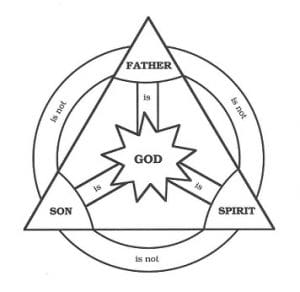
Speaking through the prophet Isaiah, God said, “My thoughts are not your thoughts, / Nor are your ways My ways … / For as the heavens are higher than the earth, / So are My ways higher than your ways, / And My thoughts than your thoughts” (Isa. 55:8–9). God is infinite, man is finite, so there are mysteries about God that man cannot fully understand. One of these mysteries is the Trinity, the tri-personality of God. According to Christian orthodoxy, God is one God in essence, power, and authority, and also eternally exists as three distinct co-equal persons. These three persons are the Father, the Son (Jesus), and the Holy Spirit. This does not mean that Christians believe in three gods (polytheism). Rather, the doctrine of the Trinity is that there is only one God who exists in three distinct persons, and all three share the exact same divine nature or essence.

Understanding this fully is beyond human comprehension and has no human parallels, although various analogies have been offered. One of these analogies is the three physical states of water. Water is not only a liquid but also a solid (ice) and a gas (vapor), yet its chemical composition (substance) never changes in all three forms (two parts hydrogen and one part oxygen—H2O). Although such analogies help us visualize the concept of the Trinity, they all fall short in some way. In the case of the water analogy, although the molecule H2O can be liquid, solid, or gas, it is never all three at one time. The Trinity, on the other hand, is all three persons as one God.

The word Trinity is not used in Scripture, but it has been adopted by theologians to summarize the biblical concept of God. Difficult as it is to understand, the Bible explicitly teaches the doctrine of the Trinity, and it deserves to be explained as clearly as possible, especially to non-Christians who find the concept a stumbling-block to belief. So let’s dig into this topic by addressing four key questions.

IS THE DOCTRINE OF THE TRINITY IRRATIONAL?

The doctrine of the Trinity is certainly a mystery but that doesn’t mean it’s irrational. The concept cannot be known by human reason apart from divine revelation, and, as we’ll soon see, the Bible definitely supports the idea of the Trinity. But for now, I want to demonstrate that the doctrine of the Trinity, although beyond human comprehension, is nevertheless rational. Our acceptance of it is congruous with how we respond to other data about the known world.

There are many things about the universe we don’t understand today and yet accept at face value simply because of the preponderance of evidence supporting their existence. The scientific method demands that empirical evidence be accepted whether or not science understands why it exists or how it operates. The scientific method does not require that all data be explained before it is accepted.

Contemporary physics, for instance, has discovered an apparent paradox in the nature of light. Depending on what kind of test one applies (both of them “equally sound”), light appears as either undulatory (wave-like) or corpuscular (particle-like). This is a problem. Light particles have mass, while light waves do not. How can light have mass and not have it, apparently at the same time? Scientists can’t yet explain this phenomenon, but neither do they reject one form of light in favor of the other, nor do they reject that light exists at all. Instead, they accept what they’ve found based on the evidence and press on.

Like physicists, we are no more able to explain the mechanics of the Trinity than they can explain the apparent paradox in the nature of light. In both cases, the evidence is clear that each exists and harbors mystery. So we must simply accept the facts and move on. Just because we cannot explain the Trinity, how it can exist, or how it operates does not mean that the doctrine must be rejected, so long as sufficient evidence exists for its reality. So let’s now explore this evidence.

HOW DOES THE BIBLE PRESENT THE DOCTRINE OF THE TRINITY?

THE OLD TESTAMENT

Although the doctrine of the Trinity is fully revealed in the New Testament, its roots can be found in the Old Testament.

In several places, God refers to Himself in plural terms. For example, “Then God said, ‘Let Us make man in Our image’” (Gen. 1:26; see 3:22; 11:7; Isa. 6:8).

The Messiah was prophesied in the Old Testament as being divine. Isaiah 9:6 states that the Messiah will be called “Mighty God,” a term applied in the Old Testament specifically to Yahweh (see Mic. 5:2).

Isaiah 48:16 refers to all three members of the Godhead: “Come near to Me, listen to this: From the first I have not spoken in secret, from the time it took place, I was there. And now the Lord God [Father] has sent Me [Jesus], and His Spirit [the Holy Spirit]” (nasv).

The Old Testament also makes numerous references to the Holy Spirit in contexts conveying His deity (Gen. 1:2; Neh. 9:20; Ps. 139:7; Isa. 63:10–14).

THE NEW TESTAMENT

The New Testament provides the most extensive and clear material on the Trinity. Here are just a few of the texts that mention all three members of the Godhead and imply their co-equal status.

•     Matthew 28:19, the baptismal formula: “Go therefore and make disciples of all the nations, baptizing them in the name [not ‘names’] of the Father and of the Son and of the Holy Spirit.”

•     Matthew 3:16, at the baptism of Christ in the Jordan: “And after being baptized, Jesus went up immediately from the water; and behold, the heavens were opened, and He saw the Spirit [Holy Spirit] of God [Father] descending as a dove, and coming upon Him [Jesus]” (nasv).

•     Luke 1:35, the prophetic announcement to Mary of Jesus’ birth: “And the angel answered and said to her, ‘The Holy Spirit will come upon you, and the power of the Highest [Father] will overshadow you; therefore, also, that Holy One who is to be born will be called the Son of God [Jesus].’”

•     The trinitarian formula is also found in 1 Peter 1:2, 2 Corinthians 13:14, and 1 Corinthians 12:4–6.

DIGGING DEEPER

To explain the doctrine of the Trinity, I will take an inductive (scientific) approach. By this I mean I will accumulate general facts in Scripture that lead to a specific conclusion—that the nature of God is triune. The argument will go like this:

1. The Bible teaches that God is one (monotheism) and that He possesses certain attributes that only God can have.

2. Yet when we study the attributes of the Father, the Son, and the Holy Spirit, we discover that all three possess the identical attributes of deity.

3. Thus we can conclude that there is one God eternally existing as three distinct persons.

God Is One (Monotheism)

The Hebrew Shema of the Old Testament is “Hear, O Israel: The Lord our God, the Lord is one!” (Deut. 6:4; see Isa. 43:10; 44:6; 46:9). Some people have argued that this passage actually refutes the concept of the triune nature of God because it states that God is one. But the Hebrew word for “one” in this text is echod, which carries the meaning of unity in plurality. It is the same word used to describe Adam and Eve becoming “one flesh” (Gen. 2:24). Scripture is not affirming that Adam and Eve literally become one person upon marriage. Rather, they are distinct persons who unite in a permanent relationship.

The New Testament confirms the teaching of the Old: “You believe that God is one. You do well; the demons also believe, and shudder” (James 2:19, nasv; see 1 Tim. 2:5; 1 Cor. 8:4; Eph. 4:4–6).

God Has a Certain Nature

Both the Old and New Testaments list the attributes of God. We won’t consider all of them here, but what follows are some of the clearest expressions of what constitutes deity.

•     God is omnipresent (present everywhere at once): Psalm 139:7–10; Jeremiah 23:23–24.

•     God is omniscient (possesses infinite knowledge): Psalms 139:1–4; 147:4–5; Hebrews 4:13; 1 John 3:20.

•     God is omnipotent (all-powerful): Psalm 139:13–18; Jeremiah 32:17; Matthew 19:26.

The Father Is God

To the Jews, who do not accept the Trinity, God is Yahweh. In the Old Testament, Yahweh is to the Hebrews what Father is in the New Testament and to Christians. The attributes of God (Yahweh) listed above are the same for Yahweh and Father because both names apply to the one God. Although the concept of God as Father is not as explicit in the Old Testament as it is in the New, nevertheless, it has its roots in the Old (see Pss. 89:26; 68:5; 103:13; Prov. 3:12).

In the New Testament, the concept of the Father as a distinct person in the Godhead becomes clear (Mark 14:36; 1 Cor. 8:6; Gal. 1:1; Phil. 2:11; 1 Pet. 1:2; 2 Pet. 1:17). God is viewed as Father over creation (Acts 17:24–29), the nation of Israel (Rom. 9:4; see Exod. 4:22), the Lord Jesus Christ (Matt. 3:17), and all who believe in Jesus as Lord and Savior (Gal. 3:26).

The Son Is God

Like the Father, Jesus possesses the attributes of God. He is omnipresent (Matt. 18:20; 28:20). He is also omniscient: He knows people’s thoughts (Matt. 12:25), their secrets (John 4:29), the future (Matt. 24:24–25), indeed all things (John 16:30; 21:17). His omnipotence is also taught. He has all power over creation (John 1:3; Col. 1:16), death (John 5:25–29; 6:39), nature (Mark 4:41; Matt. 21:19), demons (Mark 5:11–15), and diseases (Luke 4:38–41).

In addition to these characteristics, Jesus exhibits other attributes that the Bible acknowledges as belonging only to God. For example, He preexisted with the Father from all eternity (John 1:1–2), accepted worship (Matt. 14:33), forgave sins (Matt. 9:2), and was sinless (John 8:46).

The Holy Spirit Is God

The Holy Spirit is also omnipresent (Ps. 139:7–10), omniscient (1 Cor. 2:10), and omnipotent (Luke 1:35; Job 33:4).

Like Jesus, the Holy Spirit exhibits other divine attributes that the Bible ascribes to God. For instance, He was involved in creation (Gen. 1:2; Ps. 104:30), inspired the authorship of the Bible (2 Pet. 1:21), raised people from the dead (Rom. 8:11), and is called God (Acts 5:3–4).

The upshot of all this is that God is triune. In a formal argument, we can put it this way:

Major Premise:

Only God is omnipresent, omniscient, and omnipotent.

Minor Premise:

The Father, the Son, and the Holy Spirit are omnipresent, omniscient, and omnipotent.

Conclusion:

Therefore, God is triune as Father, Son, and Holy Spirit.

THE TRINITY

HOW DOES JESUS TEACH THE DOCTRINE OF THE TRINITY?

In the Bible, Jesus claims to be God and then demonstrates this claim by displaying the attributes of God and by raising Himself from the dead. So what Jesus has to say about God must be true. And Jesus clearly teaches that God is triune.

Jesus Is Equal with the Father and Holy Spirit

In Matthew 28:19, Jesus tells His followers to “make disciples of all the nations, baptizing them in the name of the Father and of the Son and of the Holy Spirit.” He uses the singular word name but associates it with three persons. The implication is that the one God is eternally three co-equal persons—Father, Son, and Holy Spirit.

Jesus Is One with the Father

In John 14:7 and 9, Jesus identifies Himself with the Father by saying to His disciples, “If you had known Me, you would have known My Father also; and from now on you know Him and have seen Him … He who has seen Me has seen the Father” (see John 5:18). Jesus is not claiming to be the Father; rather, He is saying that He is one with the Father in essence.

Jesus Is One with the Holy Spirit

Continuing in John 14, Jesus tells His disciples that, after He is gone, He will send them “another Helper” who will be with them forever and will indwell them (vv. 16–17). The “Helper” is the Holy Spirit. The trinitarian implication lies with the word another. The apostle John, as he wrote this passage, could have chosen one of two Greek words for another. Heteros denotes “another of a different kind,” while allos denotes “another of the same kind as myself.” The word chosen by John was allos, clearly linking Jesus in substance with the Holy Spirit, just as He is linked in substance with the Father in verses 7 and 9. In other words, the coming Holy Spirit will be a different person than Jesus, but He will be the same with Him in divine essence just as Jesus and the Father are different persons but one in their essential nature. Thus, in this passage, Jesus teaches the doctrine of the Trinity.

So far we have seen that the authors of Scripture and Jesus Christ teach the triune nature of God. Therefore, the only way the doctrine of the Trinity can be rejected is if one refuses to accept the biblical evidence. Some groups, such as the Jehovah’s Witnesses, do this by reinterpreting and altering Scripture. Others, such as the Unitarians (who claim that Jesus is just a man), arbitrarily and without any evidence deny anything supernatural or miraculous in the Bible. Both the Jehovah’s Witnesses and the Unitarians are guilty of the very same thing of which they accuse Christians—irrationality. They refuse to accept the evidence for the Trinity regardless of how legitimate it is. This is unscientific and irrational. If one approaches Scripture without bias, he will clearly discover what the church has maintained for centuries: God is triune—one God in essence but eternally existing in three persons as Father, Son, and Holy Spirit.

A COMMON OBJECTION

Perhaps you’ve wondered or heard someone say, “If Jesus is one in essence with the Father, an equal member of the triune Godhead, why does He say, ‘the Father is greater than I’” (John 14:28)? This question actually moves away from the doctrine of the Trinity and launches us into the doctrine of the incarnation, the process whereby Jesus, as the eternal Son of God, came to earth as man. Nevertheless, because this question is frequently raised as an objection, it needs to be answered.

Numerous passages in Scripture teach that Jesus, although fully God, is also fully man (John 1:14; Rom. 8:3; Col. 2:9; 1 Tim. 3:16). However, Philippians 2:5–8 states that, in the process of taking on humanity, Jesus did not give up any of His divine attributes. Rather, He gave up His divine glory (see John 17:5) and voluntarily chose to withhold or restrain the full use of His divine attributes. There are numerous instances in Scripture where Jesus, although in human form, exhibits the attributes of deity. If Jesus had surrendered any of His divine attributes when He came to earth, He would not have been fully God and thus could not have revealed the Father as He claimed to do (John 14:7, 9).

The key to understanding passages such as John 14:28 is that Jesus, like the Father and the Holy Spirit, has a particular position in the triune Godhead. Jesus is called the Son of God, not as an expression of physical birth, but as an expression of His position in relationship to the Father and Holy Spirit. This in no way distracts from His equality with the Father and the Holy Spirit or with His membership in the Godhead. As man, Jesus submits to the Father and acts in accordance to the Father’s will (see John 5:19, 30; 6:38; 8:28). So when we read passages such as Mark 14:36 where Jesus submits to the Father’s will, His submission has nothing to do with His divine essence, power, or authority, only with His position as the Incarnate Son.

Perhaps an illustration will help to explain this. Three people decide to pool their money equally and start a corporation. Each are equal owners of the corporation, but one owner becomes president, another vice-president, and the third secretary/treasurer. Each are completely equal so far as ownership, yet each has his own particular function to perform within the corporation. The president is the corporate head, and the vice-president and secretary/treasurer are submissive to his authority and carry out his bidding.

So when Jesus the God-man submits to the Father’s will or states that the Father is greater than He or that certain facts are known only by the Father (e.g., Matt. 24:36), it does not mean that He is less than the other members of the Godhead but that in His incarnate state He did and knew only that which was according to the Father’s will. The Father did not will that Jesus have certain knowledge while in human form. Because Jesus voluntarily restrained the full use of His divine attributes, He was submissive to the Father’s will.

Why did Jesus choose to hold back from fully using His divine powers? For our sake. God willed that Jesus feel the full weight of man’s sin and its consequences. Because Jesus was fully man, He could fulfill the requirements of an acceptable sacrifice for our sins. Only a man could die for the sins of mankind. Only a sinless man could be an acceptable sacrifice to God. And it is only because Jesus is an equal member of the triune Godhead, and thus fully God, that He was able to raise Himself from the dead after dying on the cross and thereby guarantee our eternal life.

When all the evidence is accounted for and the verdict read, the Bible clearly teaches that the Father, the Son, and the Holy Spirit are three distinct, co-equal, co-eternal members of the Godhead, yet one in essence, power, and authority. All three are one God. Were this not the case, if the Trinity were not a reality, there would be no Christianity.

[1]


[1]Story, D. (1997). Defending your faith. Originally published: Nashville : T. Nelson, c1992. (99). Grand Rapids, MI: Kregel Publications.

What solid evidence is there for the Mosaic authorship of the Pentateuch? Gleason L. Archer

What solid evidence is there for the Mosaic authorship of the Pentateuch?

What solid evidence is there for the Mosaic authorship of the Pentateuch?

It is common in liberal or neoorthodox circles to deny that Moses had anything to do with the composition of the Pentateuch. Most critics of that persuasion feel that the so-called Books of Moses were written by several different, anonymous authors beginning in the ninth century and concluding with the final portion, the “Priestly Code,” around 445 B.C.—just in time for Ezra to read it aloud at the Feast of Tabernacles (cf. Neh. 8).

Still, other scholars, especially those of the form-critical school, feel that rather little of the Pentateuch was actually written down until the time of Ezra, even though some portions of it may have existed as oral tradition for several centuries previous—perhaps even to the period of Moses himself. In view of the general consensus among non-Evangelical scholars that all claims to Mosaic authorship are spurious, it is well for us to review at least briefly the solid and compelling evidence, both internal and external, that the entire Pentateuch is the authentic work of Moses, under the inspiration of God the Holy Spirit.

Biblical Testimony to Mosaic Authorship

The Pentateuch often refers to Moses as its author, beginning with Exodus 17:14: “And Yahweh said to Moses, ‘Write for me a memorial in a book … that I will utterly blot out the remembrance of Amalek.’ ” In Exodus 24:4 we read, “And Moses wrote all the words of Yahweh.” In v.7 we are told, “And he took the book of the covenant, and read it in the hearing of the people.” Other references to Moses’ writing down the Pentateuch are found in Exodus 34:27, Numbers 33:1–2, and Deuteronomy 31:9, the last of which says, “And Moses wrote this law and delivered it to the priests.” Two verses later it is made a standing requirement for the future that when “all Israel has come to appear before Yahweh, you shall read this law before all Israel in their hearing.” This provision apparently comprises all of Exodus, Leviticus, Numbers, and most of Deuteronomy (at least through chap. 30).

Later on, after the death of Moses, the Lord gives these directions to Joshua, Moses’ successor: “This book of the Law shall not depart from your Mouth, but you are to meditate in it day and night, in order that you may be careful to do according to all that is written in it” (Josh. 1:8). The denial of Mosaic authorship would mean that every one of the above-cited verses is false and unworthy of acceptance.

Joshua 8:32–34 records that with the congregation of Israel stationed outside the city of Shechem, on the slopes of Mount Ebal and Mount Gerizim, Joshua read aloud from the Law of Moses inscribed on stones the passages in Leviticus and Deuteronomy referring to the blessings and curses, as Moses earlier had Deut. 27–28). If the Documentary Hypothesis is correct, then this account must also be rejected as a sheer fabrication. Other Old Testament references to the Mosaic authorship of the Pentateuch are 1 Kings 2:3; 2 Kings 14:6; 21:8; Ezra 6:18; Nehemiah 13:1; Daniel 9:11–13; and Malachi 4:4. All these testimonies must also be rejected as totally in error.

Christ and the apostles likewise gave unequivocal witness that Moses was the author of the Torah (law). In John 5:46–57, Jesus said, “If you believed Moses, you would believe me, for he wrote about me. But if you do not believe his writings, how can you believe my words?” How indeed! Likewise, in John 7:19, Jesus said, “Did not Moses give you the Law? And yet none of you does the Law.” If Christ’s confirmation of Moses as the real author of the Pentateuch is set aside—as it is by the modern critical theory—it inescapably follows that the authority of Christ Himself is denied.

For if He was mistaken about a factual, historical matter like this, then He might be mistaken about any other belief He held or doctrines He taught. In Acts 3:22, Peter said to his countrymen, “Moses indeed said, ‘A Prophet shall the Lord God raise up to you’ ” (cf. Deut. 18:15). Paul affirmed in Romans 10:5 that “Moses writes that the man who practices righteousness based on the law will live by that righteousness.” But the JEDP theory of Wellhausen and the rationalistic modern critics deny that Moses ever wrote any of those things. This means that Christ and the apostles were totally mistaken in thinking that he did.

Such an error as this, in matters of historical fact that can be verified, raises a serious question as to whether any of the theological teaching, dealing with metaphysical matters beyond our powers of verification, can be received as either trustworthy or authoritative. Thus we see that the question of Mosaic authenticity as the composer of the Pentateuch is a matter of utmost concern to the Christian. The authority of Christ Himself is involved in this issue.

Internal Evidence of Mosaic Composition

In addition to the direct testimonies of the Pentateuchal passages quoted above, we have the witness of the incidental allusions to contemporary events or current issues, to social or political conditions, or to matters of climate or geography. When all such factors are fairly and properly weighed, they lead to this conclusion: the author of these books and his readers must originally have lived in Egypt. Furthermore, these factors indicate that they had little or no firsthand acquaintance with Palestine and knew of it only by oral tradition from their forefathers. We cite the following evidences.

  1. The climate and weather referred to in Exodus are typically Egyptian, not Palestinian (cf. the reference to crop sequence in connection with the plague of hail, Exod. 9:31–32).
  2. The trees and animals referred to in Exodus through Deuteronomy are all indigenous to Egypt or the Sinai Peninsula, but none of them are peculiar to Palestine. The shittim or acacia tree is native to Egypt and the Sinai, but it is hardly found in Canaan except around the Dead Sea. This tree furnished the wood for much of the tabernacle furniture. The skins for its outer covering were the hide of the taḥaš, or dugong, which is foreign to Palestine but is found in the seas adjacent to Egypt and the Sinai. As for the lists of clean and unclean animals found in Leviticus 11 and Deuteronomy 14, these include some that are peculiar to the Sinai Peninsula, such as the dîśōn, or pygarg (Deut. 14:5); the yaʿanāh, or ostrich (Lev. 11:16); and the teʾô, or wild antelope (Deut. 14:5). It is difficult to imagine how a list of this sort could have been made up nine hundred years later, after the Hebrew people had been living in a country not possessing any of these beasts.
  3. Even more conclusive are the geographical references that betray the perspective of one who is personally unfamiliar with Palestine but is well acquainted with Egypt. (1) In Genesis 13:10, where the author wishes to convey to his readers how verdant the vegetation of the Jordan Valley was, he compares it to a well-know locality in the eastern part of the Egyptian Delta region, lying near Mendes, between Busiris and Tanis. He states that the Jordan Valley was like “the land of Egypt, as you go toward Zoar” (Egyp.T-;-r). Nothing could be plainer from this casual reference than that the author was writing for a readership unfamiliar with the appearance of regions in Palestine but personally acquainted with the scenery of Lower Egypt. Such could only have grown up in Egypt, and this fits in only with a Mosaic date of composition for the Book of Genesis. (2) The founding of Kirjath-arba (the pre-Israelite name of Hebron in southern Judah) is stated in Numbers 13:22 to have taken place “seven years before Zoan in Egypt.” This clearly implies that Moses’ readers were well aware of the date of the founding of Zoan but unfamiliar with when Hebron—which became one of the foremost cities in Israel after the Conquest—was first founded. (3) In Genesis 33:18, there is a reference to “Salem, a city of Shechem in the land of Canaan.” To a people who had been living in Palestine for over seven centuries since the Conquest (according to the date given this passage by the Wellhausen School), it seems rather strange that they would have to be told that so outstanding a city as Shechem was located “in the land of Canaan.” But it would be perfectly appropriate to a people who had not yet settled there—as was true of the congregation of Moses.
  4. The atmosphere and setting of the desert prevails all through the narrative, from Exodus 16 to the end of Deuteronomy (though there are some agricultural references looking forward to settled conditions in the land that they were soon to conquer). The prominence accorded to a large tent or tabernacle as the central place of worship and assembly would hardly be relevant to a readership living in Palestine for over seven centuries and familiar only with the temple of Solomon or Zerubbabel as their central sanctuary. The Wellhausen explanation for this, that the tabernacle was simply an artificial extrapolation from the temple, does not fit the facts; the temple was much different in size and furnishings from those described for the tabernacle in the Torah. But even this theory of historical fiction furnishes no explanation of why Ezra’s contemporaries would have been so interested in a mere tent as to devote to it so many chapters in Exodus (Ex. 25–40) and to refer to it in nearly three-fourths of Leviticus and very frequently also in Numbers and Deuteronomy. No other example can be found in all world literature for such absorbing attention to a structure that never really existed and that had no bearing on the generation for which it was written.
  5. There are many evidences of a technical, linguistic nature that could be adduced to support an Egyptian background for the text of the Torah. Detailed examples of this may be found in my Survey of Old Testament Introduction (pp. 111–114). Suffice it to say that a far greater number of Egyptian names and loan words are found in the Pentateuch than in any other section of Scripture. This is just what we would expect from an author who was brought up in Egypt, writing for a people who were reared in the same setting as he.
  6. If the Pentateuch was composed between the ninth and fifth centuries B.C., as the Documentary school maintains, and if it extrapolated the religious practices and political perspectives of the fifth and sixth centuries back to the times of Moses (by way of a pious fraud), it is reasonable to expect that this spurious document, concocted long after Jerusalem had been taken over as the capital of the Israelite kingdom, would surely have referred to Jerusalem by name on many occasions. It would certainly have included some prophecy of the future conquest of that city and its coming status as the location of the permanent temple of Yahweh. But a careful examination of the entire text of Genesis through Deuteronomy comes up with the astonishing result that Jerusalem is never once mentioned by name. To be sure, Mount Moriah appears in Genesis 22 as the location of Abraham’s attempted sacrifice of Isaac, but there is no suggestion that it was to be the future location of the temple.

In Genesis 14 there is a reference to Melchizedek as the “King of Salem”—not “Jerusalem”—but again without any hint that it would later become the religious and political capital of the Hebrew Commonwealth. In Deuteronomy 12:5–18 there are references to a “place that Yahweh your God shall choose from all your tribes, to establish His name there for His dwelling.”

While these references are general enough to include such places as Shiloh and Gibeon, where the tabernacle was kept for extended periods of time before the erection of Solomon’s temple, it is fair to assume that Deuteronomy 12:5 was mainly intended as a prediction of the establishment of the Jerusalem temple. Yet it is almost impossible to account for the failure of this allegedly late and spurious work of Moses to mention Jerusalem by name, when there was every incentive to do so. Only the supposition that the Torah was genuinely Mosaic, or at least composed well before the capture of Jerusalem in 1000 B.C., can account for its failure to mention the city at all by name.

  1. In dating literary documents, it is of greatest importance to take stock of the key terms that are apparently current at the time the author did his work. In the case of a religious book, the titles by which God is characteristically referred to are of pivotal significance. During the period between 850–450 B.C., we find increasing prominence given to the title YHWH ṣeḇaʾóṯ (most frequently rendered in English versions by “the LORD of Hosts”). This appellation, which lays particular stress on the omnipotence of Israel’s Convenant-God, occurs about sixty-seven times in Isaiah (late eight century), eighty three times in Jeremiah (late seventh and early sixth centuries), thirteen times in the two chapters of Haggai (late sixth century), and fifty-one times in the fourteen chapters of Zechariah (late sixth to early fifth century). These prophets cover nearly the whole span of time during which the Pentateuchal corpus was being composed by Messrs. J, E, D, and P; yet amazingly enough, the title “Yahweh of Hosts” is never once to be found in the entire Pentateuch. From the standpoint of the science of comparative literature, this would be considered the strongest kind of evidence that the Torah was composed at a period when the title “Yahweh of Hosts” was not in use—therefore, all of it, even the so-called Priestly Code, must have been composed before the eighth century B.C. If this is a valid deduction, then the entire Documentary Hypothesis must be altogether abandoned.
  2. If the Priestly Code portion of the Pentateuch was truly composed in the sixth and fifth centuries B.C., it would be expected that distinctively Levitical institutions and enrichments of public worship introduced from the time of David onward would find frequent mention in the Pentateuch. Such distinctives would surely include the guilds of temple singers, who were divided into twenty-four courses by King David (1 Chron. 25) and were often referred to in the titles of the Psalms. Yet no organized guilds of Levitical singers are ever once referred to in the Torah.

The order of scribes (sōp̱ērîm) should certainly have received mentioned as the great chief of scribes, Ezra himself, was finalizing large portions of the Pentateuch in time for the 445 B.C. celebration of the Feast of Tabernacles—according to the Wellhausen hypothesis. But for some strange reason there is no reference whatever to the scribal order or function, nor any prophetic hint that there will some day be such a class of guardians of the sacred text.

From the time of Solomon and onward, there was a very important class of temple servants known as the Nethinim (“those who have given,” i.e., to the service of the Lord in the temple). The number of Nethinim (392) who joined the 42,000 returnees from Babylon in 538 B.C. is included in the statistics of Ezra 2:58 and Nehemiah 7:60, along with the count of the Levites and priests. But there is no reference to them or prediction of them to be found in “Document P.” Very strange!

From the time of David, “the sweet psalmist of Israel” (2 Sam 23:1), liberal use was made of various musical instruments (stringed, wind, percussion—all three types) in connection with public worship before the Lord. Certainly a Mosaic sanction for this important feature of Levitical worship ought to have been included in the Torah if it had been composed as late as the tenth century or thereafter.

But surprisingly enough, it fails to contain a single reference to musical accompaniment in connection with tabernacle worship. This is impossible to reconcile with a composition date in the fifth century B.C. It is beyond debate that a professional priestly group such as the Documentarians describe would have had the strongest motivation for including such cherished institutions as these among the ordinances of “Moses.”

  1. The Pentateuch, especially in Deuteronomy, contains several references to the future conquest of Canaan by the descendants of Abraham. The Deuteronomic speaker is filled with confidence that the Hebrew host will overwhelm all opposition within the land of Canaan, defeat every army, and storm every city they decide to attack. This is clearly reflected in the repeated exhortations to destroy every Canaanite temple or shrine with complete thoroughness (Deut. 7:5; 12:2–3; cf. Exod. 23:24; 34:13).

Since every nation defends its religious shrines with the utmost resistance of which it is capable, the assumption that Israel will be able to destroy every pagan sanctuary throughout the land assumes the military supremacy of Yahweh’s people after their invasion of the land. At what other juncture in the career of the Hebrew nation could such a confidence have been entertained except in the days of Moses and Joshua?

Here again, internal evidence points very strongly to a Mosaic date of composition. Nothing could be more unrealistic than to suppose that Josiah back in 621 B.C., when Judah was a tiny vassal state under the Assyrian Empire, could have expected to break down every idolatrous altar, destroy every pillar (maṣṣēḇāh) and cultic tree (ʾašērāh), and smash every temple structure to rubble throughout the length and breadth of Palestine. Or how could the struggling little colony of post-Exilic fifth-century Judea expect to make a clean sweep of every heathen shrine from Dan to Beer-Sheba?

The only conclusion to draw from these Pentateuchal commands to destroy all traces of idolatry is that it was within Israel’s military capabilities to carry out this program throughout the whole region. But nothing could have been more inappropriate in the time of Zechariah, Ezra, and Nehemiah than to contemplate such a thorough extirpation of idol worship throughout Palestine. For them it was a battle just to survive, so repeated were their crop failure and so serious was the opposition of all the nations surrounding them. Neither “Document P” in the time of Ezra nor Deuteronomy in the days of Josiah could possibly be harmonized with such passages as these.

  1. Deuteronomy 13:2–11 provides the penalty of death by stoning for any idolater or false prophet, even for a brother, wife, or child. Deut. 13:12–17 go on to say that even if it is an entire city that has turned to idolatry, every inhabitant within it is to be put to death, all houses are to be reduced to rubble and ashes, and all property is to be put under the ban. This is no visionary theory but a serious ordinance with inbuilt investigative procedures, reflecting a program that is meant to be carried out within contemporary Israel. But as we examine the account of Judah’s religious situation in the seventh century B.C. (or, indeed, in the eighth century from the time of Ahaz on), we find that idol worship was tolerated and practiced in almost every municipality throughout the kingdom—except during the reforms of Hezekiah and Josiah. This would have meant the destruction of every city and town throughout the realm, even including Jerusalem itself. No one devises laws that are completely impossible to carry out in the light of contemporary conditions. The only period in Israel’s history when such legislation could have been enacted and enforced was back in the days of Moses and Joshua—or possibly in the time of David. (Already by Solomon’s time shrine worship on the “high places” was practiced.)

Moses’ Qualifications for Authorship of the Pentateuch

From all the biblical references to Moses’ background and training, it is apparent that he had just the right qualifications to compose just such a work as the Torah.

  1. He had a fine education as a prince reared in the Egyptian court (Acts 7:22), in a land that was more literate than any other country in the Fertile Crescent. Even the mirror handles and toothbrushes were adorned with hieroglyphic inscriptions, as well as the walls of every public building.
  2. From his Israelite ancestors, he must have received a knowledge of the oral law that was followed in Mesopotamia, where the patriarchs had come from.
  3. From his mother and blood relations, Moses must have received a full knowledge of the experiences of the patriarchs, all the way from Adam to Joseph; and from this wealth of oral tradition, he would have been equipped with all the information contained in Genesis, being under the sure guidance of the Holy Spirit as he composed the inspired text of the Torah.
  4. As a longtime resident of Egypt and also of the land of Midian in the Sinai, Moses would have acquired a personal knowledge of the climate, agricultural practices, and geographical peculiarities of both Egypt and the Sinai Peninsula, such as is obvious throughout the text of these four books (Exodus through Deuteronomy), which deal with the fifteenth-century world in the vicinity of the Red Sea and the Nile.
  5. As the divinely appointed founder of a new nation to be governed by the revealed law of God, Moses would have had every incentive to compose this monumental work, including Genesis, with its full account of God’s gracious dealings with Israel’s ancestors before the migration of Jacob’s family to Egypt. And since this young nation was to be governed by the Law of God rather than by some royal despot like the pagan nations around them, it was incumbent on Moses to compose (under God’s inspiration and guidance) a carefully detailed listing of all the Laws God had given to guide His people in the ways of justice, godliness, and worship. Over the forty-year period of the wilderness wanderings, Moses had ample time and opportunity to lay out the entire system of civil and religious law that God had revealed to him to serve as the constitution for the new theocratic commonwealth.

Moses had, then, every incentive and every qualification to compose this remarkable production.

The Basic Fallacy Underlying the Documentary Hypothesis

The most serious of the false assumptions underlying the Documentary Hypothesis and the form-critical approach (the former assumes that no part of the Torah found in written form until the mid-ninth century B.C., the latter defers all writing down of the received Hebrew text of the Pentateuch until the time of the Exile) is that the Israelites waited until many centuries after the foundation of their commonwealth before committing any part of it to written form.

Such an assumption flies in the face of all the archaeological discoveries of the last eighty years, that all of Israel’s neighbors kept written records relating to their history and religion from before the time of Moses. Perhaps the massive accumulation of inscriptions on stone, clay, and papyrus that have been exhumed in Mesopotamia and Egypt might have been questioned as necessarily proving the extensive use of writing in Palestine itself—until the 1887 discovery of the archive of Palestinian clay tablets in Tell el-Amarna, Egypt, dating from about 1420 to 1380 B.C. (the age of Moses and Joshua).

This archive contained hundreds of tablets composed in Babylonian cuneiform (at that time the language of diplomatic correspondence in the Near East), which were communications to the Egyptian court from Palestinian officials and kings. Many of these letters contain reports of invasions and attacks by the Ha-bi-ru and the so-called SA.GAZ (the oral pronunciation of this logogram may well have been Habiru also) against the city-states of Canaan.

Wellhausen himself chose to ignore this evidence almost completely after the earliest publications of these Amarna Tablets came out in the 1890s. He refused to come to terms with the implications of the now-established facts that Canaan even before the Israelite conquest was completed contained a highly literate civilization (even though they wrote in Babylonian rather than their own native tongue). The later proponents of the Documentary Hypothesis have been equally closed-minded toward the implications of these discoveries.

The most serious blow of all, however, came with the deciphering of the alphabetic inscriptions from Serabit el-Khadim in the region of Sinai turquoise mines operated by the Egyptians during the second millennium B.C. These consisted of a new set of alphabetic symbols resembling Egyptian hieroglyphs but written in a dialect of Canaanite closely resembling Hebrew.

They contained records of mining quotas and dedicatory inscriptions to the Phoenician goddess Baalat (who was apparently equated with the Egyptian Hathor). The irregular style of execution precludes all possibility of attributing these writings to a select group of professional scribes. There is only one possible conclusion to draw from this body of inscriptions (published by W.F. Albright in The Proto-Sinaitic Inscriptions and Their Decipherment [Cambridge: Harvard University, 1966]): Already back in the seventeenth or sixteenth centuries B.C., even the lowest social strata of the Canaanite population, slave-miners who labored under Egyptian foremen, were well able to read and write in their own language.

A third important discovery was the library of clay tablets discovered in the North Syrian site of Ras es-Shamra, anciently known as Ugarit, in which were many hundreds of tablets written around 1400 B.C. in an alphabetic cuneiform dialect of Canaanite, closely related to Hebrew. Along with business letters and government documents (some of which were written in Babylonian cuneiform), these tablets contained a great deal of religious literature.

They related the loves and wars and exciting adventures of various deities of the Canaanite pantheon, such as El, Anath, Baal, Asherat, Mot, and many others, composed in a poetic form resembling parallelistic Hebrew poetry as found in the Pentateuch and in the Psalms of David. Here again we have indisputable proof that the Hebrew conquerors under Joshua, having emigrated from a highly literate culture down in Egypt, came into another civilization that made liberal use of writing.

Furthermore, the high percentage of religious literature found at both Ras Shamra and Serabit el-Khadim utterly negate the supposition that, of all the ancient Near Eastern peoples, only the Hebrews did not contrive to put their religious records into written form until a thousand years later. Only the most unalterable form of bias in the minds of liberal scholars can account for their stubborn avoidance of the overwhelming mass of objective data that now support the proposition that Moses could have written, and in all probability did write, the books ascribed to him.

An even more fundamental fallacy underlies the modern Documentary approach, not only in regard to the authorship of the Pentateuch, but also to the composition of Isaiah 40–66 as an authentic work of the eighth-century Isaiah himself and the sixth-century date for the Book of Daniel. Basic to all these rationalist theories about the late and spurious nature of the composition of these Old Testament books is one firmly held assumption: the categorical impossibility of successful predictive prophecy.

It is taken for granted that there is no authentic divine revelation to be found in Scripture and that all apparently fulfilled prophecies were really the result of pious fraud. In other words, the predictions were not written down until they had already been fulfilled—or were obviously about to be fulfilled. The result is a logical fallacy known as petitio principii, or reasoning in a circle. That is to say, the Bible offers testimony of the existence of a personal, miracle-working God, who revealed His future purposes to chosen prophets for the guidance and encouragement of His people.

Through the abundance of fulfilled predictions, the Scripture furnishes the most compelling evidence of the supernatural, as exhibited by a personal God who cares for His people enough to reveal to them His will for their salvation. But the rationalist approaches all these evidences with a completely closed mind, assuming that there is no such thing as the supernatural and that fulfilled prophecy is per se impossible. With this kind of bias, it is impossible to give honest consideration to evidence pertaining directly to the matter under investigation.

After a careful study of the history of the rise of modern higher criticism as practiced by the Documentarians and the form-criticism school, this writer is convinced that the basic reason for the refusal to face up to objective archaeological evidence hostile to the antisupernaturalist theories of the critics must be found in a self defensive mentality that is essentially subjective. Thus it becomes absolutely essential for Documentarians to assign predictions of the Babylonian captivity and subsequent restoration (such as are found in Lev. 26 and Deut. 28) to a time after these events had already taken place.

This is the real philosophical basis for assigning such portions (included in the “Priestly Code” or “Deuteronomic school”) to the fifth century B.C., a thousand years later than the purported time of authorship. For, obviously, no mortal can successfully predict what lies even a few years in the future.

Since a fifteenth-century Moses would have to have foreseen what was going to happen in 587 and 537 B.C. in order to compose such chapters as these, he could never have composed them. But the Pentateuch says that Moses merely wrote down what almighty God revealed to him, rather than the product of his own unaided prophetic foresight.

Hence, there is absolutely no logical difficulty in supposing that he could have predicted, under divine inspiration, events that far in the future—or that Isaiah in the early seventh century could have foreknown the Babylonian captivity and the subsequent return to Judah, or that Daniel could have predicted the major events of history between his own day (530 B.C.) and the coming of Antiochus Epiphanes in 170 B.C. In each case the prophecy comes from God, the Lord of history, rather than from man; so there is no logical reason why God should be ignorant of the future that He Himself brings to pass.

Furthermore, the prophetic horizon of Daniel in Daniel 9:24–27 in actuality goes far beyond the Maccabean date assigned to it by rationalist scholars, for it pinpoints A.D. 27 as the exact year of Christ’s appearing (Dan. 9:25–26).

The same is true of the Deuteronomy 28:68 prediction of the aftermath of the fall of Jerusalem in A.D. 70 and of the Isaiah 13:19–20 prediction of the total and permanent desolation of Babylon, which did not take place until after the Muslim conquest in the seventh century A.D. It is hopeless to attempt to account for such late fulfillments as these by alleging that the books that contained them were not written until after the predictions had actually come to pass.

Thus we see that this guiding principle, which underlies the entire fabric of the Documentary Hypothesis, cannot be successfully maintained on objective or scientific grounds. It should, therefore, be abandoned in all our institutions of higher learning in which it is still being taught.

(As for the passages that are allegedly non-Mosaic on the basis of internal evidence, see the article on Exod. 6:26–27.)

[1]


[1]Archer, G. L. (1982). New International Encyclopedia of Bible Difficulties. Originally published: Encyclopedia of Bible difficulties. 1982. Zondervan’s Understand the Bible Reference Series (45). Grand Rapids, MI: Zondervan Publishing House.

What solid evidence is there for the Mosaic authorship of the Pentateuch?

Exit mobile version