الطلاب الكينيون طلبوا الصلاه قبل مقتلهم على يد عناصر حركة الشباب الصومالية

الطلاب الكينيون طلبوا الصلاه قبل مقتلهم على يد عناصر حركة الشباب الصومالية


الطلاب الكينيون طلبوا الصلاه قبل مقتلهم على يد عناصر حركة الشباب الصومالية
 
لا تملك عائلة ماينا أي أبقار. وتشعر الآن بفراغ أكبر.

يروي ستانلي ماينا وايهارو لصحيفة غارديان: “بعتها لأدفع تكاليف دراسته. كان ذلك نوعاً من التضحية ترافق مع توقع بأن شيئاً ما سينتج عنه. إنها تضحية طوعية”.

قال ماينا عن ابنه البكر، جون موانغي ماينا، الذي كان في الثانية والعشرين من عمره: “أخذت قرضاً بقيمة 200000 شلن (2163$) من أجل تعليم ابني لكي تكون له حياة أفضل مني. ثم، قتله هؤلاء ببساطة”.
أضاف الوالد أن جون كان الشخص الأول في عائلته الكبرى الذي يتلقى التعليم الجامعي.
أخبر ماينا الأب الصحيفة: “هذا الشاب كان يدرس دوماً في البيت، فيما كان الآخرون كلهم يلعبون خارجاً. كان يأخذ دراسته على محمل الجد. وكان أملنا فيه كبيراً”.   

الآن، تكشف التفاصيل عن حياة الأشخاص الذين توفوا في الاعتداء الذي شنه عناصر حركة الشباب على جامعة غاريسا نهار الخميس الفائت – في بداية ثلاثية الفصح. في ذاك النهار، قتل المعتدون 147 شخصاً كانوا بمعظمهم طلاباً. فقد استهدفت الجماعة الإرهابية الإسلامية المسيحيين، معتدية على حرم الكلية في الصباح الباكر ومقتحمة فترة الصلاة. 
كان معظم الضحايا أتقياء ومستعدين للتضحية بأنفسهم. يقال أن ماينا هرب وكان قادراً على النجاة بحياته، لكنه عاد من أجل إنقاذ رفيقته. عندها، أطلق النار عليه.

كذلك، أبدى الطلاب موقف تسليم أمرهم للعناية الإلهية وسط الاعتداء. ففي الرسالة النصية الأخيرة التي بعث بها طالب السنة الثانية في إدارة الأعمال أيوب نجاو كيموثو، 21 عاماً، لأخيه، كتب: “في هذه المرحلة، نسلم كل شيء إلى الله”. وحتى الآن، لا يزال مكان الطالب كيموثو مجهولاً.

“إنه شاب ورع، وكان غادر غرفته مع أحد زملائه في السكن لحضور صلوات الصباح”، حسبما أفاد أخوه دانيال شيغ لصحيفة Daily Nation.
أما إليزابيث نامارومي موسيناي، البالغة 20 عاماً، فقد اتصلت بوالدها وقالت له: “هناك إطلاق نار في كل مكان! قل لأمي أن تصلي من أجلي – لا أعلم إن كنت سأنجو”.

الاتصال فجراً كان أحد الاتصالات الكثيرة التي تلقتها عائلتها الخميس مع وقوع المأساة في الجامعة. وقد ذكر موقع Yahoo News أن رجلاً اتصل قرابة الواحدة من بعد الظهر ليطلب الاتصال بالرئيس الكيني أوهورو كينياتا خلال دقيقتين ومطالبته بسحب قواته من الصومال المجاورة حيث تحارب متطرفي حركة الشباب.

عاود الاتصال فوراً. وعندما أُعلم بأنه لم يتم الاتصال بالرئيس، قال: “سوف أقتل ابنتكم”. تلت قوله ثلاث طلقات نارية، من ثم أنهى المكالمة. وعندما اتصل والد إليزابيث، فريد كاكسون موسيناي بالرجل، قيل له: “هي الآن مع ربها”.                
كذلك، تحدثت ملكه روتو، التي كانت بانتظار التعرف على ابنتها جودي شيبكيمبوي، عن الحديث الأخير الذي دار بينهما.

قالت روتو لـ Capital News: “تمكنت ابنتي من الاتصال بي في ذاك اليوم المشؤوم، وقالت أنهم تعرضوا لهجوم من قبل عناصر حركة الشباب”. قالت جودي: “أنا تحت السرير وأحتاج إلى صلواتك لأننا في خطر”. هذا هو الحديث الأخير الذي دار بين الأم وابنتها.
هذا وأصدر رئيس أساقفة نيروبي، الكاردينال جون نجيو، رئيس مجلس أساقفة كينيا الكاثوليك، رسالة تضامن جاء فيها: “الكنيسة الكاثوليكية تلتزم بتفعيل الشبكات الرعوية لمؤمنينا المسيحيين لكي يقدموا دعمهم وصلواتهم”.

ودعا الزعماء الدينيين إلى أن “يتوقفوا عن التعليم والتبشير ببغض الأشخاص الذين لا يؤيدون دينهم وعقائدهم، وأن يعترفوا بأن الكل يؤمن بكائن أسمى”.

Is Jesus advocating pacifism and denouncing capital punishment in this passage? MATTHEW 26:52

MATTHEW 26:52—Is Jesus advocating pacifism and denouncing capital punishment in this passage?

PROBLEM: When the soldiers came to arrest Jesus, Peter took out his sword and cut off the ear of the high priest’s servant. Jesus told Peter to put back the sword because those who take up the sword will die by the sword. Some use this verse to support pacifism and to oppose capital punishment, which the Bible affirms elsewhere (Gen. 9:6).

SOLUTION: Total pacifism is not taught in this Scripture. Indeed, Abraham was blessed by the Most High God (Gen 14:19) after engaging in a war against the unjust aggression of the kings who had captured his nephew Lot. In Luke 3:14, soldiers come to inquire of John the Baptist about what they should do. John never told them to leave the army. Likewise, Cornelius, in Acts 10, was a centurion. He was called a devout man (v. 2), and the Scriptures say that the Lord heard the prayers of Cornelius (v. 4). When Cornelius becomes a Christian, Peter does not tell him to leave the army. Also, in Luke 22:36–38, Christ says that the one who has no sword should sell his robe and buy one. The apostles responded saying that they had two swords. Jesus responded saying that “it was enough.” In other words, they did not need to get rid of their swords. The Apostle Paul accepted the protection of the Roman army to save his life from unjust aggressors (Acts 23). Indeed, he reminded the Roman Christians that God had given the sword to the king who did not bear it in vain (Rom. 13:1–4). When Jesus returns to earth, He will come with the armies of heaven and will war against the kings of the earth (Rev. 19:11–19). So, from the beginning to the end, the Bible is filled with examples of the justification of war against evil aggressors.

What, then, did Jesus mean when He commanded Peter to put away his sword? Peter was making two mistakes in using his sword. First, while the Bible permits the sword by the government for civil purposes (Rom. 13:1–4), it does not endorse its use for spiritual ends. It is to be used by the state, not by the church. Second, Peter’s use was aggressive, not purely defensive. His life was not being unjustly threatened. That is, it was not clearly an act of self-defense (Ex. 22:2). Jesus appears to have endorsed the use of the sword in civil self-defense (Luke 22:36), as did the Apostle Paul (Acts 23).

Likewise, capital punishment is not forbidden in Scripture, but rather was established by God. Genesis 9:6 affirms that whoever sheds man’s blood, the blood of the killer will also be shed. Numbers 35:31 makes a similar statement. In the NT, Jesus recognized that Rome had capital authority and submitted to it (John 19:11). The Apostle Paul informed the Romans that governing authorities are ministers of God and that they still possessed the God-given sword of capital authority (13:1, 4). So Jesus in no way did away with the just use of the sword by civil authorities. He simply noted that those who live lives of aggression often die by the same means.

[1]


[1]Geisler, N. L., & Howe, T. A. (1992). When critics ask : A popular handbook on Bible difficulties (360). Wheaton, Ill.: Victor Books.

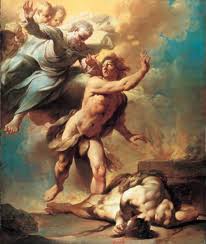
Why wasn’t Cain given capital punishment for the murder he committed


Why wasn’t Cain given capital punishment for the murder he

committed?

PROBLEM: In the OT, murderers were given capital punishment for their crime ( Gen.

9:6 ; Ex. 21:12 ). Yet Cain was not only set free after murdering his brother, but he

was protected from any avenger ( Gen. 4:15 ).

SOLUTION: There are several reasons why Cain was not executed for his capital crime.

First, God had not yet established capital punishment as an instrument of human

government (cf. Rom. 13:1–4 ). Only after violence filled the earth in the days before

the flood did God say, “Whoever sheds man’s blood, By man his blood shall be shed;

For in the image of God He made man” ( Gen. 9:6 ).

Further, who would have killed Cain? Cain had just killed Abel. At this early

stage only Adam and Eve were left. Surely, God would not have called upon the

parents to kill their only remaining son. In view of this, God, who alone is sovereign

over life and death ( Deut. 32:39 ), personally commuted Cain’s death penalty.

However, in so doing, God implied the gravity of Cain’s sin and implied he was

worthy of death by declaring that “the voice of your brother’s blood cries out to Me

[for vengeance] from the ground” (v. 10 ). Nonetheless, even Cain seemed to

recognize that he was worthy of death, and he asked God for protection (v. 14 ).

Finally, God’s promise to protect Cain from vengeance implies capital punishment

would be taken on any who took Cain’s life (cf. v. 15 ). So, Cain’s case is the

exception that proves the rule, and by no means does it argue against capital

punishment as established by God (see comments on John 8:3–11


Handling an Objection: “I love the moral teachings of Jesus but I don’t think He is divine.”

Handling an Objection: “I love the moral teachings of Jesus but I don’t think He is divine.”

 
This past week I was doing some outreach on a major college campus. When it came time to talk about the identity of Jesus, I heard two similar responses. Granted, I have heard this objection many, many, times. It goes like this:

“I really like the moral teachings of Jesus, but I don’t think he is divine.”

I could respond to this by using the C.S. Lewis argument that Jesus is either Lord, Lunatic, or Liar. I tend to not use that one a lot. While it still has some value it generally begs the question of the reliability of the New Testament. After all, some skeptics assume the deity of Jesus is a later invention of the Church. As I have noted elsewhere, this is incorrect. The Christology is Jesus was at the very start of the formation of the early Jesus movement.

Jesus is the Message

Anyway, how do I respond to this? First, since the person already admires the teachings of Jesus, I point to the blind spot in their thinking. First, it is not the moral teachings of Jesus that is the message. Rather, Jesus is the message!

Probably the most pertinent examples of how Jesus in the message is in the Gospel of John where we see the “I AM” (Gk. ego eimi,) statements. I am well aware that all these passages need to be studied in context. But we see clearly that Jesus is emphasizing He is the message. For example:

Then Jesus declared, “I am the bread of life. He who comes to me will never go hungry, and he who believes in me will never be thirsty. (John 6:35)

When Jesus spoke again to the people, he said, “I am the light of the world. Whoever follows me will never walk in darkness, but will have the light of life.” (John 8:12)

I am the gate; whoever enters through me will be saved. He will come in and go out, and find pasture. (John 10:9)

“I am the good shepherd. The good shepherd lays down his life for the sheep.” (John 10:11)

Jesus said to her, “I am the resurrection and the life. He who believes in me will live, even though he dies; and whoever lives and believes in me will never die.” (John 11:25-26)

Jesus answered, “I am the way and the truth and the life. No one comes to the Father except through me.” (John 14:6)

“I am the vine; you are the branches. If a man remains in me and I in him, he will bear much fruit; apart from me you can do nothing.” (John 15:5)

From a tactical perspective, when people say they only like the teachings of Jesus, it can allow you the opportunity to share these passages from John and ask them if they might rethink their position.

Why Was Jesus Crucified?

Second, I ask the person is why was Jesus crucified? One issue that can tend to be overlooked is that we can minimize the issue of blasphemy in a Jewish setting. by the way, none of the above figures were accused of blasphemy. According to Jewish law, the claim to be the Messiah was not a criminal, nor capital offense. Therefore, the claim to be the Messiah was not even a blasphemous claim. (1)

If this is true, why was Jesus accused of blasphemy? According to Mark 14:62, Jesus affirmed the chief priests question that He is the Messiah, the Son of God, and the Coming Son of Man who would judge the world. This was considered a claim for deity since the eschatological authority of judgment was for God alone. Jesus provoked the indignation of his opponents because of His application of Daniel 7:13 and Psalm 110:1 to himself.

Also, many parables, which are universally acknowledged by critical scholars to be authentic to the historical Jesus, show that Jesus believed himself to be able to forgive sins against God (Matt. 9:2; Mark 2: 1-12). Forgiving sins was something that was designated for God alone (Exod. 34: 6-7; Neh.9:17; Dan. 9:9) and it was something that was done only in the Temple along with the proper sacrifice. So it can be seen that Jesus acts as if He is the Temple in person. In Mark 14:58, it says, “We heard him say, ‘I will destroy this man-made temple and in three days will build another, not made by man.’ The Jewish leadership knew that God was the one who was responsible for building the temple (Ex. 15:17; 1 En. 90:28-29).(2)

Also, God is the only one that is permitted to announce and threaten the destruction of the temple (Jer. 7:12-13; 26:4-6, 9;1 En.90:28-29). (3) It is also evident that one reasons Jesus was accused of blasphemy was because He usurped God’s authority by making himself to actually be God (Jn. 10:33, 36). Not only was this considered by the Jews to be blasphemous, it was worthy of the death penalty (Matt. 26:63-66; Mk. 14:61-65; Lk. 22:66-71; Jn. 10:31-39; 19:7)

As the late Martin Hengal said:

“Jesus’ claim to authority goes far beyond anything that can be adduced as prophetic prototypes or parallels from the field of the Old Testament and from the New Testament period. [Jesus] remains in the last resort incommensurable, and so basically confounds every attempt to fit him into categories suggested by the phenomenology of sociology of religion.” (4)

Remember that there was a Jewish leader named Bar Kohba who made an open proclamation to be the real Messiah who would take over Rome and enable the Jewish people to regain their self-rule (A.D. 132-135). Even a prominent rabbi called Rabbi Akiba affirmed him as the Messiah. Unfortunately, the revolt led by Bar Kohba failed and as a result and both he and Rabbi Akiba were slain. And remember, Bar Kohba was not accused of blasphemy. He never claimed to have the authority to forgive sins or claim to be the Son of Man (as referring to Daniel 7).

Conclusion

In the end, I think the reason some people like the moral teachings of Jesus and avoid the divinity issue is an issue of autonomy. A non- divine Jesus is really not very threatening and doesn’t ask much of us.

Sources:

1. See Darrell L. Bock. Blasphemy and Exaltation in Judaism: The Charge Against Jesus in Mark 14:53-65. Grand Rapids, MI: Baker Books, 1998.
2. William Lane Craig. Reasonable Faith: Third Edition. Wheaton, Illinois: Crossway Books, 2008, 307.
3. Martin Hengel, The Charismatic Leader and His Followers. New York: Crossroad, 1981. 68-69; Cited in Edwards, 96.
4. Jacob Immanuel Schochet. Mashiach: The Principle of Mashiach and the Messianic Era in Jewish Law and Tradition. New York: S.I.E. 1992, 93-101.
5. Ibid.


Exit mobile version