MATTHEW 24:34—Did Jesus err by affirming that the signs of the end time would be fulfilled in His era?
PROBLEM: Jesus spoke of signs and wonders regarding His second coming. But Jesus said “this generation” would not end before all these events took place. Did this mean that these events would occur in the lifetime of His hearers?
SOLUTION: These events (e.g., the Great Tribulation, the sign of Christ’s return, and the end of the age) did not occur in the lifetime of Christ’s hearers. Therefore, it is reasonable to understand their fulfillment as something yet to come. This calls for a closer examination of the meaning of “generation” for meanings other than that of Jesus’ contemporaries.
First, “generation” in Greek (genea) can mean “race.” In this particular instance, Jesus’ statement could mean that the Jewish race would not pass away until all things are fulfilled. Since there were many promises to Israel, including the eternal inheritance of the land of Palestine (Gen. 12; 14–15; 17) and the Davidic kingdom (2 Sam. 7), then Jesus could be referring to God’s preservation of the nation of Israel in order to fulfill His promises to them. Indeed, Paul speaks of a future of the nation of Israel when they will be reinstated in God’s covenantal promises (Rom. 11:11–26). And Jesus’ response to His disciples’ last question implied there would yet be a future kingdom for Israel, when they asked: “Lord, will You at this time restore the kingdom to Israel?” Rather than rebuking them for their misunderstanding, He replied that “It is not for you to know times or seasons which the Father has put in His own authority” (Acts 1:6–7). Indeed, Paul in Romans 11 speaks of the nation of Israel being restored to God’s promised blessings (cf. vv. 25–26).
Second, “generation” could also refer to a generation in its commonly understood sense of the people alive at the time indicated. In this case, “generation” would refer to the group of people who are alive when these things come to pass in the future. In other words, the generation alive when these things (the abomination of desolation [v.15], the great tribulation such as has never been seen before [v. 21], the sign of the Son of Man in heaven [v. 30], etc.) begin to come to pass will still be alive when these judgments are completed. Since it is commonly believed that the tribulation is a period of some seven years (Dan. 9:27; cf. Rev. 11:2) at the end of the age, then Jesus would be saying that “this generation” alive at the beginning of the tribulation will still be alive at the end of it. In any event, there is no reason to assume that Jesus made the obviously false assertion that the world would come to an end within the lifetime of His contemporaries.
MATTHEW 21:12–19 (cf. Mark 11:12–14, 20–24)—When was the fig tree cursed by Jesus, before or after the temple was cleansed?
PROBLEM: Matthew places the cursing of the fig tree after the cleansing of the temple. But Mark places the cursing before the temple was cleansed. But, it cannot be both. Did one Gospel writer make a mistake?
SOLUTION: Jesus actually cursed the fig tree on His way to the temple as Mark said, but this does not mean that Matthew’s account is mistaken. Christ made two trips to the temple, and He cursed the fig tree on His second trip.
Mark 11:11 says that Christ entered the temple the day of His triumphal entry. When Christ enters the temple, Mark does not mention Christ making any proclamations against any wrongdoing. Verse 12 says “Now the next day,” referring to the trip to the fig tree on the way to the temple on the second day. On this day, Christ threw out those buying and selling in the temple. Matthew, however, addresses the two trips of Christ to the temple as though they were one event. This gives the impression that the first day Christ entered the temple He drove out the buyers and sellers as well. Mark’s account, however, gives more detail to the events, revealing that there were actually two trips to the temple. In view of this, we have no reason to believe that there is a discrepancy in the accounts.
MATTHEW 20:29–34 (cf. Mark 10:46–52; Luke 18:35–43)—Did Jesus heal the blind man coming into or going out of Jericho?
PROBLEM: According to Luke, a blind man was healed as Jesus entered the city of Jericho (18:35), but Matthew and Mark declare that the healing took place as Jesus left the city of Jericho. Again, the accounts do not seem to be harmonious.
SOLUTION: Some believe that the healing in Luke may have actually taken place as Jesus left Jericho, claiming that it was only the initial contact that took place as “He was coming near Jericho” (Luke 18:35) and the blind man may have followed Him through the city, since he was continually begging Jesus to heal him (vv. 38–39). But this seems unlikely, since even after the healing (v. 43) the very next verse (19:1) says, “then Jesus entered and passed through Jericho.”
Others respond by noting there were two Jerichos, the old and the new, so that as He went out of one He came into the other.
Still others suggest that these are two different events. Matthew and Mark clearly affirm the healing occurred as Jesus left the city (Matt. 20:29; Mark 10:46). But Luke speaks of healing one blind man as He entered the city. This is supported by the fact that Luke refers only to a “multitude” of people being present as Jesus entered the city (18:36), but both Matthew (20:29) and Mark (10:46) make a point to say there was a “great multitude” of people there by the time Jesus left the city. If the word spread of the miraculous healing on the way into the city, this would account for the swelling of the crowd. It might also explain why two blind men were waiting on the other side of the city to plead for Jesus to heal them. Perhaps the first blind man who was healed went quickly to tell his blind friends what happened to him. Or maybe the other blind men were already stationed at the other end of the city in their customary begging position. At any rate, there is no irresolvable difficulty in the passage. The two accounts can be understood in a completely compatible way.
Geisler, N. L., & Howe, T. A. (1992). When critics ask : A popular handbook on Bible difficulties (353). Wheaton, Ill.: Victor Books.
MATTHEW 16:18—Is Peter the rock on which the church is built?
PROBLEM: Roman Catholics use this passage to support their belief in the primacy of Peter, that is, that he is the rock on which the church is built. But Paul said the church is built on Christ, not Peter (1 Cor. 3:11). Is Peter the “rock” in this passage?
SOLUTION: There are different ways to understand this passage, but none of them support the Roman Catholic view that the church is built on St. Peter, who became the first Pope—infallible in all his official pronouncements on faith and doctrine. This is evident for many reasons.
First of all, Peter was married (Matt. 8:14), and Popes do not marry. If the first Pope could marry, why later pronounce that no priest (or Pope) can marry.
Second, Peter was not infallible in his views on the Christian life. Even Paul had to rebuke him for his hypocrisy, because he was not “straightforward about the truth of the Gospel” (Gal. 2:14).
Third, the Bible clearly declares that Christ is the foundation of the Christian church, insisting that “no other foundation can anyone lay than that which is laid, which is Jesus Christ” (1 Cor. 3:11).
Fourth, the only sense in which Peter had a foundational role in the church, all the other apostles shared in the same way. Peter was not unique in this respect. For Paul declared that in this sense the church is “built on the foundation of the apostles and prophets, Jesus Christ Himself being the chief cornerstone” (Eph. 2:20). Indeed, the early church continued steadfastly in the apostles’ doctrine [not just Peter’s]” (Acts 2:42). Even “keys of the kingdom” given to Peter (Matt. 16:19) were also given to all the apostles (cf. Matt. 18:18).
Fifth, there is no indication that Peter was the head of the early church. When the first council was held at Jerusalem, Peter played only an introductory role (Acts 15:6–11). James seems to have a more significant position, summing up the conference and making the final pronouncement (cf. Acts 15:13–21). In any event, Peter is never referred to as the “pillar” in the church. Rather, Paul speaks of “pillars” (plural), such as, “James, Cephas, and John” (Gal. 2:9). Peter (Cephas) is not even listed first among the pillars.
Sixth, many Protestant interpreters believe that Jesus’ reference to “this rock” (Matt. 16:18) upon which His church would be built was to Peter’s solid (rock-like) testimony that Jesus was “the Christ, the son of the living God” (Matt. 16:16). But even if this rock has reference to Peter (Petros, rock), which is certainly a possible interpretation, he was only a rock in the apostolic foundation of the church (Matt. 16:18), not the rock. Nor is he the only apostolic rock. Even Peter himself admitted that Christ is the chief rock (“cornerstone,” 1 Peter 2:7). And Paul notes that the other apostles are all part of the “foundation” (Eph. 2:20).
MATTHEW 2:6—How can we explain Matthew’s apparent misquotation of Micah 5:2?
PROBLEM: Matthew 2:6 quotes Micah 5:2. However, the words Matthew uses are different than those used by Micah.
SOLUTION: Although Matthew seems to have changed some of the words from the passage in Micah, there is no real deviation in the meaning of the text. Matthew, in some instances, seems to have paraphrased.
First, Matthew inserts the phrase “land of Judah” for the word “Ephrathah.” This does not really change the meaning of the verse. There is no difference between the land of Judah and Ephrathah, except one is more specific than the other. In fact, Ephrathah refers to Bethlehem in the Micah passage, and Bethlehem is located in the land of Judah. However, this does not change the basic meaning of this verse. He is speaking of the same area of land. Interestingly, when Herod asked the chief priests and the scribes where the child was to be born, they said, “in Bethlehem of Judea” (Matt. 2:5, nasb).
Second, Matthew describes the land of Judah as “not the least” but Micah states that it is “little.” Here, Matthew may be saying that since the Messiah is to come from this region, it is by no means least among the other areas of land in Judah. The phrase in Micah only says that Bethlehem is too little or small, as compared to the other areas of land in Judah. The verse does not say it is the least among them, only very little. Matthew is saying the same thing in different words, namely, that Bethlehem is little in size, but by no means the least in significance, since the Messiah was born there.
Finally, Matthew uses the phrase “who will shepherd My people Israel” and Micah does not. Micah 5:2 recognizes that there will be a ruler in Israel, and Matthew recognizes this as well. However, the phrase that is not mentioned in Micah is actually taken from 2 Samuel 5:2. The combining of verses does not take away what is being said, but it strengthens the point that the author is making. There are other instances where an author combines one Scripture with another. For example, Matthew 27:9–10 combines some of Zechariah 11:12–13 with Jeremiah 19:2, 11 and 32:6–9. Also, Mark 1:2–3 combines some of Isaiah 40:3 with Malachi 3:1. Only the first passage is mentioned, since it is the main passage being cited.
In brief, Matthew is not misrepresenting any information in his quotation of Micah 5:2 and 2 Samuel 5:2. Matthew’s quote is still accurate even though he paraphrases part of it and combines another portion of Scripture with it.
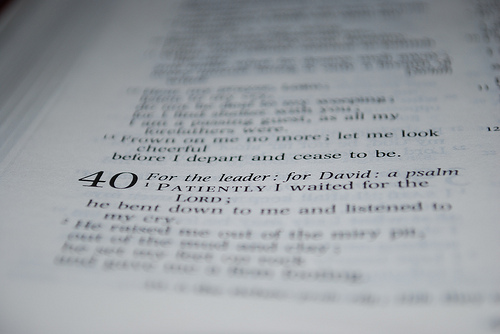
Did you know that the Talmudic rabbis interpreted all kinds of obscure verses to be Messianic? They saw hints and allusions to the Messiah in hundreds of unusual biblical texts, in passages that are totally unrelated to anything Messianic. In contrast with this, Psalm 40 has some very important Messianic themes.
As we noted in the previous answer, the Talmudic rabbis applied all kinds of scriptural passages to the Messiah, many of which seem quite far-fetched. Can the same be said of the use of Psalm 40 in the Letter to the Hebrews in the New Testament? Let’s consider the evidence.
Several verses from Psalm 40 are quoted with reference to Jesus the Messiah in Hebrews 10 (see Heb. 10:1–10). The author’s point in that chapter is that “the law is only a shadow of the good things that are coming—not the realities themselves. For this reason it can never, by the same sacrifices repeated endlessly year after year, make perfect those who draw near to worship” (Heb. 10:1). He finds support for his view in Psalm 40 where the psalmist (who is David, according to tradition) states:
Sacrifice and offering you did not desire,
but my ears you have pierced;
burnt offerings and sin offerings
you did not require.
Then I said, “Here I am, I have come—
it is written about me in the scroll.”
Psalm 40:6–7
What then is the problem? For many, it is that these words are attributed to Jesus in Hebrews: “Therefore, when [Messiah] came into the world, he said: ‘Sacrifice and offering you did not desire, but a body you prepared for me;255 with burnt offerings and sin offerings you were not pleased. Then I said, ‘Here I am—it is written about me in the scroll—I have come to do your will, O God’ ” (Heb. 10:5–7). How can these statements be attributed to Jesus? And did the writer of Hebrews actually believe that Jesus spoke the words of Psalm 40? Let me explain the background and meaning of the psalm. Then you will be able to understand why Hebrews 10 quotes it in a Messianic context.
After experiencing a great deliverance, the psalmist caught a glimpse of something new (Ps. 40:3) and crucial: “God isn’t looking for sacrifices and offerings, he wants me—my total, unreserved obedience.” In other words, “God doesn’t want me endlessly offering sacrifices for my sins and disobedience. He wants me to obey!” And as the psalmist—David?—considered the words of the Torah, repeatedly calling for sacrifices to be offered up on the altar of the Lord, he said to himself, “Sacrifice and offering you did not desire, but my ears you have pierced; burnt offerings and sin offerings you did not require. Then I said, ‘Here I am, I have come—it is written about me in the scroll’ ” (vv. 6–7).256
What does he mean? There are many different interpretations given by the commentators, both Jewish and Christian, but I personally believe he was saying, “When I read about the offerings in the scroll of the Law, I came to realize that it really speaks of your desire for me—my life given wholly over to you.” Unfortunately, just a few verses later, the psalmist goes on to lament his own sins and failures: “For troubles without number surround me; my sins have overtaken me, and I cannot see. They are more than the hairs of my head, and my heart fails within me” (v. 12). What a confession! He is saying, “I see that God wants my life wholly yielded to him. That is the sacrifice he seeks. But I’m a sinner, overwhelmed by my iniquity.” He saw the lofty ideal of the Torah; he failed miserably to live it out.
Once this psalm became part of the Hebrew Bible, it took on a life of its own, as Israelite worshipers would sing and pray these words for themselves—and every one of them would fall short of the ideal, just as the psalmist did. And this continued until the one perfect Israelite came into the world, the Messiah, the only one who was completely obedient, the one who could truly say, “In the scroll of the book it is written about me,” since he was the ultimate sacrifice, the perfect offering, the one who fulfills the image of the sacrifices of atonement and cleansing. His life satisfied the real meaning of the sacrificial system. He was not just the one who was totally yielded to the will of the Father; he was the one who actually offered himself up as a sin offering (see above, 4.1).
So, according to Hebrews 10, when Jesus the Messiah came into the world (not meaning the moment he was born, but typically and prophetically), he said, “God, you don’t want more sacrifices and offerings. You have already received hundreds of thousands of lambs and goats and rams and bulls. You want me! I’m the one you spoke of in your Law”—and for the first time, the Scripture was fulfilled and the goal was realized. It makes perfect sense!
255 For discussion of the translation of this phrase (“a body you prepared for me” in the Greek as opposed to the “my ears you have pierced, dug through” in the Hebrew) in Hebrews 10:5, see 5.5.
256 For an interesting midrashic interpretation, cf. Midrash Ruth 8:8, on Ruth 4:19.
[1]Brown, M. L. (2003). Answering Jewish objections to Jesus, Volume 3: Messianic prophecy objections (129). Grand Rapids, Mich.: Baker Books.
Isaiah 53 speaks of the people of Israel, not Jesus (or any Messiah).
It is impossible, both contextually and logically, for Isaiah 53 to be speaking of the people of Israel. Rather, the text clearly speaks of one individual, and as many rabbis recognized through the ages, that individual was the Messiah.
For the last thousand years, religious Jews have often interpreted Isaiah 53 with reference to the people of Israel, but that has by no means been the consensus interpretation, and it is not the interpretation of the Talmudic rabbis. So, for example, the Targum interprets the passage with reference to the Messiah—as a warring, victorious king, even to the point of completely twisting the meaning of key verses117—while the Talmud generally interprets the passage with reference to the Messiah, or key individuals (like Moses or Phineas), or the righteous (for details on this, see 4.8). Note also that Saʿadiah Gaon influential ninth-century Rabbinic leader, interpreted Isaiah 53 with reference to Jeremiah. This means that virtually without exception, the earliest traditional Jewish sources—and therefore the most authoritative Jewish sources—interpret Isaiah 52:13–53:12 with reference to an individual, and in some cases, with reference to the Messiah. As stated above (4.5), this is highly significant.
While it is true that Rashi, Ibn Ezra, and Radak all interpreted the passage with reference to Israel, other equally prominent leaders, such as Moses ben Nachman (called Nachmanides or the Ramban), felt compelled to follow the weight of ancient tradition and embrace the individual, Messianic interpretation of the Talmudic rabbis (found in the Midrash, despite his belief that the plain sense of the text supported the national interpretation). Noteworthy also is the oft-quoted comment of Rabbi Moshe Alshech, writing in the sixteenth century, “Our rabbis with one voice accept and affirm the opinion that the prophet is speaking of the Messiah, and we shall ourselves also adhere to the same view.” This too is highly significant, since Alshech claims that all his contemporaries agreed with the Messianic reading of the text, despite the fact that Rashi, Ibn Ezra, and Radak had all come out against that reading. Could it be that Rabbi Alshech and his contemporaries came to their conclusions because the text clearly pointed in that direction? The Messianic interpretation is also found in the Zohar as well as in some later midrashic works (for references, see below, 4.8). Thus, it is clear that there is substantial Jewish tradition—spanning a period of up to two thousand years—that differs with your objection.
Most recently—really, from the early 1990s and right up to this day—Isaiah 53 has been applied to Menachem Schneerson (1902–1994), the Grand Rabbi of the Lubavitcher Hasidic movement. Obviously, his followers had no problem applying the prophecy to him as an individual (as opposed to the people of Israel as a whole), in keeping with the most ancient Jewish traditions.
All this is especially important when you realize that sections from Isaiah 52:13–53:12 are quoted several times in the New Testament, and the passage as a whole can arguably be called the clearest prophecy of Jesus in the entire Tanakh. Yet many traditional Jewish commentators and teachers have still interpreted the prophecy as Messianic. How tempting it would have been for the Talmudic rabbis and their successors to interpret this passage with reference to Israel—rather than to the Messiah or any other individual—seeing that it played such an important role in Christian interpretation and polemics. Yet they did not interpret the passage with reference to the nation of Israel in any recorded traditional source for almost one thousand years, nor did they interpret it with reference to national Israel with unanimity thereafter.
This is all the more striking when you consider that there is a tradition dating back to Origen, a scholarly Christian leader in the second century, who stated that some Jewish leaders in his day interpreted the passage with reference to Israel, not the Messiah.118 In other words, the national, non-Messianic interpretation was apparently used in some Jewish circles more than three centuries before the completion of the Talmud, yet it simply didn’t stick. It was known, it seems, but it didn’t take root in any Rabbinic source of any kind until the eleventh century. This is saying something!
Still, the bottom line is the scriptural text itself, and a careful examination of the evidence makes it clear that Isaiah 52:13–53:12 cannot refer to Israel as a whole for the following reasons.
1. Throughout Isaiah 52:13–53:12, the servant is depicted as completely righteous yet lowly and afflicted, despised and rejected (before his final exaltation). This cannot possibly apply to the people of Israel as a nation; otherwise, the Torah cannot be true. For the Torah plainly promises, again and again, that if, as a nation, we live righteously before God, we will be the head and not the tail, lifted high and not brought low, blessed and not afflicted, revered and not rejected. This is indisputably clear, as Leviticus 26 and Deuteronomy 28 explain in great detail. Really, I see no way that an honest reading of these lengthy Torah passages (which do not stand alone but rather summarize what is taught throughout the Torah) can differ with this conclusion: If the people of Israel were righteous, as described in Isaiah 53, then they would be blessed and not cursed. (See vol. 1, 2.4.)
It was only when our nation as a whole (or as the clear majority) was sinful (and therefore hostile to God and his servants) that a righteous individual (like Jeremiah or one of the prophets) or a righteous remnant (like the few godly believers in Elijah’s day) could sufferfor their righteousness, since they would be going against the grain of a society that had rejected God and his laws. But the thought of the people of Israel, as a whole, being righteous and yet suffering for their righteousness is totally unthinkable from a Torah perspective.119 For righteous Israel to suffer humiliation, shame, and death at the hands of her enemies—going like sheep to the slaughter—would be a complete breach of the national covenant, since the Torah explicitly taught that Israel’s blessings and curses would first be experienced in this world as opposed to the world to come (see again vol. 1, 2.4). In Christian terms, such a reversal of the covenant promises would be similar to Jesus condemning a true Christian to hell. Yet according to your interpretation, God himself (see Isa. 53:10) would cause totally righteous and obedient Israel to be slaughtered by the Gentiles to the point of total, national disfigurement (interpreting Isaiah 52:14 according to your viewpoint, with reference to the nation, not an individual). Quite simply, this cannot be.
2. According to Isaiah 52:13–15, the servant of the Lord would not only suffer terrible disfigurement and suffering but would then be highly exalted, to the point that kings would stand in awe of him and bow down to him. While this applies perfectly to Jesus the Messiah, who is adored and venerated by kings and leaders around the world, no such exaltation has taken place for our people Israel. So, not only do the verses referred to not fit the corporate Israel interpretation, but the verses that follow can hardly be understood to be the words of the kings! How could these kings confess their wonder and amazement at Israel’s exaltation if such exaltation has never occurred?120
3. Isaiah presents a picture of a totally righteous, guileless servant of the Lord. According to the anti-missionaries, this is a picture of Israel. But when did our nation ever live like this? When do the Scriptures, or even our own history books, record a time when as anation, there was no deceit on our lips or violence in our midst (Isa. 53:9), when we were as silent as lambs going to the slaughter before our oppressors (v. 7)? What generation could be called God’s “righteous servant” (v. 11)? Yet if the national interpretation were true, Israel would have to be a righteous nation. At no point in our history has this been true. Is that the reason that the closest the Talmud comes to a national interpretation of Isaiah 53 is in b. Berakhot 5a, where verse 10 is applied to righteous individuals within the nation?
Note carefully that the servant was not smitten by God because of his guilt but rather because of the guilt of others (Isa. 53:4, 8). The servant was not guilty! The others transgressed, committed iniquity, and went astray (vv. 5–6). Not so the servant of the Lord! He bore the sin of many, but he himself did not sin (v. 12). This description fits Yeshua perfectly. In no way does it describe the people of Israel (or any other people for that matter).
4. According to Isaiah 53:4–6 and 12, the servant’s suffering brought healing to the people. We sinned, he suffered, and his suffering brought us redemption and forgiveness and mercy and healing. This cannot possibly apply to the sufferings of Israel. Our people’s terrible suffering did not bring healing to the nations who afflicted us. To the contrary, the nations who attacked us and punished us and abused us were judged by God for their deeds! (We will return to this shortly, when we deal with Isaiah 52:3–5, below.) In complete contrast with this, when our Messiah died on the cross, he prayed for those crucifying him, saying, “Father, forgive them, for they do not know what they are doing” (Luke 23:34), and he explained to his disciples prior to his death that his body was being broken and his blood was being shed as a ransom for many (Mark 10:45). He died for a sinning world. He died that we might live. All who have truly put their trust in him have found forgiveness of sin and transformation of life by the power of his death and resurrection.
Once again, it is only fair to ask, When can these truths be applied to the people of Israel? How is it right to apply Isaiah 53 to the nation as a whole? The answer by now should be obvious: Isaiah 53 does not apply to the nation but to a righteous individual who represents the nation—Yeshua, our Messiah and King.
“There’s still one problem with your argument,” you say. “You neglected to factor in Psalm 44, a lengthy passage of Scripture that demonstrates that even righteous Israel sometimes suffered terribly at the hands of its enemies. This undermines one of your main points and backs up my position that Isaiah 53 is speaking of righteous Israel suffering humiliation and pain at the hands of its oppressors.”
At first glance, Psalm 44 seems to back up your thesis, describing in detail the terrible sufferings that the nation was experiencing—rejected by God; plundered by their enemies; given up to be devoured by the nations; disgraced, taunted, and shamed; brought down to the dust—and then stating explicitly:
All this happened to us,
though we had not forgotten you
or been false to your covenant.
Our hearts had not turned back;
our feet had not strayed from your path.
But you crushed us and made us a haunt for jackals
and covered us over with deep darkness.
If we had forgotten the name of our God
or spread out our hands to a foreign god,
would not God have discovered it,
since he knows the secrets of the heart?
Yet for your sake we face death all day long;
we are considered as sheep to be slaughtered.
Psalm 44:17–22
Indeed, some of these very verses have been quoted at the beginning of deeply moving studies on the Holocaust, especially verse 17, “All this happened to us though we had not forgotten you or been false to your covenant.” Doesn’t this mean, then, that the Jewish people as a nation could be godly and righteous and yet be judged by God and defeated and destroyed by their enemies? Certainly not! As previously emphasized, that would make void the whole theology of the Torah and completely contradict fundamental passages in God’s covenant with our people (in particular, Leviticus 26 and Deuteronomy 28) stating that national obedience would bring blessing, while national disobedience would bring judgment. Yet if your reading of Psalm 44 were correct, it would mean that national obedience brought judgment. This simply cannot be.
“But what about Isaiah 52:3–5, where the text explicitly states that the Jewish people were sold into captivity although they had done nothing wrong. And this is the very text that precedes Isaiah 53!”
As rendered in the NJPSV, Isaiah 52:3–5 reads:
For thus said the Lord:
You were sold for no price,
And shall be redeemed without money.
For thus said the Lord God:
Of old, My people went down
To Egypt to sojourn there;
But Assyria has robbed them,
Giving nothing in return.
What therefore do I gain here?
—declares the Lord—
For My people have been carried off for nothing,
Their mockers howl
—declares the Lord—
And constantly, unceasingly,
My name is reviled.
Does this text indicate that Israel suffered without cause? Obviously not. Rather, the Hebrew words hinam (vv. 3 and 5, translated here as “no price” and “for nothing”) and ʾephes (v. 4, rendered here as “nothing”) simply compliment the words “without money” in verse 3. It is true that hinam can sometimes mean “without cause” (as in Job 9:17; Ps. 35:7), but it can also mean “in vain” (as in Prov. 1:17) or “without compensation” (as in Gen. 29:15). As for ʾephes, it simply means “nothing, none” and has no moral connotations in the Scriptures (see, e.g., Isa. 5:8, where ʾephes maqom means “no place”).121 How then can we be sure how these words should be rendered here? The context makes it obvious: As stated, the issue is one of “no money, no compensation,” as introduced in verse 3, “You were sold for nothing, and without money you will be redeemed,” and that is the theme of verses 4–5, as quoted above. Also, Isaiah elsewhere states that Israel was “sold” because of its sins! This is the prophet’s theology of why his people suffered: “Because of your sins you were sold; because of your transgressions your mother was sent away” (Isa. 50:1b; the Hebrew verb for “sold” is identical in form to that found in 52:3).122
There is even a Talmudic interpretation of Isaiah 52:3 that states that the phrase “for nothing were you sold” means “[you were exiled] because you worshipped idols [which have no value],” while the phrase “and without money you will be redeemed” means “even without repentance and good deeds” (b. Sanhedrin 98a).123 So the Talmud states that the people of Israel were exiled because of their sins rather than without cause. Note also that Isaiah 52:4 specifically mentions Assyria’s treatment of the Jewish people. But in Isaiah 10:6b, God said of this same Assyria, “I send him against a godless nation, I dispatch him against a people who anger me.” Thus, our people’s suffering and exile were hardly without cause; rather, it was without compensation. This agrees with the consistent teaching of the Scriptures.124
How then should Psalm 44 be understood? Very simply, it is the prayer of the righteous remnant on behalf of the sinning nation. It is the godly “standing in the gap” for the godless, the righteous making intercession on behalf of the unrighteous.125 You see, when the nation as a whole persisted in sin, it brought divine judgment down on everyone, and even the righteous suffered in the midst of their guilty brothers and sisters (cf. Lam. 2:1–12). National sin made life miserable for one and all alike. Thus, in Psalm 44, the godly, suffering minority intercedes for the ungodly, suffering majority. Also, because of Israel’s sense of corporate solidarity—they were one body, one community, and one member was intertwined with another member, for better or for worse—as the righteous Israelites watched their sinning brethren being destroyed, they prayed for the others as if they were praying for themselves.
Normally, in the Tanakh the righteous intercessors would take on the guilt of the nation, as Daniel did in his prayer recorded in Daniel 9. Verses 5–8 express this clearly:
… we have sinned and done wrong. We have been wicked and have rebelled; we have turned away from your commands and laws. We have not listened to your servants the prophets… . Lord, you are righteous, but this day we are covered with shame—the men of Judah and people of Jerusalem and all Israel, both near and far, in all the countries where you have scattered us because of our unfaithfulness to you. O Lord, we and our kings, our princes and our fathers are covered with shame because we have sinned against you.
Daniel himself was righteous, but he freely and fully confessed the sins of his people as his own as well, including himself by saying “we” and “our” instead of “they” and “their” (cf. also Neh. 1:4–7; Ezra 9:1–15).
In Psalm 44 the godly remnant makes an appeal to the Lord based on their innocence, crying out for mercy on the nation as a whole because of their devotion to him (or at the least, crying out for mercy on themselves because of their devotion). This is the only interpretation that makes sense in light of the explicit teaching of the Torah and the consistent historical testimony of the entire Hebrew Bible, both of which testify to the fact that obedient Israel was blessed by God, while disobedient Israel was judged by him. Moreover, this sheds light on the intercessory power of the Messiah, described in Isaiah 53 and further explained in the New Testament writings: Through his perfect righteousness, the Messiah was able to make multitudes of sinners righteous too (Isa. 53:11b; Rom. 5:15–21).
None of this can be said about the so-called righteous remnant of Israel. Certainly, the Hebrew Scriptures indicate that in every generation in Israel’s history there were righteous individuals—never the majority of the people but always the decided minority—and these individuals often went against the grain of the sinful society and corrupt religious establishment. I have no problem with the concept of a righteous remnant.126 The problem arises when we try to make them into a distinct entity, as required by the text of Isaiah 53. In reality, this “remnant” has no history and cannot possibly be described with words such as, “He grew up before him like a tender shoot, and like a root out of dry ground” (Isa. 53:2a), since the righteous remnant does not have a specific origin or upbringing. Nor do verses such as Isaiah 53:7, speaking of the servant’s lamblike silence and submission in the midst of his suffering, apply to the remnant, which was sometimes actively opposed to the sinful majority and even led resistance movements to overthrow their oppressors (as the Maccabees did in the second century B.C.E.). Nor was the righteous remnant ever highly exalted to the point that kings bowed down before it/them, as stated explicitly in the end of Isaiah 52. Quite simply, a concrete person, not an abstract group of hardly identifiable individuals, is described by the prophet in Isaiah 53.
This is driven home by reading some of Rashi’s comments to Isaiah 53, all of which make far more sense when applied to Jesus, our Messiah, than when applied to the righteous remnant. As you read, ask yourself, Who does this describe? (For an enlightening experiment, when Rashi says “Israel,” substitute “Yeshua” instead.)
4 Indeed, he bore our illnesses Heb aken an expression of ‘but’ in all places. But now we see that this came to him not because of his low state, but that he was chastised with pains so that all the nations be atoned for with Israel’s suffering. The illness that should rightfully have come upon us, he bore. yet we accounted him We thought that he was hated by the Omnipresent, but he was not so, but he was pained because of our transgressions and crushed because of our iniquities.…
5 the chastisement of our welfare was upon him The chastisement due to the welfare that we enjoyed, came upon him, for he was chastised so that there be peace for the entire world.
11… and their iniquities he would bear He would bear, in the manner of all the righteous, as it is said (Num. 18:1): “You and your sons shall bear the iniquity of the sanctuary.”
12… and with transgressors he was counted He suffered torments as if he had sinned and transgressed, and this is because of others; he bore the sin of the many. and interceded for the transgressors through his sufferings, for good came to the world through him.
Again I ask, Who does this describe?
117 See above, n. 113 (Levey); cf. further vol. 2, 3.23.
118 See Origen, Contra Celsum, bk. 1, chap. 55, cited in 4.8.
119 It is for this very reason that followers of Jesus are promised persecution, namely, suffering for righteousness in the midst of an unrighteous world, living as strangers and pilgrims in an often hostile environment (see, e.g., Matt 5:10–12; 10:16ff.; John 15:18ff.; Acts 5:41; Phil 1:29, among many references); see further vol. 1, 2.6, and cf. Joseph Ton (Tson), Suffering, Martyrdom, and Rewardsin Heaven (Lanham, Md.: Univ. Press of America, 1997).
120 Ibn Ezra, in harmony with other classical Jewish commentaries, claims that Isaiah 49:7 (“This is what the Lord says—the Redeemer and Holy One of Israel—to him who was despised and abhorred by the nation, to the servant of rulers: ‘Kings will see you and rise up, princes will see and bow down, because of the Lord, who is faithful, the Holy One of Israel, who has chosen you.’ ”) refers to the prophet himself rather than to the nation. But this passage clearly parallels the promise to the servant of the Lord in Isaiah 52:13–15, a passage interpreted by Ibn Ezra with reference to the nation of Israel as a whole.
121 According to Delitzsch (Isaiah, 772), beʾephes in this context means, “ ‘for nothing,’ i.e., without having acquired any right to it, but rather serving in its unrighteousness simply as the blind instrument of the righteousness of Jehovah, who through the instrumentality of Asshur put an end first of all to the kingdom of Israel, and then to the kingdom of Judah.” The NIV renders this as “lately,” a translation rightly rejected in its day by Delitzsch (ibid.). The Stone edition appropriately renders hinam as “for naught” in Isaiah 52:3, 5 but then translates beʾephes as “without justification”—a rendering that is without justification. For other usages of ʾephes (related to the meanings of “end, extremity, nonexistence”), see further D. J. A. Clines, Dictionary of Classical Hebrew (Sheffield, England: Sheffield Academic Press, 1993–), 1:359.
122 A number of Christian translations (such as the NLT and NRSV) render some of these terms with “without justification” or “without cause.” See, e.g., the NLT’s rendering of v. 4a, “Now they have been oppressed without cause by Assyria”), apparently overlooking the teaching of Isaiah and the other prophets that God used Assyria to judge Israel and Judah because of sin (see, e.g., Isa. 10:5ff.).
123 As rendered by Asher Finkel, Ein Yaakov, CD Rom ed. (Northvale, N.J.: Aronson).
124 Isaiah 57:1 is no exception. Rather, it says that the reason righteous individuals sometimes die before their time is to spare them from a greater calamity that is about to befall the sinning nation; cf. 1 Kings 14:1–13.
125 Cf. Ezek. 22:30–31; also 13:4–5; Ps. 106:23; cf. further Yohanan Muffs, “Who Will Stand in the Breach?: A Study of Prophetic Intercession,” in idem, Love and Joy: Law, Language and Religion in Ancient Israel (New York: Jewish Theological Seminary, 1992), 9–48. Cf. also Moshe Greenberg, Ezekiel 1–20: A New Translation with Introduction and Commentary, Anchor Bible (New York: Doubleday, 1983), 236; and idem, Ezekiel 21–37: A New Translation with Introduction and Commentary, Anchor Bible (New York: Doubleday, 1997), 463.
126 Cf. the standard study of Gerhard Hasel, The Remnant: The History and Theology of the Remnant Idea from Genesis to Isaiah, Andrews University Monographs, 5 (Berrien Springs: Andrews Univ. Press, 1974).
Brown, M. L. (2003). Answering Jewish objections to Jesus, Volume 3: Messianic prophecy objections (49). Grand Rapids, Mich.: Baker Books.
If Jesus is the Jewish Messiah, why don’t more Jews believe in him?
Actually, there are tens of thousands of Jews who have believed and do believe in him. The problem is that most Jews have not bothered to check into the facts about Jesus, and the only Jesus most of them know is either the baby Jesus of Christmas, an emaciated figure hanging on a cross in churches, or the Jesus of the Crusades and Inquisitions. The question is, Why don’t you believe Jesus is the Messiah? Do you really know who he is?
I encourage you to consider the following points.
1. Most Jews have never seriously studied the issue. Many of those who have decided to find out who Jesus is have been quite surprised by what they have learned. The greatest scholars and scientists in the world once believed the earth was flat—until firsthand investigation and discovery altered their outlook. It’s the exact same thing with Jews who honestly investigate the Messianic claims of Jesus. Everything changes—to put it mildly.
2. If most religious Jews learn anything about Jesus in their traditional studies, it is quite biased and negative. 22 Thus, they do not entertain even the possibility of the messiahship of Jesus.
3. Many so-called Christians have committed atrocities against Jews in the name of Jesus, helping to drive Jews away from their true Messiah. (See below, 2.7, for more on this, along with my book Our Hands Are Stained with Blood.)
4. These same Christians have often put forth a distorted picture of Jesus that bears little resemblance to the real Messiah who walked the earth two thousand years ago. Can Jews be blamed for thinking that Christians worshiped idols when the churches were filled with worshipers bowing before large, beautiful statues depicting Jesus as a babe in his mother’s lap?
5. There is often great pressure on those Jews—especially religious Jews—who put their faith in Jesus the Messiah. Some succumb to the fear, the pressure, the intimidation, the separation, and the loneliness, and they deny with their lips what they know to be true in their hearts.
6. Traditional Jewish teaching gives a slanted portrayal of who the Messiah is and what he will do. Since the description is faulty, people are looking in the wrong direction for the wrong person. No wonder relatively few have found him.
7. Once a learned Jew does believe in Yeshua, he is discredited, and so his name is virtually removed from the rolls of history. It’s almost as if such people ceased to exist. (Do you remember reading the novel Animal Farm in school? Revisionist history goes on to this day—even in traditional Jewish circles.) The story of Max Wertheimer provides one case in point. In the last century, Wertheimer came to the States as an Orthodox Jew, but over the course of time, he became a Reform Jew and was ordained a rabbi upon graduating from Hebrew Union College in Cincinnati in 1889. (He also received a Ph.D. from the University of Cincinnati the same year.) He then served as the greatly loved rabbi of B’Nai Yeshurun synagogue in Dayton, Ohio, for the next ten years. When he became a fervent believer in Jesus, however, pastoring a church as well, his name was literally removed from the rolls of the school—a school of alleged tolerance at that. Why was his name dropped? According to Alfred A. Isaacs, cited in the November 25, 1955, edition of the National Jewish Post, Wertheimer was disowned by Hebrew Union College solely because of his Christian faith. 23 And to think, this happened in a “liberal” Reform Jewish institution!
8. Although this may be hard for you to accept, because our leadership rejected Jesus the Messiah when he came, God judged us as a people (just as he judged us as a people for rejecting his law and his prophets in previous generations), and as a result, our hearts have become especially hardened toward the concept of Jesus as Messiah. 24 Paul explained this in his important letter to the believers in Rome: “What Israel sought so earnestly it did not obtain, but the elect did. The others were hardened, as it is written: ‘God gave them a spirit of stupor, eyes so that they could not see and ears so that they could not hear, to this very day’ ” (Rom. 11:7–8; the quote here is taken from Deut. 29:4 in our Torah and Isa. 29:10 in our Prophets).
If you stop to think about it, isn’t it strange that as a people we have almost totally lost sight of the fact that Jesus-Yeshua is one of us, actually, the most influential Jew ever to walk the earth? 25 Yet most of us think of him as if he were some fair-skinned, blue-eyed European. The good news is that Israel’s hardening was only partial: There have always been Jews who followed Jesus the Messiah, and in the end, our people will turn back to him on a national scale. Paul explains this a few verses later:
I do not want you [Gentiles] to be ignorant of this mystery, brothers, so that you may not be conceited: Israel has experienced a hardening in part until the full number of the Gentiles has come in. And so all Israel will be saved, as it is written: “The deliverer will come from Zion; he will turn godlessness away from Jacob. And this is my covenant with them when I take away their sins.”
Romans 11:25–27; the quote is taken from Isaiah 59:20–21; 27:9; and Jeremiah 31:33–34, all in our Prophets
Hopefully, you will be one of those Jews who is determined to find out the truth about the Messiah right now, determining to follow him at any cost. In the end, you must decide for yourself, and the bottom line question is one that only you can answer: Why don’t you believe Jesus is our promised Messiah?
What if more Jews—including your rabbi—did believe in him? Would you? Of course, that wouldn’t change the facts. Either Jesus is or is not the Messiah of Israel. Public opinion can’t affect the truth. But many times, when people find out that it’s okay to hold to a certain opinion, they come out of the closet.
Maybe it would help you to know that many of us in Jewish work have spoken with Orthodox and even ultra-Orthodox Jews who have told us in private that they believe Jesus is the Messiah, but they are afraid to go public for fear of what could happen to them. Maybe if a number of these religious Jews—some of whom are rabbis—showed up one day on your doorstep and told you their views, it would get you to think seriously about the matter.
As we grow and mature—from infants to children to teens to adults—we find out that not everything we have been told is true. Sometimes we just have to learn for ourselves. And even as adults, we often have skewed perspectives on many things. Just look at what Democrats believe about Republicans (and vice versa) or what Palestinians believe about Israelis (and vice versa) or what Black Muslims believe about Jews (and vice versa). Our perspectives, opinions, and convictions are not always right—no matter how strenuously we argue for our position. Common sense tells us that all of us can’t be right about everything all the time.
Even on an interpersonal level, how often have you met someone only to find out that all the bad things you heard about that person were greatly exaggerated or false? It happens all the time. As for the matter at hand, I assure you in the strongest possible terms: As a Jew, most everything you have heard about Jesus has been untrue. You owe it to yourself to find out just who this Jesus really is—and I say this to you whether you are an ultra-Orthodox rabbi reading this book in secret or you are a thoroughly secular, wealthy Jewish businessman who was given this book by a friend.
This much is certain: We have carefully investigated the claims of Jesus and can testify firsthand that Yeshua is who he said he was. What do you say?
[1]
22 The infamous Rabbinic collection of anti-Jesus fables, called Toledot Yeshu, is still studied in some ultra-Orthodox circles, although virtually all other Jewish scholars have long since repudiated the Toledot. These scurrilous writings, based in part on some Talmudic references, accusing Mary of fathering Jesus through a Roman soldier (or by rape), and portraying Jesus as an idolater, magician, and Israel’s arch-deceiver, were the primary source of information about Jesus for many traditional Jews, especially in the Middle Ages. Of course, as noted by the Oxford Dictionary of Jewish Religion, ed. Geoffrey Wigoder (New York: Oxford, 1997), 695, “the work is an expression of vulgar polemics written in reaction to the no less vulgar attacks on Judaism in popular Christian teaching and writing.” But as I have stated before, just as many Gentiles around the world have had a biased and inaccurate view of the Jewish people, so also have many Jews had a biased and inaccurate view of Jesus, the Jewish Messiah. For a representative sampling from the Toledot, see the excellent study of Walter Riggans, Yeshua ben David: Why Do the Jewish People Reject Jesus as Their Messiah? (Crowborough, England: Marc, 1995), 127–32. Interested readers of this present volume would do well to read Riggans as well.
23 For more on this, see Nahum Brodt, “The Truth about the Rabbi,” in Would I? Would You?, ed. Henry and Marie Einspruch (Baltimore: Lederer, 1970), 8–10. For a fuller account of Wertheimer’s faith, see Jacob Gartenhaus, Famous Hebrew Christians (Grand Rapids: Baker, 1979), 191–97.
24 This is not the first time in our history that God has hardened our hearts because we sinned against him. This is what God said to the prophet Isaiah more than twenty-five hundred years ago: “Go and tell this people: ‘Be ever hearing, but never understanding; be ever seeing, but never perceiving.’ Make the heart of this people calloused; make their ears dull and close their eyes. Otherwise they might see with their eyes, hear with their ears, understand with their hearts, and turn and be healed” (Isa. 6:9–10). The prophet was actually called to a ministry of hardening his people’s hearts! It was as if God were saying, “Fine. If you want to be hard-hearted, refusing to believe me or obey me, I will give you over to your hardness and make you even harder.” This is exactly what has happened to us regarding the Messiah: When so many of our people refused to follow him, God gave us over to our unbelief and obduracy to the point that through the centuries, we have become especially resistant to Jesus.
25 This well-known, anonymous tribute to Jesus, known as “One Solitary Life,” puts things in perspective: “He was born in an obscure village. He worked in a carpenter shop until He was thirty. He then became an itinerant preacher. He never held an office. He never had a family or owned a house. He didn’t go to college. He had no credentials but himself. He was only thirty-three when the public turned against him. His friends ran away. He was turned over to his enemies and went through the mockery of a trail. He was nailed to a cross between two thieves. While he was dying, his executioners gambled for his clothing, the only property he had on earth. He was laid in a borrowed grave. Nineteen centuries have come and gone, and today he is the central figure of the human race. All the armies that ever marched, all the navies that ever sailed, all the parliaments that ever sat, and all the kings that ever reigned have not affected the life of man on this earth as much as that one solitary life.”
[1]Brown, M. L. (2000). Answering Jewish objections to Jesus, Volume 1: General and historical objections. (21). Grand Rapids, Mich.: Baker Books.
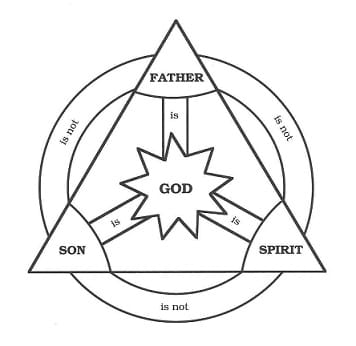
Speaking through the prophet Isaiah, God said, “My thoughts are not your thoughts, / Nor are your ways My ways … / For as the heavens are higher than the earth, / So are My ways higher than your ways, / And My thoughts than your thoughts” (Isa. 55:8–9). God is infinite, man is finite, so there are mysteries about God that man cannot fully understand. One of these mysteries is the Trinity, the tri-personality of God. According to Christian orthodoxy, God is one God in essence, power, and authority, and also eternally exists as three distinct co-equal persons. These three persons are the Father, the Son (Jesus), and the Holy Spirit. This does not mean that Christians believe in three gods (polytheism). Rather, the doctrine of the Trinity is that there is only one God who exists in three distinct persons, and all three share the exact same divine nature or essence.
Understanding this fully is beyond human comprehension and has no human parallels, although various analogies have been offered. One of these analogies is the three physical states of water. Water is not only a liquid but also a solid (ice) and a gas (vapor), yet its chemical composition (substance) never changes in all three forms (two parts hydrogen and one part oxygen—H2O). Although such analogies help us visualize the concept of the Trinity, they all fall short in some way. In the case of the water analogy, although the molecule H2O can be liquid, solid, or gas, it is never all three at one time. The Trinity, on the other hand, is all three persons as one God.
The word Trinity is not used in Scripture, but it has been adopted by theologians to summarize the biblical concept of God. Difficult as it is to understand, the Bible explicitly teaches the doctrine of the Trinity, and it deserves to be explained as clearly as possible, especially to non-Christians who find the concept a stumbling-block to belief. So let’s dig into this topic by addressing four key questions.
IS THE DOCTRINE OF THE TRINITY IRRATIONAL?
The doctrine of the Trinity is certainly a mystery but that doesn’t mean it’s irrational. The concept cannot be known by human reason apart from divine revelation, and, as we’ll soon see, the Bible definitely supports the idea of the Trinity. But for now, I want to demonstrate that the doctrine of the Trinity, although beyond human comprehension, is nevertheless rational. Our acceptance of it is congruous with how we respond to other data about the known world.
There are many things about the universe we don’t understand today and yet accept at face value simply because of the preponderance of evidence supporting their existence. The scientific method demands that empirical evidence be accepted whether or not science understands why it exists or how it operates. The scientific method does not require that all data be explained before it is accepted.
Contemporary physics, for instance, has discovered an apparent paradox in the nature of light. Depending on what kind of test one applies (both of them “equally sound”), light appears as either undulatory (wave-like) or corpuscular (particle-like). This is a problem. Light particles have mass, while light waves do not. How can light have mass and not have it, apparently at the same time? Scientists can’t yet explain this phenomenon, but neither do they reject one form of light in favor of the other, nor do they reject that light exists at all. Instead, they accept what they’ve found based on the evidence and press on.
Like physicists, we are no more able to explain the mechanics of the Trinity than they can explain the apparent paradox in the nature of light. In both cases, the evidence is clear that each exists and harbors mystery. So we must simply accept the facts and move on. Just because we cannot explain the Trinity, how it can exist, or how it operates does not mean that the doctrine must be rejected, so long as sufficient evidence exists for its reality. So let’s now explore this evidence.
HOW DOES THE BIBLE PRESENT THE DOCTRINE OF THE TRINITY?
THE OLD TESTAMENT
Although the doctrine of the Trinity is fully revealed in the New Testament, its roots can be found in the Old Testament.
In several places, God refers to Himself in plural terms. For example, “Then God said, ‘Let Us make man in Our image’” (Gen. 1:26; see 3:22; 11:7; Isa. 6:8).
The Messiah was prophesied in the Old Testament as being divine. Isaiah 9:6 states that the Messiah will be called “Mighty God,” a term applied in the Old Testament specifically to Yahweh (see Mic. 5:2).
Isaiah 48:16 refers to all three members of the Godhead: “Come near to Me, listen to this: From the first I have not spoken in secret, from the time it took place, I was there. And now the Lord God [Father] has sent Me [Jesus], and His Spirit [the Holy Spirit]” (nasv).
The Old Testament also makes numerous references to the Holy Spirit in contexts conveying His deity (Gen. 1:2; Neh. 9:20; Ps. 139:7; Isa. 63:10–14).
THE NEW TESTAMENT
The New Testament provides the most extensive and clear material on the Trinity. Here are just a few of the texts that mention all three members of the Godhead and imply their co-equal status.
• Matthew 28:19, the baptismal formula: “Go therefore and make disciples of all the nations, baptizing them in the name [not ‘names’] of the Father and of the Son and of the Holy Spirit.”
• Matthew 3:16, at the baptism of Christ in the Jordan: “And after being baptized, Jesus went up immediately from the water; and behold, the heavens were opened, and He saw the Spirit [Holy Spirit] of God [Father] descending as a dove, and coming upon Him [Jesus]” (nasv).
• Luke 1:35, the prophetic announcement to Mary of Jesus’ birth: “And the angel answered and said to her, ‘The Holy Spirit will come upon you, and the power of the Highest [Father] will overshadow you; therefore, also, that Holy One who is to be born will be called the Son of God [Jesus].’”
• The trinitarian formula is also found in 1 Peter 1:2, 2 Corinthians 13:14, and 1 Corinthians 12:4–6.
DIGGING DEEPER
To explain the doctrine of the Trinity, I will take an inductive (scientific) approach. By this I mean I will accumulate general facts in Scripture that lead to a specific conclusion—that the nature of God is triune. The argument will go like this:
1. The Bible teaches that God is one (monotheism) and that He possesses certain attributes that only God can have.
2. Yet when we study the attributes of the Father, the Son, and the Holy Spirit, we discover that all three possess the identical attributes of deity.
3. Thus we can conclude that there is one God eternally existing as three distinct persons.
God Is One (Monotheism)
The Hebrew Shema of the Old Testament is “Hear, O Israel: The Lord our God, the Lord is one!” (Deut. 6:4; see Isa. 43:10; 44:6; 46:9). Some people have argued that this passage actually refutes the concept of the triune nature of God because it states that God is one. But the Hebrew word for “one” in this text is echod, which carries the meaning of unity in plurality. It is the same word used to describe Adam and Eve becoming “one flesh” (Gen. 2:24). Scripture is not affirming that Adam and Eve literally become one person upon marriage. Rather, they are distinct persons who unite in a permanent relationship.
The New Testament confirms the teaching of the Old: “You believe that God is one. You do well; the demons also believe, and shudder” (James 2:19, nasv; see 1 Tim. 2:5; 1 Cor. 8:4; Eph. 4:4–6).
God Has a Certain Nature
Both the Old and New Testaments list the attributes of God. We won’t consider all of them here, but what follows are some of the clearest expressions of what constitutes deity.
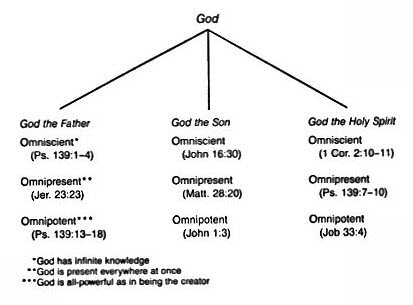
• God is omnipresent (present everywhere at once): Psalm 139:7–10; Jeremiah 23:23–24.
• God is omniscient (possesses infinite knowledge): Psalms 139:1–4; 147:4–5; Hebrews 4:13; 1 John 3:20.
• God is omnipotent (all-powerful): Psalm 139:13–18; Jeremiah 32:17; Matthew 19:26.
The Father Is God
To the Jews, who do not accept the Trinity, God is Yahweh. In the Old Testament, Yahweh is to the Hebrews what Father is in the New Testament and to Christians. The attributes of God (Yahweh) listed above are the same for Yahweh and Father because both names apply to the one God. Although the concept of God as Father is not as explicit in the Old Testament as it is in the New, nevertheless, it has its roots in the Old (see Pss. 89:26; 68:5; 103:13; Prov. 3:12).
In the New Testament, the concept of the Father as a distinct person in the Godhead becomes clear (Mark 14:36; 1 Cor. 8:6; Gal. 1:1; Phil. 2:11; 1 Pet. 1:2; 2 Pet. 1:17). God is viewed as Father over creation (Acts 17:24–29), the nation of Israel (Rom. 9:4; see Exod. 4:22), the Lord Jesus Christ (Matt. 3:17), and all who believe in Jesus as Lord and Savior (Gal. 3:26).
The Son Is God
Like the Father, Jesus possesses the attributes of God. He is omnipresent (Matt. 18:20; 28:20). He is also omniscient: He knows people’s thoughts (Matt. 12:25), their secrets (John 4:29), the future (Matt. 24:24–25), indeed all things (John 16:30; 21:17). His omnipotence is also taught. He has all power over creation (John 1:3; Col. 1:16), death (John 5:25–29; 6:39), nature (Mark 4:41; Matt. 21:19), demons (Mark 5:11–15), and diseases (Luke 4:38–41).
In addition to these characteristics, Jesus exhibits other attributes that the Bible acknowledges as belonging only to God. For example, He preexisted with the Father from all eternity (John 1:1–2), accepted worship (Matt. 14:33), forgave sins (Matt. 9:2), and was sinless (John 8:46).
The Holy Spirit Is God
The Holy Spirit is also omnipresent (Ps. 139:7–10), omniscient (1 Cor. 2:10), and omnipotent (Luke 1:35; Job 33:4).
Like Jesus, the Holy Spirit exhibits other divine attributes that the Bible ascribes to God. For instance, He was involved in creation (Gen. 1:2; Ps. 104:30), inspired the authorship of the Bible (2 Pet. 1:21), raised people from the dead (Rom. 8:11), and is called God (Acts 5:3–4).
The upshot of all this is that God is triune. In a formal argument, we can put it this way:
Major Premise:
Only God is omnipresent, omniscient, and omnipotent.
Minor Premise:
The Father, the Son, and the Holy Spirit are omnipresent, omniscient, and omnipotent.
Conclusion:
Therefore, God is triune as Father, Son, and Holy Spirit.
THE TRINITY
HOW DOES JESUS TEACH THE DOCTRINE OF THE TRINITY?
In the Bible, Jesus claims to be God and then demonstrates this claim by displaying the attributes of God and by raising Himself from the dead. So what Jesus has to say about God must be true. And Jesus clearly teaches that God is triune.
Jesus Is Equal with the Father and Holy Spirit
In Matthew 28:19, Jesus tells His followers to “make disciples of all the nations, baptizing them in the name of the Father and of the Son and of the Holy Spirit.” He uses the singular word name but associates it with three persons. The implication is that the one God is eternally three co-equal persons—Father, Son, and Holy Spirit.
Jesus Is One with the Father
In John 14:7 and 9, Jesus identifies Himself with the Father by saying to His disciples, “If you had known Me, you would have known My Father also; and from now on you know Him and have seen Him … He who has seen Me has seen the Father” (see John 5:18). Jesus is not claiming to be the Father; rather, He is saying that He is one with the Father in essence.
Jesus Is One with the Holy Spirit
Continuing in John 14, Jesus tells His disciples that, after He is gone, He will send them “another Helper” who will be with them forever and will indwell them (vv. 16–17). The “Helper” is the Holy Spirit. The trinitarian implication lies with the word another. The apostle John, as he wrote this passage, could have chosen one of two Greek words for another. Heteros denotes “another of a different kind,” while allos denotes “another of the same kind as myself.” The word chosen by John was allos, clearly linking Jesus in substance with the Holy Spirit, just as He is linked in substance with the Father in verses 7 and 9. In other words, the coming Holy Spirit will be a different person than Jesus, but He will be the same with Him in divine essence just as Jesus and the Father are different persons but one in their essential nature. Thus, in this passage, Jesus teaches the doctrine of the Trinity.
So far we have seen that the authors of Scripture and Jesus Christ teach the triune nature of God. Therefore, the only way the doctrine of the Trinity can be rejected is if one refuses to accept the biblical evidence. Some groups, such as the Jehovah’s Witnesses, do this by reinterpreting and altering Scripture. Others, such as the Unitarians (who claim that Jesus is just a man), arbitrarily and without any evidence deny anything supernatural or miraculous in the Bible. Both the Jehovah’s Witnesses and the Unitarians are guilty of the very same thing of which they accuse Christians—irrationality. They refuse to accept the evidence for the Trinity regardless of how legitimate it is. This is unscientific and irrational. If one approaches Scripture without bias, he will clearly discover what the church has maintained for centuries: God is triune—one God in essence but eternally existing in three persons as Father, Son, and Holy Spirit.
A COMMON OBJECTION
Perhaps you’ve wondered or heard someone say, “If Jesus is one in essence with the Father, an equal member of the triune Godhead, why does He say, ‘the Father is greater than I’” (John 14:28)? This question actually moves away from the doctrine of the Trinity and launches us into the doctrine of the incarnation, the process whereby Jesus, as the eternal Son of God, came to earth as man. Nevertheless, because this question is frequently raised as an objection, it needs to be answered.
Numerous passages in Scripture teach that Jesus, although fully God, is also fully man (John 1:14; Rom. 8:3; Col. 2:9; 1 Tim. 3:16). However, Philippians 2:5–8 states that, in the process of taking on humanity, Jesus did not give up any of His divine attributes. Rather, He gave up His divine glory (see John 17:5) and voluntarily chose to withhold or restrain the full use of His divine attributes. There are numerous instances in Scripture where Jesus, although in human form, exhibits the attributes of deity. If Jesus had surrendered any of His divine attributes when He came to earth, He would not have been fully God and thus could not have revealed the Father as He claimed to do (John 14:7, 9).
The key to understanding passages such as John 14:28 is that Jesus, like the Father and the Holy Spirit, has a particular position in the triune Godhead. Jesus is called the Son of God, not as an expression of physical birth, but as an expression of His position in relationship to the Father and Holy Spirit. This in no way distracts from His equality with the Father and the Holy Spirit or with His membership in the Godhead. As man, Jesus submits to the Father and acts in accordance to the Father’s will (see John 5:19, 30; 6:38; 8:28). So when we read passages such as Mark 14:36 where Jesus submits to the Father’s will, His submission has nothing to do with His divine essence, power, or authority, only with His position as the Incarnate Son.
Perhaps an illustration will help to explain this. Three people decide to pool their money equally and start a corporation. Each are equal owners of the corporation, but one owner becomes president, another vice-president, and the third secretary/treasurer. Each are completely equal so far as ownership, yet each has his own particular function to perform within the corporation. The president is the corporate head, and the vice-president and secretary/treasurer are submissive to his authority and carry out his bidding.
So when Jesus the God-man submits to the Father’s will or states that the Father is greater than He or that certain facts are known only by the Father (e.g., Matt. 24:36), it does not mean that He is less than the other members of the Godhead but that in His incarnate state He did and knew only that which was according to the Father’s will. The Father did not will that Jesus have certain knowledge while in human form. Because Jesus voluntarily restrained the full use of His divine attributes, He was submissive to the Father’s will.
Why did Jesus choose to hold back from fully using His divine powers? For our sake. God willed that Jesus feel the full weight of man’s sin and its consequences. Because Jesus was fully man, He could fulfill the requirements of an acceptable sacrifice for our sins. Only a man could die for the sins of mankind. Only a sinless man could be an acceptable sacrifice to God. And it is only because Jesus is an equal member of the triune Godhead, and thus fully God, that He was able to raise Himself from the dead after dying on the cross and thereby guarantee our eternal life.
When all the evidence is accounted for and the verdict read, the Bible clearly teaches that the Father, the Son, and the Holy Spirit are three distinct, co-equal, co-eternal members of the Godhead, yet one in essence, power, and authority. All three are one God. Were this not the case, if the Trinity were not a reality, there would be no Christianity.
[1]
[1]Story, D. (1997). Defending your faith. Originally published: Nashville : T. Nelson, c1992. (99). Grand Rapids, MI: Kregel Publications.
Using Inference to the Best Explantion: What Caused the Birth of Christology?
Using Inference to the Best Explantion: What Caused the Birth of Christology?
Anyone who studies historical method is familiar with what is called historical causation. Historians seek out the causes of a certain events. As historian Paul Barnett says, “The birth of Christianity and the birth of Christology are inseparable both as to time and essence.” (1) One thing for sure: the birth of Christology was very early and not something that was invented much later in Church history.
We must not forget that within Judaism there is a term called “avodah zara” which is defined as the formal recognition or worship as God of an entity that is in fact not God i.e., idolatry. In other words, the acceptance of a non-divine entity as your deity is a form of avodah zara. (2) As of today, traditional or Orthodox Judaism still upholds the position that Jewish people are forbidden to pray and worship anyone other than the God of Israel (Ex. 20:1–5; Deut. 5:6–9).
Paul’s Letters are the earliest records we have for the life of Jesus. We know that from about AD 48 until his death (60 to 65 AD) Paul wrote at least 13 of the New Testament’s books. They are also the earliest letters we have for the Christology of Jesus. To read any objections to Paul’s Letters, see here.
As pointed out by Richard Bauckham in his work on this topic, Paul believed that Jesus was God by attributing attributes to him that were distinctly reserved for God. And he did so in a distinctly Jewish manner while also preserving monotheism. There were three attributes that first century Jews uniquely assigned to God:
1. God is the Sole Ruler of all things
2. God is the Sole Creator of all things
3. God is the only being deserving of worship
So let’s look at how Paul matches up the data here:
1. Jesus participates in God’s sole rule over all things
Phil: 3:20-21: “For our citizenship is in heaven, from which also we eagerly wait for a Savior, the Lord Jesus Christ; who will transform the body of our humble state into conformity with the body of His glory, by the exertion of the power that He has even to subject all things to Himself.”
Eph. 1:21-22: Paul speaks of Jesus being ”far above all rule and authority and power and dominion, and every name that is named, not only in this age but also in the one to come. And He put all things in subjection under His feet…”
Here, Jesus is clearly given the authority to rule above every one of God’s created beings.
2. Jesus as the Creator of all things
Jesus is clearly thought by Paul to have been the creator of the universe. This attribute is reserved only to God in Second Temple Judaism. Paul makes it clear that Jesus created all things.
Col. 1:15-16: “He is the image of the invisible God, the firstborn over all creation. For by him all things were created: things in heaven and on earth, visible and invisible, whether thrones or powers or rulers or authorities; all things were created by him and for him.”
3. Jesus as worthy of worship
As discussed above, only God was worthy of worship in Second Temple Judaism. Nevertheless, Paul discusses the worship of Jesus. Since God is the sole Creator and Ruler of all things He alone should be worshiped. Even within the Roman Empire, Jews worshiped God alone. No other entity was worthy of worship. Here is one of the earliest Christological texts:
Philippians 2:6-11: “Who, being in very nature God, did not consider equality with God something to be grasped, but made himself nothing, taking the very nature of a servant, being made in human likeness. And being found in appearance as a man, he humbled himself and became obedient to death even death on a cross! Therefore God exalted him to the highest place and gave him the name that is above every name, that at the name of Jesus every knee should bow, in heaven and on earth and under the earth, and every tongue confess that Jesus Christ is Lord, to the glory of God the Father.”
In their book The Jesus Legend, The: A Case for the Historical Reliability of the Synoptic Jesus Tradition, Gregory Boyd and Paul Eddy say,
“During the reign of Pilate and Herod, when Caiaphas was high priest, we find a Jewish movement arising that worships a recent contemporary alongside and in a similar manner as Yahweh-God. To call this development “novel” is a significant understatement. In truth, it constitutes nothing less than a massive paradigm shift in the first century Palestinian Jewish religious worldview.” (3)
Explanations try to show how something happened. That is, what is the cause for something that has happened. So let’s weight the options on the table and see if we can come up with an explanation that explains the data at hand:
#1: Religious Syncretism
While there were various Jewish sects during the time of Jesus, religious syncretism is a form of idolatry. First, the Jewish Scriptures forbids worshiping anyone other than the God of Israel (Ex. 20:1–5; Deut. 5:6–9). Following the exile and subsequent intertestamental struggles, it can asked whether Jews still fell prey to physical idolatry. Some skeptics assert that since Israel always had problems with idolatry in their early formation, it would not be a challenge to assert they could fall into idolatry again by worshiping one of their own countrymen as God. But this is problematic; To assert that Israel’s previous problems with idolatry which would lead to further into idolatry in the Second Temple period leads me to cry “anachronism.” Remember, idolatry is rarely mentioned in the Gospels. But there are warnings about idolatry in other portions of the New Testament( 1 Cor. 6:9-10 ; Gal 5:20 ; Eph. 5:5 ; Col 3:5 ; 1 Peter 4:3 ; Rev 21:8). Paul instructs believers not to associate with idolaters ( 1 Cor .5:11 ; 10:14 ) and even commends the Thessalonian for their turning from the service of idols “to serve the living and true God” ( 1 Thess1:9) (see Walter A. Elwell’s Baker’s Evangelical Dictionary of Biblical Theology, pgs 364-365). So I guess my question is the following: Why would Paul or the early disciples commit an idolatrous act (by saying Jesus is divine) and but then later speak against idolatry? It seems rather inconsistent.
#2 Hellenism or Polytheism?
The syncretism objection is related to the Hellenism/Polytheism possibility. The first followers of Jesus were exclusively Jews. The book of Acts gives a reference to the early followers of Jesus as “the sect of Nazarenes” (Acts 24:5). However, it is asserted that as the Christian faith spread, it became a predominately Gentile based religion. By the time of Jesus, Jews had encountered the impact of Hellenistic culture for three hundred years. The word “Hellenistic” was given to describe the period of history that started with the death of Alexander the Great in 323 B.C. and ended when Rome conquered Alexander’s empire in 30 B.C .It is also safe to say that several forms of Jewish culture during the Roman period were somewhat Hellenized. This is why it is often argued that the incarnation grew out of Hellenistic presuppositions. But as Paul Eddy points out in his articleWas Christianity Corrupted by Hellenism? from the middle of the third century BC, while Jewish Palestine had already experienced the effects of Hellenism we need to remember that Hellenism did not tend to infiltrate and ‘corrupt’ the local religious traditions of the ancient world. Rather, people maintained their religious traditions in spite of Hellenistic influence in other areas of their lives. Also, there are also references to the negative views of gentile polytheism (Acts 17: 22-23; 1 Cor 8:5). Gentiles were regarded as both sinful (Gal 2:5) and idolatrous (Rom 1:23).
#3: The Deity of Jesus is Legend?
As I already said, the earliest documents for the Christology of Jesus are Paul’s Letters. In them, we have one of the earliest confessions of the deity of Jesus in 1 Corinthians 8: 5-6:
“For though there are things that are called gods, whether in the heavens or on earth; as there are many gods and many lords; yet to us there is one God, the Father, of whom are all things, and we for him; and one Lord, Jesus Christ, through whom are all things, and we live through him.”
Here is a distinct echo of the Shema, a creed that every Jew would have memorized from a very early age. When we read Deuteronomy 6:4-9, which says, “Hear O Israel! The Lord our God is our God, the Lord is one,” Paul ends up doing something extremely significant in the history of Judaism.
A glance at the entire context of the passage in 1 Corinthians 8:5-6 shows that according to Paul’s inspired understanding, Jesus receives the “name above all names,” the name God revealed as his own, the name of the Lord. In giving a reformulation of the Shema, Paul still affirms the existence of the one God, but what is unique is that somehow this one God now includes the one Lord, Jesus the Messiah. Therefore, Paul’s understanding of this passage begets no indication of abandoning Jewish monotheism in place of paganism.
For a Jewish person, when the title “Lord” (Heb. Adonai) was used in place of the divine name YHWH, this was the highest designation a Jewish person could use for deity. Furthermore, it would have been no problem to confess Jesus as prophet, priest, or king since these offices already existed in the Hebrew Bible. After all, these titles were used for a human being. There was nothing divine about them.
#4: The Christology of Jesus can be explained by the disciples experience with Jesus before the resurrection and the post-resurrection appearances
For those that are still hung up on the reliability of the New Testament, see our resource page.
Sources: 1. 1. Paul Barnett, The Birth of Christianity: The First Twenty Years (Grand Rapids: Wm. B. Eerdmans Publishing Co. 2005), 8.
2. David Berger, The Rebbe, The Messiah And The Scandal Of Orthodox Difference, 160-174.
3. Gregory A. Boyd and Paul R. Eddy, The Jesus Legend: A Case For The Historical Reliability of the Synoptic Tradition (Grand Rapids: MI: Baker Books, 2007), 132.