When was the fig tree cursed by Jesus, before or after the temple was cleansed? MATTHEW 21:12–19 (cf. Mark 11:12–14, 20–24)

MATTHEW 21:12–19 (cf. Mark 11:12–14, 20–24)—When was the fig tree cursed by Jesus, before or after the temple was cleansed?

PROBLEM: Matthew places the cursing of the fig tree after the cleansing of the temple. But Mark places the cursing before the temple was cleansed. But, it cannot be both. Did one Gospel writer make a mistake?

SOLUTION: Jesus actually cursed the fig tree on His way to the temple as Mark said, but this does not mean that Matthew’s account is mistaken. Christ made two trips to the temple, and He cursed the fig tree on His second trip.

Mark 11:11 says that Christ entered the temple the day of His triumphal entry. When Christ enters the temple, Mark does not mention Christ making any proclamations against any wrongdoing. Verse 12 says “Now the next day,” referring to the trip to the fig tree on the way to the temple on the second day. On this day, Christ threw out those buying and selling in the temple. Matthew, however, addresses the two trips of Christ to the temple as though they were one event. This gives the impression that the first day Christ entered the temple He drove out the buyers and sellers as well. Mark’s account, however, gives more detail to the events, revealing that there were actually two trips to the temple. In view of this, we have no reason to believe that there is a discrepancy in the accounts.

[1]


[1]Geisler, N. L., & Howe, T. A. (1992). When critics ask : A popular handbook on Bible difficulties (354). Wheaton, Ill.: Victor Books.

Jesus cannot be the Messiah because the Messiah had to rebuild the Temple, yet the Temple was standing in Jesus’ day.

Jesus cannot be the Messiah because the Messiah had to rebuild the Temple, yet the Temple was standing in Jesus’ day.

There is a fatal flaw to your objection, since we know for a fact that many religious Jews in Jesus’ day were expecting the coming of the Messiah in their lifetimes. This means they were not expecting the Messiah to rebuild the Temple; the Temple was already standing! As for the prophecies in the Hebrew Scriptures associating the rebuilding of the Temple with the work of the Messiah, we should point out that these prophecies were delivered during the time of the Babylonian exile and pointed to the rebuilding of the Second Temple—and that Temple was destroyed more than nineteen hundred years ago. This means that we must reinterpret these passages if we are to apply them to a future rebuilding of the Temple. In that case, it can be argued that these prophecies await the return of the Messiah, when he will establish his kingdom on the earth and build the Third Temple.

It is a widely held principle of traditional Judaism that the Messiah will rebuild the Temple. In fact, according to Maimonides, this is how the Messiah will be recognized:

If a king will arise from the House of David who is learned in Torah and observant of the miztvot [commandments], as prescribed by the written law and the oral law, as David, his ancestor was, and will compel all of Israel to walk in [the way of the Torah] and reinforce the breaches [in its observance]; and fight the wars of God, we may, with assurance, consider him the Messiah.332

If he succeeds in the above, builds the Temple in its place, and gathers the dispersed of Israel, he is definitely the Messiah.333

This scenario, however, is not universally held to by traditional Jews, as explained in the commentary to the above translation, where it is noted that

The Rambam’s [i.e., Maimonides’] source is the Jerusalem Talmud, Megillah 1:11 and Numbers Rabbah 13:2. By contrast, Rashi and Tosafot (Sukkah 41a) and Midrash Tanchuma, Pekudei, maintain that the third Temple is “the sanctuary of God, established by Your hands.” It is already completely built and is waiting in the heavens to be revealed.334

So, both the traditional Jewish sources (the Talmudic and midrashic writings) and the leading Rabbinic authorities (Rashi and Rambam) differ over this question. Nonetheless, it is understandable why the belief that the Messiah will be the one to rebuild the Temple in Jerusalem would be psychologically powerful since: (1) The destruction of the Temple in 70 C.E. was a devastating national tragedy, deeply affecting the psyche of the Jewish people. Since the Temple was destroyed over nineteen hundred years ago, it would seem that only a figure as great as the Messiah could rebuild it. (2) Traditional Jews pray three times daily for the rebuilding of the Temple, just as they pray for the Messianic era of redemption to come. This great event, then, plays a large role in the hopes of many of our people, and the longer the Temple remains in ruins, the more its restoration will seem to be a cosmic, end-time event associated with the work of the Messiah. Many Christians also believe that there will be a restored Temple in the Messianic era, although it is by no means a central doctrine and there is widespread disagreement on this subject among followers of Jesus (see vol. 2, 3.17).

The questions we must address here are: What does the Tanakh teach about the Messiah’s role in the rebuilding of the Temple? And if the Messiah is to build a literal Temple in Jerusalem, when will this take place?

Given the importance placed on this subject by Maimonides—writing more than one thousand years after the time of Jesus—you might find it surprising to learn that there are very few Messianic prophecies in the Hebrew Scriptures that say anything about the rebuilding of the Temple, and those few that speak of it seem to be pointing to the rebuilding of the Second Temple in the sixth century B.C.E. The prophet Isaiah did not say a word about a restored or rebuilt Temple, nor did he link any such concept to the Messianic hope. He did speak of Messianic subjects such as the regathering of the Jewish exiles from the nations (Isa. 11:10–11), the abolition of war from the earth (Isa. 2:1–4; 11:1–9), the atoning death of the Messiah (Isa. 53:4–6), and salvation coming to the Gentile nations, all of whom would come to the house of the Lord in Jerusalem (Isa. 2:1–4; see also 19:16–25; 42:1–7; 49:5–7). But there is nothing at all about part of the Messiah’s mission being the rebuilding of the Temple, let alone it’s being a major part of his mission.335

Jeremiah, who lived to see the Temple’s destruction in 586 B.C.E., has a number of key prophecies about the restoration of Jerusalem, including promises that the sounds of joy will once again be heard there—sounds of the bride and bridegroom, sounds of dancing and celebration—and that sacrifices will again be offered to the Lord (e.g., Jer. 33:10–11; see also vol. 2, 3.17). But there is no mention of the Temple’s restoration, nor is there any explicit connection between the Temple and the Messiah anywhere in the book. Similar statements could be made concerning every one of the remaining prophetic books except Zechariah and Ezekiel. This is true for two reasons: (1) Some of the prophets lived during the days of the First Temple (such as Hosea, Amos, Isaiah, and Micah), while others lived during the days of the Second Temple (Malachi), therefore the rebuilding of the Temple was hardly an issue for any of these prophets. Rather, their issue was God’s visitation at his Temple (see, e.g., Mal. 3:1–5). Thus, in Yeshua’s day many Jewish people were expecting the Messiah to come to the Temple (which had been standing for more than five hundred years) rather than rebuild it. (2) The rebuilding of the Temple was not the primary work of the Messiah. Rather, his role was first to make atonement for his people as a priestly King, offering forgiveness and redemption to Israel and the nations, and then, through his redeemed people, to extend his kingdom throughout the world until he would return to earth and establish a reign of universal peace. At that time, if at all, the issue of a rebuilt Temple in Jerusalem would be a factor. Thus, if part of the Messiah’s mission was to rebuild the Temple, it would be the tail end of his mission rather than the beginning (or even central) part of it.

As for the lengthy Temple prophecies of Ezekiel, studied in vol. 2, 3.17, it is important to observe that the prophet does not give any hint whatsoever that the Messiah will build this Temple, simply mentioning that “the prince” will worship there (see Ezekiel 44–46). In fact, Ezekiel doesn’t say that anyone will build it. Rather, he is shown in a vision the fully built, glorious Temple of the Lord.

Where then are the alleged prophecies that the Messiah will build the Temple? They are found in only one book of the Hebrew Scriptures, and the passages in question are by no means a clear declaration that the Messiah will one day build a literal Third Temple in Jerusalem. In fact, Rashi believes there is nothing Messianic about the verses in question and that the prophecies refer exclusively to events that took place more than twenty-five hundred years ago. Let’s look carefully at the relevant texts in the Book of Zechariah.

In the first half of Zechariah, there are two anointed leaders spoken of by the prophet—Joshua, the high priest, and Zerubbabel, the governor of Judah and a descendant of David (see Zech. 3:8; 4:1–14; 6:9–15). Both of these men serve as prototypes of “the Branch,” a well-known Messianic title (Zech. 3:8; 6:12; Jer. 23:5; 33:15; cf. also Isa. 11:1),336 and both of them were key players in the rebuilding of the Temple (the Second Temple) after the Babylonian exile (see the Books of Haggai and Ezra). But of Zerubbabel it is said, “The hands of Zerubbabel have laid the foundation of this temple; his hands will also complete it. Then you will know that the Lord Almighty has sent me to you” (Zech. 4:9). This seems to be fairly straightforward in meaning, reiterating the major role that Zerubbabel would play in the Temple’s restoration.

The longer oracle, found in Zechariah 6:9–15, is more open to Messianic interpretation:

The word of the Lord came to me: “Take silver and gold from the exiles Heldai, Tobijah and Jedaiah, who have arrived from Babylon. Go the same day to the house of Josiah son of Zephaniah. Take the silver and gold and make a crown, and set it on the head of the high priest, Joshua son of Jehozadak. Tell him this is what the Lord Almighty says: ‘Here is the man whose name is the Branch, and he will branch out from his place and build the temple of the Lord. It is he who will build the temple of the Lord, and he will be clothed with majesty and will sit and rule on his throne. And he will be a priest on his throne. And there will be harmony between the two.’ The crown will be given to Heldai, Tobijah, Jedaiah and Hen son of Zephaniah as a memorial in the temple of the Lord. Those who are far away will come and help to build the temple of the Lord, and you will know that the Lord Almighty has sent me to you. This will happen if you diligently obey the Lord your God.”

This time, it is not Zerubbabel who is singled out but rather Joshua, seated as a royal priest, a prototype of “the man whose name is the Branch.” What a fitting picture this is of Yeshua, our King and our great High Priest! (See above, 4.1 and 4.29, and more fully, vol. 1, 2.1.) But what exactly does this prophecy mean? How and when will this man called the Branch build the Temple of the Lord, and who are those who will come from “far away” and help build the Temple? I believe there are three possible answers to these questions, none of which exclude Jesus in the least.

The first possibility is on a purely historical level: Both Joshua and Zerubbabel were involved with the building of the Second Temple, and so their historical actions serve as types and shadows of things to come. It is true that Rashi sees no prophetic significance to these passages, stating, “Some interpret this [namely, the reference to “the Branch” in 6:12] as referring to the King Messiah but the entire context deals with the [time of the] Second Temple.” And if that is the case, then that would mean that there is not a single prophecy in the Tanakh predicting that the Messiah would build a future Temple—thereby undermining this entire objection. Nonetheless, the Messianic imagery in the Hebrew Bible associated with the Branch is too clear to be denied, and it is also clear that Joshua and Zerubbabel serve as Messianic prototypes, the former as the (royal) high priest, the latter as the ruling son of David.337 In light of this, I do not believe that Zechariah is speaking only of events that would take place in his lifetime but that he is delivering Messianic prophecies here as well. This would indicate that the literal building of the Second Temple by Joshua and Zerubbabel, the two Messianic prototypes, foreshadows the building of another Temple by the Messiah. But what kind of Temple will he build?

The second possibility is that this passage in Zechariah 6 is foretelling the building of a spiritual Temple, a house of the Lord made up of people, not wood and stones. This is a rich spiritual image that is found frequently in the New Testament writings, and it is an interpretation that makes very good sense when you consider the context. You see, the building of the Second Temple was already well under way when Zechariah delivered his prophecy, and it was the building of that Temple that was in view.338 To think otherwise would be totally illogical, since there would be no way in the world that anyone hearing the prophecy would be thinking about building another Temple somewhere in the distant future. They were expending all their energies on building that Temple, the prophets were encouraging them to build that Temple (see Haggai 1–2; Ezra 5:1–2), and all their hopes and aspirations were caught up with that Temple.339 How strange it would be for a prophet to bring a word of encouragement that “the Branch” (meaning the Messiah) would build a future Temple when the present Temple was not even fully rebuilt, let alone rebuilt, destroyed, and left in ruins for millennia. Hardly! This would be similar to someone standing in Japan during the early stages of the rebuilding of Hiroshima after World War II and prophesying that the city would be restored—but actually meaning that after it was rebuilt in the mid-twentieth century, it would be destroyed again hundreds of years later, then lie in ruins for more than a thousand years, then one day be restored.

Looking back at Zechariah’s prophecy, then, it could be argued that the building of the physical Temple in Jerusalem by Joshua and Zerubbabel, both of whom were Messianic prototypes, foreshadows the building of a spiritual Temple by the Messiah himself. As we noted in vol. 2, 3.17, the new covenant Scriptures do not emphasize a holy building inhabited by God but rather a holy people inhabited by God. Here are two of the key references:

Don’t you know that you yourselves are God’s temple and that God’s Spirit lives in you? If anyone destroys God’s temple, God will destroy him; for God’s temple is sacred, and you are that temple.

1 Corinthians 3:16–17

As you come to him, the living Stone—rejected by men but chosen by God and precious to him—you also, like living stones, are being built into a spiritual house to be a holy priesthood, offering spiritual sacrifices acceptable to God through Jesus [the Messiah].

1 Peter 2:4–5

What is especially interesting about this “spiritual Temple” concept is that its origins are found in the Tanakh, where the Lord declared that he would dwell in the midst of his people, just as he had promised to dwell in the midst of the Tabernacle/Temple (see vol. 2, 3.1–3.2). And so, when Paul (whose Hebrew name was Saul) exhorted Gentile followers of the Messiah to live as holy temples of the Lord, he backed up his exhortation by weaving together several passages from the Hebrew Bible:

What agreement is there between the temple of God and idols? For we are the temple of the living God. As God has said: “I will live with them and walk among them, and I will be their God, and they will be my people” [see Lev. 26:12; Jer. 32:38; Ezek. 37:27]. “Therefore come out from them and be separate, says the Lord. Touch no unclean thing, and I will receive you [see Isa. 52:11; Ezek. 20:34, 41]. I will be a Father to you, and you will be my sons and daughters, says the Lord Almighty” [see 2 Sam. 7:14; 7:8]. Since we have these promises, dear friends, let us purify ourselves from everything that contaminates body and spirit, perfecting holiness out of reverence for God.

2 Corinthians 6:16–7:1

We should also point out that these quotes deepen the spiritual meaning of the verses cited within them. That is to say, the Lord promised his obedient people that his dwelling place would be in their midst (see, e.g., Lev. 26:12, referred to in the passage cited above), meaning that there would be a literal building, in a real geographical location in the land of Israel, in which God would manifest his glory. This also means that, due to its geographical location in one place in the land, few people would have regular access to this building, and therefore they would rarely, if ever, experience the reality of God’s presence in their midst. With the coming of the Messiah into the world, all of God’s people are indwelt by his Spirit—both individually and corporately—and now communion and fellowship with the Lord can be experienced directly and universally by one and all. This is in keeping with Ezekiel’s prophecy to his Jewish people scattered among the nations:

For I will take you out of the nations; I will gather you from all the countries and bring you back into your own land. I will sprinkle clean water on you, and you will be clean; I will cleanse you from all your impurities and from all your idols. I will give you a new heart and put a new spirit in you; I will remove from you your heart of stone and give you a heart of flesh. And I will put my Spirit in you and move you to follow my decrees and be careful to keep my laws. You will live in the land I gave your forefathers; you will be my people, and I will be your God.

Ezekiel 36:24–28

Is the picture becoming more clear? This spiritual Temple is being built every day, as more and more people—both Gentiles and Jews—turn to the God of Israel through Yeshua the Messiah. And this Temple will be complete when Ezekiel’s prophecy comes to pass and the Jewish people en masse are cleansed, renewed, and indwelt by the Spirit.

This spiritual concept also sheds light on the final verse of Zechariah 6, where it is stated, “Those who are far away will come and help to build the temple of the Lord” (v. 15a). In its immediate context, this could refer to men like Heldai, Tobijah and Jedaiah (all mentioned in Zechariah 6) who were exiles who had returned from Babylon. Such an interpretation is common.340 However, if Joshua and Zerubbabel serve as earthly prototypes of coming spiritual realities, could it be that the Jewish exiles returning to Jerusalem are prototypes of the Gentile nations—all of whom are, in a sense, spiritual exiles—turning to the Lord? And could it be that just as the exiles came from far away and helped build the physical Temple in Jerusalem, these converted Gentiles will come from far away (both geographically and spiritually) and help build the worldwide spiritual Temple?341

We know that the prophets declared that the Gentile nations would come streaming to Jerusalem in the Messianic age to learn the ways of the Lord (see esp. Isa. 2:1–5; Mic. 4:1–3; cf. also Isa. 19:18–25), and we also know that Malachi prophesied that the Lord’s name would be revered among the nations. As it is written in Malachi 1:11, “ ‘My name will be great among the nations, from the rising to the setting of the sun. In every place incense and pure offerings will be brought to my name, because my name will be great among the nations,’ says the Lord Almighty.” But what is meant by the promise that “in every place incense and pure offerings will be brought to my name”? Will this be literally fulfilled, with offerings and incense being brought to the Lord from every location on the globe, or will the worshipers from every nation offer praise and prayer and adoration and service to the Lord, part of their spiritual ministry to God, part of their building a Temple fit for his dwelling?

Paul seems to give credence to the latter view, reminding Gentile followers of the Messiah that at one time they were “separate from [Messiah], excluded from citizenship in Israel and foreigners to the covenants of the promise, without hope and without God in the world. But now in [Messiah] Jesus you who once were far away have been brought near through the blood of [Messiah]” (Eph. 2:12–13). He then explains that Jesus “came and preached peace to you who were far away and peace to those who were near. For through him we both have access to the Father by one Spirit” (Eph. 2:17–18). And this leads to his final statement:

Consequently, you are no longer foreigners and aliens, but fellow citizens with God’s people and members of God’s household, built on the foundation of the apostles and prophets, with Christ Jesus himself as the chief cornerstone. In him the whole building is joined together and rises to become a holy temple in the Lord. And in him you too are being built together to become a dwelling in which God lives by his Spirit.

Ephesians 2:19–22

So then, those who were “far away” did come and help build the Temple of the Lord, with the Branch himself being the cornerstone and chief architect, thus fulfilling the prophecy of Zechariah (cf. also Isa. 57:15–19). Certainly, this interpretation deserves consideration and is a fitting complement to the earthly Temple imagery found in that prophetic book. It also makes sense when you realize that when the Messiah came into the world almost two thousand years ago, the Second Temple was still standing, having been elaborately beautified by Herod. The building of that Temple was obviously not in question. In fact, one of Yeshua’s most unpopular pronouncements was that that glorious, imposing Temple would be totally destroyed! Yet, in the providence of God, before the earthly Temple in Jerusalem was demolished, a worldwide spiritual Temple consisting of redeemed Jews and Gentiles was being built.

Having said all this, there is still the third possibility that our Messiah will rebuild a physical Temple in Jerusalem when he returns to earth to destroy the wicked and establish his Father’s kingdom. As I stated previously, this view is held to by some Christians, who see this as the culmination of God’s promises to the house of Israel. If that is the case, then we can be sure that when Yeshua sets his feet on the Mount of Olives (see Zech. 14:1–5) and brings cleansing to the land (see Zech. 12:10–13:1), he will soon order the building of the final Temple (or else, in keeping with some traditional Jewish thought, that Temple will descend to earth).

Certainly, this is a subject for speculation. But one thing is sure: If there is to be a final glorious Temple to be built by the Messiah himself, we know who that Messiah will be!

What then do we make of the description of the Messiah outlined by Maimonides? There is no doubt but that he missed the mark, painting a picture of the Messiah that (1) would be in agreement with Rabbinic Judaism and (2) would rule out Yeshua as a candidate. And so after stating that all the prophetic books make mention of “this matter” (meaning the matter of the Messiah),342 he immediately downplays the miracles of the Messiah—despite the fact that the prophets explicitly associated miraculous acts with the Messianic age (see, e.g., Isa. 35:5–7)—by stating, “One should not presume that the Messianic King must work miracles and wonders, bring about new creations within the world, resurrect the dead, or perform other similar deeds. This is definitely not true.”343 As explained in the commentary of Rabbi Eliyahu Touger, “The identity of the Messiah will not be determined by miracles and wonders, but rather, as explained in the following Halachah [legal statement], by his ability to lead the Jewish people to a more complete observance of Torah and Miztvot”344—meaning both the written and the oral law, as cited at the beginning of this objection. Maimonides even goes so far as to say that David himself observed both the written and the oral law, whereas the truth is that no one ever heard of such a thing as an authoritative “oral law” until more than one thousand years after the time of David.345

Yet there is more. Not only did Maimonides fashion the Messiah after the image of a great rabbi or Torah sage;346 he also made it clear that anyone claiming to be the Messiah who died could not be the Messiah. Thus, speaking of the false messiah Bar Kochba (who died in the war against Rome in 135 C.E.), he writes that Rabbi Akiva “and all the Sages of his generation considered him to be the Messianic King until he was killed because of sins. Once he was killed, they realized that he was not [the Messiah]. The Sages did not ask him for signs or wonders.”347 This, then, would clearly exclude Jesus, who did work signs and wonders and who did die. The only problem with this exclusion is that Jesus performed signs and wonders in keeping with the prophetic promises and in fulfillment of his liberating Messianic role.348 And he not only died, he rose from the dead—also in keeping with the prophetic Scriptures (see above, 4.13–4.14 and 4.23–4.24). Unfortunately, Maimonides failed to see the priestly role of the Messiah, of making atonement for the sins of Israel and the world, and the prophetic role of the Messiah, of bringing a message from heaven in the power of the Spirit.349 It is also unfortunate to realize that for more than eight hundred years, most observant Jews have been more familiar with the Maimonidean description of the Messiah than with the biblical description, actually believing that his description is the biblical one. It behooves us to set the record straight.

[1]


332 It is also correct to render this, “we may presume that he is the Messiah.”

333 As rendered in Touger, Laws of Kings and Their Wars, 232, rendering Laws of Kings 11:4.

334 Ibid., 233.

335 Bear in mind that when Isaiah 2:1–4 was written, the Temple in Jerusalem was standing; thus, this prophecy cannot be pointed to as evidence that the Messiah would build a future Temple to the Lord. (In fact, the Messiah is not even mentioned in this passage.) What is prophesied is the extraordinary exaltation of the house of the Lord.

336 Note, however, that Rashi applies this title to Zerubbabel in Zechariah, finding no Messianic significance to it.

337 In Haggai 2:20–23, God speaks of Zerubbabel in almost Messianic terms for at least two reasons: First, it reaffirms the universal, royal promise to the Davidic line, despite the lack of a Davidic king at that time; second, it clearly reverses the curse that was spoken over Jehoiachin (also called Jeconiah or Coniah), son of Josiah, in Jeremiah 22:18–30. The curse in question is found in 22:30. For the restoring of favor to Jehoiachin’s line—Zerubbabel was his grandson—cf. esp. Hag. 2:23 with Jer. 22:24; see also Jer. 52:31–34. It was recognized by both the Talmud and Rabbinic commentaries (cf. Radak) that the curse on Jehoiachin’s line was, in fact, reversed; for further discussion of this in the context of Messianic polemics, cf. 5.12. For Zerubbabel as a Messianic figure in later Jewish literature (esp. in the medieval Sefer Zerubbabel), cf. Patai, Messiah Texts, 37–38, 110–11, 125–28, 251–52, 254.

338 Cf. Ralph L. Smith, Micah-Malachi, Word Biblical Commentary (Waco: Word, 1984), 218–19.

339 See vol. 2, 3.13, for information about the importance attached to the building of the Second Temple.

340 See the standard contemporary commentaries for details.

341 As noted by Old Testament commentator Joyce G. Baldwin (cited in Smith, Micah-Malachi, 219), “The building of Zerubbabel’s Temple can hardly have been meant because it was already well on the way to completion, and those ‘far off’ are not necessarily confined to Jews of the dispersion (cf. 2:11; 8:22). The ‘Book of Visions’ [of which Zechariah 6 is a part] looked farther afield than the rebuilding in Jerusalem, and embraced all nations. Like many other prophetic passages it was concerned with the focal point of all history, the coming of the Davidic king, who would transform the concepts of Temple and of leadership.”

342 Cf. also b. Sanhedrin 99a, “All the prophets, all of them, did not prophesy except of the days of the Messiah,” quoted in the epigraph of this book along with Acts 3:24, “Indeed, all the prophets from Samuel on, as many as have spoken, have foretold these days.”

343 Touger, Laws of Kings and Their Wars, 230, rendering Laws of Kings 11:3.

344 Ibid.

345 It is not surprising that traditional Jews believe that the Patriarchs, Moses, the prophets, and the kings and leaders of Judah observed the precepts of the oral Torah, since it is common for religious people to project their own beliefs back on their spiritual forefathers. Thus, Christians often see references to the cross in Old Testament passages where such a concept would have been completely unknown. All of these anachronistic retrojections, however, should be rejected. As to the Messiah’s calling to lead all peoples, both Jew and Gentile, into the knowledge of God and observance of his laws (Hebrew, torah), see Isa. 42:1–4; Jer. 31:31–34.

346 For the Rabbinic recreation of the Messiah as a great Torah sage, cf. Jacob Neusner, Messiah in Context: Israel’s History and Destiny in Formative Judaism (Philadelphia: Fortress, 1984).

347 Touger, Laws of Kings and Their Wars, 230, rendering Laws of Kings 11:3. For debate and discussion concerning the Rambam’s view here, cf. ibid., 231–32.

348 Cf. Brown, Israel’s Divine Healer, 215–222.

349 Interestingly, Touger, Laws of Kings and Their Wars, 233, notes that elsewhere in his Law Code (Hilchot Teshuvah 9:2), Maimonides “relates that the Messiah will possess prophetic powers that approach those of Moses. However, in the present context, the Rambam does not mention these abilities because he desires to emphasize the Messiah’s achievements as a Torah leader and not his greatness as an individual.” Again, this is quite telling. Cf. further the standard commentaries on Maimonides’ Mishneh Torah for discussion of this section of his Law Code.

[1]Brown, M. L. (2003). Answering Jewish objections to Jesus, Volume 3: Messianic prophecy objections (170). Grand Rapids, Mich.: Baker Books.

Jesus cannot be the Messiah because the Messiah was to be a reigning king, whereas Jesus was despised, rejected, and crucified.

Jesus cannot be the Messiah because the Messiah was to be a reigning king, whereas Jesus was despised, rejected, and crucified.

The prophetic Scriptures indicate that first the Messiah would suffer and then he would reign. This is exactly what happened: Jesus-Yeshua—who is one of us and has identified himself totally with us—joined us in our suffering, rejection, and pain. We have suffered torture and death; he too was tortured and killed. We have been mocked, maligned, and misunderstood; to this day, he is the butt of ugly jokes and a common curse on people’s lips. (When people get angry, they don’t yell, “Moses!” or “Buddha!” or “Muhammad!” but “Jesus Christ!”) But whereas we have often suffered because we were guilty, he suffered because he was innocent—and he did it for us. Therefore, Jesus was and is the perfect Messiah for us, the ideal Savior for a despised and rejected people.

We have addressed this objection elsewhere (see vol. 1, 2.1 and vol. 2, 3.23), demonstrating that the Hebrew Bible pointed to a suffering-then-reigning Messiah, while many Jewish traditions also spoke of a suffering Messiah. Recently, some prominent biblical and Semitic scholars, Israel Knohl of the Hebrew University in Jerusalem and Michael Wise of the University of Chicago’s Oriental Institute, have argued that even before the time of Jesus, there was a Jewish belief in a suffering Messiah, something which scholars have debated for many decades.331 In all probability, the proposals of Wise and Knohl will stir further scholarly debate and dialogue in the decades to come, and without a doubt, their proposals will be considered correct by some and unsupportable by others.

What is much more clear is the testimony of Scripture, including the following biblical testimony:

  • According to Isaiah 52:13–15, a passage widely recognized as a Messianic prophecy in traditional Jewish circles (see above, 4.6–4.8), the servant of the Lord would suffer terrible humiliation before being highly exalted and raised up. The following chapter in its entirety (53:1–12) spells this out in detail.
  • According to Zechariah 9:9–10, the king whose reign will extend over the entire earth will come meek and lowly, riding on a donkey. (According to Rashi and b. Sanhedrin 98a, this is King Messiah.)
  • According to Zechariah 12:10, cited once as a Messianic prophecy in the Talmud, the Messiah will be pierced and killed. Zechariah 13:7 also prophesies that the shepherd—a highly significant figure—will be smitten, causing the sheep to be scattered (see above, 4.31).
  • According to Psalm 118:22 (a psalm with strong Messianic implications), the stone rejected by the builders will become the capstone. This is in keeping with the biblical pattern in which the Lord himself was a stone of stumbling to his people. See Isaiah 8:12–15, where it is declared that the Lord “will be a sanctuary; but for both houses of Israel he will be a stone that causes men to stumble and a rock that makes them fall. And for the people of Jerusalem he will be a trap and a snare. Many of them will stumble; they will fall and be broken, they will be snared and captured” (Isa. 8:14–15). Note also Isaiah 28:16–19, where the Lord says, “See, I lay a stone in Zion, a tested stone, a precious cornerstone for a sure foundation; the one who trusts will never be dismayed” (v. 16)—yet for the ungodly in Jerusalem, that stone would mean judgment (vv. 17–19). Thus, we see that just as God himself was both the rock of salvation and the rock of offense for his people, being rejected by the majority during biblical times, the same pattern holds true for the Messiah.

I pointed out when addressing the question of the Holocaust (vol. 1, 2.10), that Yeshua is the Messiah we need, our ideal representative. Would we rather have someone who was only a lofty king who exercised total authority, a royal figure who could not possibly relate to the sting of public rejection and ridicule, who had never tasted the humiliation of being stripped and beaten by taunting soldiers and had never been challenged, never misunderstood, never slandered, never repaid with evil for doing good? Is that the kind of Messiah we want? Or do we want a Messiah who suffers and then reigns, who dies and then lives again, who gives himself for us long before we give ourselves for him? The choice should be obvious.

In this light, the New Testament Letter to the Hebrews explains as follows:

Since the children have flesh and blood, he too shared in their humanity.… For surely it is not angels he helps, but Abraham’s descendants. For this reason he had to be made like his brothers in every way, in order that he might become a merciful and faithful high priest in service to God, and that he might make atonement for the sins of the people. Because he himself suffered when he was tempted, he is able to help those who are being tempted.

Hebrews 2:14, 16–18

Therefore, since we have a great high priest who has gone through the heavens, Jesus the Son of God, let us hold firmly to the faith we profess. For we do not have a high priest who is unable to sympathize with our weaknesses, but we have one who has been tempted in every way, just as we are—yet was without sin. Let us then approach the throne of grace with confidence, so that we may receive mercy and find grace to help us in our time of need.

Hebrews 4:14–16

Messiah our King is also Messiah our High Priest—just as the Scriptures foretold. It could not be any other way.

And look at the worldwide reign of Jesus the King over the lives of countless tens of millions from every nation under the sun. They give him their total allegiance and loyalty. His reign is far, far greater and more influential than the reign of any Davidic king—including David himself—and this is only the beginning.

[1]


331 Michael O. Wise, The First Messiah: Investigating the Savior Before Jesus (San Francisco: HarperCollins, 1999); Israel Knohl, The Messiah Before Jesus: The Suffering Servant of the Dead Sea Scrolls (Berkley: Univ. of California Press, 2000); for a summary of research through the mid-1980s, see Emil Schürer, The History of the Jewish People in the Age of Jesus Christ (175 B.C.-A.D. 135), rev. ed., ed. Geza Vermes, Fergus Millar, and Matthew Black (Edinburgh: T. & T. Clark, 1973–87), 2:547–49.

[1]Brown, M. L. (2003). Answering Jewish objections to Jesus, Volume 3: Messianic prophecy objections (167). Grand Rapids, Mich.: Baker Books.

Isaiah 53 cannot refer to Jesus because it says the servant of the Lord would see seed

Isaiah 53 cannot refer to Jesus because it says the servant of the Lord would see seed, an expression always meaning physical descendants when used in the Hebrew Bible.

Actually, the passage you refer to is the only occurrence of the Hebrew expression “see seed” in the Tanakh, so it is not wise to be so dogmatic about the meaning of the expression, especially since “seed” is sometimes used metaphorically in the Scriptures and since it can sometimes refer simply to a future generation. This much is certain: Through his continued life after his resurrection, we can honestly and fairly say that Jesus the Messiah fulfills the description of “seeing seed.”

It was while debating Rabbi Professor J. Immanuel Schochet on March 30, 1995, that I first heard the argument that the Hebrew expression “see seed” (yireh zeraʿ) always referred to literal offspring in the Hebrew Bible. With all due respect to Rabbi Schochet’s scholarship, I must confess I was surprised to hear this, since this idiom is found only one time in the Tanakh, namely, in Isaiah 53. How then can it be argued that this expression always refers to literal offspring in the Tanakh when it occurs only once? Of course, one could simply argue that the Hebrew word zeraʿ always refers to literal seed (= physical offspring), never to metaphorical seed (such as disciples or spiritual offspring), and therefore the verse would mean that the servant of the Lord had children. If this were true, it would rule out Jesus as a candidate. This argument, however, is not compelling for a number of reasons.

First, zeraʿ, “seed,” is sometimes used metaphorically in the Hebrew Scriptures, including the Book of Isaiah. Thus, Isaiah called Israel “a seed of evildoers,” “a seed of an adulterer,” and “a seed of falsehood” (Isa. 1:4; 14:20; 57:3–4). While some of these phrases could be intended in a literal sense (that is, the Israelites were literally children of evil, adulterous, lying people), more likely they are intended metaphorically (that is, they were wicked, adulterous, dishonest people to the very core of their beings). According to the standard Hebrew lexicon of Brown, Driver, and Briggs, in cases such as these, seed means “as marked by moral quality = persons (or community) of such a quality,”158 thus, “a seed of evildoers” would really mean “a community of evildoers” or “evildoers to the core.” In the context of Isaiah 53:10, this would mean that the servant of the Lord would see godly, spiritual posterity, true disciples transformed by means of his labors on their behalf. As Isaiah 53:10 explains, this is tied in with his “prolong[ing] his days,” referring to his resurrection (see above, 4.13).

Second, zeraʿ is sometimes used with reference to “a future generation” without referring to the specific descendants of one individual in particular. Thus, Psalm 22 declares that as a result of the mighty deliverance experienced by the righteous sufferer (see below, 4.24), “posterity [zeraʿ] will serve him; future generations will be told about the Lord. They will proclaim his righteousness to a people yet unborn—for he has done it” (Ps. 22:30-31[31-32]).159 As rendered in the NJPSV: “Offspring shall serve Him; the Lord’s fame shall be proclaimed to the generation to come; they shall tell of His beneficence to people yet to be born, for He has acted.” In the context of Isaiah 53:10, this would mean that the servant of the Lord would see future generations of his people serving the Lord. Cannot this be rightly applied to the hundreds of thousands of Jews who have followed Yeshua, the servant of the Lord, through the centuries? Certainly, this would be true to the context, especially since the text does not say that he would literally father a seed (= offspring), but rather that he would see offspring.

Third, the weakness of this argument is seen when we realize that no less a traditional Jewish authority than Saʿadiah Gaon applied Isaiah 53 to Jeremiah the prophet, yet God commanded Jeremiah never to marry or have children (Jer. 16:1; see above, 4.6). More recently, Isaiah 53 was applied to the late Lubavitcher Rebbe, yet he and his wife were unable to have children. How then could this be applied to either of these two candidates? Obviously, the text does not explicitly state that the servant of the Lord had to bear children of his own, hence the passage could be applied to these other Jewish leaders, albeit incorrectly. (In other words, many of the other specifics of the text cannot possibly apply to either Jeremiah or the Rebbe, while they apply perfectly to Yeshua.) We can see, then, that this argument has very little, if any, force.

Having concluded our discussion of Isaiah 53, let me once again encourage you to read the entire passage for yourself (beginning in Isaiah 52:13) while asking yourself honestly before the Lord, Of whom does the prophet speak? I trust you will see an amazing prophetic portrait of our Messiah, the righteous Lamb of God, who died that we could live. In fact, the description is so clear that you will understand why the charge has been raised that this section of the Bible was removed from the weekly Scripture portions read in the synagogue. It sounds too much like Yeshua! But is this charge really true?

Oxford professor Geza Vermes has argued that the Ten Commandments were once read every week in the synagogues and then were removed because of Hellenizing Jews who claimed that God gave Israel only the Ten Commandments.160 If true, this would mean there might have been polemical factors that dictated which portions of the Bible would be read aloud in the synagogue—at least in some extreme cases. Similarly, it has been argued that Isaiah 52:13–53:12 was also removed from its place because Christians often pointed to the text as a clear prophecy of Jesus, and it sounded too much like him to be read in the synagogues. More specifically, we see that Isaiah 51:12–52:12 (the section immediately preceding Isaiah 52:13–53:12) was read in conjunction with Deuteronomy 15:18–21:9 (called Parashat Shoftim) from the Torah, while Isaiah 54:1–10 (the section immediately following Isaiah 52:13–53:12) was read in conjunction with the next Torah passage, Deuteronomy 21:10–25:19 (called Parashat Ki Tetzei). What happened to Isaiah 53?

It is possible the text was simply skipped because it did not fit properly with the Torah portion in question, since the reading from the Prophets coincided in some way with the reading from the Torah. In keeping with this, the Jewish scholar Raphael Loewe has pointed to ancient synagogal traditions from Palestine that seem to indicate that Isaiah 53 was never read as part of the weekly portion. On the other hand, Loewe pointed to equally ancient synagogal traditions from Egypt that seem to indicate the opposite, namely, that Isaiah 53 was originally read one week out of every year, but it was subsequently removed, apparently for polemical reasons.161 How interesting! Of course, we may never know which tradition is accurate (or if both traditions are accurate, reflecting different customs in different parts of the world). Yet we do know this: Isaiah 53 has not been read aloud in the synagogues for many centuries, but there is nothing stopping you from carefully and prayerfully reading the text for yourself. I urge you to follow the truth wherever it may lead.

Having examined all the major objections that have been raised against the Messianic Jewish/Christian interpretation of Isaiah 53, it is clear that none of them have any substance. It is equally clear that the passage describes Jesus the Messiah with striking accuracy. What do you say?

[1]


158 Francis Brown, S. Driver, and C. Briggs, The Brown-Driver-Briggs Hebrew and English Lexicon (repr., New York: Oxford Univ. Press, 1959), 283.

159 The KJV renders Psalm 22:30a[31a] as, “A seed shall serve him,” bringing out clearly the Hebrew usage and indicating that it does not refer to specific offspring, but posterity in general.

160 Geza Vermes, “The Decalogue and the Minim,” in his Post-Biblical Jewish Studies, Studies in Judaism in Late Antiquity, vol. 8 (Leiden: E. J. Brill, 1975), 169–77.

161 Loewe, prolegomenon to Driver and Neubauer, Fifty-Third Chapter of Isaiah, 20–22.

[1]Brown, M. L. (2003). Answering Jewish objections to Jesus, Volume 3: Messianic prophecy objections (83). Grand Rapids, Mich.: Baker Books.

Isaiah 53 cannot refer to Jesus because it says the servant of the Lord would not lift up his voice or cry out, yet Jesus cried out several times on the cross, once in near blasphemy (Psalm 22:1).

Isaiah 53 cannot refer to Jesus because it says the servant of the Lord would not lift up his voice or cry out, yet Jesus cried out several times on the cross, once in near blasphemy (Psalm 22:1).

One of the most striking aspects of the suffering and death of Jesus was that he went as a lamb to the slaughter, not resisting those who arrested him, not defending himself before his accusers, and even forgiving those who crucified him. In this, he has become the worldwide symbol of a man who truly “turned the other cheek.” As for his quoting Psalm 22:1 on the cross—a beloved passage of Scripture—how is this “near blasphemy”?

Isaiah 53:7 says of the servant of the Lord: “He was oppressed and afflicted, yet he did not open his mouth; he was led like a lamb to the slaughter, and as a sheep before her shearers is silent, so he did not open his mouth.” This quite accurately describes the actions and attitudes of Yeshua the Messiah when he “was oppressed and afflicted.” In fact, his followers pointed to this very text to indicate that he, quite clearly, was the one of whom the prophet Isaiah spoke (see Acts 8:26–39). That’s why Peter, an eyewitness of the Messiah’s suffering and death, could write of him, “When they hurled their insults at him, he did not retaliate; when he suffered, he made no threats. Instead, he entrusted himself to him who judges justly” (1 Peter 2:23).

Let’s look for a moment at the specific details of Jesus’ arrest, trials, beatings, mockings, flogging, and crucifixion:

•     When Jesus was arrested in the Garden of Gethsemane, he did not allow his disciples to fight on his behalf, saying to Peter, “Put your sword back in its place, for all who draw the sword will die by the sword” (see Matt. 26:52). Thus, he went as a lamb to the slaughter.

•     When all kinds of false charges were brought against him at his bogus trial before the high priest, the Scriptures record, “The high priest stood up and said to Jesus, ‘Are you not going to answer? What is this testimony that these men are bringing against you?’ But Jesus remained silent” (Matt. 26:62–63a). Here is a man being falsely accused, with the death penalty hanging over his head, and he refuses to defend himself! It is only when the high priest orders him to state whether he is the Messiah, the Son of God, that he says, “Yes, it is as you say.… But I say to all of you: In the future you will see the Son of Man sitting at the right hand of the Mighty One and coming on the clouds of heaven” (Matt. 26:64, pointing his accusers to the prophetic picture of the Son of man in Daniel 7:13–14). When some of those at the trial then began to spit on him and punch him, he did not say a word (Matt. 26:67). His trial before Pontius Pilate, the Roman governor, was conducted along similar lines:

Early in the morning, all the chief priests and the elders of the people came to the decision to put Jesus to death. They bound him, led him away and handed him over to Pilate, the governor.

Matthew 27:1–2

Meanwhile Jesus stood before the governor, and the governor asked him, “Are you the king of the Jews?”

“Yes, it is as you say,” Jesus replied.

When he was accused by the chief priests and the elders, he gave no answer. Then Pilate asked him, “Don’t you hear the testimony they are bringing against you?” But Jesus made no reply, not even to a single charge—to the great amazement of the governor.

Matthew 27:11–14

Once again, we see Yeshua going as a lamb to the slaughter—without resistance of any kind—and his refusal to defend himself amazes the governor.156

•     After Pilate sentenced him to be crucified, Jesus was flogged and then abused by the Roman soldiers. The Gospels record the picture quite graphically. But note carefully: At no point does Jesus resist; at no point does he respond to his captors; at no point does he raise his voice and revile those attacking him. He suffers silently like a lamb.

Then the governor’s soldiers took Jesus into the Praetorium and gathered the whole company of soldiers around him. They stripped him and put a scarlet robe on him, and then twisted together a crown of thorns and set it on his head. They put a staff in his right hand and knelt in front of him and mocked him. “Hail, king of the Jews!” they said. They spit on him, and took the staff and struck him on the head again and again. After they had mocked him, they took off the robe and put his own clothes on him. Then they led him away to crucify him.

Matthew 27:28–31

•     Comparing the verses just cited with some of the other related accounts penned by Yeshua’s followers, we see that in each stage of his suffering, it is stated that he was led away, just as a lamb being led to slaughter: First, he was seized and led away to his trial at the home of the high priest (Luke 22:54); second, he was bound and led away to his trial before Pilate (Matt. 27:2; Mark 15:1); third, he was led away to be crucified after being flogged and abused (Matt. 27:31; Luke 23:26). This is exactly what Isaiah prophesied: “He was oppressed and afflicted, yet he did not open his mouth; he was led like a lamb to the slaughter, and as a sheep before her shearers is silent, so he did not open his mouth” (Isa. 53:7).

And what does our blessed Messiah say when he is being crucified? He prays that his Father would forgive those nailing him to the cross! (See Luke 23:34.) And when the soldiers and religious leaders mock him as he hangs there naked and humiliated, challenging him to demonstrate that he is the Messiah, the Son of God, he says nothing in defense. He doesn’t utter a word! Nor does he reply to the two criminals crucified on either side of him, both of whom initially mock him as well (see Matt. 27:38, 44). It is only when one of these men comes to his senses and recognizes that there is something different about Jesus, that he is in fact God’s chosen one, that Jesus says, “I tell you the truth, today you will be with me in paradise” (Luke 23:43). So, he only speaks to show mercy, not to retaliate. This goes beyond the noncombative qualities of a lamb!

His only other utterances on the cross are (1) his recitation of Psalm 22:1, pointing those listening to the words of the righteous sufferer who would be delivered from death by God (Matt. 27:46; see also below, 4.24); (2) his committing his mother’s care into the hands of his disciple John (John 19:26–27); (3) the words, “I am thirsty” (John 19:28);157 and (4) his last words, namely, “It is finished” and “Father, into your hands I commit my spirit” (John 19:30; Luke 23:46; see also Matt. 27:50). None of these utterances, in spirit or in letter, violate the words of Isaiah 53. Rather, like a lamb, he did not resist his oppressors nor did he seek to defend himself. Like a sheep silent before his shearers, he did not raise his voice when mocked, ridiculed, beaten, flogged, and crucified. And when he did speak, it was to commune with his Father, to pronounce mercy and forgiveness for the guilty, and to commit his mother to the care of one of his trusted followers. Truly, this was the Lamb of God! (See John 1:29.)

[1]


156 The account of Jesus’ trial before Pilate is most fully related in John 18:28–40, and at no time in that account does Jesus seek to defend himself, protest, or resist the sentence of death. Rather, he accepts it as his destiny.

157 As explained in John 19:28a, Jesus uttered these words “… knowing that all was now completed, and so that the Scripture would be fulfilled,” with apparent reference to verses such as Psalm 22:15[16], “My strength is dried up like a potsherd, and my tongue sticks to the roof of my mouth; you lay me in the dust of death.”

[1]Brown, M. L. (2003). Answering Jewish objections to Jesus, Volume 3: Messianic prophecy objections (80). Grand Rapids, Mich.: Baker Books.

Isaiah 53 cannot refer to Jesus because it says the servant of the Lord did no violence..

Isaiah 53 cannot refer to Jesus because it says the servant of the Lord did no violence, yet Jesus drove out the Temple money changers with a whip.

Jesus, who was known for his meekness and gentleness—all the way to the cross—did not engage in “violence” in the Temple courts. There is no record of anyone being hurt or injured, and in contrast to some of the ancient Israelite prophets like Moses, Joshua, or Samuel, Jesus did not put anyone to death in the name of the Lord. Obviously, he used a whip—not a sword—because his design was to clear the area, not to hurt anyone. This is hardly “violence” according to the standards of the Hebrew Scriptures. In fact, it’s unlikely he used a whip to drive people out; rather, the whip was used to drive out the animals.

It is interesting to note that Mahatma Gandhi and Dr. Martin Luther King Jr.—the two twentieth-century leaders best known for putting the principle of nonviolent resistance into practice—both learned this principle from Jesus. He was the ultimate example of a totally nonviolent man involved in radical action and change. The witness of the New Testament is very clear on this, even pointing out that Jesus fulfilled the words of Isaiah 42:1–4:

Here is my servant whom I have chosen,

the one I love, in whom I delight;

I will put my Spirit on him,

and he will proclaim justice to the nations.

He will not quarrel or cry out;

no one will hear his voice in the streets.

A bruised reed he will not break,

and a smoldering wick he will not snuff out,

till he leads justice to victory.

In his name the nations will put their hope.

Matthew 12:18–21

This is hardly the picture of a violent individual!

The specific question being raised here, however, does not have to do with the whole of Yeshua’s life but rather with his driving out the money changers from the Temple. Was not this an act of violence?

Let’s first consider what the Tanakh means by “violence” (Hebrew, hamas), since Isaiah 53:9b specifically states that the servant did no hamas. What exactly does this mean? The Hebrew noun hamas, “violence,” occurs sixty times in the Hebrew Bible, along with eight occurrences of the verb h-m-s, “to act violently, do violence.” What kind of actions are called “violent”? Actions such as murder, bloodshed, and robbery are, quite clearly, acts of violence, and the subject of Isaiah 53, as stated explicitly in verse 9, could not have committed any such acts. In keeping with this and true to his character, Jesus did not murder or shed blood, neither did he strike, hurt, rob, or assault anyone at any time, nor did he allow his followers to do so. In fact, when the Temple guards came to take him away by force in the middle of the night, his overzealous disciple Peter struck one of those guards, cutting off his ear. But Jesus rebuked him for his violence, telling him to put his sword away—before healing the man’s ear (John 18:10–11; see also Matt. 26:52, where the Messiah taught that “all who draw the sword will die by the sword”).

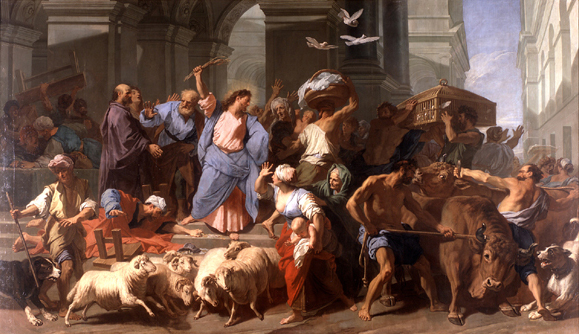
As for Yeshua’s controversial actions in the Temple, the text is clear: He made a whip of cords, drove out the sheep and cattle with that whip, overturned the money tables, scattered the coins, and ordered the money changers to get out, exclaiming, “Get these out of here! How dare you turn my Father’s house into a market!… It is written… ‘My house will be called a house of prayer,’ but you are making it a ‘den of robbers’ ” (John 2:16; Matt. 21:13). This is hardly “violence”!

It is understandable that some have failed to read the varied accounts in the four Gospels carefully and therefore have failed to put together the fact that John 2 mentions Jesus making a whip of cords (with which he drove out the sheep and cattle) while Matthew 21, Mark 11, and Luke 19 mention that he drove out the people selling. But the whip was for the animals; sharp words of rebuke were for the people. It is interesting that all four Gospels speak of this event (some believe it was actually two separate events), which indicates the great importance attached to the Messiah’s prophetic actions in the Temple.155 He was cleaning out his Father’s house, and it was a praiseworthy deed motivated by zeal for God and the work of God (see John 2:17). We should also point out that none of the Gospels record a single word of criticism from the Jewish leadership for Jesus’ actions here, even when false witnesses were being brought to slander and attack him (Matt. 26:59–61). Not a word about this incident was spoken by any of his accusers—obviously because there was nothing worth mentioning. (None of the Rabbinic literature mentions this incident either, despite the fact that there are some ugly attacks on Yeshua in that literature. See vol. 1, pp. 136–39, for more on these anti-Jesus hostilities.)

Returning again to the specific nature of hamas, “violence,” in the Tanakh, we must remember that Moses, Joshua, David, Samuel, and other great leaders put people to death at God’s command, yet they were not called “violent” because of their deeds. That is because hamas speaks of illegal violent acts, as opposed to simply carrying out God’s righteous judgments against sinners. Thus, when Moses called on the Levites to put their fellow Israelites to death for their idolatry, they were not committing violence (Exod. 32:25–28); when Joshua killed the five Canaanite kings, he was not committing violence (Josh. 10:16–27), nor was Samuel when he chopped up the Amalekite king, Agag (1 Sam. 15:32–33). How then could anyone say Jesus acted violently when he drove out animals with a whip and overturned the tables of money changers? This is certainly not violence!

What I find most ironic is that anti-missionaries say Isaiah 53 cannot possibly apply to Yeshua because of his alleged violence in cleansing the Temple, yet they freely apply Isaiah 53 to the nation of Israel (or the righteous remnant within Israel; see above, 4.6). Yet our people have been at their most heroic historically when they have used armed, forceful resistance against their adversaries—be it the warring Maccabees in the second century C.E., the courageous fighters of the Warsaw Ghetto uprising during the Holocaust, or the Israeli Defense Forces (IDF) who recaptured the Golan in 1973. We commend our people for heroic acts of war! How then can we apply Isaiah 53 to Israel—as a nonviolent people—while disqualifying Yeshua, the greatest example of nonviolence the world has ever known? Obviously, we cannot.

[1]


155 For discussion of the various Gospel accounts of this incident (whether there was one cleansing of the Temple or two), cf. the standard evangelical commentaries on the Synoptics and John.

[1]Brown, M. L. (2003). Answering Jewish objections to Jesus, Volume 3: Messianic prophecy objections (77). Grand Rapids, Mich.: Baker Books.
Isaiah 53 cannot refer to Jesus because it says the servant of the Lord was sickly and died of disease.

Isaiah 53 cannot refer to Jesus because it says the servant of the Lord was sickly and died of disease.

This is the least likely interpretation of the relevant verses in the Hebrew, as confirmed by many major translations, both Jewish and Christian. The text indicates that the servant of the Lord will be a man who is intimately associated with pain, grief, and sickness, a man suffering at the hands of people and crushed by the Lord as a guilt offering on our behalf. Such an understanding of the words is found in some Rabbinic interpretations too.

There are a number of expressions in Isaiah 52:13–53:12 that clearly describe violent acts committed against the servant of the Lord rather than simply describing the servant as sickly. According to 53:5, he was pierced, crushed, and wounded; according to 53:7, he was oppressed and afflicted, led as a lamb to the slaughter; according to 53:8, he was taken away by oppression and judgment.146 This explains what is written in 52:14: “There were many who were appalled at him—his appearance was so disfigured beyond that of any man and his form marred beyond human likeness.” This is also in keeping with the New Testament description of the sufferings of Jesus, as he was beaten, flogged, abused, and mocked before his crucifixion.

Classical Rabbinic commentaries that interpreted Isaiah 53 with reference to Israel’s sufferings also emphasized the violent deaths that the Jewish people have suffered at the hands of their enemies rather than speaking only of sickness and disease (see, e.g., Radak). This too agrees with a Messianic Jewish reading of the text.

What then of the passages that apparently speak of the servant’s own sickness? As rendered in the Orthodox Jewish Stone edition, Isaiah 53:3 reads, “He was despised and isolated from men, a man of pains and accustomed to illness. As one from whom we would hide our faces; he was despised, and we had no regard for him.” This could mean that the servant was sickly to the point of being disfigured and thus rejected. But it could plausibly mean that the servant was hated and misunderstood, totally identified with sick and hurting humanity. The NJPSV renders this passage, “He was despised, shunned by men, a man of suffering, familiar with disease,” a rendering that indicates the ambiguity of the Hebrew. (The rendering in the NIV is very similar: “He was despised and rejected by men, a man of sorrows, and familiar with suffering.”) This interpretation is confirmed by the following verses, which tell us clearly that (1) he actually carried our sickness and bore our pains, bringing healing to us through his wounds, and (2) he suffered the penalty for our sins, bringing us forgiveness and redemption. Thus, the servant himself was not sick, neither did he himself sin; rather, he identified with us in our sicknesses and sins, bringing us restoration in body and spirit.

What then of Isaiah 53:10a, which states, “But the Lord chose to crush him by disease” (NJPSV)? Once again, the original text is certainly not clear and unambiguous, as indicated by the footnote to this verse in the NJPSV, which states that the meaning of the Hebrew is uncertain. That’s why it is no surprise that the Stone edition renders this verse, “Hashem desired to oppress him and He afflicted him,” even though this same translation spoke of the servant’s sickness in 53:3 (as cited above). The fact is that there are other, totally valid ways to understand the Hebrew, as reflected once again in the NIV: “Yet it was the Lord’s will to crush him and cause him to suffer.” The reason there are such differences in translation is simply that the Hebrew root hlh can mean “to be sick” or it can mean “to be debilitated,” both definitions coming from a root meaning “to be weak.”147

An excellent example of the root hlh being used to mean “weak” is found in Judges 16:7, where Samson tells Delilah, “If anyone ties me with seven fresh thongs that have not been dried, I’ll become as weak as any other man” (see also 16:11, 17). The meaning “sick” stems from this root meaning of “weak.” In a similar way, someone who was severely wounded or hurt could say, “I have become hlh”—and it is obvious that the meaning here is not “sick.” Thus, after King Ahab was mortally wounded when he was struck by an archer’s arrow, he said to his chariot driver, “I am severely wounded!” (1 Kings 22:34 and 2 Chron. 18:33 nasb). The Hebrew says hohaleti (literally, “I have been made hlh”), which is identical in form to 2 Chronicles 35:23, where King Josiah, also struck by a fatal arrow, says to his attendants, “I am badly wounded”—the Hebrew word meʾod, “very,” being added here. It makes perfect sense, then, to understand this same verb in Isaiah 53:10 as stating that the Lord severely afflicted his righteous servant, allowing him to suffer in the most terrible and inhumane ways at the hands of wicked men, since the Hebrew verb heheli does not only mean “made sick” but can also mean “made to suffer, made weak, afflicted” (see further the lengthy discussion of the fifteenth-century Jewish commentator Don Isaac Abravanel).

Would even an anti-missionary object to such a reading of the passage if it were interpreted with reference to the people of Israel rather than Yeshua? Would the text refer only to those Jews who were smitten with sickness and disease, while it would not refer to those Jews who were expelled from their countries, or imprisoned and tortured, or starved to death in ghettos, or executed in gas chambers? Would not all of these varied sufferings fit under the heading of “being afflicted”? The simple fact is that the Hebrew root does not have exclusive reference to sickness and disease, and even when it does refer to sickness, it can have a metaphorical meaning, as in Deuteronomy 29:22[21], where the text speaks of God’s judgments on the land of Israel as diseases.

How then do we explain Isaiah 53:3, which states that the servant of the Lord was “a man of suffering and acquainted with infirmity” (NRSV)? There is actually some ambiguity in the Hebrew text, since: (1) The nouns makʾob and holi can refer to either physical or metaphorical pain and sickness (see, e.g., Exod. 3:7 for makʾob and Eccles. 6:2 for holi). (2) The Hebrew does not say that the servant of the Lord was sick and in pain but rather that he was “a man of pains” and “intimate with sickness/suffering.”148 This describes Jesus quite accurately: He was often in anguish and pain because of the depth of human suffering (and human sinfulness), sometimes sighing or groaning under the burden of it all, at other times being moved to tears (see, e.g., Mark 7:31–34; John 11:32–36). Truly, he was a man of sorrows and pains, intimately involved with sick and afflicted people.149 (3) The Stone edition renders Isaiah 53:4b as, “but we had regarded him diseased [naguʿa], stricken by God, and afflicted!” It is this verse—in particular the word naguʿa (rendered here as “diseased”)—from which the Talmud drew the concept of the “leper Messiah” (see b. Sanhedrin 98b).150 Naguʿa, however, can simply mean “smitten,” with no reference to leprosy or sickness, as can be seen from the use of the word in Psalm 73:14, where it speaks of the psalmist’s spiritual chastisements.151

Jesus spent a tremendous amount of his time pouring himself out for those who were severely ill, crippled, lame, blind, and even demonized—a ministry not nearly as glamorous as it sounds. These were often the outcasts, the untouchables, the beggars, the wretched; people with terrible wounds and sores and disfiguring skin conditions; screaming lunatics and wild men; epileptics tormented with seizures, foaming at the mouth. At times the stench of sickness and death must have been unbearable. At other times the horrific sights of twisted bodies and sightless eyes must have been overwhelming. And the crowds never stopped coming to him with their sick and dying family members and friends, even removing the roof of a house to get a paralytic to Jesus when there was no other way to reach him because of the throngs (Mark 2:1–12). And the text records that Yeshua healed them all! (See, e.g., Matt. 4:24; 8:16–17; 9:35; 12:15; 14:14, 35–36; 15:30–31; 21:14; Mark 6:53–56; Luke 4:40; 6:17–19; 17:12–19.)

This helps us to understand Isaiah 53:4, which states, “He has borne our infirmities and carried our diseases” (NRSV). He did not bear our sicknesses by becoming sick, nor did he carry our diseases by becoming diseased; rather, he bore our sicknesses by healing them and carried our diseases by removing them. And in the agonies of crucifixion, suffering in body and spirit, he became our ideal substitute. As his disciple Peter taught, “He himself bore our sins in his body on the tree, so that we might die to sins and live for righteousness; by his wounds you have been healed. For you were like sheep going astray, but now you have returned to the Shepherd and Overseer of your souls” (1 Peter 2:24–25).

[1]


146 Different translations of the Hebrew in this passage of Isaiah are possible, none of which greatly affect the overall meaning, despite the specious arguments set forth in Gerald Sigal, The Jew and the Christian Missionary: A Jewish Response to Missionary Christianity (New York: Ktav, 1981), 50–53.

147 A working definition, then, for the root would be, “to be weak, debilitated; to be sick, suffer.” For discussion of the relevant lexical data by a leading authority in the field, cf. Klaus Seybold, “chalah, etc.,” TDOT, 4:399–409; see further the references in Michael L. Brown, Israel’s Divine Healer, Studies in Old Testament Biblical Theology (Grand Rapids: Zondervan, 1995), 36–37, with nn. on 265.

148 D. Winton Thomas, a leading Hebrew and Old Testament scholar, devoted a number of studies to the root ydʿ (normally translated “to know”), arguing that in some instances it actually masked a different root meaning “to be humbled.” For references, and for a translation of Isaiah 53 incorporating these insights, cf. Loewe, prolegomenon to Driver and Neubauer, Fifty-Third Chapter of Isaiah.

149 The New Testament portrays Jesus as being intimately involved with human sickness and pain—to the point of causing him grief and anguish—yet full of divine joy (Heb. 1:9, citing Ps. 45:7[8]; see also Luke 10:21). Such a picture is psychologically consistent, given the dual realities with which Yeshua lived: great intimacy with his heavenly Father—producing boundless joy—and great intimacy with the human race—producing boundless pain.

150 The portion of the Talmudic text in question is dealing with Rabbinic speculation about the name of the Messiah. One opinion of the sages is that “his name is the leprous one [Aramaic, hiwwraʾ] of the house of Rabbi”; Isaiah 53:4 is quoted as support.

151 For further discussion of the root ngʿ with bibliographical references, cf. Brown, Israel’s Divine Healer, 317, n. 160. See also Rejected Cornerstone, 166–68, with reference to Delitzsch’s treatment of ngʿ.

[1]Brown, M. L. (2003). Answering Jewish objections to Jesus, Volume 3: Messianic prophecy objections (71). Grand Rapids, Mich.: Baker Books.

Isaiah 53 cannot refer to Jesus because it says no one was interested in the servant of the Lord

Isaiah 53 cannot refer to Jesus because it says no one was interested in the servant of the Lord or attracted to him, yet the New Testament records that large crowds followed Jesus.

Actually, the New Testament record agrees with the picture of the servant of the Lord described in Isaiah 53, despite the fact that great crowds did follow Jesus at numerous times during his ministry. This is because he spent most of his life almost unknown, and then once he became popular, he became the center of controversy and was vehemently rejected by many religious teachers and influential leaders, ultimately dying a criminal’s death on the cross. This is certainly in harmony with Isaiah 53.

At first glance, this objection might seem odd. After all, wasn’t Jesus rejected by his own people, and didn’t he die a horrific, humiliating death on the cross? Doesn’t he clearly fulfill the image of the suffering servant of the Lord described in Isaiah 53? And don’t the anti-missionaries sometimes claim that the authors of the New Testament made up details about the life of Jesus in order to give the impression that he was fulfilling Messianic prophecies? How then can they claim that the picture of Yeshua painted by the writers of the Gospels actually contradicts the words of the prophets?

Obviously, there is something self-contradictory in these two objections: arguing on the one hand that Yeshua, as described in the New Testament, did not fulfill the Messianic prophecies, while arguing on the other hand that the very same New Testament gives a false picture of Yeshua in order to make it appear that he fulfilled those very same prophecies. I address this contradiction directly in vol. 4, 5.14. For now, however, we will simply deal with the objection raised here, an objection based on the fact that the Gospels record that great crowds often followed Jesus, whereas Isaiah prophesied that he would be despised, rejected, and unpopular.

The key relevant verses in Isaiah 52:13–53:12 of the servant of the Lord are these:

Just as there were many who were appalled at him—

his appearance was so disfigured beyond that of any man

and his form marred beyond human likeness …

He grew up before him like a tender shoot,

and like a root out of dry ground.

He had no beauty or majesty to attract us to him,

nothing in his appearance that we should desire him.

He was despised and rejected by men,

a man of sorrows, and familiar with suffering.

Like one from whom men hide their faces

he was despised, and we esteemed him not.

Surely he took up our infirmities

and carried our sorrows,

yet we considered him stricken by God,

smitten by him, and afflicted.

Isaiah 52:14; 53:2–4

Isn’t this picture contradicted by New Testament passages stating that “large crowds” followed Jesus? Verses such as these are fairly common: “Large crowds from Galilee, the Decapolis, Jerusalem, Judea and the region across the Jordan followed him… . When he came down from the mountainside, large crowds followed him… . Such large crowds gathered around him that he got into a boat and sat in it, while all the people stood on the shore” (Matt. 4:25; 8:1; 13:2; see also Matt. 19:2; Luke 14:25, among other passages). How does this agree with the verses from Isaiah, just cited, that say “he had no beauty or majesty to attract us to him” and “he was despised and rejected by men”?

Let’s examine these verses in greater detail, without twisting anything, rewriting anything, or taking anything out of context. What does the text actually say? It begins with the servant’s humble, inauspicious origins: “He grew up before him like a tender shoot, and like a root out of dry ground. He had no beauty or majesty to attract us to him, nothing in his appearance that we should desire him” (Isa. 53:2–3). This agrees well with the humble, inauspicious origins of Jesus. He was raised by (apparently) poor parents in Nazareth,143 his foster father, Joseph, was a carpenter, and there is only one mention of Jesus doing anything of prominence in his first thirty years of life (Luke 2:41–51; 3:23a). Truly, he grew up like a tender shoot, like a root out of dry ground, and when he began his public ministry, those who knew him were taken aback: “ ‘Isn’t this the carpenter’s son? Isn’t his mother’s name Miriam, and aren’t his brothers Jacob, Joseph, Simon and Judah? Aren’t all his sisters with us? Where then did this man get all these things?’ And they took offense at him” (Matt. 13:55–57 NIV, with Hebraized names).

The fact that Jesus hailed from Nazareth in Galilee also raised some eyebrows. When Nathaniel, who became one of the Messiah’s followers, was introduced to “Jesus of Nazareth,” he exclaimed, “Nazareth! Can anything good come from there?” (John 1:45–46). And when the religious leaders heard talk about Jesus being the Messiah, some of them protested asking, “How can the [Messiah] come from Galilee?” and again, “Look into it, and you will find that a prophet [or the Prophet] does not come out of Galilee” (John 7:41, 52).

The prophet Isaiah stated, “he had no beauty or majesty to attract us to him, nothing in his appearance that we should desire him” (53:2b), and this too accords well with the Gospel witness, since there is not a single reference to Yeshua’s having a stately appearance or imposing physical presence. This is in clear contrast with the descriptions of some of Israel’s leaders of old, men like Saul, who was head and shoulders above his people in height (1 Sam. 10:23), or David, who was “ruddy, with a fine appearance and handsome features” (1 Sam. 16:12b). Nothing like this is said of Yeshua!

Isaiah also stated that the servant of the Lord was “despised and rejected by men,” something that very accurately describes the ministry of Jesus. No sooner did he preach his inaugural message in the synagogue in Capernaum than some of the people tried to kill him (Luke 4:16–30). Such murderous plots against Jesus followed him wherever he went—because of both his teachings and his miracles—right up to the time of his betrayal and crucifixion (see, e.g., Mark 3:1–6; Luke 22:47–71). Religious leaders accused him of being a demon-possessed Samaritan and of healing the sick by satanic power (John 8:48; Matt. 12:22–24). This certainly qualifies as being “despised and rejected,” especially when you realize that the rejection followed him more closely than the crowds did!

And there was something else about these crowds: They were fickle! For example, John 6:2 records that “a great crowd of people followed him because they saw the miraculous signs he had performed on the sick.” But by the end of the chapter, after hearing him teach some hard things, it is written that “many of his disciples turned back and no longer followed him” (John 6:66). In fact, it was common for Jesus to present a hard teaching to the big crowds that followed him in order to expose their hypocrisy and the shallowness of their commitment (see Luke 14:25–34). That’s why it is no surprise that one day great crowds could shout, “Crown him! Crown him!” when he entered Jerusalem and then shout “Crucify him! Crucify him!” only a few days later. As Christian leader Dan Harman pointed out, “So long as Jesus was misunderstood He was followed by the crowd. When they came to really understand Him, they crucified Him.”144

It is the graphic portrait of a crucified Messiah that Isaiah so powerfully describes: “His appearance was so disfigured beyond that of any man and his form marred beyond human likeness” (Isa. 52:14b)—the result of the savage beating he endured before his crucifixion (Matt. 26:67; 27:26–30); “we considered him stricken by God, smitten by him, and afflicted” (Isa. 53:4b)—as he hung on the cross dying a criminal’s death; he was pierced and crushed and punished and wounded (Isa. 53:5). “He was oppressed and afflicted, … led like a lamb to the slaughter, … cut off from the land of the living; … he poured out his life unto death, and was numbered with the transgressors” (see Isa. 53:7–8, 12). How could the picture be any clearer? Only transgressors were flogged and nailed to a cross. Jesus was numbered among them!(See 4.12, below.)

It should be perfectly clear, then, to any unbiased reader of the text that Isaiah 53 accurately describes the life, ministry, and sufferings of Jesus the Messiah. Go back and read the chapter again for yourself, or ask a Jewish friend who is unfamiliar with this chapter to read it and then ask him or her, “Who does this describe?” You might be surprised with the response.145

[1]


143 Cf. Luke 2:22–24 with Leviticus 12:8.

144 The original source of this quote is unknown to me.

145 It is fair to ask a follower of the late Lubavitcher Rebbe, Menchaem Schneerson, hailed by many of his followers as the Messiah, how the picture of Isaiah 53 correlates with his life, since his disciples pointed to this very passage of Scripture when he suffered a debilitating stroke in 1992 at the age of ninety. He had several hundred thousand devotees around the world and was considered by his people to be the most influential Jewish leader of the twentieth century. Can’t the same objection raised here against Jesus—incorrectly so, as we have seen—also be raised against the Rebbe? Yet anti-missionaries in his camp use this objection against Yeshua!

[1]Brown, M. L. (2003). Answering Jewish objections to Jesus, Volume 3: Messianic prophecy objections (67). Grand Rapids, Mich.: Baker Books.
How Can One God Be Three?

How Can One God Be Three?

Speaking through the prophet Isaiah, God said, “My thoughts are not your thoughts, / Nor are your ways My ways … / For as the heavens are higher than the earth, / So are My ways higher than your ways, / And My thoughts than your thoughts” (Isa. 55:8–9). God is infinite, man is finite, so there are mysteries about God that man cannot fully understand. One of these mysteries is the Trinity, the tri-personality of God. According to Christian orthodoxy, God is one God in essence, power, and authority, and also eternally exists as three distinct co-equal persons. These three persons are the Father, the Son (Jesus), and the Holy Spirit. This does not mean that Christians believe in three gods (polytheism). Rather, the doctrine of the Trinity is that there is only one God who exists in three distinct persons, and all three share the exact same divine nature or essence.

Understanding this fully is beyond human comprehension and has no human parallels, although various analogies have been offered. One of these analogies is the three physical states of water. Water is not only a liquid but also a solid (ice) and a gas (vapor), yet its chemical composition (substance) never changes in all three forms (two parts hydrogen and one part oxygen—H2O). Although such analogies help us visualize the concept of the Trinity, they all fall short in some way. In the case of the water analogy, although the molecule H2O can be liquid, solid, or gas, it is never all three at one time. The Trinity, on the other hand, is all three persons as one God.

The word Trinity is not used in Scripture, but it has been adopted by theologians to summarize the biblical concept of God. Difficult as it is to understand, the Bible explicitly teaches the doctrine of the Trinity, and it deserves to be explained as clearly as possible, especially to non-Christians who find the concept a stumbling-block to belief. So let’s dig into this topic by addressing four key questions.

IS THE DOCTRINE OF THE TRINITY IRRATIONAL?

The doctrine of the Trinity is certainly a mystery but that doesn’t mean it’s irrational. The concept cannot be known by human reason apart from divine revelation, and, as we’ll soon see, the Bible definitely supports the idea of the Trinity. But for now, I want to demonstrate that the doctrine of the Trinity, although beyond human comprehension, is nevertheless rational. Our acceptance of it is congruous with how we respond to other data about the known world.

There are many things about the universe we don’t understand today and yet accept at face value simply because of the preponderance of evidence supporting their existence. The scientific method demands that empirical evidence be accepted whether or not science understands why it exists or how it operates. The scientific method does not require that all data be explained before it is accepted.

Contemporary physics, for instance, has discovered an apparent paradox in the nature of light. Depending on what kind of test one applies (both of them “equally sound”), light appears as either undulatory (wave-like) or corpuscular (particle-like). This is a problem. Light particles have mass, while light waves do not. How can light have mass and not have it, apparently at the same time? Scientists can’t yet explain this phenomenon, but neither do they reject one form of light in favor of the other, nor do they reject that light exists at all. Instead, they accept what they’ve found based on the evidence and press on.

Like physicists, we are no more able to explain the mechanics of the Trinity than they can explain the apparent paradox in the nature of light. In both cases, the evidence is clear that each exists and harbors mystery. So we must simply accept the facts and move on. Just because we cannot explain the Trinity, how it can exist, or how it operates does not mean that the doctrine must be rejected, so long as sufficient evidence exists for its reality. So let’s now explore this evidence.

HOW DOES THE BIBLE PRESENT THE DOCTRINE OF THE TRINITY?

THE OLD TESTAMENT

Although the doctrine of the Trinity is fully revealed in the New Testament, its roots can be found in the Old Testament.

In several places, God refers to Himself in plural terms. For example, “Then God said, ‘Let Us make man in Our image’” (Gen. 1:26; see 3:22; 11:7; Isa. 6:8).

The Messiah was prophesied in the Old Testament as being divine. Isaiah 9:6 states that the Messiah will be called “Mighty God,” a term applied in the Old Testament specifically to Yahweh (see Mic. 5:2).

Isaiah 48:16 refers to all three members of the Godhead: “Come near to Me, listen to this: From the first I have not spoken in secret, from the time it took place, I was there. And now the Lord God [Father] has sent Me [Jesus], and His Spirit [the Holy Spirit]” (nasv).

The Old Testament also makes numerous references to the Holy Spirit in contexts conveying His deity (Gen. 1:2; Neh. 9:20; Ps. 139:7; Isa. 63:10–14).

THE NEW TESTAMENT

The New Testament provides the most extensive and clear material on the Trinity. Here are just a few of the texts that mention all three members of the Godhead and imply their co-equal status.

•     Matthew 28:19, the baptismal formula: “Go therefore and make disciples of all the nations, baptizing them in the name [not ‘names’] of the Father and of the Son and of the Holy Spirit.”

•     Matthew 3:16, at the baptism of Christ in the Jordan: “And after being baptized, Jesus went up immediately from the water; and behold, the heavens were opened, and He saw the Spirit [Holy Spirit] of God [Father] descending as a dove, and coming upon Him [Jesus]” (nasv).

•     Luke 1:35, the prophetic announcement to Mary of Jesus’ birth: “And the angel answered and said to her, ‘The Holy Spirit will come upon you, and the power of the Highest [Father] will overshadow you; therefore, also, that Holy One who is to be born will be called the Son of God [Jesus].’”

•     The trinitarian formula is also found in 1 Peter 1:2, 2 Corinthians 13:14, and 1 Corinthians 12:4–6.

DIGGING DEEPER

To explain the doctrine of the Trinity, I will take an inductive (scientific) approach. By this I mean I will accumulate general facts in Scripture that lead to a specific conclusion—that the nature of God is triune. The argument will go like this:

1. The Bible teaches that God is one (monotheism) and that He possesses certain attributes that only God can have.

2. Yet when we study the attributes of the Father, the Son, and the Holy Spirit, we discover that all three possess the identical attributes of deity.

3. Thus we can conclude that there is one God eternally existing as three distinct persons.

God Is One (Monotheism)

The Hebrew Shema of the Old Testament is “Hear, O Israel: The Lord our God, the Lord is one!” (Deut. 6:4; see Isa. 43:10; 44:6; 46:9). Some people have argued that this passage actually refutes the concept of the triune nature of God because it states that God is one. But the Hebrew word for “one” in this text is echod, which carries the meaning of unity in plurality. It is the same word used to describe Adam and Eve becoming “one flesh” (Gen. 2:24). Scripture is not affirming that Adam and Eve literally become one person upon marriage. Rather, they are distinct persons who unite in a permanent relationship.

The New Testament confirms the teaching of the Old: “You believe that God is one. You do well; the demons also believe, and shudder” (James 2:19, nasv; see 1 Tim. 2:5; 1 Cor. 8:4; Eph. 4:4–6).

God Has a Certain Nature

Both the Old and New Testaments list the attributes of God. We won’t consider all of them here, but what follows are some of the clearest expressions of what constitutes deity.

•     God is omnipresent (present everywhere at once): Psalm 139:7–10; Jeremiah 23:23–24.

•     God is omniscient (possesses infinite knowledge): Psalms 139:1–4; 147:4–5; Hebrews 4:13; 1 John 3:20.

•     God is omnipotent (all-powerful): Psalm 139:13–18; Jeremiah 32:17; Matthew 19:26.

The Father Is God

To the Jews, who do not accept the Trinity, God is Yahweh. In the Old Testament, Yahweh is to the Hebrews what Father is in the New Testament and to Christians. The attributes of God (Yahweh) listed above are the same for Yahweh and Father because both names apply to the one God. Although the concept of God as Father is not as explicit in the Old Testament as it is in the New, nevertheless, it has its roots in the Old (see Pss. 89:26; 68:5; 103:13; Prov. 3:12).

In the New Testament, the concept of the Father as a distinct person in the Godhead becomes clear (Mark 14:36; 1 Cor. 8:6; Gal. 1:1; Phil. 2:11; 1 Pet. 1:2; 2 Pet. 1:17). God is viewed as Father over creation (Acts 17:24–29), the nation of Israel (Rom. 9:4; see Exod. 4:22), the Lord Jesus Christ (Matt. 3:17), and all who believe in Jesus as Lord and Savior (Gal. 3:26).

The Son Is God

Like the Father, Jesus possesses the attributes of God. He is omnipresent (Matt. 18:20; 28:20). He is also omniscient: He knows people’s thoughts (Matt. 12:25), their secrets (John 4:29), the future (Matt. 24:24–25), indeed all things (John 16:30; 21:17). His omnipotence is also taught. He has all power over creation (John 1:3; Col. 1:16), death (John 5:25–29; 6:39), nature (Mark 4:41; Matt. 21:19), demons (Mark 5:11–15), and diseases (Luke 4:38–41).

In addition to these characteristics, Jesus exhibits other attributes that the Bible acknowledges as belonging only to God. For example, He preexisted with the Father from all eternity (John 1:1–2), accepted worship (Matt. 14:33), forgave sins (Matt. 9:2), and was sinless (John 8:46).

The Holy Spirit Is God

The Holy Spirit is also omnipresent (Ps. 139:7–10), omniscient (1 Cor. 2:10), and omnipotent (Luke 1:35; Job 33:4).

Like Jesus, the Holy Spirit exhibits other divine attributes that the Bible ascribes to God. For instance, He was involved in creation (Gen. 1:2; Ps. 104:30), inspired the authorship of the Bible (2 Pet. 1:21), raised people from the dead (Rom. 8:11), and is called God (Acts 5:3–4).

The upshot of all this is that God is triune. In a formal argument, we can put it this way:

Major Premise:

Only God is omnipresent, omniscient, and omnipotent.

Minor Premise:

The Father, the Son, and the Holy Spirit are omnipresent, omniscient, and omnipotent.

Conclusion:

Therefore, God is triune as Father, Son, and Holy Spirit.

THE TRINITY

HOW DOES JESUS TEACH THE DOCTRINE OF THE TRINITY?

In the Bible, Jesus claims to be God and then demonstrates this claim by displaying the attributes of God and by raising Himself from the dead. So what Jesus has to say about God must be true. And Jesus clearly teaches that God is triune.

Jesus Is Equal with the Father and Holy Spirit

In Matthew 28:19, Jesus tells His followers to “make disciples of all the nations, baptizing them in the name of the Father and of the Son and of the Holy Spirit.” He uses the singular word name but associates it with three persons. The implication is that the one God is eternally three co-equal persons—Father, Son, and Holy Spirit.

Jesus Is One with the Father

In John 14:7 and 9, Jesus identifies Himself with the Father by saying to His disciples, “If you had known Me, you would have known My Father also; and from now on you know Him and have seen Him … He who has seen Me has seen the Father” (see John 5:18). Jesus is not claiming to be the Father; rather, He is saying that He is one with the Father in essence.

Jesus Is One with the Holy Spirit

Continuing in John 14, Jesus tells His disciples that, after He is gone, He will send them “another Helper” who will be with them forever and will indwell them (vv. 16–17). The “Helper” is the Holy Spirit. The trinitarian implication lies with the word another. The apostle John, as he wrote this passage, could have chosen one of two Greek words for another. Heteros denotes “another of a different kind,” while allos denotes “another of the same kind as myself.” The word chosen by John was allos, clearly linking Jesus in substance with the Holy Spirit, just as He is linked in substance with the Father in verses 7 and 9. In other words, the coming Holy Spirit will be a different person than Jesus, but He will be the same with Him in divine essence just as Jesus and the Father are different persons but one in their essential nature. Thus, in this passage, Jesus teaches the doctrine of the Trinity.

So far we have seen that the authors of Scripture and Jesus Christ teach the triune nature of God. Therefore, the only way the doctrine of the Trinity can be rejected is if one refuses to accept the biblical evidence. Some groups, such as the Jehovah’s Witnesses, do this by reinterpreting and altering Scripture. Others, such as the Unitarians (who claim that Jesus is just a man), arbitrarily and without any evidence deny anything supernatural or miraculous in the Bible. Both the Jehovah’s Witnesses and the Unitarians are guilty of the very same thing of which they accuse Christians—irrationality. They refuse to accept the evidence for the Trinity regardless of how legitimate it is. This is unscientific and irrational. If one approaches Scripture without bias, he will clearly discover what the church has maintained for centuries: God is triune—one God in essence but eternally existing in three persons as Father, Son, and Holy Spirit.

A COMMON OBJECTION

Perhaps you’ve wondered or heard someone say, “If Jesus is one in essence with the Father, an equal member of the triune Godhead, why does He say, ‘the Father is greater than I’” (John 14:28)? This question actually moves away from the doctrine of the Trinity and launches us into the doctrine of the incarnation, the process whereby Jesus, as the eternal Son of God, came to earth as man. Nevertheless, because this question is frequently raised as an objection, it needs to be answered.

Numerous passages in Scripture teach that Jesus, although fully God, is also fully man (John 1:14; Rom. 8:3; Col. 2:9; 1 Tim. 3:16). However, Philippians 2:5–8 states that, in the process of taking on humanity, Jesus did not give up any of His divine attributes. Rather, He gave up His divine glory (see John 17:5) and voluntarily chose to withhold or restrain the full use of His divine attributes. There are numerous instances in Scripture where Jesus, although in human form, exhibits the attributes of deity. If Jesus had surrendered any of His divine attributes when He came to earth, He would not have been fully God and thus could not have revealed the Father as He claimed to do (John 14:7, 9).

The key to understanding passages such as John 14:28 is that Jesus, like the Father and the Holy Spirit, has a particular position in the triune Godhead. Jesus is called the Son of God, not as an expression of physical birth, but as an expression of His position in relationship to the Father and Holy Spirit. This in no way distracts from His equality with the Father and the Holy Spirit or with His membership in the Godhead. As man, Jesus submits to the Father and acts in accordance to the Father’s will (see John 5:19, 30; 6:38; 8:28). So when we read passages such as Mark 14:36 where Jesus submits to the Father’s will, His submission has nothing to do with His divine essence, power, or authority, only with His position as the Incarnate Son.

Perhaps an illustration will help to explain this. Three people decide to pool their money equally and start a corporation. Each are equal owners of the corporation, but one owner becomes president, another vice-president, and the third secretary/treasurer. Each are completely equal so far as ownership, yet each has his own particular function to perform within the corporation. The president is the corporate head, and the vice-president and secretary/treasurer are submissive to his authority and carry out his bidding.

So when Jesus the God-man submits to the Father’s will or states that the Father is greater than He or that certain facts are known only by the Father (e.g., Matt. 24:36), it does not mean that He is less than the other members of the Godhead but that in His incarnate state He did and knew only that which was according to the Father’s will. The Father did not will that Jesus have certain knowledge while in human form. Because Jesus voluntarily restrained the full use of His divine attributes, He was submissive to the Father’s will.

Why did Jesus choose to hold back from fully using His divine powers? For our sake. God willed that Jesus feel the full weight of man’s sin and its consequences. Because Jesus was fully man, He could fulfill the requirements of an acceptable sacrifice for our sins. Only a man could die for the sins of mankind. Only a sinless man could be an acceptable sacrifice to God. And it is only because Jesus is an equal member of the triune Godhead, and thus fully God, that He was able to raise Himself from the dead after dying on the cross and thereby guarantee our eternal life.

When all the evidence is accounted for and the verdict read, the Bible clearly teaches that the Father, the Son, and the Holy Spirit are three distinct, co-equal, co-eternal members of the Godhead, yet one in essence, power, and authority. All three are one God. Were this not the case, if the Trinity were not a reality, there would be no Christianity.

[1]


[1]Story, D. (1997). Defending your faith. Originally published: Nashville : T. Nelson, c1992. (99). Grand Rapids, MI: Kregel Publications.

Exit mobile version