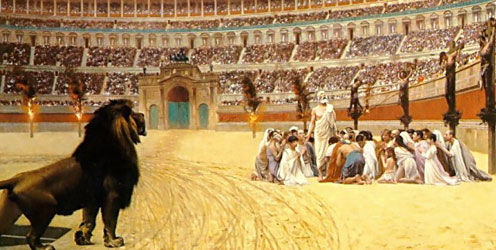
من أقيم مصادر المعلومات التي لدينا عن عصر الاضطهاد هي تلك الروايات التي تتحدث عن الآلام التي جازها الشهداء؛ والتي كانت تُقرأ للجماعات المسيحية في أثناء الخدمة الليتورجية التي تقام في الذكرى السنوية لاستشهاد الشهيد. وتنقسم تلك الروايات من وجهة النظر التاريخية إلى ثلاث مجموعات:
المجموعة الأولى: وتتكون من محاضر المحاكمات الرسمية وهي لا تحتوي على أي شيء سوى الأسئلة التي واجهتها السُلطات إلى الشهداء، وإجاباتهم عليها كما سجلت بواسطة الموثقين القانونيين أو كُتاب المحكمة، وكذلك الأحكام التي نُطقت ضدهم. وقد كانت هذه الوثائق تحفظ في الأرشيف العام، وأحياناً كان المسيحيون ينجحون في الحصول على نسخ منها. ويجب أن يكون العنوان “أعمال الشهداء” مقصوراً على هذه المجموعة لا غيرها، لأنه هنا فقط توجد مصادر تاريخية مباشرة وموثوق منها، وترد المعلومات ببساطة وبتجرد.
المجموعة الثانية: وتضم شهادات شهود العيان أو المعاصرين، ويُطلق على هذه الروايات عنوان “روايات الآلام” (Passiones) أو “روايات الاستشهاد” (Martyria).
المجموعة الثالثة: وتحتوي على الأساطير التي تدور حول الشهداء والتي أُلفت لغرض تهذيبي وتعليمي بعد وقت طويل من حادثة الاستشهاد. وفي بعض الأحيان تكون هذه الأساطير عبارة عن خليط رائع من بعض الحقائق ومحتوى أسطوري صرف، والبعض الآخر ما هو إلا خيال بدون أي أساس تاريخي.
أولاً: ينتمي إلى المجموعة الأولى[1] كل من التالي:
أعمال القديس يوستينوس ورفقائه: ولهذه الأعمال قيمة كبيرة، لأنها تحتوي على محضر جلسة المحكمة الرسمية التي أقيمت ضد أهم المدافعين اليونانيين، الفيلسوف يوستينوس الشهير. وكان يوستينوس قد ألقي في السجن ومعه ستة مسيحيين آخرين بأمر من الحاكم الروماني (Q. Junius Rusticus) في عهد الإمبراطور “ماركوس أوريليوس أنطونينوس” الفيلسوف الرواقي. وتتكون “أعمال يوستينوس ورفقائه” من مقدمة مختصرة جداً، يتبعها التحقيق مع الشهيد ورفقائه ثم الحكم الذي حكم به عليهم، ثم خاتمة قصيرة. ولقد كان منطوق الحكم الذي نطق به الوالي الروماني هو التالي: “ليُجلد هؤلاء الذين لا يضحون للآلهة ولا ينصاعون لأمر الإمبراطور، وليُساقوا لتقطع رؤوسهم وفقاً للقانون”. وقد استشهد القديس يوستينوس ورفقاؤه في مدينة روما عام 165م على أرجح الأقوال.
أعمال شهداء سيليوم[2] في أفريقيا: وهي تشكل أقدم وثيقة في تاريخ الكنيسة الأفريقية، وهي في الوقت نفسه أقدم وثيقة مسيحية لدينا باللغة اللاتينية من شمال أفريقيا. أما من حيث المحتوى، فهي عبارة عن المحضر الرسمي لجلسة مُحاكمة كل من “نامفانو الذي من مادورا” (Namphano of Madaura) و”ميجن” (Miggin) و”سانام” (Sanam) وستة مسيحيين آخرين من “نوميديا”[3] (Nuimidi)، حُكم عليهم بالموت بواسطة القُنصل “ساتورنينوس” (Saturninus)، وقُطعت رؤوسهم بتاريخ 17 يوليو عام 180م. وبالإضافة إلى الأصل اللاتيني، لدينا ترجمة يونانية لهذه الأعمال.
الأعمال الحكومية للقديس كبريانوس أسقف قرطاج: الذي استشهد يوم 14 سبتمبر 258م. وهي تعتمد على تقارير رسمية رُبطت معا بعبارات قليلة من قلم المحرر. وهي تتكون من ثلاث وثائق منفصلة تحتوي على: (1) المحاكمة الأولى التي حكمت بنفي كبريانوس إلى (Curubis). (2) القبض عليه والمحاكمة الثانية، ثم (3) عملية الإعدام. ولقد كانت شهادة القديس كبريانوس في عهد الإمبراطورين “فاليريان” (Valerian) و “جالينوس” (Gallienus).
ثانياً: ينتمي إلى المجموعة الثانية[4] كل من التالي:
شهادة بوليكاريوس: وهي تعود إلى سنة 156م.
رسالة كنائس فيينا وليون إلى كنائس آسيا وفريجية: وتعطي تلك الرسالة تقريراً مؤثراً عن آلام الشهداء الذين ماتوا في الاضطهاد العنيف الذي وقع على كنيسة ليون عام 177م أو 178م، والذي سجله يوسابيوس القيصري في (Hist. eccl. 51: 1-28). وتُعد تلك الرسالة واحدة من أكثر الوثائق التي تتكلم عن الاضطهادات إثارة للاهتمام، وهي لا تخفي أمر ارتداد بعض أعضاء الجماعة. ونجد من ضمن الشهداء الشجعان الأسقف “فوتينوس” (Photinus)، وذاك الذي “كان يتنفس بصعوبة لكونه تجاوز التسعين من عمره ومريضاً جداً، لكنه قد تقوى بحماس الروح الذي استمده من رغبته الملتهبة في الاستشهاد”؛ و”بلاندينا” (Blandina) الجديرة بالإعجاب، والتي كانت جارية ضعيفة ورقيقة عززت من شجاعة إخوتها بمثالها وكلامها؛ و”ماتوروس” (Maturus)، الذي كان مؤمناً جديداً ذا شجاعة مذهلة؛ و”سانكتوس” (Sanctus) الشماس من فيينا؛ و”أليكساندر” (Alexander) الطبيب؛ و”بونتيكوس” (Ponticus) الذي كان صبياً في الخامسة عشرة من العمر.
وتقول الرسالة عن بلاندينا: “إن المباركة بلاندينا، التي كانت آخرهم جميعاً، وشجعت أولادها مثل أم نبيلة وأرستلهم قبلها إلى الملك متوجين بالمجد، قد عادت لتخوض بنفسها كل المعارك التي خاضها أولادها، مسرعة إليهم، مبتهجة ومنتصرة في رحيلها كما لو كانت مدعوة إلى عشاء عرس لا إلى الطرح للوحوش المفترسة. وبعد الجلد، وبعد الجلد، وبعد الوحوش المفترسة، وبعد الحريق، طُرحت أخيراً في شبكة وأُلقيت أمام ثور. وبعد أن ظل الوحش يتقاذفها لوقت طويل وهي غير مدركة لما يحدث بسبب رجائها، وتمسكها بما تؤمن به، وشركتها مع المسيح، فاضت روحها أيضاً. إن الوثنيين أنفسهم يعترفون أنهم لم يروا قط امرأة تحملت آلاماً كثيرة هكذا أو عظمية هكذا”.
آلام بيريتوا وفيليسيتاس: ويروي هذا العمل قصة استشهاد ثلاثة موعوظين هم: “ساتوروس” (Saturus)، و”ساتورنينوس” (Saturninus)، و”ريفوكاتوس” (Revocatus)، وشابتين هما: “فيبيا بيريتوا” (Vibia perpetua) ذات الاثنين والعشرين عاماً، والتي كانت “ذات نسب عريق، متعلمة جيداً، متزوجة زيجة كريمة، لديها أب وأم وأخان واحد منهما موعوظ مثلها، وابن رضيع على ثديها”، وجاريتها “فيليسيتاس” (Filicitas) التي كانت حبلى وقت القبض عليها ثم ولدت بنتاً قبل أن تموت في حلبة المصارعين بوقت قصير. وقد استشهدوا جميعاً في يوم 7 مارس 202م بمدينة قرطاج.
وتعد هذه الرواية واحدة من أجمل قطع الأدب المسيحي المبكر، كما أنها فريدة من حيث تأليفها، ذلك لأن الجزء الأكبر من الرواية (من الفصل 3 إلى الفصل 10) هو من مذكرات بيربتوا اليومية: “من الآن فلاحقاً ستروي هي نفسها قصة استشهادها وفقاً لما تركته هي مكتوباً بخط يدها وبحسب أفكارها”. (فصل 2) وكتب ستاوروس (أو ستافروس) الفصول من 11 إلى 13.
وهناك سبب يجعلنا نصدق أن كاتب الفصول الأخرى ومحرر العمل كله لم يكن إلا ترتليانوس الذي كان معاصراً لبيريتوا وأعظم كاتب في الكنيسة الأفريقية في ذلك الوقت، فتشابه العبارات وبناء الجُمل والكلمات بين عملي ترتليانوس: (Ad Martyres) و(De Patientia)، وآلام بيربتوا وفيليسيتاس” مُلفت للنظر. وقد كان الناس في زمن القديس أغسطينوس لا يزالوا يكنون احتراماً كبيراً لهذا العمل، حتى إن أغسطينوس كان مضطراً لتحذير مستمعيه ألا يضعوا هذا الكتاب على قدم المساواة مع الأسفار القانونية.
والعمل موجود في نص يوناني وآخر لاتيني، ويبدو أن النص اللاتيني هو الأصلي، لأنه يوحد بالنص اليوناني فقرات محُرفة وخاتمة مشوهة. ويعتقد (C. Van Beek) أن المؤلف الذي حرر قصة الآلام في اللاتينية هو نفسه الذي حررها في اليونانية، ولك الفقرات (21: 2) و(16: 3) تثبت أنه لا بد من أن يكون النص اللاتيني هو الأصلي، وأن النص اليوناني ما هو إلا ترجمة لاحقة له، لأن اللعب بالكلمات الموجود في هذه الفقرات لا يمكن فهمه إلا في اللاتينية.
ولمحتوى هذا العمل أهمية كبيرة في تاريخ الفكر المسيحي، خاصة أن الرؤى التي رأتها بيربتوا أثناء فترة سجنها ودونتها لها قيمة كبيرة في معرفة الأفكار الإسخاتولوجية التي اعتقد بها المسيحيون الأوائل، وتضرب رؤيا “دينوكراتس” (Dinocrates)، ورؤيا “السلم والتنين” أمثلة مدهشة على ذلك، وقد أطلق هذا العمل على الاستشهاد اسم “المعمودية الثانية” مرتين (18: 3 و21: 2)، وكذلك تظهر طقوس التناول في الرؤيا التي رأتها بيربتوا عن الراعي الصالح.
4 – أعمال القديسين كربوس وبابيلوس وأغاثونيس: وهي رواية أصيلة من قلم شاهد عيان على استشهاد “كربوس” (Carpus) و”بابيلوس” (Papylus) اللذين ماتا مشدودين إلى وتد في مسرح مدينة برغامس المدرج، واستشهاد أغاثونيس (Agathonice) التي كانت امرأة مسيحية ألقت بنفسها في النار. ويبدو أن العمل في صورته الحالية غير كامل، فالجزء الذي ذكر فيه صدور الحكم على أغاثونيس – كالشخصين الآخرين – مفقود، وذلك جعل أغاثونيس تبدو كما لو كانت قد ماتت منتحرة. وقد استشهد الثلاثة في عهد الإمبراطورين “ماركوس أوريليوس” و”لوسيوس فيروس” (161-169م). وقد كان هذا العمل لا يزال متداولاً في زمن يوسابيوس القيصري”[5].
5 – أعمال أبوللونيوس: ويعطي يوسابيوس القيصري في كتابه (Eccl. Hist. 5: 21: 2-5) ملخصاً لهذا الكتاب الذي ذكره ضمن ما جمعه من روايات الاستشهاد القديمة. وقد كان أبوللونيوس (Apollonius) فيلسوفاً متعلماً حوكم بواسطة بيرينيس (Perennis) حاكم دار الولاية بروما وقطعت رأسه في عهد الإمبراطور كومودوس (Commodus) (180-185م).
وتشبه الخُطب التي دافع بها أبوللونيوس عن إيمانه أمام بيرينيس كتابات المُدافعين في الحجج التي توردها، وهي في الغالب تعتمد على الإجابات التي أعطاها الفيلسوف في أعمال الولاية الرسمية. ويطلق (A. Harnack) على هذه الخطب “أبرز دفاع عن المسيحية وصلنا من العصور القديمة”.
وقد نشرت ترجمتان لهذا العمل، واحدة أرمينية نشرها كونيبير (Conybeare) عام 1893م، والثانية يونانية نشرها البولانديستيون[6] (The Bollandists) عام 1895م.
ثالثاً: ينتمي إلى المجموعة الثالثة كل من التالي:
أعمال الشهداء الرومانيين: القديسة أجنس (Agnes)، والقديسه سيسيليا (Cecilia)، والقديسة فيليسيتاس (Filicitas) وأولادها السبع، والقديس هيبوليتس، والقديس لورانس (Lorandce)، والقديس سيكتوس، والقديس سباستيان (Sebastian)، والقديسون يوحنا، وبولس، وكوزماس (Cosma)، ودميان (Damian)؛ وأيضاً استشهاد القديس كليمندس واستشهاد القديس إغناطيوس. ولكن هذه الأعمال لا تُثبت بأي شكل من الأشكال وجود هؤلاء الشهداء من عدمه، لكنها تعني فقط أن هذه الوثائق لا يمكن استخدامها كمصادر تاريخية.
المجموعات: لقد جمع يوسابيوس مجموعة من أعمال الشهداء في كتابه المعنون بـ “حول الشهداء القدامى” (On the Ancient Martyrs)، وقد فقد هذا المرجع المهم للأسف، لكن يوسابيوس لخص معظم هذه الأعمال في كتابه “تاريخ الكنيسة”. ومن ناحية أخرى، لدينا مقالته عن شهداء فلسطين، وهو تقرير عن ضحايا الاضطهادات التي وقعت بداية من سنة 303م إلى 311م، تلك التي كان شاهداً عليها باعتباره أسقفاً لقيصرية.
جمع كاتب مجهول أعمال الشهداء الفرس الذين قتلوا في عهد سابور الثاني (Sabor II) (339-379م)، وهي موجودة لدينا باللغة السريانية التي كُتبت بها. ولقد وردت المحاكمات ومحاضر التحقيقات هنا بطريقة تشبه تقارير أعمال الشهداء الأصلية، أما “الأعمال السريانية لشهداء إديسا” فعبارة عن أساطير.
[1] هي التي تحتوي على محاضر وأحكام المحاكمات الرسمية للشهداء كما سجلت بواسطة الموثقين القانونيين.
[2] قرية صغيرة في نواحي قرطاج بشمال أفريقيا (المراجع)
[3] تقع شمال الجزائر الحالية (المراجع)
[4] وهي المجموعة التي تحتوي على شهادات شهود العيان أو المعاصرين.
[5] Hist. eccl. 4, 15, 48.
[6] البولانديستيون هم مجموعة من الرهبان اليسوعيين المقيمين في بلجيكا، وقد سموا باسم قائدهم “جان بولاند”، وهو راهب يسوعي عاش في القرن السابع عشر. وقد كلف الكرسي الرسولي البولانديستيين بمهمة جمع وتأليف مؤلف رسمي معتمد يضم سير القديسين، وهو ذلك المسمى بـ “Acta Sanctorum” (المراجع).
مقدمه ضد الماركيونيين وقانونية العهد الجديد – القمص عبد المسيح بسيط
مقدمه ضد الماركيونيين وقانونية العهد الجديد – القمص عبد المسيح بسيط
مقدمه ضد الماركيونيين وقانونية العهد الجديد – القمص عبد المسيح بسيط
وجدت هذه المقدمة في المخطوطات اللاتينية، ويرى العلماء أن هناك مقدمتين واحدة للإنجيل للقديس لوقا والثانية للإنجيل للقديس يوحنا تردان على قانون ماركيون[1]، وجاء فى هذه المقدمة المسماة: ” مقدمه ضد الماركيونيين – Anti Marcionite Prologue “. التى أشتهرت فى الكنيسة الرومانية، وترجع إلى النصف الثانى من القرن الثانى، وتنتهي هذه المقدمة بالحديث عن الإنجيل للقديس مرقس ورؤيا يوحنا والإنجيل للقديس يوحنا: ” لوقا سورى إنطاكي، سورى السلالة، طبيب المهنة، أصبح تلميذاً للرسل، وتبع بولس الرسول أخيراً حتى استشهاده (بولس)، وخدم الرب بإصرار ولم يتزوج، ولم يكن له ولد، أمتلأ بالروح القدس، ومات فى الرابعة والثمانين من العمر فى بيوثية.
فبعد أن كُتب الإنجيل الذى لمتى فى اليهودية والإنجيل الذى لمرقس فى إيطاليا، قاد الروح القدس لوقا لكتابه إنجيله هو فى إقليم اخائية، ويذكر فى مقدمته أن كتابات أخرى قد دونت قبله، لكن الضرورة أجبرته أن يكتب بدقة قدر الإمكان للمؤمنين بين الأمم سيره كاملة وشاملة روايات الإنجيل … فقد سلم لنا لوقا قصة ميلاد يوحنا المعمدان كشيء جوهري جداً في الإنجيل، ويوحنا مرقس يبدأ الإنجيل بمعد طريق ربنا والذي شارك في الإعداد للإنجيل وخدمة المعمودية والاتصال بالروح. وكانت خدمة يوحنا قد تنبأ بها أثنان من الأنبياء[2].
وفيما بعد كتب لوقا نفسه أعمال الرسل، وفيما بعد كتب يوحنا واحد من الاثني عشر الرؤيا في جزيرة بطمس، ثم الإنجيل في آسيا “[3].
وتقول المقدمة الخاصة بالإنجيل للقديس يوحنا: ” ونشر الإنجيل بحسب يوحنا وأعطي للكنائس، كما كتب بابياس أسقف هيرابوليس تلميذ يوحنا المحبوب في مؤلفة الأخير من مؤلفاته الخمس. وقد كُتب الإنجيل بدقة كإملاء يوحنا “[4].
[1] F.F. Bruce The Canon Of The Scripture, P. 154-155.
It is not true that the medieval rabbis were the first to apply Isaiah 53 to Israel instead of the Messiah. The Israel interpretation is actually very ancient.
You’re partially correct. The earliest reference to this interpretation is found in a second-century Christian source recounting a discussion between a Gentile follower of Jesus and some Jewish teachers who did not believe in him. But aside from one passing reference in Midrash Rabbah (where part of one verse is interpreted with reference to the righteous), a specific identification of Isaiah 53 with Israel is not found in any Rabbinic literature until almost one thousand years after Jesus. (In other words, it is not found in the Talmuds, the Targums, or in the midrashim.) Therefore, the view that Isaiah 53 spoke of Israel can hardly be considered a standard (or ancient) Rabbinic interpretation, and for the traditional Jew, that’s what really matters.
There is really nothing puzzling here at all. The evidence is well known and has been fully accessible for centuries. The Rabbinic data is as follows:
•Targum Jonathan interprets Isaiah 52:13–53:12 (which, for simplicity in this discussion, we will simply call Isaiah 53) with reference to the Messiah, despite the fact that the Targum virtually rewrites the entire passage, changing the verses that speak clearly of the servant’s sufferings so that they speak instead of the suffering of the nations. This means the Messianic interpretation of the passage must have been quite prominent when the Targum was being formed, since it would have been much easier to not add the explicit reference to the Messiah (in 52:13) rather than to virtually rewrite the verses that seemed to contradict the expected role of the Messiah.131
•The Talmud interprets various verses in this section with reference to righteous individuals within Israel (including the Messiah) but never once with reference to the nation of Israel as a whole.132 The Jerusalem Talmud (Shekalim 5:1) applies 53:12 to Rabbi Akiva, while the Babylonian Talmud applies 53:4 to the Messiah in Sanhedrin 98b, 53:10 to the righteous in general in Berakhot 5a, and 53:12 to Moses in Sotah 14a.
•Midrash Rabbah interprets 53:5 with reference to the Messiah (Ruth Rabbah 2:14), while interpreting 53:12 with reference to Israel in exile (Numbers Rabbah 13:2). This last interpretation, offered in a passing interpretation of Song of Solomon 5:1, is the one and only time in the first thousand years of recorded Rabbinic literature that any portion of any verse in Isaiah 53 is applied to Israel as a nation.
•Yalkut Shimoni (a thirteenth-century compilation of earlier midrashic writings) applies 52:13 to the Messiah, stating that the Messiah—called the great mountain according to the Yalkut’s interpretation of Zechariah 4:7—is “greater than the patriarchs … higher than Abraham … lifted up above Moses … and loftier than the ministering angels” (2:571; see also 2:621). Isaiah 53:5 is applied to the sufferings of “King Messiah” (2:620),133 while 53:12 is applied to Moses (2:338), as in the Talmudic passage referred to above.
Reviewing the above evidence, one thing is clear: The ancient rabbis—traditional Judaism’s most authoritative sources—almost always interpreted Isaiah 53 with reference to an individual rather than to Israel as a whole or to the righteous within Israel, and this individual was most commonly interpreted to be the Messiah. Once again, I cannot underscore how important this is for a traditional Jew, nor can I emphasize enough how this fact has largely been obscured by later interpreters: The Messianic interpretation was common among the ancient rabbis! As we noted above (4.6), even Rabbi Saʿadiah Gaon, the renowned leader of Babylonian Jewry in the ninth century, who did not interpret this chapter as Messianic, still follows the individual interpretation of the passage, explaining it with reference to Jeremiah. Surely, if the national interpretation had been common, he would have endorsed it, especially since it would have helped him in his polemics against the Christianity of his day.
The first authoritative recorded instance of Isaiah 53 being interpreted with reference to national Israel is found in the commentary of Rashi (eleventh century), who interpreted it, however, in terms of the righteous remnant of Jacob. Not surprisingly, Ibn Ezra (twelfth century), who also read Isaiah 53 as speaking of the people of Israel, began his comments with the words, “This is an extremely difficult passage.” But when we read it with reference to Yeshua, it is not difficult at all. Rather, it is wonderfully clear, giving the reader the distinct feeling that the chapter was written after the Messiah’s crucifixion and resurrection. Despite the fact that Rashi, Ibn Ezra, and Radak (twelfth to thirteenth century) as well all stated that the servant of the Lord in Isaiah 53 was national Israel (or the righteous remnant within the nation)—rather than the prophet himself or the Messiah—many other Jewish commentators, even in our day, still claim that the servant of the Lord in Isaiah 53 is the Messiah.
As stated above (4.6), the only ancient reference of any kind to the national interpretation of Isaiah 53 is actually found in a non-Jewish source, namely, a polemical work entitled Contra Celsum, written by the second-century Christian scholar Origen. In this work Origen refutes the arguments of an opponent of both Judaism and Christianity named Celsus, and while discussing Messianic prophecies, Origen makes reference to a disputation he once had with some learned Jews, stating that the Jews interpreted Isaiah 53 in terms of Israel’s national suffering:
Now I remember that, on one occasion, at a disputation held with certain Jews, who were reckoned wise men, I quoted these prophecies; to which my Jewish opponent replied, that these predictions bore reference to the whole people, regarded as one individual, and as being in a state of dispersion and suffering, in order that many proselytes might be gained, on account of the dispersion of the Jews among numerous heathen nations. And in this way he explained the words, “Thy form shall be of no reputation among men;” and then, “They to whom no message was sent respecting him shall see;” and the expression, “A man under suffering.”
Origen had an immediate reply to this line of interpretation:
Many arguments were employed on that occasion during the discussion to prove that these predictions regarding one particular person were not rightly applied by them to the whole nation. And I asked to what character the expression would be appropriate, “This man bears our sins, and suffers pain on our behalf;” and this, “But He was wounded for our sins, and bruised for our iniquities;” and to whom the expression properly belonged, “By His stripes were we healed.” For it is manifest that it is they who had been sinners, and had been healed by the Savior’s sufferings (whether belonging to the Jewish nation or converts from the Gentiles), who use such language in the writings of the prophet who foresaw these events, and who, under the influence of the Holy Spirit, applied these words to a person. But we seemed to press them hardest with the expression, “Because of the iniquities of My people was He led away unto death.” For if the people, according to them, are the subject of the prophecy, how is the man said to be led away to death because of the iniquities of the people of God, unless he be a different person from that people of God? And who is this person save Jesus Christ, by whose stripes they who believe on Him are healed, when “He had spoiled the principalities and powers (that were over us), and had made a show of them openly on His cross?”134
Outside of this one lone reference—from an ancient Christian source, not an ancient Jewish source—there are no ancient Jewish references to this national interpretation, an interpretation that does not become prominent until the biblical commentary of Rashi, who wrote more than four hundred years after the completion of the Babylonian Talmud.
From this survey, it should be clear that your objection is completely unfounded.
131 Cf. the discussion in Levey, The Messiah, an Aramaic Interpretation; see further Pinkhos Churgin, Targum Jonathan to the Prophets, repr. with Leivy Smolar and Moses Aberbach as Studies in Targum Jonathan to the Prophets (New York: Ktav, 1983).
132 The question raised by the Ethiopian eunuch in Acts 8:34 (while reading Isaiah 53:7–8)—“Tell me, please, who is the prophet talking about, himself or someone else?”—is in keeping with this line of reasoning and is completely consistent with the most obvious meaning of the text.
133 This interpretation is in the midrash to Psalm 2:6, dealing with the Hebrew word nasakti, interpreted here to mean, “I have woven him,” with reference to Judges 16:14, i.e., “I have drawn him out of the chastisements.” R. Huna, on the authority of R. Aha, says, “The chastisements are divided into three parts: one for David and the fathers, one for our own generation, and one for the King Messiah; and this is that which is written, ‘He was wounded for our transgressions, etc.’ ” See Driver and Neubauer, Fifty-Third Chapter of Isaiah, 2:10, for the translation.
134 Origen, Contra Celsum (i.e., Origen Against Celsus), bk. 1, chap. 55 (5:218).
Brown, M. L. (2003). Answering Jewish objections to Jesus, Volume 3: Messianic prophecy objections (58). Grand Rapids, Mich.: Baker Books.
The Truth of Scripture and the Problem of Historical Relativity
Philip Edgcumbe Hughes
The Bible is a collection of documents belonging to a period of history now long past. The most recent of its writings, those that comprise the books of the New Testament, are nineteen hundred years removed from the age in which we live. It can be stated without exaggeration that the remarkable scientific and technological advances of our day would have been inconceivable to persons living less than a century ago, let alone in the first century of the Christian era. To these people our world with its nuclear power and its computerization, its man-made satellites orbiting the earth, and its landing of men on the moon would have seemed like some legendary other planet. There is every justification, then, for asking what possible relevance the ancient writings of a bygone prescientific and unsophisticated age can possibly have for modern man.
Such a question, however, is less momentous than at first sight it appears to be. A large proportion of our much-vaunted twentieth-century world may accurately be described as to all intents and purposes prescientific and unsophisticated. Let us restrict the question accordingly to that portion of our planet’s population that is able to enjoy, because it can afford, the benefits of our advanced technological inventions. (I say nothing here about the terrible blight of death and destruction that modern “progress” has brought with it.) Yet even granting this qualifying restriction, the scenario is still far from realistic. Two other modifications of our present world situation should not be left out of account. First, a moment of reflection will suffice to show that the great majority of the millions who daily use the wonderful gadgets and appliances of our electronic civilization are, except for the fact that they take these conveniences for granted, hardly more scientifically minded than the underprivileged masses who know no power other than that of muscles and mules. The expertise of our “civilized” society is limited, in the main, to turning switches on and off. The prevailing ignorance and incompetence become starkly apparent when the machines in common use break down or function erratically. Even the multitudes who now travel by air with a display of sophistication, being devoid of any knowledge of aeronautics, are adept only at taking seats in jet planes—an achievement inferior to that of riding a camel over the sands of the Sahara. Second, it is no less evident that the members of “simple” and “backward” societies are equally capable of learning to turn switches on and off, to make use of modern machinery, and rapidly to become as technologically sophisticated as the average members of an “advanced” society. Moreover, those who are so inclined can readily be taught the technicalities of assembling and maintaining our modern inventions. In short, the technological distance between the “first” and the “third” worlds, and by the same token between the twentieth and the first centuries, is more apparent than real insofar as human powers of adaptability are concerned.
In the unfolding of history man is naturally a constant focal point because it is with the affairs of mankind that history is concerned. But there is another constant, superior to man. God, as the Creator of all things, sovereignly overrules the course of history by His exercise of providence, judgment, and redemption. Made in the image of God and entrusted with the mandate to have dominion, under God, over the rest of the created order, man is the divinely appointed agent through whom, in the unfolding of history, the purpose for which all things were created is carried forward to its fulfillment. The fundamental tragedy of history is that man, by reason of his self-induced fallenness, has perverted the potential implicit in this mandate. That this potential has not been destroyed is evident in man’s cultural and scientific achievements. The tragic perversion of that potential is seen in the ever-present propensity to put these achievements to ungodly and inhuman uses. Technological progress has certainly not brought ethical improvement. Man is no better today, no more loving and compassionate, than he was two thousand or four thousand years ago.
Now of course the Bible is not free from historical relativity. The New Testament, for example, was written in the Greek language of the first-century Mediterranean world, not in classical or modern Greek. The cultural conventions of those originally addressed by the New Testament authors were certainly not those that prevail in the twentieth century; and even those conventions varied from community to community, depending on whether they were predominantly Jewish, Greek, Roman, or barbarian. It is plain that the apostle Paul was well aware of these variations in the cultural norms and backgrounds of those he was evangelizing and adjusted his approach accordingly.
To the Jews I became like a Jew, to win the Jews [he wrote]. To those under the law I became like one under the law (though I myself am not under the law), so as to win those under the law. To those not having the law I became like one not having the law (though I am not free from God’s law but am under Christ’s law), so as to win those not having the law. To the weak I became weak, to win the weak. I have become all things to all men so that by all possible means I might save some (1 Cor. 9:20–22).
When speaking to Jews it was Paul’s custom to demonstrate the truth of the Christian gospel by proving that in it there was a complete fulfillment of the promises and prophecies of the Old Testament Scriptures, which they knew and venerated. In the synagogue of the Jews at Thessalonica, for instance, “he reasoned with them from the Scriptures, explaining and proving that the Christ had to suffer and rise from the dead, and saying, ‘This Jesus I am proclaiming to you is the Christ’ ” (Acts 17:1–3). But shortly afterward, in Athens, when he was given the opportunity of addressing a group of Epicurean and Stoic philosophers, who were ignorant of the Old Testament Scriptures, he followed a different line, speaking to them as sophisticated religious inquirers and even attempting to establish rapport by quoting from their own philosopher-poets, but without compromising the essential gospel. He declared to them the true God, hitherto unknown to them, who has revealed Himself redemptively in the incarnation, death, and resurrection of Jesus (Acts 17:16–31). Subsequently, no doubt, those who believed were carefully instructed in the witness of the Scriptures. But by adjusting his presentation to the cultural formalities and preferences of his audiences, and showing himself sensitive to their degree of sophistication, Paul effectively pursued the objective “by all means to save some.”
This objective, we should notice, is ever the same: to save some. Whether they be religious Jews or philosophical Greeks or imperialistic Romans or unpolished barbarians, whether they be kings and rulers or just the ordinary everyday men and women in the street, all are human beings and all are sinners in desperate need of the saving grace of God, and therefore all share the one basic necessity of being evangelized. Hence the apostle’s protestation: “I am compelled to preach. Woe to me if I do not preach the gospel!” (1 Cor. 9:16). And “to save some” is also the primary purpose of Holy Scripture, which is so designed that it is “able to make [us] wise for salvation through faith in Christ Jesus” (2 Tim. 3:15). The Bible belongs integrally within the divine scheme of redemption. That is why its central message, which does not vary from age to age, is not at all culturally conditioned and why, precisely because it is directed to the heart of the human predicament, which also does not vary from age to age, it is unfailingly relevant to mankind in every period of history.
This means that the cultural environment within which the biblical writings first saw the light of day is not of central significance. But it would be wrong to conclude that it is of no significance. Our understanding of the language of the New Testament, for example, has been enhanced by knowledge acquired from the study of nonliterary material still available to us from the first century; and the discovery of the Dead Sea Scrolls has added an important dimension to our comprehension of Jewish thought and interpretation in the age of the apostles. The more we know of the period and its culture, in all its manifestations, the better equipped we are to penetrate to the sense of the biblical text. Such intellectual advances, however, do not change the central message of the Scriptures, which is unmistakably clear for all to see, with or without linguistic and archaeological training. The scholarly specialist is able to give valuable aid to the ordinary reader who is unskilled in the original languages and social background of the Bible.
But, as is plain from the evangelistic purpose of Holy Scripture and as the history of the spread of the Christian faith shows, the Bible is for everyone. It is not the preserve of the specialist. To allow it to become the book of the expert, on whose pronouncements the average person is dependent, is an abuse and inversion that can lead only to disastrous results. The effect is to take the Bible out of the hands of those for whom it is intended, that is, the totality of mankind. Whatever the difficulties and obscurities associated with particular passages (on which the expert may be able to throw some light), not only is the Bible’s central message, in all its plainness and constancy, addressed to everyone, but it is also accessible to everyone. It is especially pertinent to the one who recognizes in himself or herself the sinner for whom Christ died, and therefore the one who needs above all else to hear and heed the good news of redemption and reconciliation in Christ. The apostle John’s explanation of the purpose of his Gospel provides also a perfect epitomy of the primary purpose of Scripture in its entirety: “These are written that you may believe that Jesus is the Christ, the Son of God, and that by believing you may have life in his name” (John 20:31).
This was a lesson that P. T. Forsyth, himself an academic and an expert, had to learn. Once he learned it, the whole thrust of his theological perception was reshaped.
The authority of the Bible [he wrote] speaks not to the critical faculty that handles evidence but to the soul that makes response. The Bible witness of salvation in Christ is felt immediately to have authority by every soul pining for redemption. It is not so much food for the rationally healthy, but it is medicine for the sick, and life for the dead. All the highest interpretation of the Bible comes from that principle of grace.1
The Bible, Forsyth has said in another place,
is not a history of Israel, but it is a history of redemption. It is not the history of an idea, but of a long divine act.… [The] first value of the Bible is not to historical science but to evangelical faith, not to the historian, but to the gospeller.2
This insistence is of course congenial to the evangelical mind, which, while it welcomes the advances in understanding resulting from scholarly research, is unwilling, as a matter both of principle and of experience, to concede that the absolute truth of revelation can in any way become outmoded or invalidated by the changing relativities of the historical situation. We live in a day, however (as did Forsyth), when many academic “experts” are intent on persuading us that a radical restructuring of the central message of Scripture is necessary. They demand a change not merely at the periphery but at the very heart of the Christian faith. They argue that teaching conditioned by and appropriate to a historical context now long past is meaningless and unacceptable to modern scientific man.
For more than fifteen hundred years the authority and authenticity of the Bible as the infallibly inspired Word of God was a fixed and uncontested belief of the Christian church. The widespread departure from this position in the modern era is symptomatic of the abandonment by many of the distinctive teaching of Christ and His apostles, and this development is responsible for the present ecclesiastical crisis of authority. At the same time it is symptomatic of the attempt to secularize the church by the removal of its ancient landmarks on the part of those who wish to accomodate it to the spirit of the age and thus to win the world’s favor. The ground was prepared for the questioning of the relevance of past history to present faith by the leaders of the intellectual movement of the eighteenth century known as the Enlightenment, whose roots reached back into the deistic soil of the preceding century. Naturalism, which left little or no room for the presence of the supernatural; rationalism, which affirmed the self-adequacy of human reason; and confidence in the essential goodness and freedom of man were the characteristic tenets of this movement. God, if His existence was allowed, was regarded as little more than an uninvolved spectator remote from the course of this world’s affairs. The philosophical skepticism that became fashionable for members of the Republic of Letters inevitably cast a shadow over theological beliefs hitherto held sacrosanct.
Against this background Hermann Reimarus (1694–1768), a Hamburg schoolmaster, composed, privately, and avowedly for the purpose of quieting his own conscience, a manuscript of considerable length to which he gave the title An Apology or Defence on behalf of the Rational Worshippers of God. Not long after the author’s death the work came into the possession of Gotthold Lessing (1729–1781), who decided to proceed with its publication, though designating it an anonymous composition (Reimarus had not intended to make it public). Lessing alleged that he had discovered it at Wolfenbüttel in the collection of the Duke of Brunswick, by whom he was appointed librarian in 1770. Accordingly, between the years 1774 and 1778 Lessing brought out a number of excerpts, calling them Fragments by an Anonymous Person (also known as the Wolfenbüttel Fragments), in which the teachings of the New Testament were quite radically “demythologized,” the figure of Jesus being reduced to that of a merely human Palestinian Jew, and the account of His resurrection from the dead and His significance as the world’s redeemer being dismissed as inventions of His apostles, who, it was averred, had succeeded in spiriting His corpse away, thus leaving His tomb empty. The appearance of the Fragments aroused a storm of denunciation. In 1778 Lessing responded with an essay On the Proof of the Spirit and of Power—a title borrowed from 1 Corinthians 2:4. That text had long, though not necessarily accurately, been interpreted as referring to the fulfillment of prophecy (spirit) and the performance of miracles (power). It was Lessing’s contention that, even if the factuality of prophetic and miraculous events was accepted, once prophecies had been fulfilled and miracles performed, their force and significance were exhausted. Though their occurrence might be historically true, the report or record of their occurrence afforded no proof that Christianity was true, since the logical demonstration of historical truth was an impossibility. Only the one to whom particular events happened could possess the proof and the knowledge that they were true. Absolute truth, it was contended, cannot rest on contingent events of the past, or, as Lessing put it, “accidental truths of history can never become the proof of necessary truths of reason,” for between the two there is an “ugly broad ditch” that cannot be bridged.
It was in this way that Lessing postulated the irrelevance of past history to Christian faith and reason. Occurrences, then, like the virgin birth of Jesus, His death on the cross, and His bodily resurrection, even if they were actual historical events, could not validate present faith, which must be founded in reason. This is the subsoil of twentieth-century existentialism, for the effect of such theorizing is not only to individualize man but also to isolate him, and to isolate him not merely from the past but even from God.
It is little wonder that Lessing succeeded in persuading himself that it is not by the possession of the truth but by the search for the truth that man finds his true worth. “Is it not a fact,” Karl Barth pertinently asked, “that Lessing’s man is self-sufficient, and has no need of God in any event?”3 The Reimarus-Lessing reassessment represents a radical departure from the central perspective of Scripture. The very essence of the biblical gospel is its indissoluble connection with particular historical events proclaimed as the acts of God Himself sovereignly intervening in the midst of human history for the purpose of reconciling the world to Himself. Hence the further observation of Karl Barth that “it is precisely the Protestant doctrine of Scripture that Lessing is trying to juggle away.”4 Despite his professed hostility to rationalism and liberalism, however, Barth’s own thought did not free itself from Lessing’s intellectual motives: he too, with his distinction (learned from Martin Kähler) between Historie and Geschichte, adopted the “ditch” mentality, and with his illuministic theory of Scripture came close to existential individualism. To relax one’s hold on the objectivity of the great biblical absolutes can only result in the vacuous speculations of finite subjectivism.
Impressed by Lessing’s views, Immanuel Kant (1724–1804) formulated his philosophical system in which the principle of keeping history separate from faith was given an important place. Redemption, for Lessing, consisted in respecting the divinely given laws of morality, in doing better than previously, in cancelling wrong with right, in doing for ourselves what Christ our fellow had done for Himself. Kant, in turn, developed this theme. He asserted the universal givenness of what he called practical reason, that is to say, the rational moral awareness in every person of the “categorical imperative,” the absolute sense of duty, which lays on us both the obligation and the ability to fulfill the dictates of that ultimate and unconditioned law which alone engenders unity between God and man. Thus defined, practical reason is both prior and superior to the happenings of history. Indeed, in his treatise Religion within the Limits of Reason Alone, published in 1793, Kant postulated not just an “ugly ditch” but a “mighty chasm” between objective facts of history (which would include the supernatural events of the Gospel accounts) and the subjective constant of reason. He insisted that finite man is totally incapable of grasping the Infinite One by means of revelation—that is to say, revelation as biblically understood, which involves reception and handing down as a historical faith. The only true revelation, according to Kant, is the God within ourselves who speaks to us through our own reason and whom we worship in the duty of honoring our moral obligations. The authority of the Bible is experienced by interpreting it in a manner that harmonizes with this inward moralistic revelation. Not surprisingly, the celebrated Kantian scholar Edward Caird accused Kant of “saving his morality at the expense of his religion” and objected that the defect of Kant’s position lay precisely in the sharp line he drew
between rational and revealed religion, or in other words between the essential elements in religion and the accidents of its historical form … for the division between the ideal and the real, the subjective and the objective, which Kant adopted from the individualism of his time, makes him cast away as part of the external form much that belongs to the very essence of religion.5
A movement of religious romanticism (which also had roots in previous centuries) developed in reaction to the intellectualism of the Enlightenment. But it left Lessing’s ditch or Kant’s chasm unbridged. Rejecting the moralistic rationalism of Lessing and Kant, though like them opposing dogmatic formulations of Christianity, Friedrich Schleiermacher (1768–1834) insisted that feeling was the heart of religion, and in particular man’s feeling of absolute dependence and his sensation of oneness with God. Lessing, as a matter of fact, had also placed considerable emphasis on feeling. Part of his argument against historicism was that the Christian feels that Christianity is true quite independently of historical testimony to its truth. He granted that if one’s personal feeling of experience of truth happened to coincide with historically communicated truth, then, but only then, could the accidental truth of the latter convey the force of proof and become one with the necessary truth of reason: it must be my truth, not someone else’s. In this teaching, once again, we hear the genuine ring of existentialism two hundred years before our day. Schleiermacher’s argument followed a different line. However, he arrived at a similar conclusion regarding the relevance to contemporary man of the historical witness of the Bible. He would not allow that “faith in Jesus as the Christ or as the Son of God and the Redeemer of men” could be based on the authority of Scripture. He contended that if Scripture were treated as authoritative in this way it would place reason before faith, so that unbelieving hearts might be persuaded, even though they felt absolutely no need of redemption. Schleiermacher’s perspective betrayed an unfortunate misunderstanding of the purpose of Scripture (2 Timothy 3:15 and John 20:31 again!) and a failure to recognize that it is only to the believing heart that Scripture authenticates itself in the deepest sense (John 5:39–47).
The Bible, in Schleiermacher’s view, may be useful without being indispensable for the Christian faith. As the apostles’ faith was prior to the New Testament, so ours may be independent of it. Schleiermacher held that “the grounds of our faith must be the same for us as for the first Christians,” in whose souls faith was awakened by “a direct impression.” Their description of Jesus, now embodied in the writings of the New Testament, “was only an expression of this faith.” It may indeed move us to faith, “but in no sense conditionally on the acceptance of a special doctrine about these writings, as having had their origin in special divine revelation or inspiration.” For Schleiermacher, then, there is no necessity of Scripture but only of “faith itself, present in a feeling of need (in whatever source that feeling may have originated).” Scripture may be adduced, he says, “only as expressing the same faith in detail.”6 The destination reached by Schleiermacher is that of his starting point, namely, one of subjective individualism.
Limitations of space preclude the possibility of discussing the significant contributions to the articulation of nineteenth-century liberalism made by other notable scholars and theorists such as Ferdinand Christian Baur and the Tübingen School that he founded, David Friedrich Strauss, and Albrecht Ritschl; or the remarkable influence of the Hegelian dialectic on theological as well as philosophical minds; or the powerful, though delayed, impact in our own century of the anti-Hegelian “existential” thought of Sören Kierkegaard. The twentieth century has seen the rise of existentialism as a philosophy that has for the most part been atheistic and unconcerned with Christian presuppositions. In the light of the formulation of liberal theology over the past two centuries, with its heavy emphasis on subjectivity, it should not be found surprising that contemporary reductionists have embraced existentialism as though it were a blood relative. The rejection of objectivity leaves no alternative but to seek the meaning and the worth of things entirely within oneself, and in existentialism the isolation of the individual has been carried to the extreme.
There is, indeed, this difference between the subjectivism of the past two centuries and that of our own day: the former was conceived and formed by unbounded confidence in the rational and ethical powers of man, whereas the latter is the offspring of desperation. The ghastly carnage of two world wars and the disorientation of society in general gave a painful check to the optimism of the past and caused widespread disillusionment. The modern existentialist, feeling himself engulfed by meaninglessness, sought to make some sense of life by passionately asserting the meaning of his own existence in the face of futility and to affirm his own dignity even by choosing that over which he had no choice, including the ultimate negation and absurdity of his own death. For him there is only one history that has meaning, and that is his own history. The future is black nothingness. He is solely a man of the present, and that present is solely his own individualistic present. Not all forms of contemporary existentialism are stamped with such utter hopelessness. In some there is a place for the numinous, and in those that have been “christianized” the relevance of Jesus and the existence of God are postulated in one way or another. But all forms, whether present or past, have this in common: they are expressions of humanistic egocentricity.
The outstanding exponent of the amalgamation of theology and existentialism is Rudolf Bultmann (1884–1979), whose writings have been remarkably influential. Insisting that the New Testament was filled with mythological notions and elements unacceptable to modern scientific man, he propounded a procedure of demythologization that cut away from the Gospel accounts every aspect of the supernatural. Bultmann portrayed Jesus as a merely human figure who lived and died in first-century Palestine, himself the exemplary existentialist. In their recollection of him, his disciples found existential worth and inspiration. His value to them was given graphic expression by their embellishment of his story with miraculous (and mythical) additions, such as his deity, his preexistence, his virgin birth, his sinlessness, his vicarious sacrifice, his resurrection and ascension, and his heavenly glory and future return. All this was not a reprehensible falsification of history but an honorable attempt to find symbols and put into words the significance he had for them. We now know, of course, on the authority of Bultmann, that the church was mistaken in thinking for so many centuries that such supernormal elements could be or were intended to be literally believed—and that we who live in the age of man’s maturity must make allowances for the fact that those were the naïve, prescientific centuries.
The gospel history, as Bultmann sees it, is the history of subjective moments of encounter effected through the agency of preaching. Far from being events of past history, the incarnation and resurrection of Jesus are eschatological events that come to pass every time that the message preached meets with the faith of the hearer. Indeed, Bultmann speaks of the Word of God becoming incarnate in the preacher: “For the incarnation is likewise an eschatological event and not a datable event of the past; it is an event which is continually being re-enacted in the event of the proclamation.”7 Again, he has written elsewhere: “Jesus Christ cannot be objectively established as an Eschatological Event, so that one could there and then believe in him. Rather he is such—indeed, to put it more exactly, he becomes such—in the encounter—when the Word which proclaims him meets with belief.” Revelation, too, has to be understood as belonging, not to a divine action of the past, but to the immediate, present moment or encounter: “It is only revelation as an event in the present, that is, where he [Jesus] confronts me at any time with what he preached and what he is—as the act of God to me or to us.”8 E. L. Mascall has tartly commented that Bultmann has succeeded in substituting magic for myth.9
Bultmann’s method turns out to be a game of words—words without moorings, words in a vacuum, words about the deity, incarnation, and resurrection of a mere man long since dead and buried, who was not God and was not incarnate and did not rise from the dead and is not a savior. What possible sense could there be in my believing them? And in any case why connect them especially with the man Jesus? Why not with anyone else who made extravagant claims for himself—Simon Magus, for example? And why the New Testament? Why should not any other book of inspiring thoughts produce the same existential response from me? Bultmann, who has subjectivized everything to the ultimate degree, can only suggest that a christological pronouncement about Jesus is a pronouncement about myself, simply a value-judgment of his significance at a particular moment to me. Jesus, I am told, does not help me because he is the Son of God (that would be to objectify him) but he is the Son of God because he helps me. Bultmann explains that “the sentence ‘And we believe and are sure that thou art that Christ, the Son of the living God’ (John 6:69) would be quite simply just a confession of significance for the ‘moment’ in which it was uttered, and not a dogmatic pronouncement.”10 This, of course, is Bultmann’s dogmatic christological pronouncement.
We may readily acknowledge that the message of the gospel, as it is read in Scripture and heard in preaching, is thoroughly existential. There is indeed such a thing as a dynamic moment of encounter, when the message meets with faith and becomes truly and transformingly present and the Bible leaps to life in the experience of the believer as the authentic Word of God. But this is not the same thing as the illuminism of Karl Barth, according to which a fallible word of man may at a given moment become the veritable Word of God to me; nor is it compatible with the humanistic egocentrism of Rudolf Bultmann, which tears the heart out of the gospel record and makes the value of Scripture dependent on the judgment of my experience of its worth. What is at stake is the actual truth of the biblical witness; not in the first place its truth for me—though, as we have agreed, this is important because the message of the gospel is addressed to me—but its truth as coming from God. In other words, the objective character of Scripture as truth given by God comes before and validates my subjective experience of its truth. A person may willfully shut his eyes and deny that the sun is shining, and in doing so he is truly in darkness, both physical and intellectual; but once he opens his eyes, the sun’s brightness will transform his outlook. Though it is at that moment that his darkness is dispelled, the sun has never ceased objectively to be the sun and to radiate forth its brilliance. The objectivity of the light of biblical truth has not only been a classical doctrine of the Christian church but was also fundamental in the teaching of Christ and His apostles, for whom the word of Scripture was identical with the Word of God. It should be added that the believer’s experience of the truth of the biblical witness within himself is not solely a subjective experience, because it is concomitant with and effected by the dynamic working of the Holy Spirit in the heart of his being, so that in this respect it is objective in character, and the experience in its fullness is an indivisibly objective-subjective event. Thus the apostle John says, “Anyone who believes in the Son of God has this testimony in his heart. Anyone who does not believe God has made him out to be a liar, because he has not believed the testimony God has given about his Son (1 John 5:10; cf. Rom. 8:16; Gal. 4:6).
It can be taken for granted that scholars who nowadays offer for our approval their own attempts at the “reconstruction” of the Christian faith are in fact busily engaged in the demolition of historic orthodoxy. A recent contribution of this genre is a symposium of essays by seven British academics with the title The Myth of God Incarnate.11 The authors, who rightly “make no pretence to originality,” prepare the ground for the radical change they wish to advocate by maintaining that Christianity has ever been a “changing movement.” They point to “two major new adjustments” of the nineteenth century, namely, the recognition that man must now be naturalistically understood as having “emerged within the evolution of the forms of life on this earth” (ignoring the fact that evolutionism is scientifically highly vulnerable), and the realization that the books of the Bible “cannot be accorded a verbal divine authority” (ignoring the fact that the majority of Christendom still believes otherwise). Then, contending that the doctrine of the incarnation was not an element of the original faith of Christian believers, they express their conviction “that another major theological development is called for in this the last part of the twentieth century,” namely, the abandonment of belief in the Incarnation. “The later conception” of Jesus, they explain, “as God incarnate, the Second Person of the Holy Trinity living a human life, is a mythological or poetic way of expressing his significance for us” (once more simply a matter of subjective value-judgment!). For those who think that this would be the betrayal of something essential to the faith once delivered they throw in the assurance that “modern scholarship has shown that the supposed unchanging set of beliefs is a mirage,” with the result that “ ‘Orthodoxy’ is a myth.”12 These academics are in fact hoping to persuade us that historic orthodoxy is actually heterodoxy and that their heterodoxy is after all these centuries of ecclesiastical incomprehension the original orthodoxy.
Accordingly, it is the atonishing claim of these authors that they have “come full circle back to the primitive faith of the church.”13 If this is really so, what, we may ask, has happened to the insistence on the necessity for constant change? Apparently the changes of the centuries, elsewhere said to be so integral a part of the church’s life, now need to be eradicated. The only change to be made is that of the elimination of change, so that we may return to a pristine faith. However, this is a faith that the first Christians would have found unrecognizable and unworthy of the name, and certainly so paltry and powerless that there could have been no point in living and dying for it. The distinctive character of this “primitive faith” is that it is totally natural and human; there is no place in it for the dimension of the supernatural or for divine intervention. This is a most happy discovery, because in our modern sophisticated world, too, “there is no room for God as a causal factor in our international, industrial or personal lives.”14 What we are invited to return to, then, is “a ‘deabsolutized’ scripture” which, we are instructed, “is of infinitely greater religious value than the flat oracle of fundamentalism”; and “a ‘deabsolutized’ Jesus” who “can be recognized as revealing God to us in much more complex ways than the Christ of Chalcedon.”15 Indeed, we are warned that “Chalcedonian christology could be a remote ancestor of modern unbelief”!16 It is even contended that these regrettable changes and additions to the simple “primitive faith” were made not only by the Nicene and Chalcedonian fathers but by the apostles themselves.17 Evidently these latter-day theologians have transferred to their own pronouncements the dogmatic infallibility that the church always believed to be a distinctive mark of the teaching of the apostles.
Nonetheless, careless of contradiction, they approve of change as a beneficial necessity inseparable from the relativities of the historical perspective. Thus they draw attention to “the great cultural gap which separates Jesus and his contemporaries from all things ‘modern.’ ”18 and assure us that, while “the idea of supernatural divine intervention was a natural category of thought and faith” and “supernatural causation was accepted without question” in the first century, such notions have become “simply incredible” for most people in this twentieth century, including “the main body even of convinced believers.”19 This, in fact, is a tendentious and misleading assertion, since millions of convinced believers in our modern world find these notions anything but incredible. One can only wonder at the puny god, deprived of the power of causation and intervention, that these reductionist academics have formed for themselves. For them to assure us, further, that “the raising of the dead to life, understood in the most literal sense, did not at that time and in those circles seem so utterly earth-shaking and well-nigh incredible as it does to the modern mind”20 flies in the face of all the evidence. Since the apostles themselves, let alone the rest of their first-century world, thought that the death of Jesus meant the end of Jesus and of their hopes in Him. They were at first completely incredulous when it was reported that He was alive from the dead. But, attributing the resurrection appearances of Jesus to “the power of hysteria within a small community,”21 the symposiasts will have none of this. For them, the measure of our sophistication must provide the canon of our christology. Christ, they stress, can remain a figure of inspiring significance to our world only “if he is an ever-changing figure. Just as he changed greatly between apostolic and Nicene times, so he has changed down the generations and must continue to change if, as cultural change accelerates, he is to continue to mediate the nature, grace and demands of God to succeeding generations.”22
The faith of the New Testament is secure and immutable precisely because it is founded on absolutes. But now with their plea for the deabsolutization of Christ and the Scriptures the authors of The Myth of God Incarnate are inviting the church to engulf itself in the quagmire of relativism. We are told that we must bid farewell to the uniqueness of the Christian faith and see it as merely sharing a place, pluralistically, with the other religions of the world. We are informed, as though it were a matter no longer open to question, of “our new recognition of the validity of the other great world faiths as being also, at their best, ways of salvation.” Consequently, our witness to Christ can only be relativistic, no more than a part contributed to the whole of religious reality, and the answer given to the question, “Should our revelation of the Logos, namely in the life of Jesus, be made available to all mankind?” is, “Yes, of course; and so also should other particular revelations of the Logos at work in human life—in the Hebrew prophets, in the Buddha, in the Upanishads and Bhagavad Gita, in the Koran, and so on.”23
In brief, we are being urged to abandon the uniqueness of the Christian gospel and to subjectivize the Christian faith (on the understanding that any other religion or none will serve the purpose equally well). No wonder the obligatory prerequisite for doing so is the “deabsolutization” of Christ and Bible, for it would be most inconvenient if the dominical pronouncement “No one comes to the Father except through me” (John 14:6), the apostolic admonition that “salvation is found in no one else” (Acts 4:12), and the Pauline anathema thundered against any who should preach a different gospel (Gal. 1:6–9) were to remain unobliterated. But to remove the church’s landmarks in order to render it completely open and congenial to all and sundry of whatever persuasion is to lose the Christian faith, for it requires the dismantlement of the gospel. Those who are willing to pay that price have no right to the name of Christians. “The final tendency of ‘advanced theology’ is backwards” P. T. Forsyth once pointedly observed. “Like Molière’s ghost, it has improved very much for the worse.”24
As we have seen, it is the contention of modern liberal scholars that the Bible is historically and culturally conditioned not only in its provenance but also in the course of its interpretation across the centuries. Because the mentality of the first century was supposedly anything but commensurate with the mentality of the twentieth century, a radical reinterpretation is now being demanded as a necessity for the church. Their battle cry, like that of the militant evolutionists of a former generation, is “Change or perish!”—though always with the proviso that the change must be one of which they approve, that is to say, of a reductionist nature. For example, they deplore as a change for the worse the transition that they postulate took place from the understanding of the primitive church to that of the Chalcedonian Definition of the Faith in the fourth century. This is a judgment that I believe to be mistaken in respect, first, to there being a change and, second, to there being a change for the worse.
That there have been differing interpretations of the biblical text throughout the history of the church is an undeniable fact. But it is wrongheaded to adduce this as evidence that demonstrates either that the authority of Scripture (which can be made to mean different things by different people) is an illusion or that biblical interpretation is subject to historical relativity. It is not the comparatively few difficult and obscure passages that are in question here; precisely because of the uncertainty of their meaning, these passages naturally evoke a variety of judgments and explanations. Nor, for that matter, is it a question of those places where there are gaps in our knowledge rather than exegetical difficulties in the text. In this connection it is somewhat ironical that the earliest Christians were much better informed than we are. They knew, for instance, which languages Jesus spoke on different occasions, whether Paul realized his desire to carry the gospel as far west as Spain (Rom. 15:24, 28), who wrote the Epistle to the Hebrews, and the identity and location of its recipients, and they had the answer to numerous other matters now in dispute on which much intellectual energy in scholarly research and speculative ingenuity has been expended.
Our concern here, rather, is with straightforward passages whose sense is plain for all to see and that nonetheless have had a variety of interpretations imposed on them. This is not the place for a survey of hermeneutics, but it is well known that in the history of biblical exposition a fourfold scheme of interpretation (comprising the literal, allegorical, tropological, and anagogical senses) was long prevalent in church circles. For all practical purposes, however, these four senses amounted basically to two main senses, namely the literal and the allegorical—the literal being the natural or surface sense, and the allegorical the “spiritual” or deep sense. In the early Christian centuries two rival schools of interpretation appeared: the Antiochene, which insisted on the primacy of the literal sense, and the Alexandrian, which championed the allegorical sense, with Theodore of Mopsuestia as a leading exponent of the former and Origen of the latter. The allegorical method may be traced back to Greek intellectualism that prior to the Christian era had become accustomed to interpret the Hellenic mythology and the Homeric epics in an allegorical manner. Alexandria had for some considerable time enjoyed a reputation as a center of Greek culture. It was there that Philo, the Jewish philosopher and contemporary of the apostles, constructed his platonic allegorization of the events and personages of the Old Testament. But the allegorical method of biblical interpretation was not limited to a particular city or a restricted period of time. It had many exponents throughout the church from the subapostolic generation for fifteen hundred years. The method in fact persists right up to the present day in some Christian circles. Therefore it cannot be categorized as a phenomenon of historical relativity.
The principle behind the allegorizing method is nonetheless a pernicious one. It presupposes that under the surface of the text, hidden from the sight of the multitude, there lies a profound “spiritual” sense that only the expert is capable of discerning. This inevitably fosters an attitude of disdain and disregard for the plain, natural sense of the text and reduces the Bible to a book of intellectual word puzzles. It also leads to the spinning out of exegesis of the most elaborate and fantastic character that is as unedifying as it is fanciful. And, worst of all, it has the effect of taking the Bible out of the hands of the common people and making it the preserve of inventive academics. The two rival schools of Alexandria and Antioch have been mentioned, but it would be an oversimplification to imagine that the theory of either was invariably matched by its practice. The Antiochene exegetes pursued the saner course, allowing that different senses were present in Scripture and holding that any of these senses—whether historical, allegorical, ethical, or heavenly—might, depending on the nature of the passage and its context, be the proper or literal sense. They acknowledged also that a particular passage might well be susceptible of more than one sense. Thus, for example, it was certainly not illegitimate to see christological significance in much of the history of the Old Testament. But even these commentators occasionally succumbed to the temptation to indulge in allegorization of a questionable nature.
Allegorical esotericism is an abuse of Scripture. Its practitioners disclose deep secrets and arcane significances that were never there to begin with and never entered the mind of the author. The same results could be produced by the application of their ingenuity to virtually any other text of whatever kind, religious or irreligious. Moreover, as Luther remarked, “allegories of this sort prove nothing, and it is better to teach these things at their proper places, for it is hazardous to change meanings in this way and to depart so far from the literal meaning.”25 In general, the allegorizers “discovered” truths that were explicitly taught and constituted the literal sense elsewhere in the Bible; hence Luther’s admonition that “it is better to teach these things at their proper places.” In other words, the church’s allegorizers were inherently orthodox: it was not their intention to develop their technique as an instrument for the propagation of heterodoxy.
The point I am making here is that, until modern times, the church always had a clear and acknowledged line of orthodoxy. However much corrupt and unspiritual practices might infiltrate into its ranks, the standard of orthodoxy remained constant, and that standard was the doctrine of Holy Scripture. We cannot afford to overlook the significance of the church’s recognition of Scripture as canon, or measuring rod, to whose teaching all faith and practice, if they are to be genuinely Christian, must conform. Furthermore, the church formulated the ecumenical creeds as controls for the assents of its members, not, however, as additions or alternatives to the biblical canon, but as summary statements of central beliefs directly derived from Scripture, and authoritative precisely for that reason. The same is true of the Chalcedonian Definition of 451, which as a filling-out or amplification of the original Creed of Nicea was avowedly the church’s affirmation of the authentic apostolic faith of the New Testament. It did not create a departure from or alteration of the primitive Christian position (though some modern academics, as we have seen, would like to persuade us otherwise).
This consideration, however, should not be taken to imply that the church is immune to pressures arising from specific historical situations. Undoubtedly there was a strong temptation for the early church to accommodate its formulations to the idiosyncrasies of Greek thought then prevalent. But the orthodox leaders resolutely resisted this temptation. To maintain, as it is now fashionable to do in some academic circles, that the creedal documents of Nicea and Chalcedon represent a capitulation to Greek thought and the Hellenization of the church is to turn things upside down. As Greek was the language used, the articles of belief were expressed in Greek terms. But it is precarious to argue that the presence of Greek terminology means the adoption of Greek philosophy. Equally precarious is the conception, also fashionable, that there is a radical difference between Hebrew and Greek ways of thinking and that this radical difference is actually ingrained in the Hebrew and Greek languages. Hebrew thought/language, we have been assured a thousand times, is dynamic and concrete, whereas Greek thought/language is static and abstract, so that one might wonder how it could ever be possible to translate the one into the other. James Barr nailed the lid on the coffin of this scientifically disreputable canard in his book The Semantics of Biblical Language,26 but the misconception obstinately persists. The authors of The Myth of God Incarnate, for example, explain that the original (subjective) “poetry” hardened later into (objective) prose “and escalated from a metaphorical son of God to a metaphysical God the Son.”27 Moreover, Rudolf Bultmann speaks of the early church as having sought a solution to the christological question “in an inadequate way by means of Greek thought with its objectivizing nature, a solution which indeed found an expression that is now impossible for our thought, in the Chalcedonian formula.”28
Far from Greek philosophical notions being readily absorbed into the Christian system, it was precisely against the Hellenization of the faith that the leaders of the early church waged unrelenting warfare. Seen in its historical perspective, the Chalcedonian affirmation of Christ’s incarnation, death and resurrection, and double homoousios (“truly God and truly man, … of one substance with the Father as regards his Godhead, and at the same time of one substance with us as regards his manhood”) was a categorical rejection of the Greek philosophical mind, to which an affirmation of this kind was totally unacceptable. The battle actually began in the time of the apostles who emphatically opposed the threat to the gospel posed by docetism. The philosophical principle of docetism was the dualistic spirit/matter antithesis whose ancestry went back at least as far as Pythagoras and that continued its existence as the core of the more complicated forms of gnosticism elaborated in the postapostolic period. For those whose thought was governed by this principle the incarnation was an impossibility. So also the roots of Arianism, whose subtle formulations caused a crisis in the church of the fourth century, can be traced back to the theories of Greek philosophy. It was such Hellenizing movements that were decisively denounced and repudiated as heretical by the church’s first four general councils. In short, the real Hellenizers were the heretics! And the orthodox leaders of the church opposed them so resolutely because they saw clearly that the alien notions they wished to import attacked the heart of the gospel itself and that therefore the survival of authentic Christianity was at stake. It may well be that to some degree the statement of christological truth could benefit from a limited revision of the ancient terminology, but only with the proviso that this truth, being unique and ageless, is not itself compromised or subjected to revision.
The Chalcedonian Definition did not mark the end of the battle of truth against error. It was, however, the culmination of the church’s efforts in these early centuries to provide for all persons, and for all time, a statement of theological (and especially, because of the nature of their struggle, christological) orthodoxy that preserved the integrity of the gospel and faithfully set forth the teaching of Holy Scripture. The situation has been presented in admirable perspective by Aloys Grillmeier, who has expressed his conviction that “the simple, original proclamation of Christ, the revealer and bringer of salvation, the proclamation of Christ the Son of God can be heard in undiminished strength through all the philosophoumena of the Fathers.” He continues:
These philosophoumena, these technical concepts and formulas (though their “technical” character should not be exaggerated), are not an end in themselves. They have a service to perform for the faith of the church. They are intended to preserve the Christ of the gospels and the apostolic age for the faith of posterity. In all the christological formulas of the ancient church there is a manifest concern not to allow the total demand made on men’s faith by the person of Jesus to be weakened by pseudo-solutions. It must be handed on undiminished to all generations of Christendom. On a closer inspection, the christological “heresies” turn out to be a compromise between the original message of the Bible and the understanding of it in Hellenism and paganism. It is here that we have the real Hellenization of Christianity.29
Now again, in our day, the christological battle lines are drawn. As in the apostolic age, so once more in ours the warfare is quite simply between Christianity and antichristianity, between the authentic faith and a philosophical counterfeit, between divinely revealed truth and humanistic speculation. The admonition of the disciple whom Jesus loved is just as urgent in our twentieth century as it was when it was first written: “Many deceivers, who do not acknowledge Jesus Christ as coming in the flesh, have gone out into the world. Any such person is the deceiver and the antichrist. Watch out.… Anyone who runs ahead and does not continue in the teaching of Christ does not have God” (2 John 7–9).
In the perennial struggle against heterodoxy there has frequently been, perhaps not surprisingly, a tendency for the orthodox mind to lose the theological equilibrium that rightly belongs to the fullness of Christian truth. Preoccupation with the defense and affirmation of a doctrine that is under attack is understandable and necessary. In such a situation, however, the temptation is always there to allow the threatened doctrine so to dominate the orthodox perspective that other important doctrines, just as firmly believed, are not given due prominence. This leads to imbalance. The christological controversy of the fourth and fifth centuries provides an illustration of this sort of overreaction. The erroneous constructions placed by the Arians on certain texts, which they cited as proof that Christ was not the eternal Second Person of the Trinity but a creature of some kind, were in some cases countered by the champions of orthodoxy with interpretations that themselves were questionable. Thus it was agreed that the assertion of Psalm 2:7, “Thou art my Son, today I have begotten thee” (rsv) had christological significance. This passage, according to the Arian explanation, meant that there was a day when the Son was begotten and therefore a time when He came into being. Anxious to maintain the eternal deity of the Son, the majority of the orthodox theologians responded by asserting that the “day” in question was the everlasting day of God’s eternity and thus that the text implied not the temporal creatureliness but the eternal generation of the Son. They would, however, have done better to be guided by the apostolic interpretation according to which this verse was fulfilled in the resurrection of Jesus, the incarnate Son, from the dead (Acts 13:32–33; Rom. 1:4; Heb. 1:5): the resurrection day was the day of the begetting or rebirth, in Christ, of the humanity He had taken to Himself. It was not as though the orthodox were dependent on the exposition of this text in a particular way for the establishment of their case. But in this and other instances their zeal for the doctrine of Christ’s eternal sonship caused them to engage in a less-than-satisfactory form of polemical exegesis. This, though, was no more than a tendency—an example, one might say, of the pressure of “historical relativism.” The unfailing loyalty of these advocates of the authentic faith was to the truth divinely revealed in Scripture, and it would be unpardonable to leave out of account the great number of passages legitimately adduced and interpreted by them to the confusion of their opponents.
Still today this tendency is discernible in the ranks of orthodoxy. In the face of current christological reductionism, which cuts the figure of the historic Jesus Christ down to the paltry dimensions of a mere man, dead and buried for nearly two millennia (psilanthropism), there has rightly been an emphatic insistence on His divine and eternal existence. But at the same time, and largely because of this, there has been an inadvertent neglect or misplacing of the rich biblical doctrine of the humanity of Christ and the absolutely fundamental significance for the believer of the human life, death, and glorification of Christ, since it was our humanity that He took to Himself in the incarnation in order that He might redeem it and bring it to its destined glory, which is His glory.
Likewise the modern humanistic determination to destroy the authenticity and therefore the authority of Holy Scripture, leaving no more than a mutilated corpse of a document, has rightly spurred those who have experienced the saving power of the Bible’s message to reaffirm with passion the truth of the Scriptures as the genuine and binding Word of God. But, challenged with the necessity for asserting the “divinity” of the Bible, some orthodox voices have remained silent about its “humanness.” There has been an unwillingness to acknowledge that the phenomenon of Scripture is a mystery. That the infinite God should condescend to us, in the sense of His coming down to our finite level, whether by the eternal Word’s becoming flesh and dwelling among us as man with man and for man, or by the communication of His truth, and in particular this truth, to us in the frail form of human language, is something so marvelous that it is beyond the limited grasp of our comprehension—though not, thanks to divine grace, beyond our experience. This condescension is humiliation, self-humbling. But it is humiliation with a purpose, and that purpose, being God’s purpose, is achieved with absolute adequacy and indefectibility.
Thus again today orthodox Christians are feeling the pressure of “historical relativity” as fresh and fierce assaults are launched against the bastion of Holy Scripture. In the heat of the conflict there is a strong temptation, when insisting on the “divinity” of Scripture, to thrust aside its “humanity,” and this can only be at the expense of upsetting the balance of the paradox and ignoring the mystery. There is then, inevitably, resort to rationalization, which in itself is a form of reductionism (even though this is the last thing that is intended) as the level is lowered to the capacity of human thought by putting the emphasis on one pole of the paradox. This tendency is sometimes displayed in the postulation that inerrancy belongs only to the original autographs, which (as far as we know) are no longer in existence. It is seen also in the deduction from this premise that we now possess only errant copies of these autographs. To be assured that these copies, though errant, are nonetheless infallible is far from helpful. The use of language in this confused and confusing manner is hardly conducive to sound reason and understanding. It creates, rather, the impression of verbal acrobatics.
Here I must state plainly that I certainly do not regard the original text as unimportant or as only relatively important. Obviously, full authenticity belongs only to the autograph or to a completely faithful copy of the autograph. This is the first principle of all textual and literary research, secular as well as religious. Obviously, too, in our reconstruction of the authentic biblical text we will favor the text that, to the best of our judgment, approximates most nearly to what was originally written—hence the painstaking process of textual criticism—and we will reject variant readings that we judge to be unoriginal. By the same token, we will welcome that translation that most accurately reproduces the meaning of the original (or, as we do not possess the original, the text closest to the original)—though a merely literalistic translation, word for word, would be altogether pitiful and inadequate (as a reference to any interlinear Hebrew-English or Greek-English Bible will show), since it is not a sequence of isolated words that have to be translated, but rather words in context and in combination as sentences and ideas and idioms. The points I wish to stress are these: (1) that even without possessing the autographs we have the Word of God, whether in Hebrew or Greek or in the form of a translation; (2) that the Scriptures are translatable without ceasing thereby to be the authentic Word of God; (3) that the term inerrancy is sometimes used in an ambiguous and confusing manner; (4) that the distinction between inerrancy and infallibility as between superior and inferior concepts is open to serious question; (5) that the “humanity” of Scripture, the fact that it involves the “weakness” inseparable from the finiteness of human language, must not be left out of account, even though by God’s grace it adequately fulfills its revelatory and redemptive purpose and there is a true harmony in the union of the “human” and the “divine”; (6) that thanks to the providential control and guidance of the Holy Spirit throughout the course of the church’s history the integrity of the Scriptures has been essentially preserved in the transmission of the text; and (7) that even if the autographs were to be discovered tomorrow, though this would display the authentic text and mean the end of all textual criticism, the problems and perplexities that puzzle us now would remain unresolved—the chronological questions regarding passion week, for example, or the difference in the order of Christ’s temptations as given by Matthew and Luke. Thus, much though we would like to have the original autographs, we are not at a disadvantage for not having them. No good purpose is served by taking refuge in unavailable autographs, and it is much healthier for us to speak simply, positively, and confidently of the Bible as the Word of God without any qualification.
Rather than stretch out the arm of our human reason to steady the ark of Scripture when it seems to be in danger of falling, we should approach the Bible with simplicity, reverence, and expectancy, and always with thankfulness, knowing it to be that inexplicable mystery that is the Word of God written. As such we acknowledge its teaching to be absolutely true and supremely authoritative. We shall not depend on our limited powers of logic or on the testimonies of experts and scholars (valuable though these may be in their place) for our persuasion that Scripture is indeed the Word of God, for it is only by the inner working and witness of the Holy Spirit that this conviction becomes unshakably established in our hearts and minds. And this is a certainty, as Calvin has observed, that is primary because it is “higher and stronger than any human judgment.”30 We must not allow “the certainty of faith to be supplanted by the certainty of intellect.”31 Moreover, the certainty of faith confirms to us the understanding that the Holy Spirit who first sovereignly gave the truth of Holy Scripture also sovereignly superintends the transmission of the Word of grace from generation to generation, kindling simultaneously in our hearts the response of belief in the gospel and the recognition that Scripture is indeed the dynamic Word of God. Thus throughout the course of history the written Word, precisely because it is God-breathed, accomplishes the purpose of its giving and prospers in the thing for which it was sent (Isa. 55:10). The Holy Spirit is indeed the primary author of Scripture, but we may also say, with Abraham Kuyper, that He is the perpetual author of Scripture as He graciously writes its revitalizing truth in the hearts and lives of believers from one age to another.32 Apart from the light He brings, the Scripture remains, because of our sinful blindness, as lusterless as a diamond in the dark.33 God’s Word will not and, by virtue of its being God’s Word, cannot return to Him empty. Its truth is eternal, its message is infinite grace, its power is to bring us from death to life through faith in Jesus Christ. That is why the truth of Holy Scripture triumphantly transcends and transforms all relativities of human history.
We who cherish the orthodox and evangelical faith have become too defensive about the Bible; we have grown accustomed to jumping from a worthy premise: “The Bible is the Word of God,” to a conclusion negative in form: “… therefore it is inerrant.” This, of course, is not wrong in itself, but I suggest that it reflects the position into which we have allowed ourselves to be maneuvered. We must move on to the offensive, boldly wielding this powerful weapon that we know to be the sword of the Spirit (Eph. 6:17), as we positively (and, I believe, more biblically) proclaim to the world that the Bible is the Word of God and therefore is living, dynamic, penetrating, and unfailingly effective as it cuts with the edge of redemption for the believer and with the edge of condemnation for the unbeliever (Heb. 4:12).
In much contemporary writing about hermeneutics, or the interpretation of Scripture, there seems to be a preoccupation with methods of understanding that may variously be described as humanistic, relativistic, or existentialist (self-centered). It is quite legitimate to recognize that there are significant differences between the horizon of the biblical author and the horizon of the modern interpreter and to take this difference into account; but, as Anthony Thiselton has pointed out, “historical method becomes anthropocentric when the interpreter’s own experience of life becomes the test of all historical truth.”34 Besides, as I have said earlier, the radical predicament of man remains unaltered through the centuries, and the authentic force of God’s Word, precisely because it is God’s Word, continues undiminished.
1 P. T. Forsyth, The Person and Place of Jesus Christ (London: Hodder and Stoughton, 1909), p. 178.
2 P. T. Forsyth, Positive Preaching and the Modern Mind (New York: A. C. Armstrong, 1907), pp. 10, 13.
3 Karl Barth, Protestant Thought: From Rousseau to Ritschl (New York: Harper & Row, 1959), p. 148.
4 Ibid., p. 146.
5 Edward Caird, The Critical Philosophy of Immanuel Kant (Glasgow: J. Maclehose, 1889), 2:574–75.
6 Friedrich Schleiermacher, The Christian Faith (Edinburgh: T. & T. Clark, 1928), §128, pp. 591–93. (The German work was first published in 1821/22.)
7 Rudolf Bultmann, in Kerygma and Myth, ed. H.-W. Bartsch (London: SPCK, 1953), p. 209.
8 Rudolf Bultmann, Essays Philosophical and Theological (New York: Macmillan/London: SCM, 1955), pp. 286–87.
9 E. L. Mascall, The Secularization of Christianity (London: Darton, Longman and Todd, 1965), p. 11.
10 Bultmann, Essays, p. 280.
11 John Hick, ed., The Myth of God Incarnate (London: SCM, 1978).
12 Ibid., pp. ix–x.
13 Ibid., p. 61.
14 Ibid., p. 31.
15 Ibid., p. 141.
16 Ibid., p. 143.
17 Ibid., p. 60.
18 Ibid., p. 192.
19 Ibid., pp. 4, 31.
20 Ibid., p. 170.
21 Ibid., p. 59.
22 Ibid., p. 200.
23 Ibid., pp. 180ff.
24 Forsyth, Person and Place, p. 133.
25 Martin Luther, Lectures on Genesis (on Gen. 14:18).
26 Oxford: University Press, 1961.
27 Hick, ed., Myth, p. 176.
28 Bultmann, Essays, p. 286.
29 Aloys Grillmeier, Christ in Christian Tradition, vol. 1, From the Apostolic Age to Chalcedon, 2nd ed. (London: Mowbrays, 1975), p. 555.
30 John Calvin, Institutes I. vii. 1.
31 Abraham Kuyper, Principles of Sacred Theology (English trans., 1898; reprint ed., Grand Rapids: Eerdmans, 1965), p. 550.
32 Ibid., p. 402.
33 Ibid., p. 551.
34 Anthony Thiselton, The Two Horizons: New Testament Horizons and Philosophical Descriptions (Grand Rapids: Eerdmans, 1980), p. 78.
The Treasures of Coptic Art in the Coptic Museum and Churches of Old Cairo Hardcover – Dr. Gawdat Gabra
Egypt’s Coptic Church is one of the oldest in the world, with a cultural tradition dating back two millennia, during which time churches have been built and a variety of distinctive art forms have flourished. The world’s largest and most exquisite collection of Coptic artifacts is now housed in the Coptic Museum, founded in Old Cairo in 1908. Here for the first time, in this lavishly illustrated book, more than one hundred of the greatest treasures of the Coptic Museum have been beautifully photographed to present an overview of this rich artistic heritage. Objects from churches and monasteries across Egypt include some of the finest examples of Coptic icons, stelae, sculptures, wall paintings, wooden altar screens, metal crosses, censers, liturgical implements and vestments, chandeliers, and bible caskets. Besides being objects of great craftsmanship and beauty, these artifacts, which range in date from the third to the nineteenth centuries, represent indispensable material for the study of the origins and development of Coptic art, as well as its relations with the ancient Egyptian, Byzantine, and Islamic traditions. Textiles, ceramics, terracotta, ivory and bone carvings, and documents (including the famous Nag Hammadi Gnostic library from the fourth century, one of the most valuable collections of papyri in the world) provide invaluable insights into the economic and social life of Egypt over the past two thousand years. In addition to objects from the Coptic Museum, this book also includes photographs of surrounding churches, some of Egypt’s oldest, that illustrate the architectural legacy of the Copts. The accompanying text and captions provide a description of Coptic civilization in general and Coptic art in particular.
Dr. Gawdat Gabra
Dr. Gawdat Gabra is an independent scholar specializing in Coptic studies, and former director of the Coptic Museum in Cairo (1985). He is also a member of the board of the Society of Coptic Archaeology and chief editor for the St. Mark Foundation for Coptic History Studies
He is the author and editor of numerous books related to the literary and material culture of Egyptian Christianity, including Coptic Monasteries: Egypt’s Monastic Art and Architecture and Christian Egypt: Coptic Art and Monuments through Two Millennia (both AUC Press 2002). He is also the co-editor of the three volumes of The Popes of Egypt (vol. I: AUC Press, 2004
Dr Gabra was born in Luxor, Egypt, but spend a great deal of his childhood in Aswan. He subsequently gained his LIC in Egyptian Antiquities at Cairo University in 1967, obtaining his PhD in Coptic Antiquities at Munster University, Germany.
Gawdat is currently resident in Southern California and a visiting lecturer at Claremont Graduate University.
Using Inference to the Best Explantion: What Caused the Birth of Christology?
Using Inference to the Best Explantion: What Caused the Birth of Christology?
Anyone who studies historical method is familiar with what is called historical causation. Historians seek out the causes of a certain events. As historian Paul Barnett says, “The birth of Christianity and the birth of Christology are inseparable both as to time and essence.” (1) One thing for sure: the birth of Christology was very early and not something that was invented much later in Church history.
We must not forget that within Judaism there is a term called “avodah zara” which is defined as the formal recognition or worship as God of an entity that is in fact not God i.e., idolatry. In other words, the acceptance of a non-divine entity as your deity is a form of avodah zara. (2) As of today, traditional or Orthodox Judaism still upholds the position that Jewish people are forbidden to pray and worship anyone other than the God of Israel (Ex. 20:1–5; Deut. 5:6–9).
Paul’s Letters are the earliest records we have for the life of Jesus. We know that from about AD 48 until his death (60 to 65 AD) Paul wrote at least 13 of the New Testament’s books. They are also the earliest letters we have for the Christology of Jesus. To read any objections to Paul’s Letters, see here.
As pointed out by Richard Bauckham in his work on this topic, Paul believed that Jesus was God by attributing attributes to him that were distinctly reserved for God. And he did so in a distinctly Jewish manner while also preserving monotheism. There were three attributes that first century Jews uniquely assigned to God:
1. God is the Sole Ruler of all things
2. God is the Sole Creator of all things
3. God is the only being deserving of worship
So let’s look at how Paul matches up the data here:
1. Jesus participates in God’s sole rule over all things
Phil: 3:20-21: “For our citizenship is in heaven, from which also we eagerly wait for a Savior, the Lord Jesus Christ; who will transform the body of our humble state into conformity with the body of His glory, by the exertion of the power that He has even to subject all things to Himself.”
Eph. 1:21-22: Paul speaks of Jesus being ”far above all rule and authority and power and dominion, and every name that is named, not only in this age but also in the one to come. And He put all things in subjection under His feet…”
Here, Jesus is clearly given the authority to rule above every one of God’s created beings.
2. Jesus as the Creator of all things
Jesus is clearly thought by Paul to have been the creator of the universe. This attribute is reserved only to God in Second Temple Judaism. Paul makes it clear that Jesus created all things.
Col. 1:15-16: “He is the image of the invisible God, the firstborn over all creation. For by him all things were created: things in heaven and on earth, visible and invisible, whether thrones or powers or rulers or authorities; all things were created by him and for him.”
3. Jesus as worthy of worship
As discussed above, only God was worthy of worship in Second Temple Judaism. Nevertheless, Paul discusses the worship of Jesus. Since God is the sole Creator and Ruler of all things He alone should be worshiped. Even within the Roman Empire, Jews worshiped God alone. No other entity was worthy of worship. Here is one of the earliest Christological texts:
Philippians 2:6-11: “Who, being in very nature God, did not consider equality with God something to be grasped, but made himself nothing, taking the very nature of a servant, being made in human likeness. And being found in appearance as a man, he humbled himself and became obedient to death even death on a cross! Therefore God exalted him to the highest place and gave him the name that is above every name, that at the name of Jesus every knee should bow, in heaven and on earth and under the earth, and every tongue confess that Jesus Christ is Lord, to the glory of God the Father.”
In their book The Jesus Legend, The: A Case for the Historical Reliability of the Synoptic Jesus Tradition, Gregory Boyd and Paul Eddy say,
“During the reign of Pilate and Herod, when Caiaphas was high priest, we find a Jewish movement arising that worships a recent contemporary alongside and in a similar manner as Yahweh-God. To call this development “novel” is a significant understatement. In truth, it constitutes nothing less than a massive paradigm shift in the first century Palestinian Jewish religious worldview.” (3)
Explanations try to show how something happened. That is, what is the cause for something that has happened. So let’s weight the options on the table and see if we can come up with an explanation that explains the data at hand:
#1: Religious Syncretism
While there were various Jewish sects during the time of Jesus, religious syncretism is a form of idolatry. First, the Jewish Scriptures forbids worshiping anyone other than the God of Israel (Ex. 20:1–5; Deut. 5:6–9). Following the exile and subsequent intertestamental struggles, it can asked whether Jews still fell prey to physical idolatry. Some skeptics assert that since Israel always had problems with idolatry in their early formation, it would not be a challenge to assert they could fall into idolatry again by worshiping one of their own countrymen as God. But this is problematic; To assert that Israel’s previous problems with idolatry which would lead to further into idolatry in the Second Temple period leads me to cry “anachronism.” Remember, idolatry is rarely mentioned in the Gospels. But there are warnings about idolatry in other portions of the New Testament( 1 Cor. 6:9-10 ; Gal 5:20 ; Eph. 5:5 ; Col 3:5 ; 1 Peter 4:3 ; Rev 21:8). Paul instructs believers not to associate with idolaters ( 1 Cor .5:11 ; 10:14 ) and even commends the Thessalonian for their turning from the service of idols “to serve the living and true God” ( 1 Thess1:9) (see Walter A. Elwell’s Baker’s Evangelical Dictionary of Biblical Theology, pgs 364-365). So I guess my question is the following: Why would Paul or the early disciples commit an idolatrous act (by saying Jesus is divine) and but then later speak against idolatry? It seems rather inconsistent.
#2 Hellenism or Polytheism?
The syncretism objection is related to the Hellenism/Polytheism possibility. The first followers of Jesus were exclusively Jews. The book of Acts gives a reference to the early followers of Jesus as “the sect of Nazarenes” (Acts 24:5). However, it is asserted that as the Christian faith spread, it became a predominately Gentile based religion. By the time of Jesus, Jews had encountered the impact of Hellenistic culture for three hundred years. The word “Hellenistic” was given to describe the period of history that started with the death of Alexander the Great in 323 B.C. and ended when Rome conquered Alexander’s empire in 30 B.C .It is also safe to say that several forms of Jewish culture during the Roman period were somewhat Hellenized. This is why it is often argued that the incarnation grew out of Hellenistic presuppositions. But as Paul Eddy points out in his articleWas Christianity Corrupted by Hellenism? from the middle of the third century BC, while Jewish Palestine had already experienced the effects of Hellenism we need to remember that Hellenism did not tend to infiltrate and ‘corrupt’ the local religious traditions of the ancient world. Rather, people maintained their religious traditions in spite of Hellenistic influence in other areas of their lives. Also, there are also references to the negative views of gentile polytheism (Acts 17: 22-23; 1 Cor 8:5). Gentiles were regarded as both sinful (Gal 2:5) and idolatrous (Rom 1:23).
#3: The Deity of Jesus is Legend?
As I already said, the earliest documents for the Christology of Jesus are Paul’s Letters. In them, we have one of the earliest confessions of the deity of Jesus in 1 Corinthians 8: 5-6:
“For though there are things that are called gods, whether in the heavens or on earth; as there are many gods and many lords; yet to us there is one God, the Father, of whom are all things, and we for him; and one Lord, Jesus Christ, through whom are all things, and we live through him.”
Here is a distinct echo of the Shema, a creed that every Jew would have memorized from a very early age. When we read Deuteronomy 6:4-9, which says, “Hear O Israel! The Lord our God is our God, the Lord is one,” Paul ends up doing something extremely significant in the history of Judaism.
A glance at the entire context of the passage in 1 Corinthians 8:5-6 shows that according to Paul’s inspired understanding, Jesus receives the “name above all names,” the name God revealed as his own, the name of the Lord. In giving a reformulation of the Shema, Paul still affirms the existence of the one God, but what is unique is that somehow this one God now includes the one Lord, Jesus the Messiah. Therefore, Paul’s understanding of this passage begets no indication of abandoning Jewish monotheism in place of paganism.
For a Jewish person, when the title “Lord” (Heb. Adonai) was used in place of the divine name YHWH, this was the highest designation a Jewish person could use for deity. Furthermore, it would have been no problem to confess Jesus as prophet, priest, or king since these offices already existed in the Hebrew Bible. After all, these titles were used for a human being. There was nothing divine about them.
#4: The Christology of Jesus can be explained by the disciples experience with Jesus before the resurrection and the post-resurrection appearances
For those that are still hung up on the reliability of the New Testament, see our resource page.
Sources: 1. 1. Paul Barnett, The Birth of Christianity: The First Twenty Years (Grand Rapids: Wm. B. Eerdmans Publishing Co. 2005), 8.
2. David Berger, The Rebbe, The Messiah And The Scandal Of Orthodox Difference, 160-174.
3. Gregory A. Boyd and Paul R. Eddy, The Jesus Legend: A Case For The Historical Reliability of the Synoptic Tradition (Grand Rapids: MI: Baker Books, 2007), 132.